
Post-op care — MCQs

On this page
Three days after being admitted to the hospital because of a fall from the roof of a two-story building, a 27-year-old man is being monitored in the intensive care unit. On arrival, the patient was somnolent and not oriented to person, place, or time. A CT scan of the head showed an epidural hemorrhage that was 45 cm3 in size and a midline shift of 7 mm. Emergency surgery was performed with craniotomy and hematoma evacuation on the day of admission. Perioperatively, a bleeding vessel was identified and ligated. Postoperatively, the patient was transferred to the intensive care unit and placed on a ventilator. His temperature is 37°C (98.6°F), pulse is 67/min, and blood pressure is 117/78 mm Hg. The ventilator is set at a FiO2 of 55%, tidal volume of 520 mL, and positive end-expiratory pressure of 5.0 cm H2O. In addition to intravenous administration of fluids, which of the following is the most appropriate next step in managing this patient's nutrition?
A 65-year-old woman comes to the physician because of progressive weight loss for 3 months. Physical examination shows jaundice and a nontender, palpable gallbladder. A CT scan of the abdomen shows an ill-defined mass in the pancreatic head. She is scheduled for surgery to resect the pancreatic head, distal stomach, duodenum, early jejunum, gallbladder, and common bile duct and anastomose the jejunum to the remaining stomach, pancreas, and bile duct. Following surgery, this patient is at the greatest risk for which of the following?
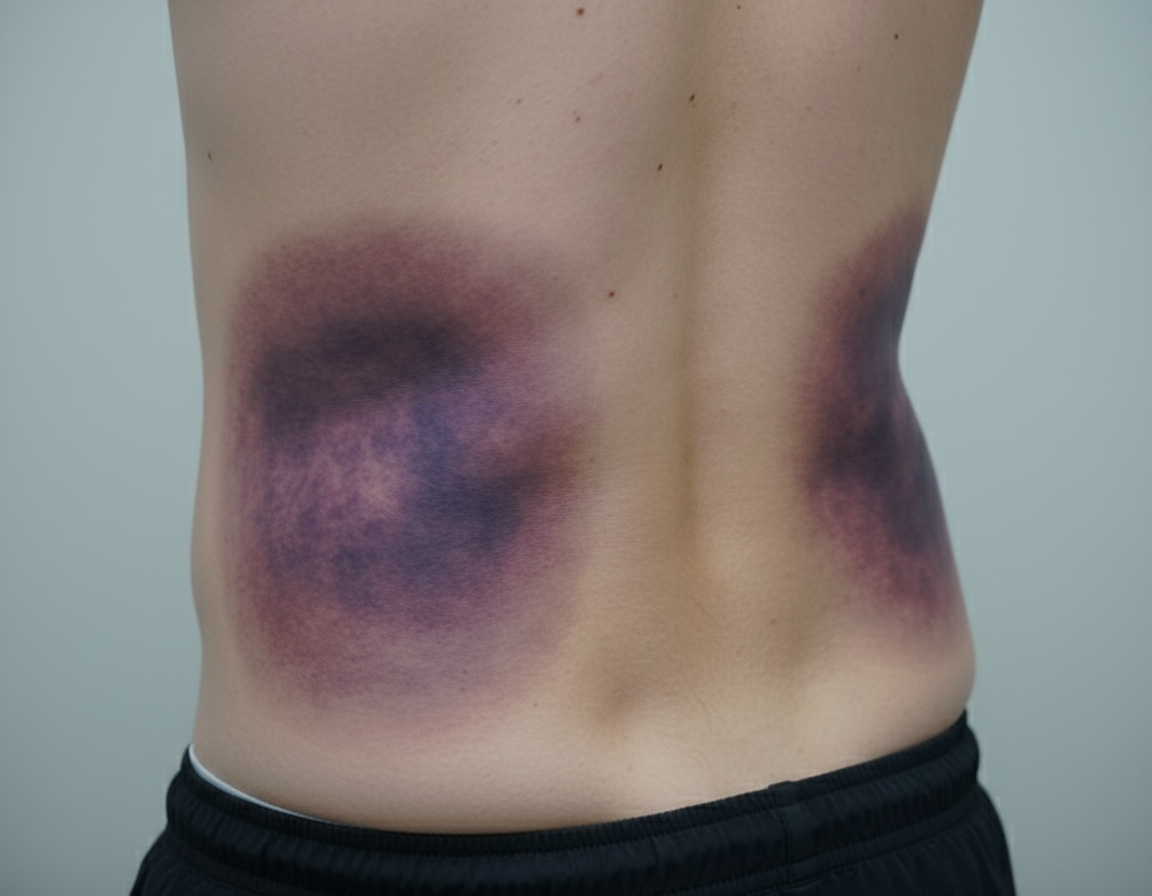
A 55-year-old woman is brought to the emergency department due to sudden onset retrosternal chest pain. An ECG shows ST-segment elevation. A diagnosis of myocardial infarction is made and later confirmed by elevated levels of troponin I. The patient is sent to the cardiac catheter laboratory where she undergoes percutaneous catheterization. She has 2 occluded vessels in the heart and undergoes a percutaneous coronary intervention to place 2 stents in her coronary arteries. Blood flow is successfully restored in the affected arteries. The patient complains of flank pain on post-procedure evaluation a few hours later. A significant drop in hematocrit is observed, as well as a drop in her blood pressure to 90/60 mm Hg. Physical examination reveals extensive ecchymoses in the flanks and loin as seen in the provided image. Which of the following conditions is this patient most likely experiencing?
Twelve days after undergoing total pancreatectomy for chronic pancreatitis, a 62-year-old woman notices oozing from her abdominal wound. She first noticed fluid draining 8 hours ago. Her postoperative course has been complicated by persistent hypotension requiring intravenous fluids and decreased ability to tolerate food. She has type 1 diabetes mellitus and glaucoma. The patient smoked one pack of cigarettes daily for 30 years, but quit 2 years ago. She drank a pint of vodka every day starting at age 20 and quit when she was 35 years old. Her current medications include subcutaneous insulin and timolol eye drops. She appears comfortable. Her temperature is 37°C (98.6°F), pulse is 95/min, and blood pressure is 104/78 mm Hg. The abdomen is soft and mildly tender to palpation. There is a 12-cm vertical wound beginning in the epigastrium and extending caudally. 25 mL of a viscous, dark green substance is draining from the middle of the wound. There is a small amount of dried fluid on the patient's hospital gown. The wound edges are nonerythematous. There is no pus draining from the wound. Laboratory studies show: Hematocrit 38% Leukocyte count 8,000/mm3 Serum Na+ 135 mEq/L Cl- 100 mEq/L K+ 3.4 mEq/L HCO3- 23 mEq/L Urea nitrogen 13 mg/dL Creatinine 1.1 mg/dL Glucose 190 mg/dL Which of the following is the most appropriate next step in management?
Three hours after undergoing open proctocolectomy for ulcerative colitis, a 42-year-old male complains of abdominal pain. The pain is localized to the periumbilical and hypogastric regions. A total of 20 mL of urine has drained from his urinary catheter since the end of the procedure. Temperature is 37.2°C (98.9°F), pulse is 92/min, respirations are 12/min, and blood pressure is 110/72 mm Hg. Pulse oximetry on room air shows an oxygen saturation of 99%. Physical examination shows a 20 cm vertical midline incision and an ileostomy in the right lower quadrant. There is no fluid drainage from the surgical wounds. The urinary catheter flushes easily and is without obstruction. Cardiopulmonary examination shows no abnormalities. Serum studies show a blood urea nitrogen of 30 mg/dL and a creatinine of 1.3 mg/dL. Which of the following is the most appropriate next step in management?
Practice by Chapter
Immediate post-anesthesia care
Practice Questions
Postoperative pain management
Practice Questions
Fluid and electrolyte management
Practice Questions
Nutrition support in surgical patients
Practice Questions
Wound care principles
Practice Questions
Drain management
Practice Questions
Early mobilization protocols
Practice Questions
Postoperative fever evaluation
Practice Questions
Recognition and management of SSIs
Practice Questions
DVT prophylaxis
Practice Questions
Enhanced recovery after surgery (ERAS)
Practice Questions
Postoperative respiratory care
Practice Questions
Transition of care planning
Practice Questions
Want unlimited practice?
Get full access to all questions, explanations, and performance tracking.
Scan to download app