
Growth/Development — MCQs

On this page
You are counseling a pregnant woman who plans to breast-feed exclusively regarding her newborn's nutritional requirements. The child was born at home and the mother only plans for her newborn to receive vaccinations but no other routine medical care. Which vitamins should be given to the newborn?
A previously healthy 6-year-old boy is brought to the physician because he has increased facial and axillary hair. There is no family history of serious illness. He is at 95th percentile for height and weight. Examination shows coarse pubic and axillary hair. The penis and left testicle are enlarged. Serum concentrations of human chorionic gonadotropin and alpha-fetoprotein are within the reference range. Which of the following is the most likely cause of these findings?
An 11-year-old girl presents to the pediatrician with her mother, who is concerned about her sexual development. She mentions that she herself experienced the onset of menses at the age of 10.5 years, while her daughter has still not had a menstrual period. However, she is otherwise a healthy girl with no significant medical problems since birth. On physical examination, her vital signs are stable. Evaluation of breast and pubic hair are Tanner stage 2. The pediatrician reassures the mother that her daughter's sexual development is within the normal range for girls and there is nothing to worry about at present. Which is a sign of Tanner stage 2?
A 14-year-old girl is brought to the physician for evaluation of her short stature. She was born at term, and her birth length was normal. She has not yet attained menarche. Her mother is 162 cm (5 ft 4 in) tall and her father is 177 cm (5 ft 10 in) tall. She is at the 3rd percentile for height and 40th percentile for weight. Vital signs are within normal limits. Breast and pubic hair development are Tanner stage 2. The remainder of the examination shows no abnormalities. Which of the following is the most appropriate next step in diagnosis?
A 6-year-old boy is brought to the physician by his mother for coughing, nasal congestion, and intermittent wheezing for the past 2 months. The child has a history of eczema. Since birth, he has had three upper respiratory tract infections that resolved without treatment, and one episode of acute otitis media treated with antibiotics. His family moved into affordable housing 3 months ago. His temperature is 37.2°C (98.9°F), pulse is 120/min, respirations are 28/min, and blood pressure is 90/60 mmHg. There are scattered wheezes on pulmonary examination. Which of the following is the most appropriate next step in management?
A 5-year-old girl is brought to the emergency department because of abdominal pain, vomiting, and diarrhea for 6 days. Her mother says that over the last 24 hours she has developed a rash and has been urinating less frequently than usual. One month ago, she had a 3-day episode of high fever and sore throat that subsided without medical treatment. She appears weak. Her temperature is 37.7°C (99.8°F), pulse is 120/min, respirations are 28/min, and blood pressure is 114/72 mm Hg. Examination shows petechiae on the trunk and jaundice of the skin. The abdomen is diffusely tender with no peritoneal signs. Neurological examination shows no abnormalities. Laboratory studies show: Hemoglobin 8 g/dL Mean corpuscular volume 85 μm3 Leukocyte count 16,200/mm3 Platelet count 38,000/mm3 Serum Blood urea nitrogen 43 mg/dL Creatinine 2.9 mg/dL pH 7.0 Urine dipstick is positive for blood and protein. A blood smear shows schistocytes and normochromic, normocytic cells. In addition to supportive treatment, which of the following is the most appropriate next step in management of this patient?
An 11-year-old boy with a history of attention deficit disorder presents to a general medicine clinic with leg pain. He is accompanied by his mother. He reports dull, throbbing, diffuse pain in his bilateral lower extremities. He reports that the pain feels deep in his muscles. He has awakened several times at night with the pain, and his symptoms tend to be better during the daylight hours. He denies fatigue, fever, or pain in his joints. On physical examination, his vital signs are stable, and he is afebrile. Physical examination reveals full range of motion in the hip and knee joints without pain. He has no joint effusions, erythema, or warmth. What is the next best step in management?
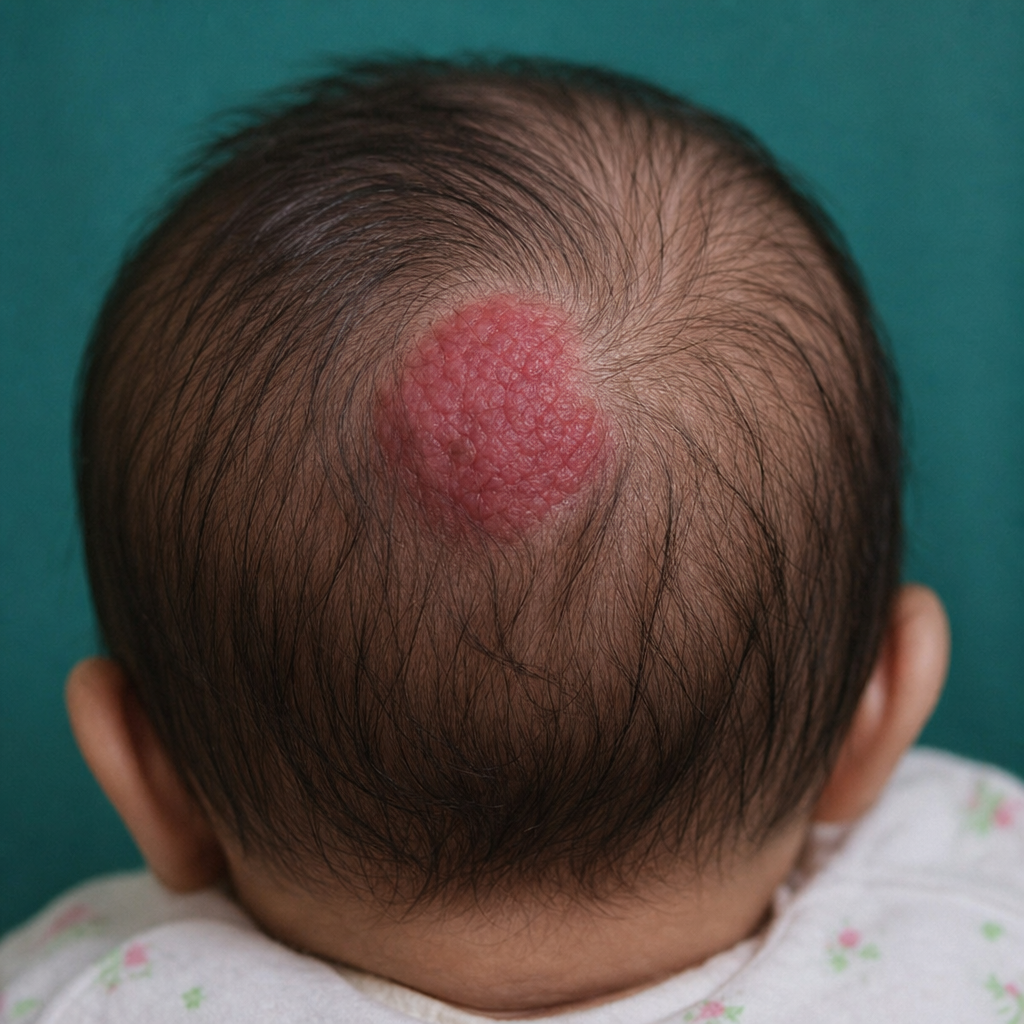
A 5-month-old girl is brought to the physician with a red lesion on her scalp that was first noticed 2 months ago. The lesion has been increasing in size slowly. It is not associated with pain or pruritus. She was born at 37 weeks of gestation after an uncomplicated pregnancy and delivery. The patient’s older sister is currently undergoing treatment for fungal infection of her feet. Examination reveals a solitary, soft lesion on the vertex of the scalp that blanches with pressure. A photograph of the lesion is shown. Which of the following is the most appropriate next step in management?
A 15-year-old boy is brought to the emergency department one hour after sustaining an injury during football practice. He collided head-on into another player while wearing a mouthguard and helmet. Immediately after the collision he was confused but able to use appropriate words. He opened his eyes spontaneously and followed commands. There was no loss of consciousness. He also had a headache with dizziness and nausea. He is no longer confused upon arrival. He feels well. Vital signs are within normal limits. He is fully alert and oriented. His speech is organized and he is able to perform tasks demonstrating full attention, memory, and balance. Neurological examination shows no abnormalities. There is mild tenderness to palpation over the crown of his head but no signs of skin break or fracture. Which of the following is the most appropriate next step?
A 3-year-old boy is brought to your pediatrics office by his parents for a well-child checkup. The parents are Amish and this is the first time their child has seen a doctor. His medical history is unknown, and he was born at 39 weeks gestation. His temperature is 98.3°F (36.8°C), blood pressure is 97/58 mmHg, pulse is 90/min, respirations are 23/min, and oxygen saturation is 99% on room air. The child is in the corner stacking blocks. He does not look the physician in the eye nor answer your questions. He continually tries to return to the blocks and becomes very upset when you move the blocks back to their storage space. The parents state that the child has not begun to speak and often exhibits similar behaviors with toy blocks he has at home. On occasion, they have observed him biting his elbows. Which of the following is the best next step in management?
Practice by Chapter
Normal growth patterns
Practice Questions
Growth charts and interpretation
Practice Questions
Failure to thrive evaluation
Practice Questions
Short stature workup
Practice Questions
Tall stature evaluation
Practice Questions
Obesity in children
Practice Questions
Nutritional assessment tools
Practice Questions
Puberty stages (Tanner stages)
Practice Questions
Precocious puberty
Practice Questions
Delayed puberty
Practice Questions
Growth hormone disorders
Practice Questions
Impact of chronic disease on growth
Practice Questions
Catch-up growth
Practice Questions
Want unlimited practice?
Get full access to all questions, explanations, and performance tracking.
Scan to download app