
Growth/Development — MCQs

On this page
A 1-year-old boy is brought to the emergency department after his mother witnessed him swallow a nickel-sized battery a few hours ago. She denies any episodes of vomiting or hematemesis. The vital signs include: temperature 37.0°C (98.6°F), blood pressure 95/45 mm Hg, pulse 140/min, respiratory rate 15/min, and oxygen saturation 99% on room air. On physical examination, the patient is alert and responsive. The oropharynx is clear. The cardiac exam is significant for a grade 2/6 holosystolic murmur loudest at the left lower sternal border. The lungs are clear to auscultation. The abdomen is soft and nontender with no hepatosplenomegaly. Bowel sounds are present. What is the most appropriate next step in the management of this patient?
An 8-year-old boy is brought to the emergency department with severe dyspnea, fatigue, and vomiting. His mother reports that he has been lethargic for the last several days with an increase in urine output. She thinks he may even be losing weight, despite eating and drinking more than normal for the last couple weeks. Laboratory results are notable for glucose of 440, potassium of 5.8, pH of 7.14 and HCO3 of 17. After administrating IV fluids and insulin, which of the following would you expect?
An 18-month-old boy presents to the clinic with his mother for evaluation of a rash around the eyes and mouth. His mother states that the rash appeared 2 weeks ago and seems to be very itchy because the boy scratches his eyes often. The patient is up to date on all of his vaccinations and is meeting all developmental milestones. He has a history of asthma that was recently diagnosed. On examination, the patient is playful and alert. He has scaly, erythematous skin surrounding both eyes and his mouth. Bilateral pupils are equal and reactive to light and accommodation, and conjunctiva is clear, with no evidence of jaundice or exudates. The pharynx and oral mucosa are within normal limits, and no lesions are present. Expiratory wheezes can be heard in the lower lung fields bilaterally. What is the most likely diagnosis in this patient?
A 12-month-old boy presents with pallor, fatigue, and conjunctival pallor. Examination reveals a grade II systolic ejection murmur. Labs show: Leukocytes 6,500/mm^3, Hemoglobin 6.4 g/dL, Platelets 300,000/mm^3, MCV 71 µm^3, Reticulocytes 2.0%, Serum iron 34 mcg/dL, Ferritin 6 ng/mL (normal 7-140 ng/mL), TIBC 565 mcg/dL (normal 240-450 mcg/dL). Peripheral smear shows microcytosis and hypochromia. In addition to starting iron supplementation, what dietary modification is most important to address the underlying cause?
A 6-year-old boy presents to the clinic because of monosymptomatic enuresis for the past month. Urinalysis, detailed patient history, and fluid intake, stool, and voiding diary from a previous visit all show no abnormalities. The parent and child are referred for education and behavioral therapy. Enuresis decreases but persists. Both the patient and his mother express concern and want this issue to resolve as soon as possible. Which of the following is the most appropriate next step in management?
A 12-month-old boy is brought to the physician for a well-child examination. He was born at 38 weeks' gestation and was 48 cm (19 in) in length and weighed 3061 g (6 lb 12 oz); he is currently 60 cm (24 in) in length and weighs 7,910 g (17 lb 7 oz). He can walk with one hand held and can throw a small ball. He can pick up an object between his thumb and index finger. He can wave 'bye-bye'. He can say 'mama', 'dada' and 'uh-oh'. He cries if left to play with a stranger alone. Physical examination shows no abnormalities. Which of the following is most likely delayed in this child?
A 7-year-old boy is brought to the physician for recurrent 3–4 minutes episodes of facial grimacing and staring over the past month. He is nonresponsive during these episodes and does not remember them afterward. He recalls a muddy taste in his mouth before the onset of symptoms. One week ago, his brother witnessed an episode where he woke up, stared, and made hand gestures. After the incident, he felt lethargic and confused. Examination shows no abnormalities. Which of the following is the most likely diagnosis?
A 19-year-old African female refugee has been granted asylum in Stockholm, Sweden and has been living there for the past month. She arrived in Sweden with her 2-month-old infant, whom she exclusively breast feeds. Which of the following deficiencies is the infant most likely to develop?
A 3-year-old girl is brought to the physician by her 30-year-old mother, who reports that her daughter has been passing multiple foul-smelling, bulky stools with flatulence every day for the last 6 months. The girl was born in Guatemala, and soon after her birth, her parents moved to the United States so that they could access better healthcare. During pregnancy, the mother had little prenatal care, but labor and delivery were uneventful. However, the newborn had significant abdominal distention immediately at birth that increased when she ate or yawned. She failed to pass stool in the first 24 hours of life and had greenish-black vomitus. The parents report similar symptoms in other family members. After diagnosis, the girl underwent a procedure that alleviated her symptoms; however, there was no remission. Her abdominal X-ray (see the first image) and barium contrast enema (second image) from when she was born is shown. Her blood pressure is 100/68 mm Hg, heart rate is 96/min, respiratory rate is 19/min, and temperature is 36.7°C (98.0°F). The girl is in the 10th percentile for height and weight. On physical exam, she has periumbilical and midepigastric tenderness to palpation without rebound tenderness or guarding. There is a slight genu varum deformity and bony tenderness noted in her legs. She has foul-smelling flatulation 2–3 times during the visit. Her rectosphincteric reflex is intact. She has decreased fecal elastase and a negative D-xylose test. Which of the following is the most appropriate long-term treatment for her condition?
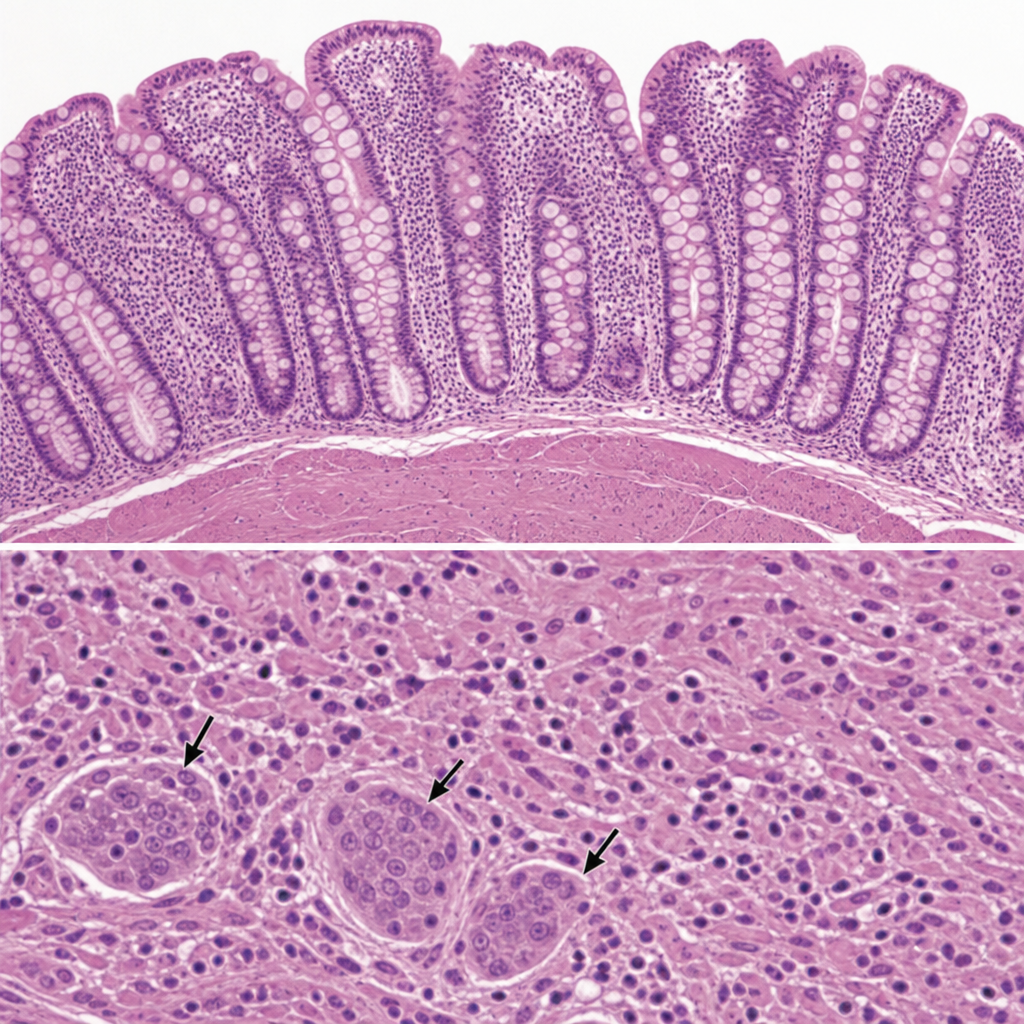
A previously healthy 10-year-old boy is brought to the emergency room by his mother 5 hours after the onset of abdominal pain and nausea. Over the past 2 weeks, he has also had progressive abdominal pain and a 4-kg (8.8-lb) weight loss. The mother reports that her son has been drinking more water than usual during this period. Last week he wet his bed three times despite being completely toilet-trained since 3 years of age. His temperature is 37.8°C (100°F), pulse is 128/min, respirations are 35/min, and blood pressure is 95/55 mm Hg. He appears lethargic. Physical examination shows deep and labored breathing and dry mucous membranes. The abdomen is soft, and there is diffuse tenderness to palpation with no guarding or rebound. Serum laboratory studies show: Na+ 133 mEq/L K+ 5.9 mEq/L Cl- 95 mEq/L HCO3- 13 mEq/L Urea nitrogen 25 mg/dL Creatinine 1.0 mg/dL Urine dipstick is positive for ketones and glucose. Further evaluation is most likely to reveal which of the following?
Practice by Chapter
Normal growth patterns
Practice Questions
Growth charts and interpretation
Practice Questions
Failure to thrive evaluation
Practice Questions
Short stature workup
Practice Questions
Tall stature evaluation
Practice Questions
Obesity in children
Practice Questions
Nutritional assessment tools
Practice Questions
Puberty stages (Tanner stages)
Practice Questions
Precocious puberty
Practice Questions
Delayed puberty
Practice Questions
Growth hormone disorders
Practice Questions
Impact of chronic disease on growth
Practice Questions
Catch-up growth
Practice Questions
Want unlimited practice?
Get full access to all questions, explanations, and performance tracking.
Scan to download app