
Growth/Development — MCQs

On this page
A 1-month-old boy is brought in by his mother for episodes of “not breathing.” She reports noticing that the patient will occasionally stop breathing while he’s sleeping, and that these episodes have been occurring more frequently. The patient was born at 32 weeks due to placental insufficiency. He was in the neonatal intensive care unit for 1 day to be placed on a respirator. During prenatal testing, it was revealed that the mother was not immune to rubella, but she otherwise had an uncomplicated pregnancy. She has no medical conditions and took only prenatal vitamins. The patient has a 3-year-old sister who is healthy. His father has a “heart condition.” The patient’s temperature is 98°F (36.7°C), blood pressure is 91/55 mmHg, pulse is 207/min, and respirations are 50/min with an oxygen saturation of 97% on room air. Physical examination is notable for pale conjunctiva. Labs are obtained, as shown below: Leukocyte count: 10,000/mm^3 with normal differential Hemoglobin: 8.2 g/dL Hematocrit: 28% Mean corpuscular volume (MCV): 100 um^3 Platelet count: 300,000/mm^3 Reticulocyte count: 0.8% (normal range: 2-6%) Lactate dehydrogenase: 120 U/L (normal range: 100-250 U/L) A peripheral smear reveals normocytic and normochromic red blood cells. Which of the following is a mechanism for the patient’s most likely diagnosis?
An 11-month-old boy presents with the recent loss of appetite and inability to gain weight. His diet consists mainly of cow’s milk and fruits. Family history is unremarkable. Physical examination shows conjunctival pallor. Laboratory findings are significant for the following: Hemoglobin 9.1 g/dL Mean corpuscular volume 75 μm3 Mean corpuscular hemoglobin 20 pg/cell Red cell distribution width 18% The patient is presumptively diagnosed with iron deficiency anemia (IDA) and ferrous sulfate syrup is prescribed. Which of the following laboratory values would most likely change 1st in response to this treatment?
A 10-month-old infant is brought in by his parents because he is vomiting and not passing stool. His parents say he has vomited multiple times over the past couple of hours, but the most recent vomit was green. The patient has no significant past medical history. On physical examination, the patient is irritable and crying. On palpation in the periumbilical region, an abdominal mass is present. Emergency laparotomy is performed, which shows a part of the patient’s intestine folded into the section adjacent to it. Which of the following is the most likely diagnosis for this patient?
A 3-year-old boy is brought to the physician by his mother for the evaluation of delay in attaining developmental milestones. He could sit upright by 14 months and has not been able to walk without support. He can build a tower of 3 blocks and cannot use utensils to feed himself. He speaks in unclear 2-word phrases and cannot draw a circle yet. His mother has noticed him hitting his head against the wall on multiple occasions. He is at 20th percentile for height and at 50th percentile for weight. Vitals signs are within normal limits. Examination shows multiple lacerations of his lips and tongue. There are multiple healing wounds over his fingers. Neurological examination shows increased muscle tone in all extremities. Laboratory studies show: Hemoglobin 10.1 g/dL Mean corpuscular volume 103 μm3 Serum Na+ 142 mEq/L Cl- 101 mEq/: K+ 4.1 mEq/L Creatinine 1.6 mg/dL Uric acid 12.3 mg/dL Which of the following is the most likely cause of this patient's findings?
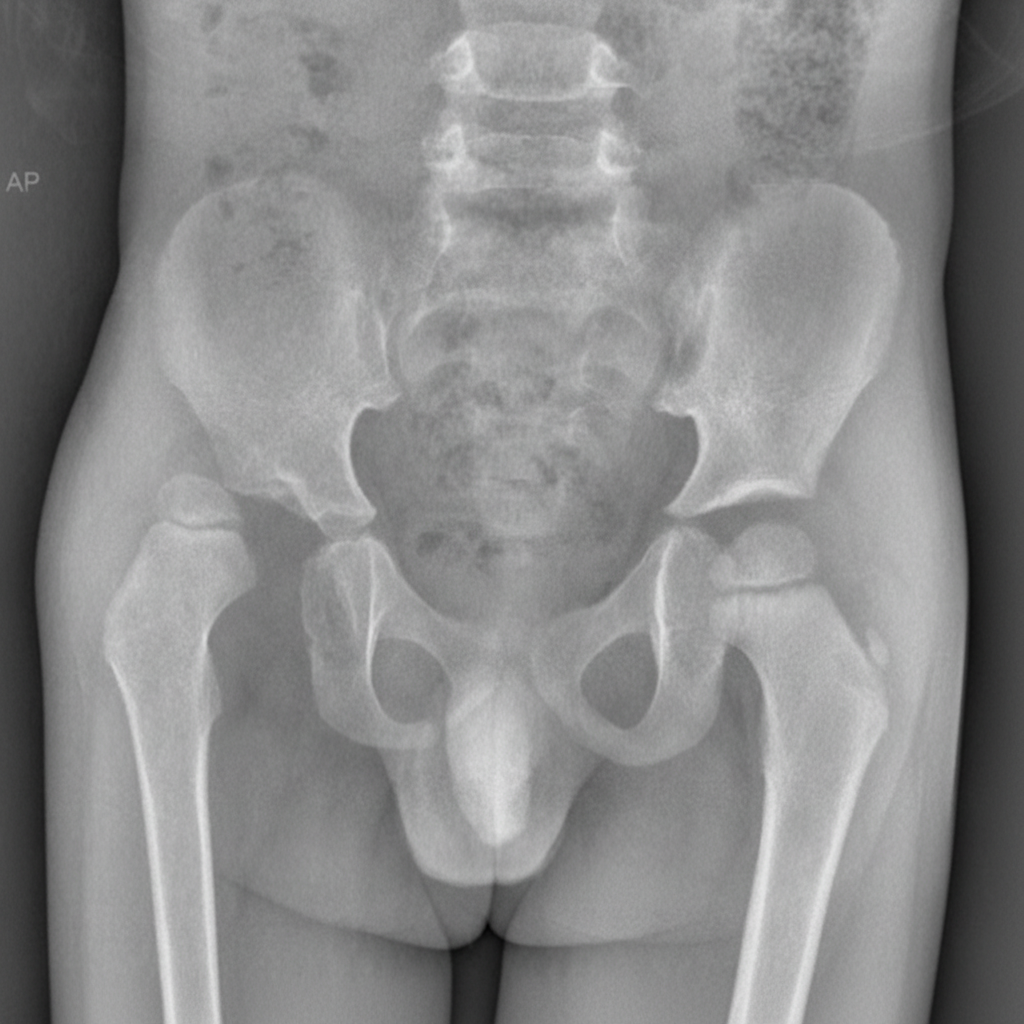
A 7-year-old boy is brought to the physician by his mother because of a limp for the last 3 weeks. He has also had right hip pain during this period. The pain is aggravated when he runs. He had a runny nose and fever around a month ago that resolved with over-the-counter medications. He has no history of serious illness. His development is adequate for his age. His immunizations are up-to-date. He appears healthy. He is at the 60th percentile for height and at 65th percentile for weight. Vital signs are within normal limits. Examination shows an antalgic gait. The right groin is tender to palpation. Internal rotation and abduction of the right hip is limited by pain. The remainder of the examination shows no abnormalities. His hemoglobin concentration is 11.6 g/dL, leukocyte count is 8,900/mm3, and platelet count is 130,000/mm3. An x-ray of the pelvis is shown. Which of the following is the most likely underlying mechanism?
A previously healthy 13-year-old boy is brought to the physician because of a lump beneath his right nipple that he discovered 1 week ago while showering. He has allergic rhinitis treated with cetirizine. He is at the 65th percentile for height and 80th percentile for weight. Examination shows a mildly tender, firm, 2-cm subareolar mass in the right breast; there are no nipple or skin changes. The left breast shows no abnormalities. Sexual development is Tanner stage 3. Which of the following is the most likely explanation for this patient's breast lump?
A 7-week-old male presents to the pediatrician for vomiting. His parents report that three weeks ago the patient began vomiting after meals. They say that the vomitus appears to be normal stomach contents without streaks of red or green. His parents have already tried repositioning him during mealtimes and switching his formula to eliminate cow’s milk and soy. Despite these adjustments, the vomiting has become more frequent and forceful. The patient’s mother reports that he is voiding about four times per day and that his urine looks dark yellow. The patient has fallen one standard deviation off his growth curve. The patient's mother reports that the pregnancy was uncomplicated other than an episode of sinusitis in the third trimester, for which she was treated with azithromycin. In the office, the patient's temperature is 98.7°F (37.1°C), blood pressure is 58/41 mmHg, pulse is 166/min, and respirations are 16/min. On physical exam, the patient looks small for his age. His abdomen is soft, non-tender, and non-distended. Which of the following is the best next step in management?
An 8-month-old girl is brought to her pediatrician because her mom is concerned that she may have a "lazy eye". She was born prematurely at 33 weeks and was 3 pounds at birth. Her mother also says that there is a history of visual problems that run in the family, which is why she wanted to make sure that her daughter was evaluated early. On presentation, she is found to have eyes that are misaligned both horizontally and vertically. Physical examination and labs reveal no underlying disorders, and the patient is discharged with occlusion therapy to help correct the misalignment. Which of the following would most likely have also been seen on physical exam?
A 12-month-old boy is brought to the pediatrician for a routine examination. Past medical history is significant for a pyloric myomectomy at 2 months of age after a few episodes of projectile vomiting. He has reached all appropriate developmental milestones. He currently lives with his parents and pet cat in a house built in the 1990s. He was weaned off of breast milk at 6 months of age. He is a very picky eater, but drinks 5–6 glasses of whole milk a day. The patient's height and weight are in the 50th percentile for his age and sex. The vital signs are within normal limits except for the presence of slight tachycardia. Physical examination reveals an alert infant with a slight pallor. Abdomen is soft and nondistended. A grade 2/6 systolic ejection murmur is noted in the left upper sternal border. Which of the following will most likely be expected in this patient's laboratory results?
A 15-year-old girl comes to the physician with her father for evaluation of short stature. She feels well overall but is concerned because all of her friends are taller than her. Her birth weight was normal. Menarche has not yet occurred. Her father says he also had short stature and late puberty. The girl is at the 5th percentile for height and 35th percentile for weight. Breast development is Tanner stage 2. Pubic and axillary hair is absent. An x-ray of the left hand and wrist shows a bone age of 12 years. Further evaluation of this patient is most likely to show which of the following sets of laboratory findings?
Practice by Chapter
Normal growth patterns
Practice Questions
Growth charts and interpretation
Practice Questions
Failure to thrive evaluation
Practice Questions
Short stature workup
Practice Questions
Tall stature evaluation
Practice Questions
Obesity in children
Practice Questions
Nutritional assessment tools
Practice Questions
Puberty stages (Tanner stages)
Practice Questions
Precocious puberty
Practice Questions
Delayed puberty
Practice Questions
Growth hormone disorders
Practice Questions
Impact of chronic disease on growth
Practice Questions
Catch-up growth
Practice Questions
Want unlimited practice?
Get full access to all questions, explanations, and performance tracking.
Scan to download app