
Bacteria — MCQs

On this page
A 42-year-old woman presents to a medical office with complaints of fatigue, weight loss, and low-grade fever for 1 week. She noticed bleeding spots on her feet this morning. The past medical history is significant for a recent dental appointment. She is a non-smoker and does not drink alcohol. She does not currently take any medications. On examination, the vital signs include temperature 37.8°C (100.0°F), blood pressure 138/90 mm Hg, respirations 21/min, and pulse 87/min. Cardiac auscultation reveals a pansystolic murmur in the mitral area with radiation to the left axilla. Laboratory studies show hemoglobin levels of 17.2 g/dL, erythrocyte sedimentation rate (ESR) of 25 mm/h, and a white blood cell (WBC) count of 12,000 cells/mm3. An echocardiogram reveals valvular vegetations on the mitral valve with mild regurgitation. Blood samples are sent for bacterial culture. Empiric antibiotic therapy is initiated with ceftriaxone and vancomycin. The blood cultures most likely will yield the growth of which of the following organisms?
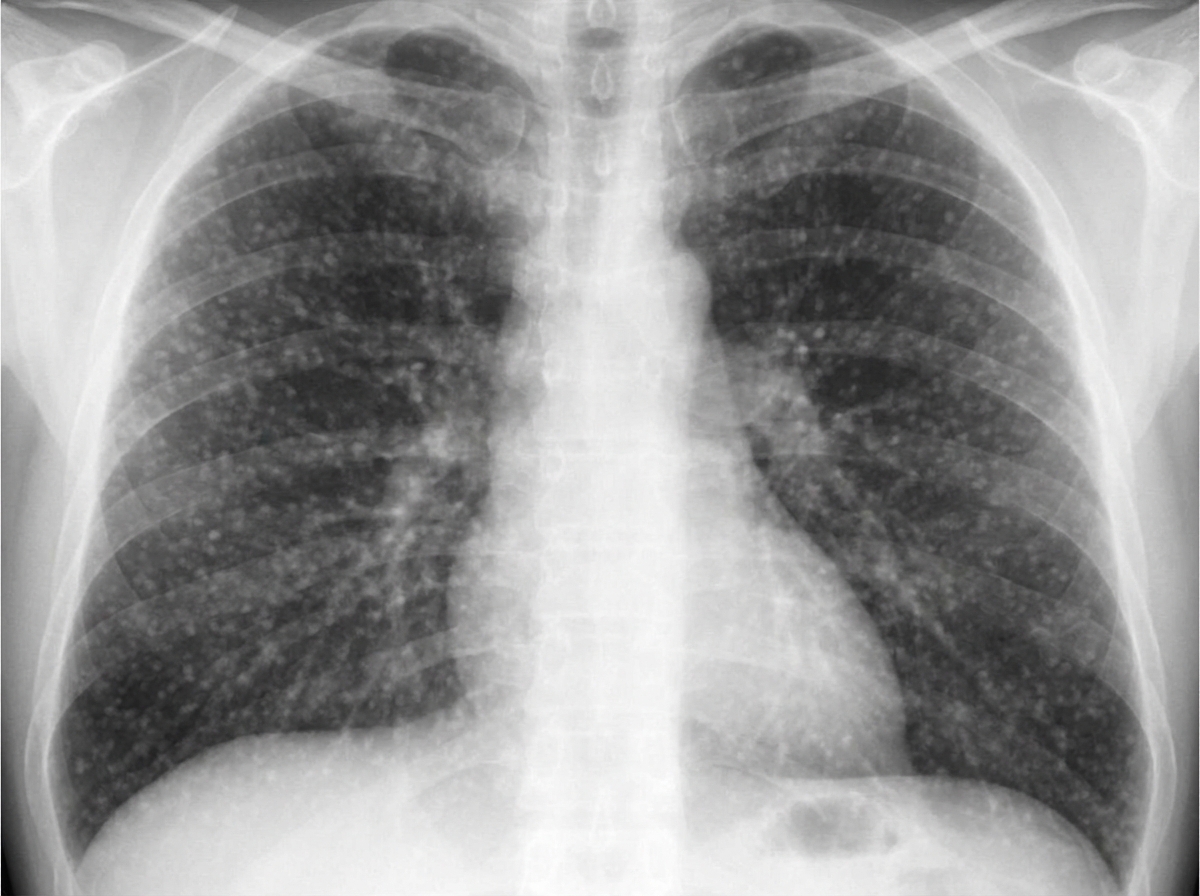
A 68-year-old man presents to the physician with fever, cough, weakness, night sweats, and poor appetite for the past 6 months. Medical records suggest that he has lost 7.5 kg (16.5 lb) of weight during this period. There is no history of breathlessness, nasal discharge, nasal obstruction, palpitations, chest pain, or symptoms related to digestion. He was released from prison 9 months ago after serving a 2-year sentence. His temperature is 38.1°C (100.6°F), pulse is 84/min, respirations are 16/min, and blood pressure is 122/80 mm Hg. Physical examination shows hepatomegaly and generalized lymphadenopathy, and auscultation of the chest reveals diffuse crackles throughout the lung fields bilaterally. On direct ophthalmoscopy, three discrete, yellow-colored, 0.5 mm to 1.0 mm lesions with indistinct borders are seen in the posterior pole. A chest X-ray is shown in the image. Tuberculin skin test with purified protein derivative is negative. What is the most likely diagnosis?
A 47-year-old alcoholic man presents to the office for a 72-hour history of intense right hemithorax pain. He also complains of fever, chills, and sweating that started 10 days ago, as well as persistent coughing with abundant malodorous sputum. Chest radiography shows a round consolidation with air-fluid levels in the middle third of the right hemithorax. Sputum samples for a direct exam, culture, and acid-fast bacilli (AFB) are sent. What is the correct diagnosis?
During a humanitarian medical mission in rural Vietnam, a medical resident encounters a 50-year-old man with a year-long history of a pruritic rash on his upper body and face, along with numbness and tingling sensation of both of his palms. He mostly works on his family’s rice farm, where he also takes care of livestock. A physical examination revealed multiple erythematous macules and papules on the face, arms, chest, and back, as well as thinning of the eyebrows and loss of some eyelashes. Additional findings include hypopigmented macules around the elbows, which are insensitive to light touch, temperature, and pinprick. The grip strength is slightly diminished bilaterally with the conservation of both bicipital reflexes. What is the most likely diagnosis?
A previously healthy 5-year-old boy is brought to the physician with a recurring fever and malaise for 3 weeks. He has also had fatigue and loss of appetite. He initially presented 2 weeks ago with a maculopapular rash that has since resolved. At the time, he was given a prescription for amoxicillin-clavulanate. He denies sore throat or myalgias. He is home-schooled and has had no sick contacts. There are no pets at home, but he often visits a feline animal shelter where his mother volunteers. His temperature is 38.4°C (101.2°F). Physical examination shows a 1-cm papular lesion on the back of the right hand. He also has tender, bulky lymphadenopathy of the axillae and groin. Which of the following is the most appropriate next step in management?
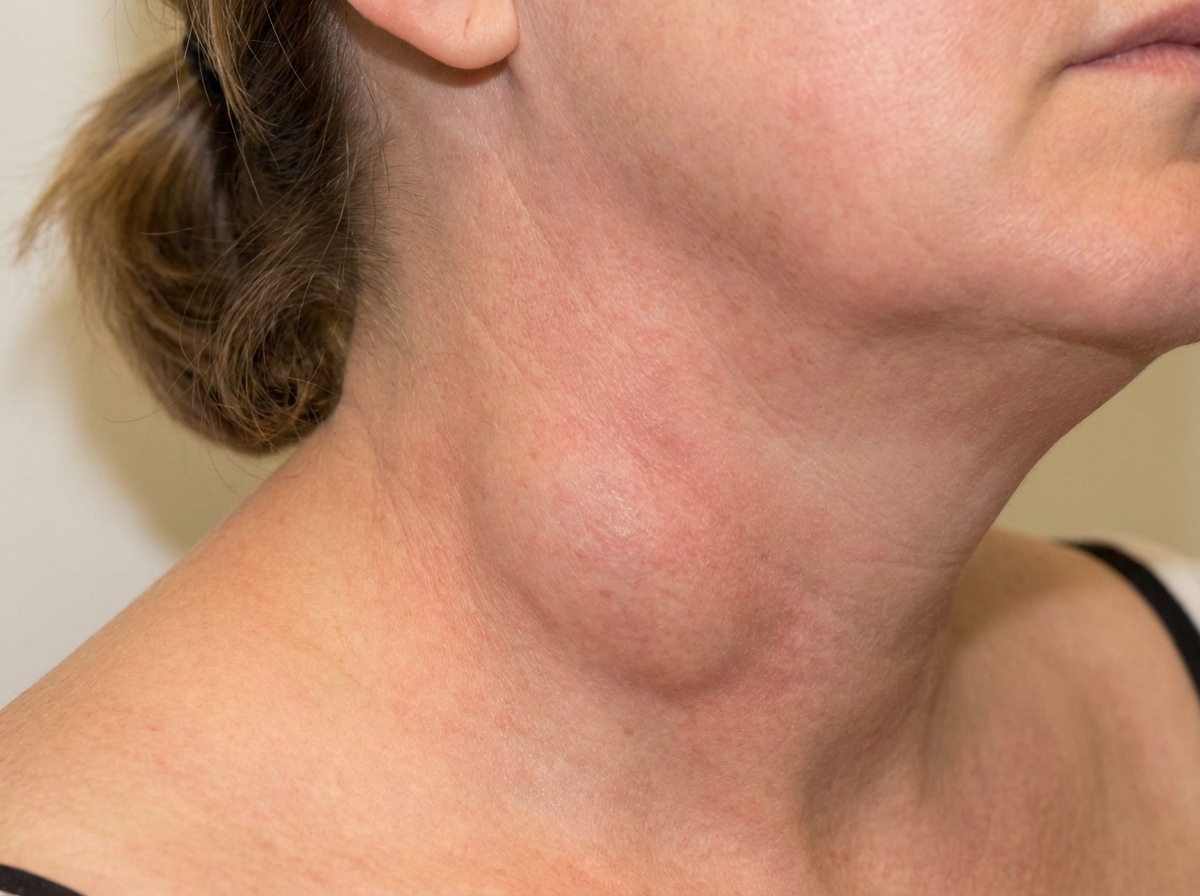
A 42-year-old woman presents because of a painful mass she first noticed on her neck 1 week ago (see image). The mass has grown over the last few days. She has no history of serious illness and takes no medications. On physical exam, her temperature is 38.0°C (100.4°F), pulse is 86/min, respirations are 12/min, blood pressure is 135/80 mm Hg. The mass is tender and relatively soft and mobile. The overlying skin is warm. On her right ear, there is a series of small and healing skin punctures left by the bite of her neighbor's kitten 3 weeks ago. No other mass is detected in the neck, supraclavicular, axillary, or inguinal regions. Oral examination reveals several discolored teeth. Her lungs are clear to auscultation and heart sounds are normal. A biopsy of the neck mass is performed. Which of the following would be most useful in establishing the diagnosis?
A 28-year-old man presents with a draining abscess on his left jaw. The patient states that he had a “bad tooth” a few weeks ago which has progressed to his current condition. His vital signs include: blood pressure 110/80 mm Hg, heart rate 85/min, and temperature 37.9°C (100.3°F). On physical examination, the patient has a 4 cm abscess on the left maxillary line that is draining a granulous, purulent material. Which of the following is the most likely causative organism of this abscess?
A 21-year-old U.S. born first year medical student with no prior hospital or healthcare work presents to the physician for a routine physical exam. The patient is HIV negative, denies drug use, and denies sick contacts. The physician places a purified protein tuberculin test in the patient's right forearm intradermally. What is the proper time to read the test and induration diameter that would indicate a positive test result?
A 43-year-old Caucasian male spent the past month on a business trip in the Caribbean. Two weeks following his return, he began experiencing diarrhea, pain in his abdomen, and a headache. He presents to the hospital and is noted to be febrile with prominent rose-colored spots on his chest and abdomen. Following recovery, the patient may become a carrier of the bacteria with the bacteria heavily localized to the:
Three days after undergoing coronary bypass surgery, a 67-year-old man becomes unresponsive and hypotensive. He is intubated, mechanically ventilated, and a central line is inserted. Vasopressin and noradrenaline infusions are begun. A Foley catheter is placed. Six days later, he has high unrelenting fevers. He is currently receiving noradrenaline via an infusion pump. His temperature is 39.6°C (102.3°F), pulse is 113/min, and blood pressure is 90/50 mm Hg. Examination shows a sternal wound with surrounding erythema; there is no discharge from the wound. Crackles are heard at both lung bases. Cardiac examination shows an S3 gallop. Abdominal examination shows no abnormalities. A Foley catheter is present. His hemoglobin concentration is 10.8 g/dL, leukocyte count is 21,700/mm3, and platelet count is 165,000/mm3. Samples for blood culture are drawn simultaneously from the central line and peripheral IV line. Blood cultures from the central line show coagulase-negative cocci in clusters on the 8th postoperative day, and those from the peripheral venous line show coagulase-negative cocci in clusters on the 10th postoperative day. Which of the following is the most likely diagnosis in this patient?
Practice by Chapter
Bacterial cell structure and physiology
Practice Questions
Bacterial genetics
Practice Questions
Bacterial metabolism
Practice Questions
Bacterial virulence factors
Practice Questions
Exotoxins and endotoxins
Practice Questions
Bacterial culture methods
Practice Questions
Antimicrobial susceptibility testing
Practice Questions
Bacterial identification methods
Practice Questions
Bacterial taxonomy and classification
Practice Questions
Zoonotic bacterial infections
Practice Questions
Foodborne bacterial pathogens
Practice Questions
Waterborne bacterial pathogens
Practice Questions
Emerging bacterial pathogens
Practice Questions
Want unlimited practice?
Get full access to all questions, explanations, and performance tracking.
Scan to download app