
Bacteria — MCQs

On this page
A 40-year-old woman comes to the emergency department due to severe right flank pain, fever, chills, and decreased urine output. The vital signs include a temperature of 39.0°C (102.2°F), heart rate of 120/min, a regular breathing pattern, and blood pressure of 128/70 mm Hg. Cardiopulmonary auscultation is normal. In addition, tenderness is elicited by right lumbar percussion. After initiating intravenous antibiotics empirically, the condition of the patient improves significantly. However, a low urine output persists. The results of the ordered laboratory tests are as follows: Urine culture Proteus mirabilis, > 150,000 CFU/mL (normal range: < 100,000 CFU/mL to no bacterial growth in asymptomatic patients) Density 1.030; Leukocyte esterase (+); Nitrites (+) pH 7.8 (normal range: 4.5–8.0) C-reactive protein 60 mg/dL (normal range: 0–10 mg/dL) Serum creatinine 1.8 mg/dL (normal range: 0.6–1.2 mg/dL) BUN 40 mg/dL (normal range: 7–20 mg/dL) Plain abdominal film Complex renal calculus in the right kidney Which of the following is the most likely type of stone the patient has?
A 35-year-old man comes to the emergency department with fever, chills, dyspnea, and a productive cough. His symptoms began suddenly 2 days ago. He was diagnosed with HIV 4 years ago and has been on triple antiretroviral therapy since then. He smokes one pack of cigarettes daily. He is 181 cm (5 ft 11 in) tall and weighs 70 kg (154 lb); BMI is 21.4 kg/m2. He lives in Illinois and works as a carpenter. His temperature is 38.8°C (101.8°F), pulse is 110/min, respirations are 24/min, and blood pressure is 105/74 mm Hg. Pulse oximetry on room air shows an oxygen saturation of 92%. Examinations reveals crackles over the right lower lung base. The remainder of the examination shows no abnormalities. Laboratory studies show: Hemoglobin 11.5 g/dL Leukocyte count 12,800/mm3 Segmented neutrophils 80% Eosinophils 1% Lymphocytes 17% Monocytes 2% CD4+ T-lymphocytes 520/mm3(N ≥ 500) Platelet count 258,000/mm3 Serum Na+ 137 mEq/L Cl- 102 mEq/L K+ 5.0 mEq/L HCO3- 22 mEq/L Glucose 92 mg/dL An x-ray of the chest shows a right lower-lobe infiltrate of the lung. Which of the following is the most likely causal organism?
A 62-year-old woman presents to the emergency department for evaluation of a spreading skin infection that began from an ulcer on her foot. The patient has type 2 diabetes mellitus that is poorly controlled. On examination, there is redness and erythema to the lower limb with skin breakdown along an extensive portion of the leg. The patient’s tissues separate readily from the fascial plane, prompting a diagnosis of necrotizing fasciitis. What is the exotoxin most likely associated with this patient’s presentation?
A previously healthy 13-year-old girl is brought to the physician by her parents because of a 2-day history of low-grade fever, headache, nausea, and a sore throat. Examination of the oral cavity shows enlarged, erythematous tonsils with exudates and palatal petechiae. There is cervical lymphadenopathy. Her parents agree to her participating in a study of microbial virulence factors. A culture of the girl's throat is obtained and an organism is cultivated. The physician finds that the isolated organism is able to withstand phagocytosis when placed in fresh blood. The most likely explanation for this finding is the expression of which of the following?
A 55-year-old man presents with fever, chills, fatigue, cough, sore throat, and breathlessness for the past 7 days. He describes the cough as productive and says he is fatigued all the time. He says he is a farmer with daily contact with rabbits, horses, sheep, pigeons, and chickens and reports cleaning the barn 3 days before his symptoms started. The patient denies any history of tick bites. Past medical history is irrelevant. His temperature is 39.4°C (103.0°F), pulse is 110/min, and respirations are 26/min. On physical examination, there are decreased breath sounds on the right side. A large tender node is palpable in the right axilla. A chest radiograph reveals multiple homogenous opacities in the lower lobe of the right lung and a right-sided pleural effusions. Gram staining of a sputum sample is negative for any organism. Serology tests are negative. Which of the following is the most likely causative organism for this patient’s condition?
A 4-year-old boy presents with bloody diarrhea. The patient’s mother states that he was fine this morning, but around midday, she received a call from his daycare center stating that the patient had a single bloody bowel movement. His mother states that there have been no recent changes in his diet, although they did attend a barbecue over the weekend. The patient has no recent history of fever, chills, or similar symptoms in the past. No significant past medical history. Initial laboratory studies show an elevated white blood cell (WBC) count, anemia, and a blood urea nitrogen (BUN)/creatinine ratio of 40. Stool examination shows 3+ blood but no fecal leukocytes. Which of the following tests would be diagnostic for this patient’s most likely condition?
A 10-month-old boy is brought to the emergency department by his parents because he has a high fever and severe cough. His fever started 2 days ago and his parents are concerned as he is now listless and fatigued. He had a similar presentation 5 months ago and was diagnosed with pneumonia caused by Staphylococcus aureus. He has been experiencing intermittent diarrhea and skin abscesses since birth. The child had an uneventful birth and the child is otherwise developmentally normal. Analysis of this patient's sputum reveals acute angle branching fungi and a throat swab reveals a white plaque with germ tube forming yeast. Which of the following is most likely to be abnormal in this patient?
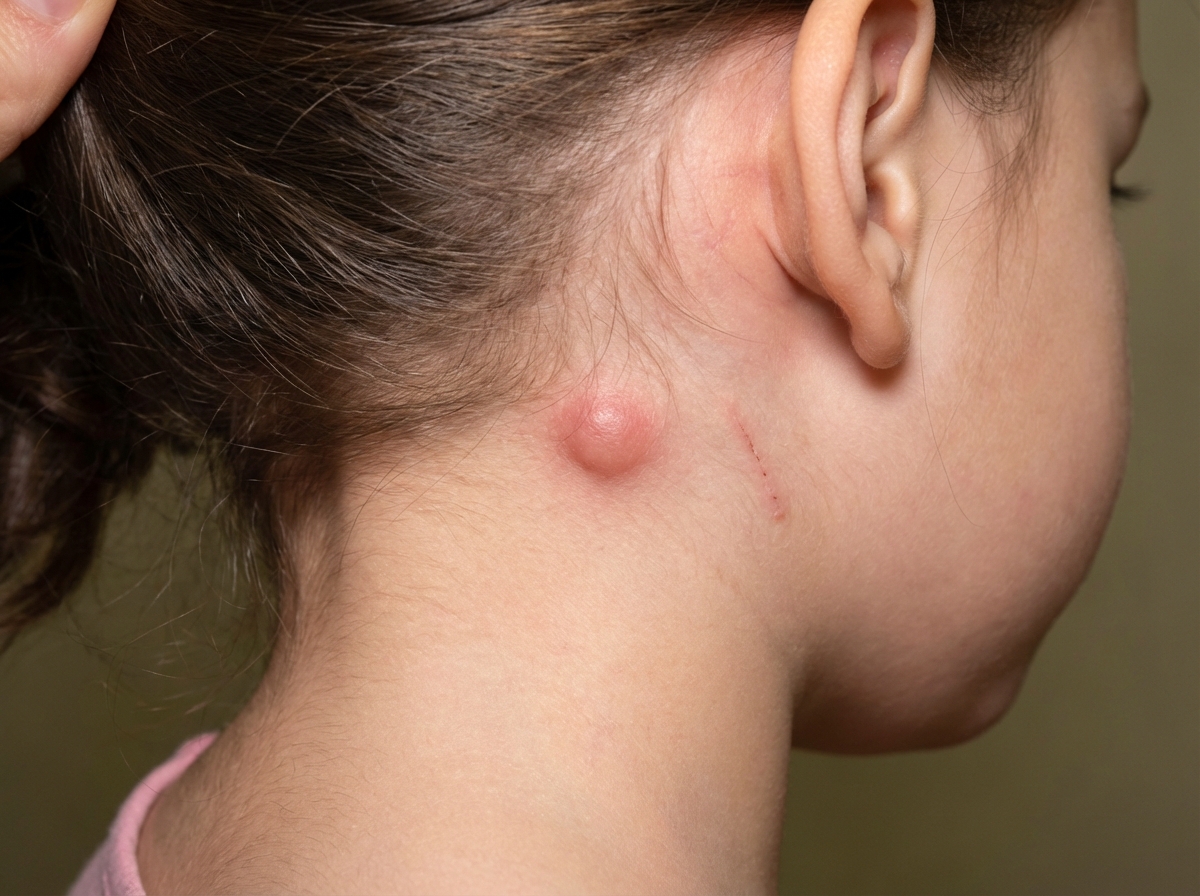
An 8-year-old girl is brought into your clinic with a 5 day history of decreased oral intake, body aches and lymphadenopathy. She has no significant medical history. Upon further questioning you find that the patient frequently plays outside, where she enjoys chasing the neighborhood cats and dogs. She has had no recent sick contacts or travel to foreign countries. The patients vital signs are: temperature 100.4F, HR 80, BP 105/75 and RR 15. Physical exam is significant for a 1-cm erythematous and tender lymph node in the right posterior cervical area (Figure 1). There is a nearly healed scratch in the right occipital region. What is the most likely diagnosis for this patient?
A scientist is studying the process by which innate immune cells are able to respond to damage and pathogen infiltration. Specifically, she examines patients with an immunodeficiency where they are unable to respond to local infections. She notices that these patients do not produce pustulant fluid and do not have recruitment of immune cells in the first several hours of inflammation. Examining neutrophils within these patients reveals that they are able to slow their movement in a flow chamber by loosely attaching to purified vessel tissues. Subsequently, she shows that the neutrophils attach tightly to these vessel walls and move across the walls to the other side. Finally, when different levels of pathogenic proteins are placed on two sides of a purified vessel wall, the neutrophils from this patient do not exhibit a preference between the two sides. The step of neutrophil recruitment that is most likely defective in this patient involves which of the following mediators?
A 46-year-old man is brought to the emergency room by police after being found passed out on the sidewalk. He is intermittently alert and smells strongly of alcohol. He is unable to provide a history, but an electronic medical record search reveals that the patient has a history of alcohol abuse and was seen in the emergency room twice in the past year for alcohol intoxication. Further review of the medical record reveals that he works as a day laborer on a farm. His temperature is 98.8°F (37.1°C), blood pressure is 122/78 mmHg, pulse is 102/min, and respirations are 14/min. On examination, he is somnolent but arousable. He has vomitus on his shirt. He is given intravenous fluids and provided with supportive care. He vomits twice more and is discharged 6 hours later. However, 6 days after discharge, he presents to the emergency room again complaining of shortness of breath and fever. His temperature is 102°F (38.9°C), blood pressure is 100/58 mmHg, pulse is 116/min, and respirations are 24/min. The patient is actively coughing up foul-smelling purulent sputum. Which of the following is the most likely cause of this patient’s current symptoms?
Practice by Chapter
Bacterial cell structure and physiology
Practice Questions
Bacterial genetics
Practice Questions
Bacterial metabolism
Practice Questions
Bacterial virulence factors
Practice Questions
Exotoxins and endotoxins
Practice Questions
Bacterial culture methods
Practice Questions
Antimicrobial susceptibility testing
Practice Questions
Bacterial identification methods
Practice Questions
Bacterial taxonomy and classification
Practice Questions
Zoonotic bacterial infections
Practice Questions
Foodborne bacterial pathogens
Practice Questions
Waterborne bacterial pathogens
Practice Questions
Emerging bacterial pathogens
Practice Questions
Want unlimited practice?
Get full access to all questions, explanations, and performance tracking.
Scan to download app