
Cardiology — MCQs

On this page
A 59-year-old man is brought to the emergency department by his wife for a 1-hour history of sudden behavior changes. They were having lunch together when, at 1:07 PM, he suddenly dropped his sandwich on the floor. Since then, he has been unable to use his right arm. She also reports that he is slurring his speech and dragging his right foot when he walks. Nothing like this has ever happened before. The vital signs include: pulse 95/min, blood pressure 160/90 mm Hg, and respiratory rate 14/min. The physical exam is notable for an irregularly irregular rhythm on cardiac auscultation. On neurological exam, he has a facial droop on the right half of his face but is able to elevate his eyebrows symmetrically. He has 0/5 strength in his right arm, 2/5 strength in his right leg, and reports numbness throughout the right side of his body. Angiography of the brain will most likely show a lesion in which of the following vessels?
A 58-year-old woman presents to the clinic with an abnormal sensation on the left side of her body that has been present for the past several months. At first, the area seemed numb and she recalls touching a hot stove and accidentally burning herself but not feeling the heat. Now she is suffering from a constant, uncomfortable burning pain on her left side for the past week. The pain gets worse when someone even lightly touches that side. She has recently immigrated and her past medical records are unavailable. Last month she had a stroke but she cannot recall any details from the event. She confirms a history of hypertension, type II diabetes mellitus, and bilateral knee pain. She also had cardiac surgery 20 years ago. She denies fever, mood changes, weight changes, and trauma to the head, neck, or limbs. Her blood pressure is 162/90 mm Hg, the heart rate is 82/min, and the respiratory rate is 15/min. Multiple old burn marks are visible on the left hand and forearm. Muscle strength is mildly reduced in the left upper and lower limbs. Hyperesthesia is noted in the left upper and lower limbs. Laboratory results are significant for: Hemoglobin 13.9 g/dL MCV 92 fL White blood cells 7,500/mm3 Platelets 278,000/mm3 Creatinine 1.3 U/L BUN 38 mg/dL TSH 2.5 uU/L Hemoglobin A1c 7.9% Vitamin B12 526 ng/L What is the most likely diagnosis?
A 40-year-old man comes to the physician because of fatigue, increased sweating, and itching in his legs for the past 2 years. He has chronic bronchitis. He has smoked two packs of cigarettes daily for 24 years and drinks one to two beers every night. His only medication is a tiotropium bromide inhaler. His vital signs are within normal limits. He is 175 cm (5 ft 9 in) tall and weighs 116 kg (256 lb); BMI is 38 kg/m2. Physical examination shows facial flushing and bluish discoloration of the lips. Scattered expiratory wheezing and rhonchi are heard throughout both lung fields. Abdominal examination shows no abnormalities. Laboratory studies show: Erythrocyte count 6.9 million/mm3 Hemoglobin 20 g/dL Mean corpuscular volume 91 μm3 Leukocyte count 13,000/mm3 Platelet count 540,000/mm3 Serum Ferritin 8 ng/mL Iron 48 μg/dL Iron binding capacity 402 μg/dL (N: 251 - 406 μg/dL) Which of the following is the most appropriate next step in treatment?
A 32-year-old man presents to the physician for a check-up as part of his immigration application. On auscultation, there is a mild rumble heard at the cardiac apex preceded by an opening snap. His blood pressure is 132/76 and heart rate is 78/min. The patient suffers from occasional asthma attacks but has noticed that he becomes short of breath on exertion over the past 2 years. He is otherwise healthy. He does not recall if he had any serious infections during childhood, and there is no family history of congenital diseases. Which of the following could have been used to prevent the development of this condition?
A 29-year-old nulliparous woman is found upon transthoracic echocardiography to have a dilated aorta and mitral valve prolapse. The patient has a history of joint pain, and physical examination reveals pectus excavatum and stretch marks on the skin. She does not take any medications and has no history of past drug use. The patient’s findings are most likely associated with which of the following underlying diagnoses?
A 40-year-old man comes to the physician for the evaluation of episodic headaches for 5 months. The headaches involve both temples and are 4/10 in intensity. The patient has been taking acetaminophen, but the headaches did not subside. He has also had visual disturbances, including double vision. He has no nausea, temperature intolerance, or weight changes. The patient does not smoke. He drinks 2–3 beers on weekends. He appears pale. His temperature is 37°C (98.6°F), pulse is 75/min, and blood pressure 125/80 mm Hg. Ophthalmologic examination shows impaired peripheral vision bilaterally. An MRI scan of the head with contrast shows a 16 × 11 × 9 mm intrasellar mass. Further evaluation is most likely to show which of the following findings?
A 24-year-old woman comes to the physician because of progressively worsening joint pain. She has had diffuse, aching pain in her knees, shoulders, and hands bilaterally for the past few months, but the pain has become much more severe in the past few weeks. She also reports night sweats and generalized malaise. On physical examination, radial and pedal pulses are weak. There are erythematous nodules over the legs that measure 3–5 cm. Laboratory studies show: Hematocrit 33.2% Hemoglobin 10.7 g/dL Leukocyte count 11,300/mm3 Platelet count 615,000/mm3 Erythrocyte sedimentation rate 94 mm/h Serum C-reactive protein 40 mg/dL (N=0.08–3.1) Which of the following is the most likely diagnosis?
A 55-year-old man presents to the physician with a cough which he has had for the last 5 years. He also mentions that he has been feeling breathless when playing any active sport for the last 1 year. He is a manager in a corporate company and has been a regular smoker for 10 years. He has visited multiple physicians and undergone multiple diagnostic evaluations, without permanent benefit. On physical examination his temperature is 37.0°C (98.6°F), the heart rate is 88/min, the blood pressure is 122/80 mm Hg, and the respiratory rate is 20/min. Inspection suggests a barrel chest and auscultation reveals the presence of bilateral end-expiratory wheezing and scattered rhonchi. He undergoes a detailed diagnostic evaluation which includes a complete blood count, chest radiogram, arterial blood gas analysis, and pulmonary function tests, all of which confirm a diagnosis of chronic obstructive lung disease. After analyzing all the clinical information and diagnostic workup, the physician differentiates between emphysema and chronic bronchitis based on a single clue. Which of the following is the most likely clue that helped the physician in making the differential diagnosis?
A 60-year-old man comes to the emergency department because of nausea, headache, and generalized fatigue for 2 days. He has not vomited. He was diagnosed with small cell lung cancer and liver metastases around 3 months ago and is currently receiving chemotherapy with cisplatin and etoposide. His last chemotherapy cycle ended one week ago. He has chronic obstructive lung disease and type 2 diabetes mellitus. Current medications include insulin and a salmeterol-fluticasone inhaler. He appears malnourished. He is oriented to time, place, and person. His temperature is 37.1°C (98.8°F), pulse is 87/min, respirations are 13/min, and blood pressure is 132/82 mm Hg. There is no edema. Examination shows decreased breath sounds over the left lung. Cardiac examination shows an S4. The abdomen is soft and nontender. Neurological examination shows no focal findings. Laboratory studies show: Hemoglobin 11.6 g/dL Leukocyte count 4,300/mm3 Platelet count 146,000/mm3 Serum Na+ 125 mEq/L Cl− 105 mEq/L K+ 4.5 mEq/L HCO3− 24 mEq/L Glucose 225 mg/dL Total bilirubin 1.1 mg/dL Alkaline phosphatase 80 U/L Aspartate aminotransferase (AST, GOT) 78 U/L Alanine aminotransferase (ALT, GPT) 90 U/L Further evaluation of this patient is likely to show which of the following sets of laboratory findings? (Serum osmolality / Urine osmolality / Urinary sodium excretion)
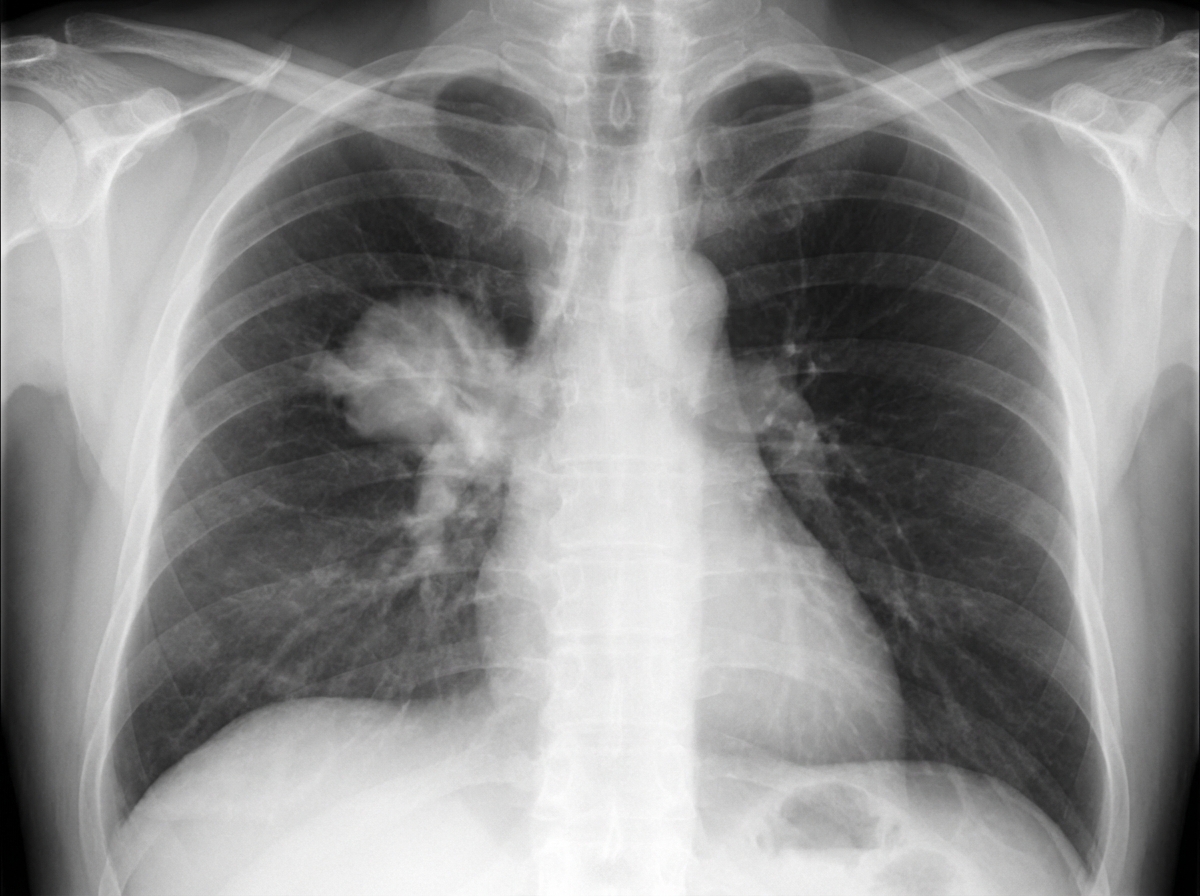
A 71-year-old woman comes to the physician because of a 4-month history of worsening cough and a 4.5-kg (10-lb) weight loss. She has smoked one pack of cigarettes daily for 35 years. Physical examination shows wheezing over the right lung fields. Laboratory studies show a serum calcium concentration of 12.5 mg/dL. X-rays of the chest are shown. Which of the following is the most likely diagnosis?
Practice by Chapter
Hypertension diagnosis and management
Practice Questions
Stable coronary artery disease
Practice Questions
Peripheral arterial disease
Practice Questions
Aortic diseases
Practice Questions
Valvular heart disease
Practice Questions
Pericardial diseases
Practice Questions
Adult congenital heart disease
Practice Questions
Cardiac tumors
Practice Questions
Cardiac manifestations of systemic diseases
Practice Questions
Pre-operative cardiac risk assessment
Practice Questions
Cardiac imaging modalities
Practice Questions
Preventive cardiology
Practice Questions
Cardiac rehabilitation
Practice Questions
Want unlimited practice?
Get full access to all questions, explanations, and performance tracking.
Scan to download app