
Cardiology — MCQs

On this page
A 45-year-old man presents with 2 weeks of low-grade fever, malaise, night sweats, orthopnea, and shortness of breath. Past medical history is unremarkable. He reports a long-standing history of intravenous drug use for which he has been hospitalized a couple of times in the psychiatry ward. His vital signs upon admission show a blood pressure of 100/80 mm Hg, pulse of 102/min, a respiratory rate of 20/min, and a body temperature of 38.4°C (101.0°F). On cardiac auscultation, there is an S3 gallop and a 3/6 holosystolic murmur heard best along the right sternal border. There are fine rattles present over the lung bases bilaterally. Which of the following tests would be of the greatest diagnostic value in this patient?
A 60-year-old-man presents to his physician with worsening myalgias and new symptoms of early fatigue, muscle weakness, and drooping eyelids. His wife presents with him and states that he never used to have such symptoms. His medical history is significant for gout, hypertension, hypercholesterolemia, diabetes mellitus type II, and pilocytic astrocytoma as a teenager. He denies smoking, drinks a 6-pack of beer per day, and endorses a past history of cocaine use but currently denies any illicit drug use. His vital signs include temperature 36.7°C (98.0°F), blood pressure 126/74 mm Hg, heart rate 87/min, and respiratory rate 15/min. Physical examination shows minimal bibasilar rales, but otherwise clear lungs on auscultation, grade 2/6 holosystolic murmur, 3/5 strength in all extremities, and benign abdominal findings. The Tensilon test result is positive. Which of the following options explains why a chest CT should be ordered for this patient?
A 69-year-old woman is brought to the emergency department by her husband for evaluation of the sudden onset of chest pain and breathlessness 2 hours ago. The pain increases with deep inspiration. She had a total hip replacement 20 days ago. She has hypertension, for which she takes a calcium channel blocker. She has smoked 1 pack of cigarettes daily since adolescence. Her vital signs include a blood pressure of 100/60 mm Hg, pulse of 82/min, and respiratory rate of 30/min. She is cyanotic. Examination of the chest revealed tenderness over the right lower lung with dullness to percussion. A chest CT scan showed a focal, wedged-shaped, pleura-based triangular area of hemorrhage in the right lower lobe of the lung. What is the most probable cause of the pulmonary lesion?
A 9-year-old boy presents with persistent epistaxis. The patient’s mother says that his nosebleed started suddenly 2 hours ago, and has not ceased after more than 20 minutes of applying pressure. She states that he has a history of nosebleeds since he was a toddler, but, in the past, they usually stopped after a few minutes of applying pressure. The patient is otherwise healthy and has been meeting all developmental milestones. The family history is significant for a grandfather and an uncle who had excessive bleeding tendencies. Which of the following is the most likely cause of this patient’s symptoms?
A 55-year-old man presents to his primary care physician for leg pain. The patient works as a mailman but states he has had difficulty completing his deliveries for the past month. He complains of a burning and tingling pain in his legs when he walks that goes away when he sits down and takes a break. The patient has a past medical history of obesity, diabetes, stable angina, and constipation. His current medications include insulin and metformin. The patient has a 22-pack-year smoking history and he drinks 2-3 alcoholic beverages per day. Physical exam reveals a stout man with a ruddy complexion. His gait is stable and he demonstrates 5/5 strength in his upper and lower extremities. Which of the following is the best next step in management?
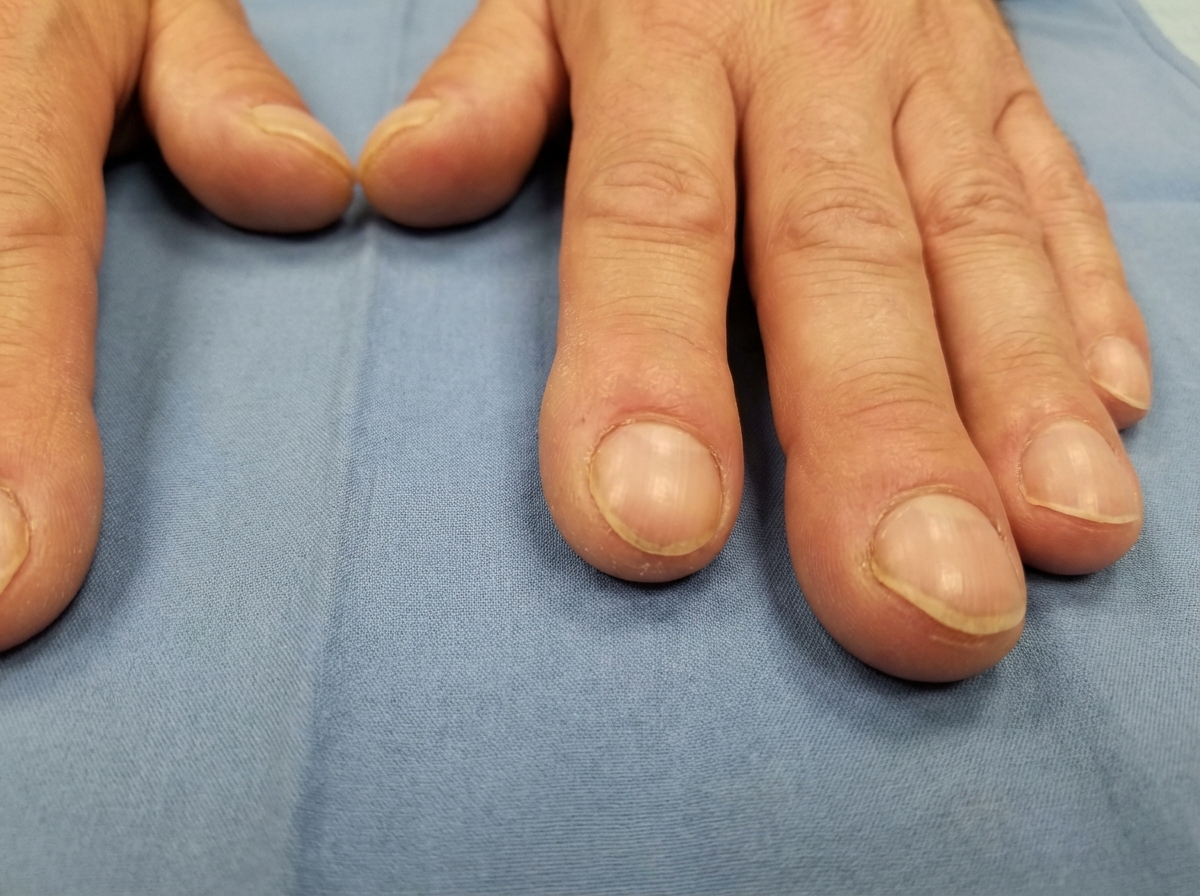
A 39-year-old woman comes to the physician for worsening fatigue and dyspnea for several months. She has not been seen by a physician in 10 years. She is also concerned about the appearance of her fingernails. A photograph of her hands is shown. Which of the following is the most likely underlying cause for the patient's nail findings?
A 58-year-old woman with a history of rheumatic fever has been experiencing exertional fatigue and dyspnea. She has begun using several pillows at night to sleep and occasionally wakes up at night gasping for air. On exam, she appears dyspneic and thin. Cardiac exam reveals a loud S1, opening snap, and apical diastolic rumble. Which of the following is the strongest predictor of the severity of her cardiac problem?
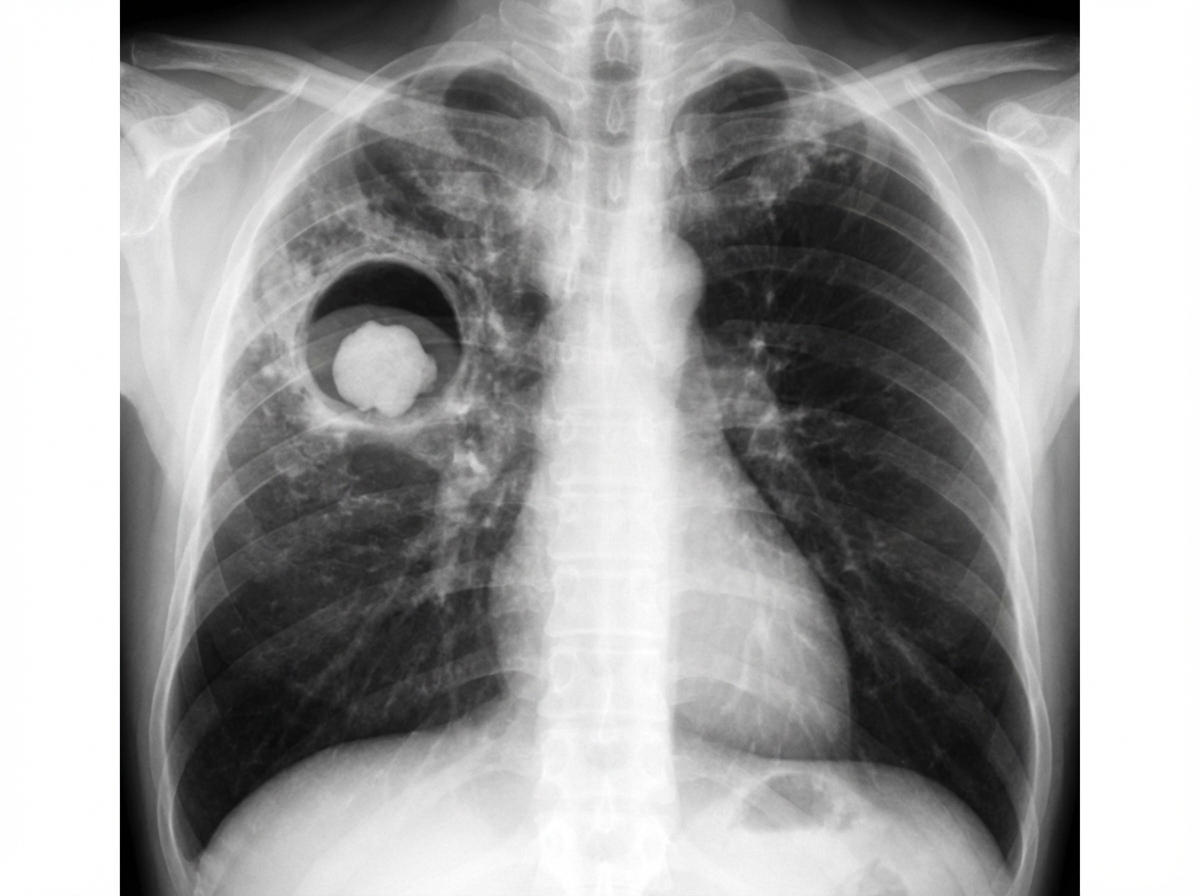
A 48-year-old man comes to the physician because of a 1-month history of a productive cough. He has daily yellowish sputum with occasional streaks of blood in it. Twelve years ago, he was treated for pulmonary tuberculosis for 6 months. He has hypertension and coronary artery disease. He does not smoke or drink alcohol. Current medications include metoprolol, clopidogrel, rosuvastatin, and enalapril. He appears thin. His temperature is 37.2°C (99°F), pulse is 98/min, and blood pressure is 138/92 mm Hg. Pulmonary examination shows inspiratory crackles at the right infraclavicular area. His hemoglobin concentration is 12.2 g/dL, leukocyte count is 11,300/mm3, and erythrocyte sedimentation rate is 38 mm/h. Urinalysis is normal. An x-ray of his chest is shown. Which of the following is most likely to be seen on further evaluation of the patient?
A 33-year-old African American woman presents to the clinic complaining of pain and swelling of her hands and wrists for the past 5 months. The symptoms are worse in the morning and are associated with stiffness that lasts about 15 minutes. She also complains of profound fatigue and decreased appetite. She is sexually active with one partner in a monogamous relationship. Past medical history is unremarkable and she is taking oral contraceptives. She smokes 1–2 cigarettes per day and drinks alcohol socially on the weekends. Temperature is 37.2°C (99.1°F), blood pressure is 130/82 mm Hg, pulse is 76/min, and respirations are 12/min. Physical examination reveals wrists that are tender to palpation, warm, and mildly swollen. Several metacarpophalangeal and proximal interphalangeal joints on both hands are also tender. Hand and wrist strength is 5/5 bilaterally. A non-tender ulcer on the buccal mucosa is also noted. When asked about it, the patient reports that it has been there for several months and does not bother her. Laboratory results are as follows: Complete blood count Hemoglobin 10.3 g/dL Platelets 90,000/mm3 Leukocytes 6,700/mm3 Blood urea nitrogen 16 mg/dL Creatinine 2.1 mg/dL Urinalysis Blood 10–20 red blood cells/hpf Protein 2+ protein B-HCG Negative Which of the following is the most likely diagnosis in this patient?
A 62-year-old man presents to the physician because of difficulty initiating urination, terminal dribbling of urine, and bone pain for 3 months. He has no medical history of serious illness, and he currently takes no medications. His father had prostate cancer at age 58. His vital signs are within normal limits. The physical examination shows tenderness over the lower lumbar vertebrae and the right pelvis. The digital rectal exam (DRE) shows a prostate size equivalent to 2 finger pads with a hard nodule. The laboratory tests show the following results: Serum Prostate-specific antigen (PSA) 15 ng/mL Testosterone 350 ng/mL (N=270–1070 ng/mL) The prostate biopsy confirms the presence of prostate cancer with aggressive histologic features. The MRI shows local extension of the tumor. The radionuclide bone scan shows multiple metastatic sites. Which of the following is the most appropriate next step in management?
Practice by Chapter
Hypertension diagnosis and management
Practice Questions
Stable coronary artery disease
Practice Questions
Peripheral arterial disease
Practice Questions
Aortic diseases
Practice Questions
Valvular heart disease
Practice Questions
Pericardial diseases
Practice Questions
Adult congenital heart disease
Practice Questions
Cardiac tumors
Practice Questions
Cardiac manifestations of systemic diseases
Practice Questions
Pre-operative cardiac risk assessment
Practice Questions
Cardiac imaging modalities
Practice Questions
Preventive cardiology
Practice Questions
Cardiac rehabilitation
Practice Questions
Want unlimited practice?
Get full access to all questions, explanations, and performance tracking.
Scan to download app