
Pharmacokinetics and Pharmacodynamics — MCQs

On this page
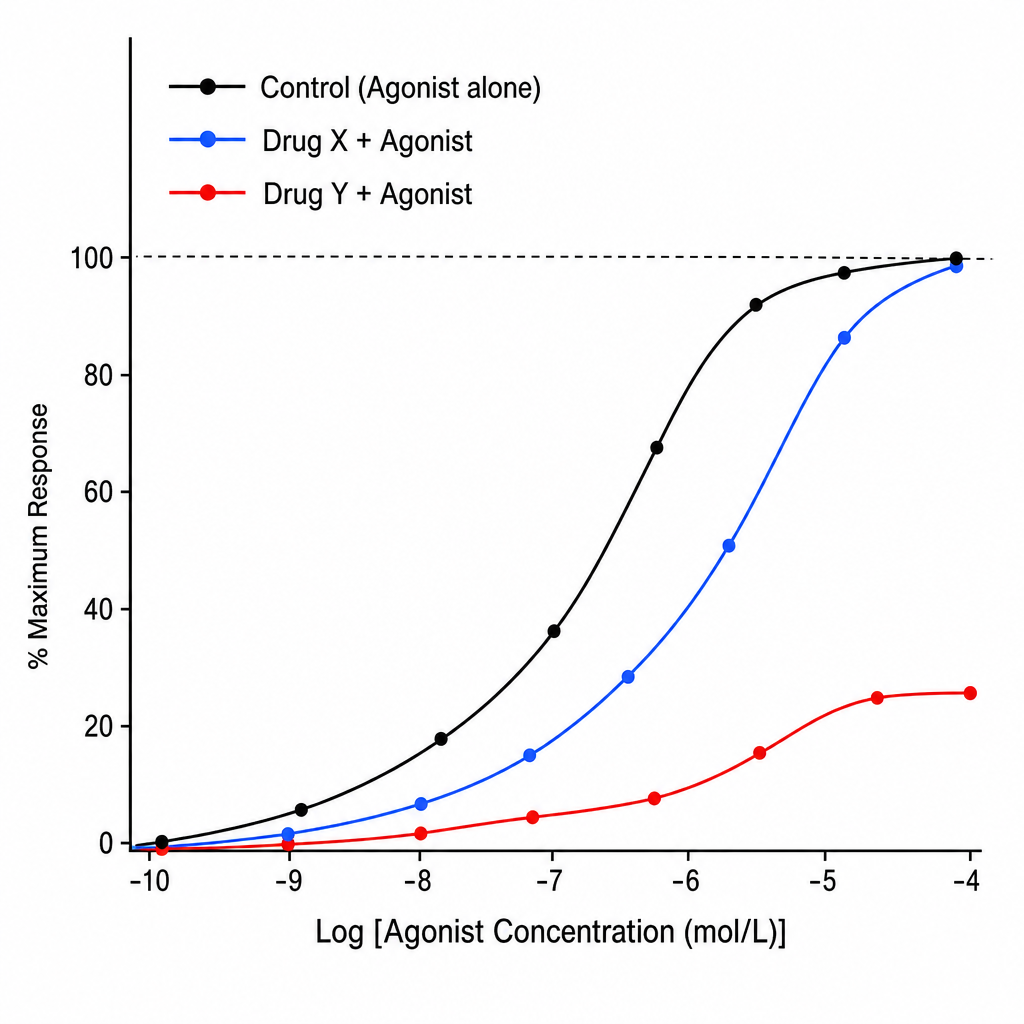
A pharmacology researcher is studying the interaction of a new drug with a receptor system. Two candidate antagonist compounds (Drug X and Drug Y) are tested against a standard agonist at increasing concentrations. The resulting dose-response curves are plotted (Image 1). In the graph, the X-axis represents Log [Agonist Concentration (mol/L)] and the Y-axis represents % Maximum Response (0–100%). Three labeled sigmoid curves are shown: (1) 'Control' — the agonist alone, reaching 100% Emax; (2) 'Drug X + Agonist' — a parallel rightward shift of the control curve with unchanged Emax (~100%); (3) 'Drug Y + Agonist' — a rightward shift with a clearly depressed/lowered Emax (~50–60%). Based on the curves, which of the following statements best describes the mechanism of Drug Y?
Zero order kinetics is followed by all of the following drugs EXCEPT?
If a drug is excreted in urine at the rate of 10 mg/hr at a steady-state plasma concentration of 5 mg/L, then its renal clearance is:
A drug with a plasma half-life of 12 hours is administered twice a day. Steady-state plasma concentration reached is 300 mg/dl. Which of the following statements about this drug is not true?
Which of the following drugs does not produce active metabolites?
Excretion of barbiturates in the urine can be increased by which of the following interventions?
ED50 is used for determining which of the following?
Which of the following is an example of learned tolerance?
Sodium thiopental is ultra-short acting due to –
Which of the following statements regarding plasma protein binding is NOT true?
Practice by Chapter
Absorption and Bioavailability
Practice Questions
Drug Distribution and Protein Binding
Practice Questions
Biotransformation and Metabolism Pathways
Practice Questions
Renal and Non-renal Excretion
Practice Questions
Compartment Models
Practice Questions
Dose-Response Relationships
Practice Questions
Drug Efficacy and Potency
Practice Questions
Drug Tolerance and Tachyphylaxis
Practice Questions
Population Pharmacokinetics
Practice Questions
Pharmacokinetic Variability
Practice Questions
Want unlimited practice?
Get full access to all questions, explanations, and performance tracking.
Scan to download app