
Pulmonology — MCQs

On this page
A patient presents with elevated JVP on the right side and a positive Kussmaul sign. Superior Vena Cava (SVC) obstruction is suspected. In which of the following is SVC obstruction commonly seen?
A 30-year-old woman presents with fatigue, dark "tea color" urine, and yellowish eyes. Her past medical history includes myasthenia gravis treated with azathioprine and pyridostigmine. Laboratory findings are consistent with autoimmune hemolytic anemia. A chest X-ray shows an anterior mediastinal mass. What is the most likely diagnosis?
On spirometry, decreased FEV1, normal FVC, increased TLC, and decreased DLCO2 suggest which diagnosis?
A 65-year-old man presents with a chronic cough, which has recently changed character. Tuberculosis and other infectious causes have been ruled out. What should be the next investigation?
A 60-year-old man with a history of COPD and old TB presents with mild hemoptysis and chronic cough. He is HIV negative and has been ill for approximately 2 weeks. Vital signs: pulse 110 bpm; temperature 101°F; respirations 24/min; blood pressure 108/70 mm Hg. No skin lesions are noted. Laboratory data: Hb 14 g/dL; HCT 42%; WBCs 8.7/uL; BUN 24 mg/dL; creatinine 0.8 mg/dL; sodium 131 mEq/L; potassium 4.3 mEq/L. Arterial blood gases on room air: pH 7.37; PCO2 43 mm Hg; PO2 87 mm Hg. Sputum tests reveal numerous AFB-positive organisms on smear. Spirometry shows an obstructive ventilatory impairment with marginal reversibility. Chest X-ray is provided. Among the choices listed, what is the most likely diagnosis?
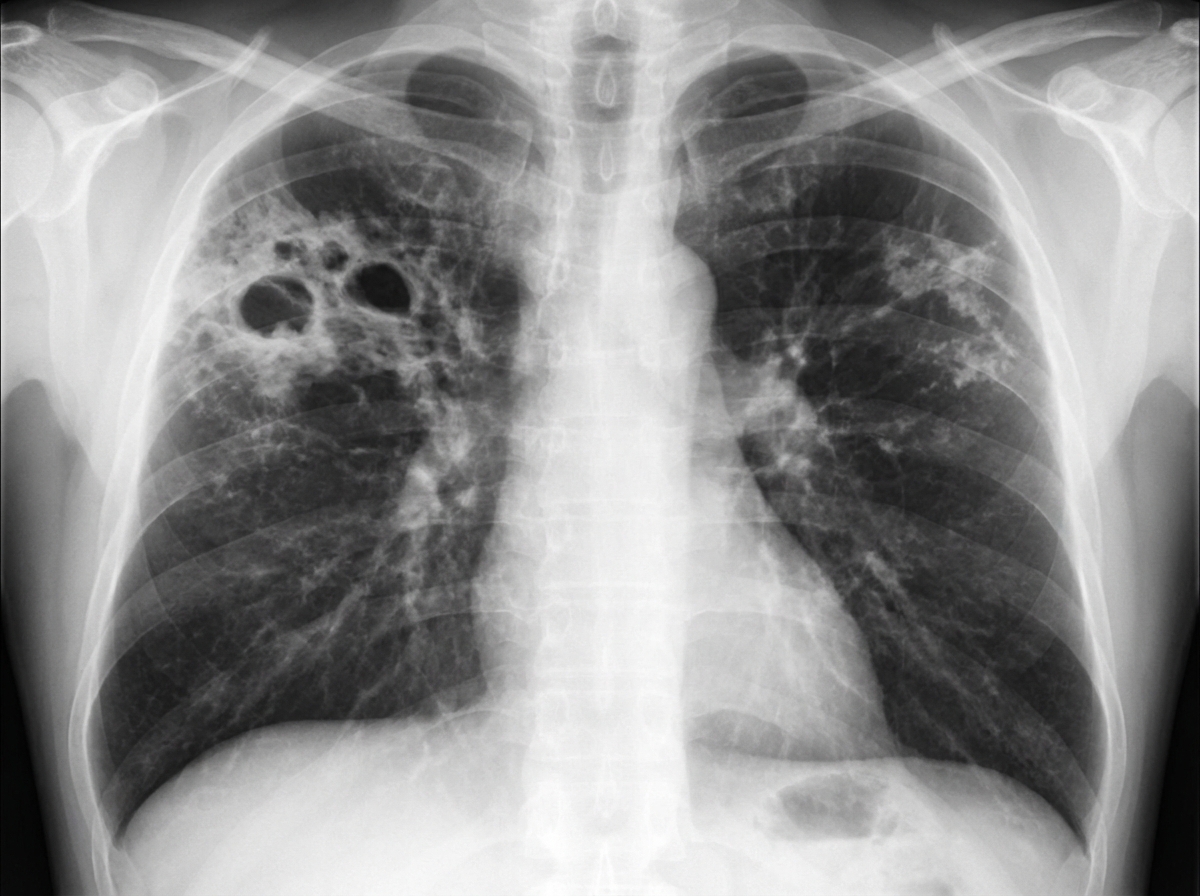
What is the most common cause of fungal infection in a known case of bronchial asthma with eosinophilia?
Which one of the following is not likely to be associated with pulmonary fibrosis?
A 32-year-old patient presents with complaints of difficulty in breathing, chest pain, and increased respiratory rate. Pulmonary thromboembolism is suspected. Which investigation is most useful in acute pulmonary thromboembolism?
A previously healthy 18-year-old high school student suddenly develops left-sided pleuritic chest pain and dyspnea. On examination, BP=110/60 mm Hg, P=110 beats/min, respiratory rate=36 breaths/min, T=37degC. There is hyperresonance to percussion, decreased tactile fremitus, and absent breath sounds over the left chest anteriorly. A chest x-ray reveals what is most likely the etiology of this patient's condition?
What is true about intrinsic asthma?
Practice by Chapter
Obstructive Airway Diseases (Asthma, COPD)
Practice Questions
Interstitial Lung Diseases
Practice Questions
Pulmonary Infections
Practice Questions
Pulmonary Vascular Diseases
Practice Questions
Pleural Diseases
Practice Questions
Sleep-Disordered Breathing
Practice Questions
Respiratory Failure
Practice Questions
Mediastinal Disorders
Practice Questions
Occupational Lung Diseases
Practice Questions
Pulmonary Function Testing
Practice Questions
Bronchiectasis and Cystic Fibrosis
Practice Questions
Lung Cancer Approach
Practice Questions
Want unlimited practice?
Get full access to all questions, explanations, and performance tracking.
Scan to download app