
Pulmonology — MCQs

On this page
Following pelvic gynecologic surgery, a 34-year-old woman becomes dyspneic, her peripheral arterial O2 saturation falls from 94% to 81%, and her measured PaO2 is 52 on a 100% non-rebreather mask. She is hemodynamically stable. A CT angiogram is consistent with a right lower lobe pulmonary embolus. Which of the following is the next step in her management?
Which of the following is used for the management of pneumomediastinum?
What is the most common cause of diffuse bronchiectasis?
A 60-year-old chronic smoker presents with weight loss, cough, and hemoptysis. A chest radiograph revealed a specific appearance. The patient subsequently developed gradually progressive left upper limb pain, paresthesia, and weakness. He also developed left-sided Horner's syndrome. What is the most likely diagnosis?
What is true about Bronchial Asthma?
A 16-year-old asthmatic uses a salbutamol inhaler twice a week on average and frequently wakes up coughing. She is compliant with her treatment regimen and has good inhaler technique. Which of the following would be the most appropriate next step in managing her asthma?
A 57-year-old recently retired demolitions worker complains of increasing shortness of breath. The patient was a chronic heavy cigarette smoker throughout his adult life but quit about a year before presentation. A chest CT was performed. Which of the following steps is not appropriate in the evaluation of this patient?
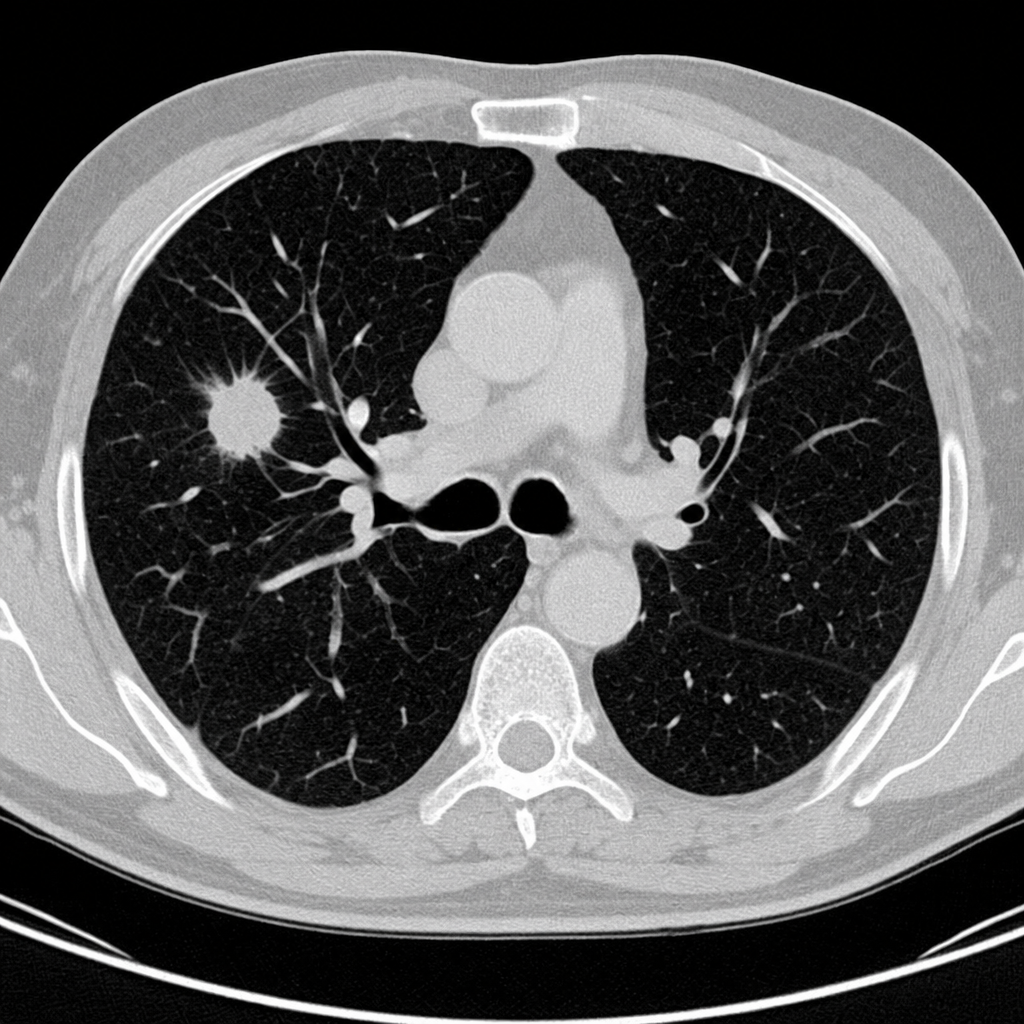
A 65-year-old miner presents with a two-month history of 7 kg weight loss, cough, and blood-streaked sputum. He had a history of pulmonary tuberculosis 10 years ago. He also reports drooping of his left eyelid for one month. Physical examination reveals left-sided ptosis and pupillary miosis. Chest X-ray shows a round opacification in the left upper apical lobe. What is the most probable diagnosis?
A 58-year-old female smoker with end-stage chronic obstructive pulmonary disease and osteoarthritis, who is on ipratropium bromide, albuterol inhalers, and hydrocodone-acetaminophen, presents with respiratory distress for 2 days. She has increased thick, yellow sputum production, low-grade fever, and increasing confusion. On examination, she is mildly obtunded but arousable, with a blood pressure of 160/100 mmHg, pulse of 115/min, respiratory rate of 30/min, and O2 saturation of 84% on her usual 3 L/min nasal cannula oxygen. She is using accessory muscles to breathe, has diffuse wheezing and rhonchi bilaterally, a prolonged expiratory phase, distant but regular heart sounds, and no peripheral edema. Arterial blood gases (ABGs) on arrival are: pH 7.20, PO2 70 mmHg, PCO2 65 mmHg, calculated HCO3 29 mEq/L. Electrolytes are: Na 140 mEq/L, K 5.1 mEq/L, HCO3 29 mEq/L, Cl 100 mEq/L, BUN 20 mg/dL, creatinine 1.5 mg/dL, glucose 89 mg/dL. After prompt initiation of noninvasive positive pressure ventilation (Bi-pap), blood cultures, toxicology screen, intravenous fluids, and IV antibiotics, consider the patient's metabolic situation. Which of the following best describes the acid-base condition and its etiology?
A patient presents with elevated JVP on the right side and a positive Kussmaul sign. Superior Vena Cava (SVC) obstruction is suspected. In which of the following is SVC obstruction commonly seen?
Practice by Chapter
Obstructive Airway Diseases (Asthma, COPD)
Practice Questions
Interstitial Lung Diseases
Practice Questions
Pulmonary Infections
Practice Questions
Pulmonary Vascular Diseases
Practice Questions
Pleural Diseases
Practice Questions
Sleep-Disordered Breathing
Practice Questions
Respiratory Failure
Practice Questions
Mediastinal Disorders
Practice Questions
Occupational Lung Diseases
Practice Questions
Pulmonary Function Testing
Practice Questions
Bronchiectasis and Cystic Fibrosis
Practice Questions
Lung Cancer Approach
Practice Questions
Want unlimited practice?
Get full access to all questions, explanations, and performance tracking.
Scan to download app