Physiological Changes in Laparoscopy Indian Medical PG Practice Questions and MCQs
Practice Indian Medical PG questions for Physiological Changes in Laparoscopy. These multiple choice questions (MCQs) cover important concepts and help you prepare for your exams.
Physiological Changes in Laparoscopy Indian Medical PG Question 1: Which of the following surgical incisions is associated with the highest risk of postoperative pulmonary complications ?
- A. Median sternotomy
- B. Horizontal laparotomy
- C. Vertical laparotomy
- D. Lateral thoracotomy (Correct Answer)
Physiological Changes in Laparoscopy Explanation: ***Lateral thoracotomy***
- **Lateral thoracotomy** is associated with the **highest risk of postoperative pulmonary complications** among common surgical incisions, with complication rates ranging from **15-70%** depending on the procedure.
- This incision **directly violates the chest wall** with rib resection or spreading, causing severe postoperative pain that significantly impairs respiratory mechanics.
- The procedure disrupts **intercostal muscles**, damages **intercostal nerves**, and violates the **pleura**, leading to immediate risks like **pneumothorax**, **hemothorax**, and **pleural effusion**.
- Severe pain leads to **splinting**, **shallow breathing**, **impaired cough**, and **reduced lung expansion**, markedly increasing the risk of **atelectasis**, **pneumonia**, and **respiratory failure**.
- The **ipsilateral lung** is particularly affected with reduced functional residual capacity and impaired secretion clearance.
*Vertical laparotomy*
- **Upper abdominal vertical incisions** are indeed associated with high pulmonary complication rates (**30-50%**), second only to thoracotomy.
- Pain leads to **diaphragmatic splinting** and impaired respiratory mechanics, increasing risk of **atelectasis** and **pneumonia**.
- However, the chest wall itself remains intact, making complications generally less severe than with thoracotomy.
*Median sternotomy*
- While a major thoracic procedure, **median sternotomy** has relatively **lower pulmonary complication rates** compared to lateral thoracotomy.
- The sternal split preserves **intercostal muscles** and **nerve integrity**, resulting in less severe pain and better preserved respiratory mechanics.
- Postoperative pain management is generally more effective than with lateral thoracotomy.
*Horizontal laparotomy*
- **Transverse abdominal incisions** (e.g., Pfannenstiel, transverse supraumbilical) cause significantly less pain than vertical incisions.
- These incisions follow **natural tissue planes**, cause less muscle disruption, and allow better respiratory mechanics.
- Lower pain levels facilitate **effective coughing**, **deep breathing**, and **early mobilization**, reducing pulmonary complication risk.
Physiological Changes in Laparoscopy Indian Medical PG Question 2: Trendelenburg position produces decrease in all of the following except –
- A. Compliance
- B. Functional residual capacity
- C. Respiratory rate (Correct Answer)
- D. Vital capacity
Physiological Changes in Laparoscopy Explanation: ***Respiratory rate***
- Trendelenburg position (head down, feet elevated) increases **venous return** to the heart and **intrathoracic blood volume**.
- This position does not directly or consistently decrease the respiratory rate; instead, it might even slightly increase it due to **increased intrathoracic pressure** and reduced lung compliance.
*Compliance*
- The Trendelenburg position causes **abdominal contents** to shift towards the diaphragm, increasing **intra-abdominal pressure**.
- This upward pressure on the diaphragm restricts its movement and reduces the **compliance** of the respiratory system, making it harder to inflate the lungs.
*Functional residual capacity*
- The cephalad displacement of the diaphragm by abdominal contents in the Trendelenburg position significantly reduces the **volume of air remaining in the lungs** after a normal exhalation.
- This leads to a decrease in **functional residual capacity (FRC)**.
*Vital capacity*
- The decreased lung compliance and reduced FRC due to the elevated diaphragm in the Trendelenburg position make it more difficult for the lungs to fully expand.
- This restriction can lead to a decrease in the **maximum amount of air** a person can exhale after a maximal inhalation, thus reducing **vital capacity**.
Physiological Changes in Laparoscopy Indian Medical PG Question 3: Which of the following is the LEAST significant risk factor for postoperative pulmonary complications?
- A. Age >70
- B. Patient with 7 pack years of smoking
- C. Upper abdominal surgery
- D. BMI>30 (Correct Answer)
Physiological Changes in Laparoscopy Explanation: ***BMI>30***
- While **obesity (BMI >30)** is associated with some surgical risks, it is generally considered a less significant independent risk factor for postoperative pulmonary complications compared to other factors like age, smoking, and surgical site.
- The impact of obesity on pulmonary function is complex and varies depending on the type of surgery and presence of comorbid conditions like **sleep apnea**.
*Age >70*
- **Advanced age (>70)** is a significant independent risk factor due to decreased physiological reserve, reduced pulmonary function (e.g., decreased lung elasticity, impaired cough reflex), and increased prevalence of comorbidities.
- Older patients are more susceptible to **atelectasis**, **pneumonia**, and **respiratory failure** postoperatively.
*Patient with 7 pack years of smoking*
- Even a relatively low cumulative smoking history of **7 pack-years** can impair mucociliary clearance, increase bronchial secretions, and cause airway inflammation, significantly increasing the risk of pulmonary complications.
- Smoking compromises lung function and increases the risk of **bronchospasm** and infection.
*Upper abdominal surgery*
- **Upper abdominal surgery** is a significant risk factor because incisions close to the diaphragm interfere with diaphragmatic movement, leading to reduced lung volumes, impaired cough, and increased risk of **atelectasis** and **pneumonia**.
- Pain from the incision further restricts deep breaths and coughing, contributing to pulmonary complications.
Physiological Changes in Laparoscopy Indian Medical PG Question 4: During abdominal surgery under local anesthesia, the patient suddenly felt pain due to
- A. Liver
- B. Parietal peritoneum (Correct Answer)
- C. Intestines
- D. Visceral peritoneum
Physiological Changes in Laparoscopy Explanation: ***Parietal peritoneum***
- The **parietal peritoneum** is richly innervated by somatic nerves (**spinal nerves**), making it highly sensitive to pain, pressure, and temperature.
- When stimulated during surgery, even under local anesthesia which might not completely block deeper somatic nerves or if the local block is inadequate, it can cause the patient to suddenly feel **sharp, localized pain**.
*Liver*
- The liver itself has very few pain receptors in its parenchyma; pain from the liver typically arises from stretching of its fibrous capsule (**Glisson's capsule**).
- This pain is usually dull and poorly localized, not the sudden, sharp pain typically experienced during surgical manipulation.
*Intestines*
- The intestines are primarily innervated by the **autonomic nervous system** and are sensitive to distension and ischemia, causing visceral pain, which is typically dull, crampy, and poorly localized.
- They are generally not sensitive to cutting or burning, which are common surgical manipulations.
*Visceral peritoneum*
- The **visceral peritoneum** covers abdominal organs and is innervated by the autonomic nervous system, similar to the organs it covers.
- Like the intestines, it is sensitive to stretch and ischemia, producing diffuse, poorly localized visceral pain rather than sharp, localized pain from surgical incision or manipulation.
Physiological Changes in Laparoscopy Indian Medical PG Question 5: In surgical stress all hormones are increased except:
- A. Insulin (Correct Answer)
- B. Epinephrine
- C. ACTH
- D. Cortisol
Physiological Changes in Laparoscopy Explanation: ***Insulin***
- While other **stress hormones** increase, **insulin** levels typically **decrease** or remain stable due to increased **insulin resistance** during surgical stress.
- This physiological response aims to maintain **blood glucose** levels for energy during heightened metabolic demands.
*Epinephrine*
- **Epinephrine** (adrenaline) is a key **catecholamine** released during surgical stress, leading to a "fight or flight" response.
- It increases **heart rate**, **blood pressure**, and promotes **gluconeogenesis** to supply quick energy.
*ACTH*
- **Adrenocorticotropic hormone (ACTH)** is released from the **pituitary gland** in response to surgical stress.
- **ACTH** stimulates the adrenal cortex to produce **cortisol**, a critical stress hormone.
*Cortisol*
- **Cortisol** levels significantly rise during surgical stress, mediated by **ACTH** release.
- It plays a crucial role in **modulating inflammation**, **glucose metabolism**, and maintaining **hemodynamic stability**.
Physiological Changes in Laparoscopy Indian Medical PG Question 6: A patient scheduled for elective inguinal hernia surgery has a history of myocardial infarction (MI) and underwent coronary artery bypass grafting (CABG). What should be included in the preoperative assessment?
- A. History + c/e + routine labs + V/Q scan
- B. History + c/e + routine labs
- C. History + c/e + routine labs + stress test (Correct Answer)
- D. History + c/e + routine labs + angiography to assess graft patency
Physiological Changes in Laparoscopy Explanation: ***History + c/e + routine labs + stress test***
- A **stress test** is crucial in patients with a history of MI and CABG to assess **myocardial ischemia** and functional capacity, guiding perioperative management.
- This evaluation helps determine the patient's **cardiac risk** for non-cardiac surgery and the need for further cardiac optimization.
*History + c/e + routine labs + angiography to assess graft patency*
- **Coronary angiography** is an invasive procedure and is generally not indicated as a routine preoperative assessment unless there are new, significant cardiac symptoms or signs of **graft dysfunction**.
- Assessing graft patency through angiography carries risks and would only be justified if there were strong clinical indications suggesting acute or severe **cardiac ischemia**.
*History + c/e + routine labs*
- While critical for any preoperative assessment, **routine history, physical examination, and basic laboratory tests** are insufficient for a patient with a significant cardiac history like MI and CABG.
- This approach would **underestimate the cardiac risk** and might miss undetected ischemia, leading to adverse perioperative cardiac events.
*History + c/e + routine labs + V/Q scan*
- A **ventilation-perfusion (V/Q) scan** is primarily used to diagnose **pulmonary embolism** or assess regional lung function.
- It does not provide information about myocardial ischemia or cardiac functional capacity, making it **irrelevant** for assessing cardiac risk in this clinical scenario.
Physiological Changes in Laparoscopy Indian Medical PG Question 7: Which is the most frequently used gas for laparoscopy?
- A. Carbon Dioxide (Correct Answer)
- B. Helium
- C. Nitrogen
- D. Oxygen
Physiological Changes in Laparoscopy Explanation: ***Correct: Carbon Dioxide***
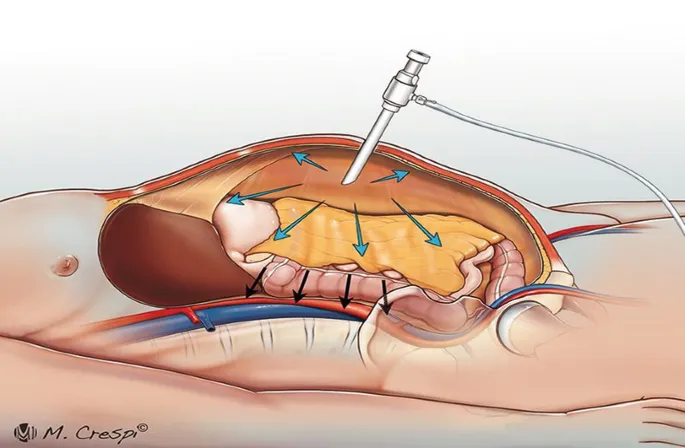
- **Carbon dioxide (CO2)** is the most commonly used gas for creating **pneumoperitoneum** in laparoscopy due to its high solubility in blood and rapid elimination through the respiratory system.
- Its rapid absorption minimizes the risk of **gas emboli**, and its lower cost makes it a practical choice.
*Incorrect: Helium*
- While helium can be used, it is generally reserved for patients who cannot tolerate **CO2 insufflation**, such as those with severe **hypercapnia** or acidosis.
- Helium is less soluble in blood, increasing the risk of **gas embolism**, and is also more expensive.
*Incorrect: Nitrogen*
- **Nitrogen** is generally avoided in laparoscopic procedures because of its low solubility in blood, which poses a significant risk of **gas embolism**.
- Its slow absorption from the peritoneal cavity can prolong recovery and is less desirable than CO2.
*Incorrect: Oxygen*
- **Oxygen** is not used for creating **pneumoperitoneum** because it supports combustion and would increase the risk of fire during surgical procedures involving electrocautery or lasers.
- Additionally, like nitrogen, its solubility and physiological effects are not ideal for laparoscopic insufflation.
Physiological Changes in Laparoscopy Indian Medical PG Question 8: Best gas used for creating pneumoperitoneum at laparoscopy is
- A. N2
- B. CO2 (Correct Answer)
- C. O2
- D. N2O
Physiological Changes in Laparoscopy Explanation: ***CO2***
- **Carbon dioxide** is rapidly absorbed from the peritoneum, minimizing the risk of a **gas embolism** and its associated complications.
- It is also **non-flammable**, which is crucial in an operating room environment where electrocautery or lasers may be used.
*N2*
- **Nitrogen** is poorly soluble in blood, increasing the risk of a **gas embolism** if it escapes into the vascular system.
- It is an **inert gas** but is not used because of poor solubility and lack of rapid absorption from the peritoneum.
*O2*
- **Oxygen** poses a significant **fire hazard** in the operating room when electrocautery is used.
- It is also very reactive and could lead to **tissue oxidation** if used for insufflation.
*N2O*
- **Nitrous oxide** supports **combustion** and thus carries a risk of fire with electrocautery.
- It can cause **bowel distension** due to rapid diffusion into the intestinal lumen, hindering visibility during laparoscopy.
Physiological Changes in Laparoscopy Indian Medical PG Question 9: Which one of the following is the safest gas for creating pneumoperitoneum in operative laparoscopy?
- A. Oxygen
- B. Carbon monoxide
- C. Nitrous oxide
- D. Carbon dioxide (Correct Answer)
Physiological Changes in Laparoscopy Explanation: ***Carbon dioxide***
- **Carbon dioxide (CO2)** is the gold standard for creating **pneumoperitoneum** because it is rapidly absorbed from the **peritoneal cavity** and excreted by the lungs, minimizing the risk of gas embolism.
- Its **high solubility in blood** (20x more soluble than nitrogen) reduces the risk of serious complications if inadvertently injected intravascularly.
- **Non-combustible** and does not support combustion, making it safe to use with electrocautery and other heat sources during surgery.
*Oxygen*
- **Oxygen** is highly **combustible** and would create a significant fire hazard in the presence of electrocautery or other heat sources during surgery.
- It could also cause **gas emboli** if it enters the bloodstream, as it is less soluble than CO2.
- Risk of **oxidative tissue damage** with prolonged exposure.
*Carbon monoxide*
- **Carbon monoxide** is extremely **toxic** and binds irreversibly to hemoglobin with 200-250 times greater affinity than oxygen, forming **carboxyhemoglobin**, which impairs oxygen transport.
- Even minimal exposure can be life-threatening due to systemic hypoxia.
- Absolutely contraindicated for clinical use.
*Nitrous oxide*
- **Nitrous oxide** can diffuse into gas-filled spaces (bowel loops) 30x faster than nitrogen, potentially causing **bowel distension** and increased intra-abdominal pressure during prolonged procedures.
- Although less of a fire risk than oxygen, it can **support combustion** at high concentrations.
- Less rapidly absorbed than CO2, posing higher embolism risk if intravascular injection occurs.
Physiological Changes in Laparoscopy Indian Medical PG Question 10: Best gas used for creating pneumoperitoneum at laparoscopy is:
- A. N2
- B. CO2 (Correct Answer)
- C. N2O
- D. O2
Physiological Changes in Laparoscopy Explanation: ***CO2***
- **Carbon dioxide** is rapidly absorbed and expelled by the respiratory system, minimizing the risk of **gas embolism**.
- It is **non-flammable**, which is crucial in a surgical environment where electrosurgical devices are often used.
- CO2 is **highly soluble in blood**, allowing rapid clearance if venous absorption occurs.
*N2*
- **Nitrogen** is not ideal for pneumoperitoneum as its poor solubility in blood leads to a significant risk of **gas embolism**.
- **Increased nitrogen pockets** can create complications that make it a poor choice.
*O2*
- **Oxygen** poses a significant **fire hazard** in the presence of electrosurgical instruments.
- It **supports combustion**, making the surgical field dangerous when using electrocautery or laser devices.
*N2O*
- **Nitrous oxide** supports **combustion**, making it unsafe for use with electrosurgical devices.
- It can also diffuse into **bowel loops**, causing distension and obstructing visibility, which is undesirable during laparoscopy.
More Physiological Changes in Laparoscopy Indian Medical PG questions available in the OnCourse app. Practice MCQs, flashcards, and get detailed explanations.


 oka
oka