
Autonomic/CV Drugs — MCQs

On this page
A 56-year-old man with coronary artery disease agrees to participate in a pharmacological study. He takes an oral medication that leads to dephosphorylation of myosin light chains in venous smooth muscle cells. An investigator measures the plasma concentration of the drug over time after intravenous and then after oral administration. There is no statistically significant difference in the dose-corrected area under the curve for the 2 routes of administration. The patient most likely ingested which of the following drugs?
A 50-year-old woman presents with sudden onset right upper quadrant abdominal pain. She says her symptoms started 6 hours ago after she had dinner. She describes the pain as cramping, radiating to her shoulders. She had similar episodes in the past, but they were less severe and resolved with over-the-counter analgesics. Her medical history is significant for hypertension and coronary artery disease. Her current medications include warfarin, hydrochlorothiazide, and fibrates. Her temperature is 37.7°C (99.9°F), blood pressure is 110/80 mm Hg, pulse is 80/min, and respirations are 15/min. Abdominal exam reveals severe right upper quadrant tenderness, and she catches her breath when palpated deeply just below the right costal margin. Surgical consult determines her to be surgically unfit for any intervention due to her high risk of bleeding. After treating her pain with appropriate analgesics, which of the following is the next best step in the management of this patient?
A 70-year-old male immigrant from Asia is brought to the emergency room with complaints of palpitations and light-headedness for 1 hour. The patient was sitting in his chair watching television when he felt his heart racing and became dizzy. He was unable to stand up from his chair because of weakness and light-headedness. His past medical history is notable for mitral stenosis secondary to rheumatic fever as a child. On arrival to the emergency department, the patient's temperature is 99.7°F (37.6°C), blood pressure is 110/55 mmHg, pulse is 140/min, and respirations are 15/min. The patient appears comfortable but anxious. Electrocardiogram shows atrial fibrillation with rapid ventricular response. The patient is started on dofetilide. Which of the following would be expected in this patient’s cardiac action potential as a result of this drug?
A 57-year-old man calls his primary care physician to discuss the results of his annual laboratory exams. The results show that he has dramatically decreased levels of high-density lipoprotein (HDL) and mildly increased levels of low-density lipoprotein (LDL). The physician says that the HDL levels are of primary concern so he is started on the lipid level modifying drug that most effectively increases serum HDL levels. Which of the following is the most likely a side effect of this medication that the patient should be informed about?
A 53-year-old male presents to his primary care provider for tremor of his right hand. The patient reports that the shaking started a few months ago in his right hand but that he worries about developing it in his left hand as well. He reports that the shaking is worse when he is sitting still or watching television and improves as he goes about his daily activities. The patient has a past medical history of hypertension, hyperlipidemia, and diabetes mellitus, and his home medications are hydrochlorothiazide, lisinopril, and atorvastatin. He works as an accountant and drinks 1-2 beers per week. He has a 15-pack-year smoking history but quit ten years ago. On physical exam, the patient has bilateral hand tremors with a frequency of 4-5 Hz. The tremor improves on finger-to-nose testing. His upper extremities also display a mild resistance to passive movement, and he has 2+ reflexes throughout. He has no gait abnormalities, and he scores 29/30 on the Mini-Mental State Examination (MMSE). This patient should be started on which of the following classes of medications?
A 52-year-old man with a history of hypertension and hyperlipidemia comes to the physician because of a 10-month history of substernal chest pain on exertion that is relieved with rest. His pulse is 82/min and blood pressure is 145/82 mm Hg. He is prescribed a drug that acts by forming free radical nitric oxide. The patient is most likely to experience which of the following adverse effects as a result of this drug?
A 68-year-old male with a history of congestive heart failure presents to his cardiologist complaining of mild dyspnea on exertion and swollen ankles. His past medical history is also significant for hypertension and alcohol abuse. He has a 50 pack-year smoking history. He currently takes lisinopril, aspirin, and metoprolol. His temperature is 99°F (37.2°C), blood pressure is 135/85 mmHg, pulse is 85/min, and respirations are 18/min. An echocardiogram reveals an ejection fraction of 35%. His cardiologist adds an additional medication to the patient’s regimen. Two weeks later, the patient notices yellow halos in his vision. Which of the following medications did this patient most likely start taking?
A previously healthy 36-year-old woman comes to the emergency department because of a progressively worsening headache for 5 days. She vomited twice after waking up this morning. She does not smoke or drink alcohol. She is sexually active with one male partner and uses an oral contraceptive. Her temperature is 37.5°C (99.5°F), pulse is 105/min, and blood pressure is 125/80 mm Hg. Examination shows tearing of the right eye. The pupils are equal and reactive to light; right lateral gaze is limited. Fundoscopic examination shows bilateral optic disc swelling. The remainder of the examination shows no abnormalities. An MR venography of the head shows a heterogeneous intensity in the left lateral sinus. Which of the following is the most appropriate next step in management?
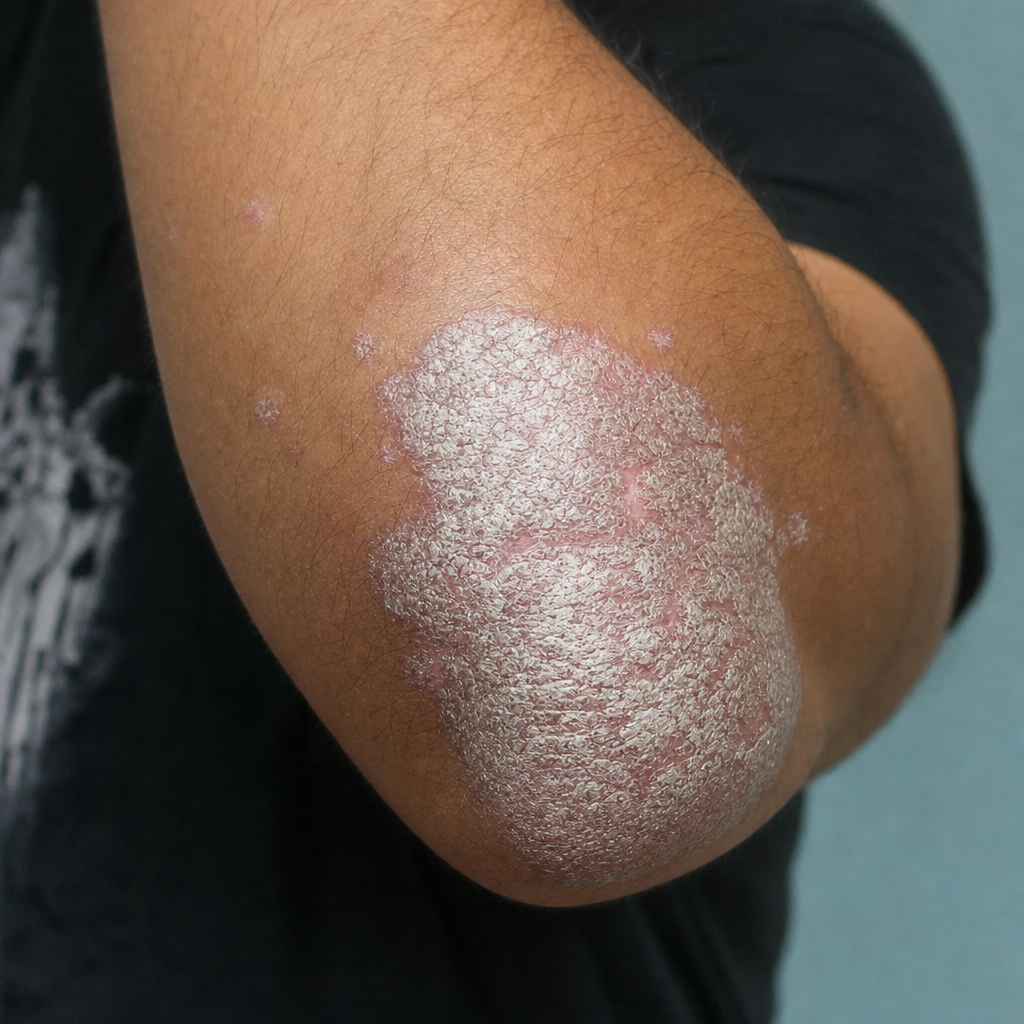
A previously healthy 30-year-old man comes to the physician because of a 2-week history of lesions on his elbows. He has no history of serious illness and takes no medications. Physical examination shows skin lesions on bilateral elbows. A photograph of his right elbow is shown. Which of the following is the most appropriate treatment for this patient's skin condition?
A 48-year-old man presents to the emergency department with complaints of substernal chest pain for the past 1 hour. The pain is crushing in nature and radiates to his neck and left arm. He rates the pain as 7/10. He gives a history of similar episodes in the past that resolved with rest. He is a non-smoker and drinks alcohol occasionally. On physical examination, the temperature is 37.0°C (98.6°F), the pulse rate is 130/min and irregular, the blood pressure is 148/92 mm Hg, and the respiratory rate is 18/min. The physician immediately orders an electrocardiogram, the findings of which are consistent with an acute Q-wave myocardial infarction (MI). After appropriate emergency management, he is admitted to the medical floor. He develops atrial fibrillation on the second day of admission. He is given a β-adrenergic blocking agent for the arrhythmia. On discharge, he is advised to continue the medication for at least 2 years. Which of the following β-adrenergic blocking agents was most likely prescribed to this patient?
Practice by Chapter
Antiarrhythmic classification and mechanisms
Practice Questions
Class I antiarrhythmics (sodium channel blockers)
Practice Questions
Class II antiarrhythmics (beta blockers)
Practice Questions
Class III antiarrhythmics (potassium channel blockers)
Practice Questions
Class IV antiarrhythmics (calcium channel blockers)
Practice Questions
Other antiarrhythmic agents
Practice Questions
Antianginal drugs
Practice Questions
Positive inotropic agents
Practice Questions
Phosphodiesterase inhibitors
Practice Questions
Cardiac glycosides
Practice Questions
Vasopressors and inotropes
Practice Questions
Pulmonary hypertension therapies
Practice Questions
Peripheral vascular disease therapies
Practice Questions
Want unlimited practice?
Get full access to all questions, explanations, and performance tracking.
Scan to download app