
Systemic Pathology — MCQs

On this page
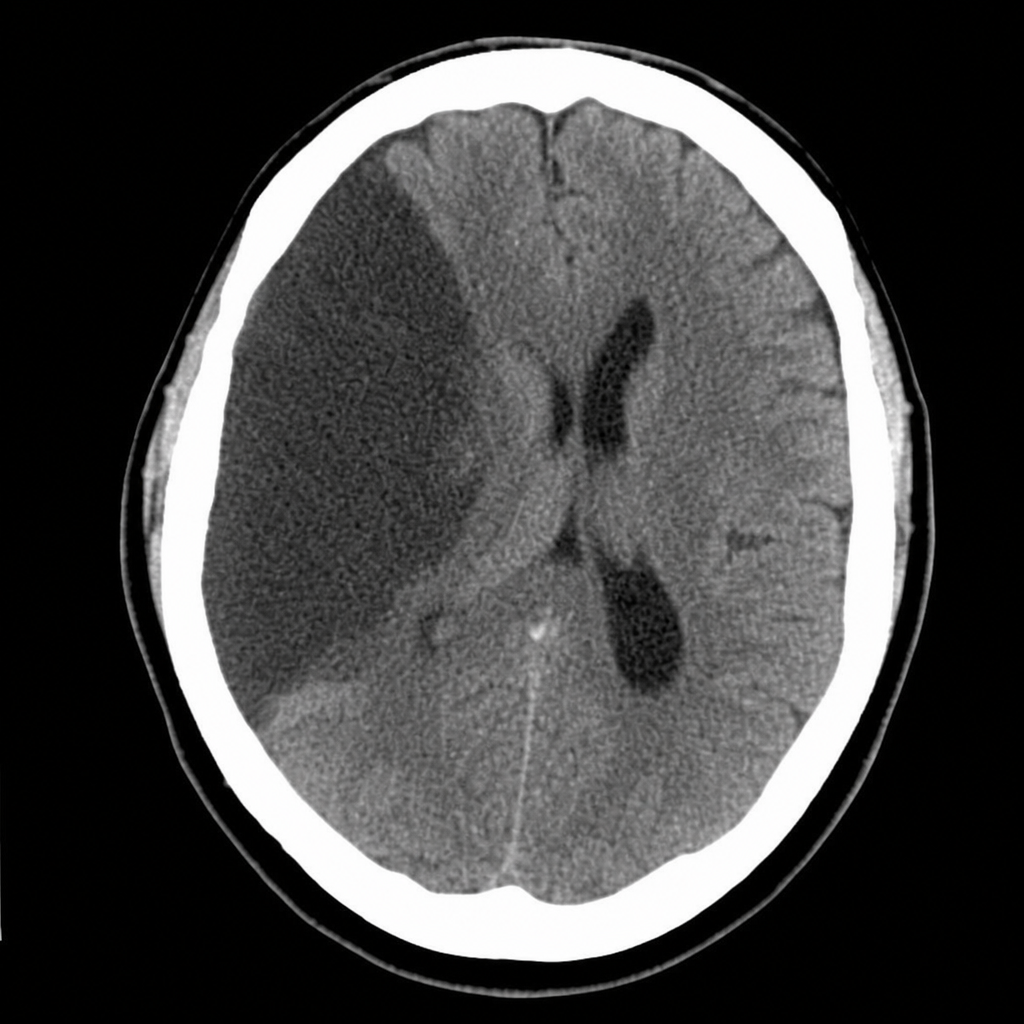
A 35-year-old woman presents with an inability to move her right arm or leg. She states that symptoms onset acutely 2 hours ago. Past medical history is significant for long-standing type 1 diabetes mellitus, well-managed with insulin. The patient reports a 15-pack-year smoking history. Family history is significant for breast cancer in her mother at age 66 and her father dying of a myocardial infarction at age 57. Review of systems is significant for excessive fatigue for the past week, and her last menstrual period that was heavier than normal. Her vitals signs include: temperature 38.8°C (101.8°F), blood pressure 105/75 mm Hg, pulse 98/min, respirations 15/min, and oxygen saturation 99% on room air. On physical examination, the patient appears pale and tired. The cardiac exam is normal. Lungs are clear to auscultation. The abdominal exam is significant for splenomegaly. There is a non-palpable purpura present on the lower extremities bilaterally. Conjunctiva and skin are pale. Laboratory results are pending. A peripheral blood smear is shown in the exhibit. Which of the following laboratory findings would least likely be seen in this patient?
A 68-year-old man with alcohol use disorder is brought to the physician by his sister for frequent falls and an unsteady gait over the past 2 months. He has not seen a physician in 10 years. He appears emaciated and inattentive. He is oriented to person only. Physical examination shows a wide-based gait with slow, short steps. Eye examination shows lateral gaze paralysis and horizontal nystagmus. One month later, he dies. Which of the following is the most likely finding on autopsy?
A 57-year-old male with diabetes mellitus type II presents for a routine check-up. His blood glucose levels have been inconsistently controlled with medications and diet since his diagnosis 3 years ago. At this current visit, urinalysis demonstrates albumin levels of 250 mg/day. All prior urinalyses have shown albumin levels below 20 mg/day. At this point in the progression of the patient’s disease, which of the following is the most likely finding seen on kidney biopsy?
A 44-year-old man presents to his primary care physician for muscle pain and weakness. He says that his muscle pain mainly affects his legs. He also experiences difficulty with chewing gum and has poor finger dexterity. Medical history is significant for infertility and cataracts. On physical exam, the patient's face is long and narrow with a high arched palate and mild frontal balding. There is bilateral ptosis and temporalis muscle and sternocleidomastoid muscle wasting. Creatine kinase level is mildly elevated. Which of the following is most likely to be found on genetic testing?
A 31-year-old woman presents to the emergency department with a 2-week history of dry cough and shortness of breath on exertion. She says that she has also been feeling joint pain that has been increasing over time and is worst in the mornings. Finally, she has noticed painful swellings that have been appearing on her body over the last month. Her past medical history is significant for childhood asthma that does not require any current medications. She drinks socially and has smoked 2 packs per day since she was 16 years old. Physical exam reveals erythematous nodular lesions on her trunk and upper extremities. Serum protein electrophoresis shows polyclonal gammopathy. Which of the following would most likely also be seen in this patient?
A 33-year-old woman comes to the physician for the evaluation of bleeding from her gums for 2 weeks. These episodes occur spontaneously and are self-limiting. She has also had purplish skin lesions over her legs for 2 months. Last week, she had one episode of hematuria and watery diarrhea, both of which resolved without treatment. She has mild asthma. Her brother has hemophilia. Her only medication is a fenoterol inhaler. She appears healthy. Her temperature is 37.1°C (99.3°F), pulse is 88/min, respirations are 14/min, and blood pressure is 122/74 mm Hg. Cardiopulmonary examination shows no abnormalities. The abdomen is soft and nontender; there is no organomegaly. Oropharyngeal examination shows gingival bleeding. There are petechiae over the neck and the right upper extremity and purpuric spots over both lower extremities. Laboratory studies show: Hemoglobin 13.3 mg/dL Mean corpuscular volume 94 μm3 Leukocyte count 8,800/mm3 Platelet count 18,000/mm3 Bleeding time 9 minutes Prothrombin time 14 seconds (INR=0.9) Partial thromboplastin time 35 seconds Serum Glucose 88 mg/dL Creatinine 0.9 mg/dL Which of the following is the most likely underlying mechanism of this patient's symptoms?
A 48-year-old African American male presents to his primary care provider complaining of facial swelling. He reports a three-day history of worsening swelling primarily around his eyes. The patient’s medical history is notable for sickle cell disease and poorly controlled hypertension. The patient currently takes enalapril, hydrochlorothiazide, and amlodipine but has a history of medication non-adherence. He has a 15 pack-year smoking history. His temperature is 99.1°F (37.3°C), blood pressure is 155/100 mmHg, pulse is 90/min, and respirations are 20/min. Physical examination is notable for periorbital swelling and 1+ bilateral lower extremity edema. Multiple serum and urine labs are ordered. A kidney biopsy in this patient would most likely yield which of the following sets of findings on light and electron microscopy?
A 49-year-old obese woman presents with a chronic non-healing ulcer on the right medial malleolus. Past medical history is significant for type 2 diabetes mellitus, diagnosed 10 years ago, poorly managed with metformin. Review of systems is significant for a recurrent white vaginal discharge. The patient is afebrile, and her vital signs are within normal limits. Her BMI is 31 kg/m2. On physical examination, there is a 2 cm by 2 cm nontender, erythematous shallow ulcer present over the right medial malleolus. Sensation is decreased symmetrically in the lower extremities below the level of the midcalf. Which of the following histopathological findings would most likely be seen in the peripheral nerves in this patient?
A 2-year-old boy is brought to the pediatrician for recurrent nosebleeds. The boy was adopted two months ago and the parents have no record of his medical or family history. They report that the child has had frequent prolonged nosebleeds several times per week. Despite them applying pressure on the distal aspect of the nares and keeping his head elevated, the bleeding generally continues for hours. On exam, the boy appears pale and lethargic. A blood sample is obtained but the child bleeds through multiple pieces of gauze. No agglutination is observed when ristocetin is added to the patient’s blood. The addition of normal plasma to the sample still does not lead to agglutination. This patient has a condition that is most consistent with which of the following modes of transmission?
A 25-year-old man is brought to the emergency department by ambulance after a motor vehicle accident. His car was rear-ended by a drunk driver while he was stopped at a traffic light. At the scene, he was noted to have multiple small lacerations over his upper extremities from broken glass. He has otherwise been healthy, does not smoke, and drinks 5 beers per night. He notes that he recently started trying out a vegan diet and moved to an apartment located in a historic neighborhood that was built in the 1870s. Physical exam reveals several small lacerations on his arms bilaterally but is otherwise unremarkable. A complete blood workup is sent and some of the notable findings are shown below: Hemoglobin: 12.1 g/dL (normal: 13.5-17.5 g/dL) Platelet count: 261,000/mm^3 (normal: 150,000-400,000/mm^3) Mean corpuscular volume: 74 µm^3 (normal: 80-100 µm^3) Further testing using serum hemoglobin electrophoresis reveals: Hemoglobin A1 92% (normal 95-98%) Hemoglobin A2: 6% (normal: 1.5-3.1%) Which of the following cell morphologies would most likely be seen on blood smear in this patient?
Practice by Chapter
Liver pathology (hepatitis, cirrhosis)
Practice Questions
Gallbladder and biliary tract disorders
Practice Questions
Pancreatic diseases
Practice Questions
Kidney diseases
Practice Questions
Male reproductive pathology
Practice Questions
Female reproductive pathology
Practice Questions
Breast pathology
Practice Questions
Endocrine pathology
Practice Questions
Bone and joint pathology
Practice Questions
Skeletal muscle diseases
Practice Questions
Peripheral nerve disorders
Practice Questions
Soft tissue tumors
Practice Questions
Head and neck pathology
Practice Questions
Want unlimited practice?
Get full access to all questions, explanations, and performance tracking.
Scan to download app