
Endocrine pathology — MCQs

On this page
A 28-year-old man presents with polyuria (6 liters/day), polydipsia, and nocturia for 2 months. He has no significant medical history. Serum sodium is 148 mEq/L, serum osmolality 305 mOsm/kg, and urine osmolality 180 mOsm/kg. After 8-hour water deprivation, urine osmolality increases to 250 mOsm/kg. Following administration of desmopressin, urine osmolality increases to 650 mOsm/kg. Apply this data to determine the diagnosis.
A 32-year-old woman with a history of postpartum hemorrhage 18 months ago presents with fatigue, cold intolerance, and inability to lactate after delivery. She reports having no menstrual periods since delivery and has gained 15 pounds. Laboratory studies show low TSH, low free T4, low cortisol, and low estradiol. Apply your knowledge to determine the underlying pathologic process.
A 45-year-old woman presents with a 3-month history of heat intolerance, weight loss, and palpitations. Physical examination reveals exophthalmos, diffuse thyroid enlargement, and a fine tremor. Laboratory studies show TSH <0.01 mIU/L (normal: 0.4-4.0), free T4 6.8 ng/dL (normal: 0.8-1.8), and positive TSH receptor antibodies. A thyroid ultrasound shows diffuse enlargement with increased vascularity. Apply the pathophysiologic mechanism to explain her ocular findings.
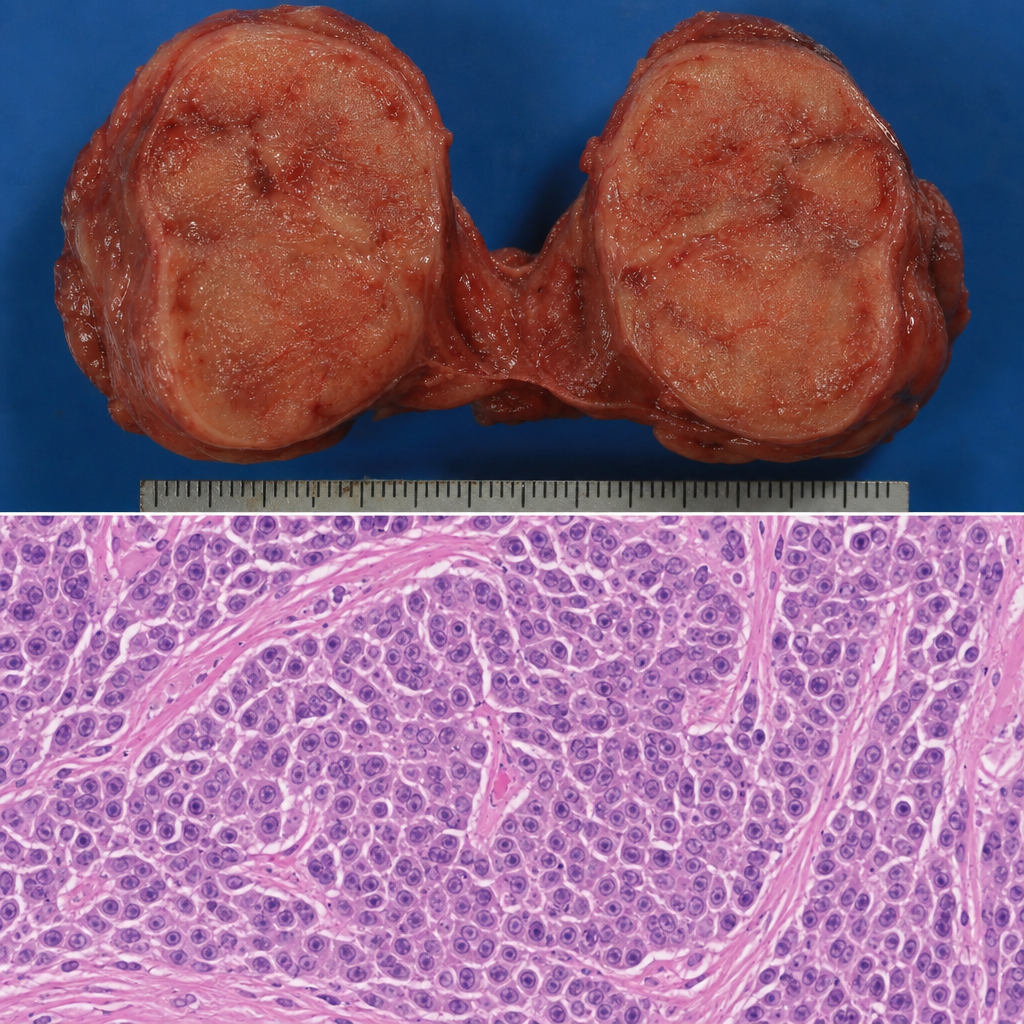
A 50-year-old lady with thyroid swelling underwent total thyroidectomy. The gross specimen and histopathological slide is shown below. Diagnosis is:
Practice by Chapter
Pituitary disorders
Practice Questions
Thyroid diseases (hyper/hypothyroidism)
Practice Questions
Thyroiditis
Practice Questions
Thyroid neoplasms
Practice Questions
Parathyroid disorders
Practice Questions
Adrenal cortical diseases
Practice Questions
Adrenal medullary disorders
Practice Questions
Pheochromocytoma and paraganglioma
Practice Questions
Pancreatic endocrine tumors
Practice Questions
Multiple endocrine neoplasia syndromes
Practice Questions
Diabetes mellitus pathology
Practice Questions
Endocrine disorders in pregnancy
Practice Questions
Endocrine effects of non-endocrine tumors
Practice Questions
Want unlimited practice?
Get full access to all questions, explanations, and performance tracking.
Scan to download app