
Gastroenterology — MCQs

On this page
A 59-year-old woman presents to her primary care physician for trouble sleeping. The patient states that when she goes to bed at night she has an urge to get up out of bed and walk around. The patient often wakes her husband when she does this which irritates him. She states that there is a perpetual uneasiness and feeling of a need to move at night which is relieved by getting up and walking around. The patient denies symptoms during the day. She works as a mail carrier and is nearing retirement. She has a past medical history of anxiety, depression, irritable bowel syndrome, and dysmenorrhea. She is not currently taking any medications. Her temperature is 99.5°F (37.5°C), blood pressure is 157/98 mmHg, pulse is 80/min, respirations are 17/min, and oxygen saturation is 98% on room air. Physical exam reveals 5/5 strength in the upper and lower extremities, 2+ reflexes in the upper and lower extremities, a stable gait pattern, and normal sensation. Cardiopulmonary and abdominal exams are within normal limits. Which of the following is the best initial step in management?
A 55-year-old man presents to the emergency department for fever and altered mental status. The patient was found by his wife in his chair at home. She noticed he responded incoherently to her questions. He has a past medical history of pancreatitis and alcohol abuse and is currently in a rehabilitation program. His temperature is 103°F (39.4°C), blood pressure is 127/68 mmHg, pulse is 120/min, respirations are 12/min, and oxygen saturation is 98% on room air. Laboratory values are obtained and shown below. Serum: Na+: 139 mEq/L Cl-: 100 mEq/L K+: 4.3 mEq/L HCO3-: 25 mEq/L BUN: 29 mg/dL Glucose: 99 mg/dL Creatinine: 1.5 mg/dL Ca2+: 5.2 mg/dL AST: 12 U/L ALT: 10 U/L 1,25 dihydroxycholecalciferol: 50 nmol/L Physical exam notes a diffusely distended and tender abdomen. Which of the following is the most likely symptom this patient is experiencing secondary to his laboratory abnormalities?
A 46-year-old woman presents to her primary care provider reporting several weeks of fatigue and recent episodes of lightheadedness. She is concerned that she will have an episode while driving. She has never lost consciousness, and reports that there is no associated vertigo or dizziness. She states that she normally goes for a jog 3 times a week but that she has become winded much more easily and has not been able to run as far. On exam, her temperature is 97.9°F (36.6°C), blood pressure is 110/68 mmHg, pulse is 82/min, and respirations are 14/min. Auscultation of the lungs reveals no abnormalities. On laboratory testing, her hemoglobin is found to be 8.0 g/dL. At this point, the patient reveals that she was also recently diagnosed with fibroids, which have led to heavier and longer menstrual bleeds in the past several months. Which of the following would suggest that menstrual bleeding is the cause of this patient’s anemia?
A 75-year-old woman presents with episodic abdominal pain following meals for the past few years. She says these episodes have worsened over the past month. Past medical history is significant for type 2 diabetes mellitus diagnosed 30 years ago, managed with metformin. Her most recent HbA1C last month was 10%. Vital signs include: blood pressure 110/70 mm Hg, pulse 80/min, and respiratory rate 16/min. Physical examination is unremarkable. Which of the following is the most likely diagnosis in this patient?
A 53-year-old man presents to your office with a 2 month history of abdominal bloating. He states that he feels full after eating only a small amount and has experienced bloating, diarrhea, and occasionally vomiting when he tries to eat large amounts. He states his diarrhea has now become more profuse and is altering the quality of his life. One week ago, the patient was given antibiotics for an ear infection. He states he is trying to eat more healthy and has replaced full fat with fat free dairy and is reducing his consumption of meat. His temperature is 99.0°F (37.2°C), blood pressure is 164/99 mmHg, pulse is 85/min, respirations are 14/min, and oxygen saturation is 98% on room air. Laboratory values from a previous office visit are notable for a hemoglobin A1c of 13%. Which of the following is the best treatment of this patient's diarrhea?
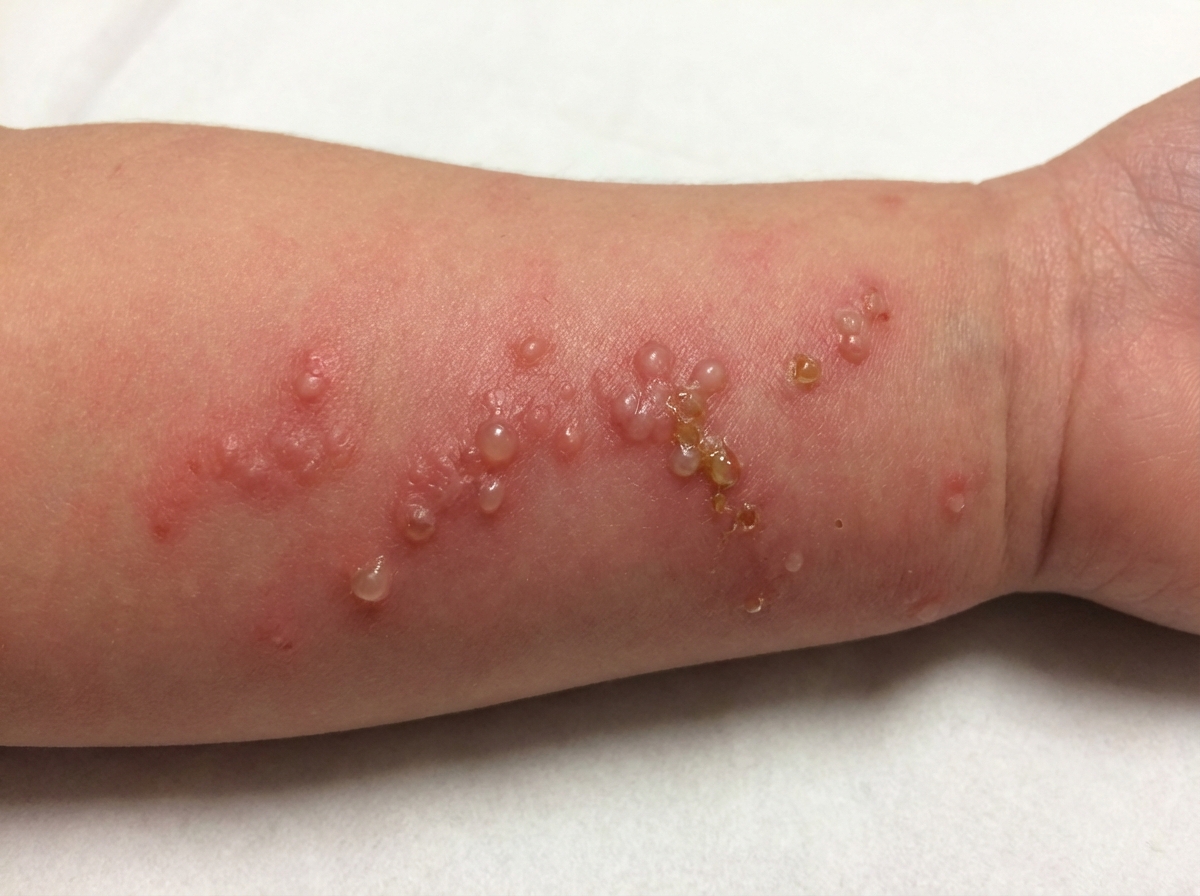
A 14-year-old boy comes to the physician because of an itchy rash on his right arm for 1 day. The rash started as small papules, then progressed into blisters with oozing. He has had atopic dermatitis at the age of 6 years. His vital signs are within normal limits. A photograph of the patient's arm is shown. There is no lymphadenopathy. Avoidance of contact with which of the following would most likely have prevented this patient's symptoms?
A 51-year-old white female presents to her primary care physician for a regular check-up. She endorses eating a healthy diet with a balance of meat and vegetables. She also states that she has a glass of wine each night with dinner. As part of the evaluation, a complete blood count and blood smear were performed and are remarkable for: Hemoglobin 8.7 g/dL, Hematocrit 27%, MCV 111 fL, and a smear showing macrocytes and several hypersegmented neutrophils. Suspecting an autoimmune condition with anti-intrinsic factor antibodies, what other finding might you expect in this patient?
Treatment with intravenous acyclovir is initiated. Three days later, the patient develops progressively worse fatigue, headache, and colicky pain in his right flank. His temperature is 36.7°C (98°F), pulse is 85/min, and blood pressure is 135/80 mm Hg. Examination shows no new lesions. Laboratory studies show: Hemoglobin 11.3 g/dL Serum Na+ 140 mEq/L Cl- 99 mEq/L K+ 5.5 mEq/L HCO3- 22 mEq/L Urea nitrogen 56 mg/dL Creatinine 3.2 mg/dL Which of the following is the most likely finding on urinalysis?
A 28-year-old man comes to the physician for the evaluation of five episodes of painful oral ulcers over the past year. During this period, he has also had two painful genital ulcers that healed without treatment. He reports frequently having diffuse joint pain, malaise, and low-grade fever. There is no personal or family history of serious illness. He emigrated to the US from Syria with his family four years ago. He is sexually active with one female partner and they do not use condoms. He takes no medications. His temperature is 38°C (100.4°F), pulse is 90/min, and blood pressure is 130/80 mm Hg. Physical examination shows three painful ulcers on the oral buccal mucosa. Pelvic examination shows that the external genitalia has several healing scars. The remainder of the examination shows no abnormalities. Which of the following is the most likely diagnosis?
A 67-year-old man presents to his primary care physician for abdominal pain. The patient states that he has had abdominal pain for the past month that has been steadily worsening. In addition, he endorses weight loss and general fatigue. The patient has a past medical history of obesity, diabetes, and hypertension. His current medications include metformin, insulin, and lisinopril. The patient is a current smoker and drinks roughly 3 drinks per day. His temperature is 99.5°F (37.5°C), blood pressure is 139/79 mmHg, pulse is 95/min, respirations are 17/min, and oxygen saturation is 98% on room air. The patient's cardiac and pulmonary exams are within normal limits. Examination of the patient's lower extremity reveals multiple tender palpable masses bilaterally that track linearly along the patient's lower extremity. Which of the following is the next best step in management?
Practice by Chapter
GERD and esophageal disorders
Practice Questions
Peptic ulcer disease
Practice Questions
Helicobacter pylori infection
Practice Questions
Celiac disease
Practice Questions
Irritable bowel syndrome
Practice Questions
Diverticular disease
Practice Questions
GI bleeding (upper and lower)
Practice Questions
Small intestinal bacterial overgrowth
Practice Questions
Malabsorption syndromes
Practice Questions
Colorectal cancer screening
Practice Questions
Functional GI disorders
Practice Questions
Anorectal disorders
Practice Questions
GI motility disorders
Practice Questions
Want unlimited practice?
Get full access to all questions, explanations, and performance tracking.
Scan to download app