
Gastroenterology — MCQs

On this page
A 28-year-old African American woman presents to her primary care physician with two weeks of nausea, abdominal pain, and increased urination. She states she has had kidney stones in the past and is concerned because her current pain is different in character from what she had experienced then. In addition she reports increasing weakness and fatigue over the past several months as well as mild shortness of breath. Chest radiography shows bilateral hilar adenopathy. Which of the following processes is most likely responsible for her current symptoms?
A 65-year-old man presents to the emergency department due to an episode of lightheadedness. The patient was working at his garage workbench when he felt like he was going to faint. His temperature is 98.8°F (37.1°C), blood pressure is 125/62 mmHg, pulse is 117/min, respirations are 14/min, and oxygen saturation is 98% on room air. Laboratory values are ordered as seen below. Hemoglobin: 7 g/dL Hematocrit: 22% Leukocyte count: 6,500/mm^3 with normal differential Platelet count: 197,000/mm^3 The patient is started on blood products and a CT scan is ordered. Several minutes later, his temperature is 99.5°F (37.5°C), blood pressure is 87/48 mmHg, and pulse is 180/min. The patient's breathing is labored. Which of the following is also likely to be true?
A 55-year-old woman with poorly controlled type 2 diabetes mellitus comes to the emergency department because of a 5-day history of a severely painful, blistering rash. The rash began over the right forehead, and spread to the chest, back, and bilateral upper extremities over the next 2 days. She is diagnosed with disseminated cutaneous herpes zoster and hospitalized for further management. Prior to admission, her only medication was insulin. On the second day of her stay, she develops bilateral episodic, cramping flank pain and nausea. Her temperature is 36.7°C (98°F), pulse is 80/min, and blood pressure is 128/76 mm Hg. Examination shows a healing rash over the forehead, chest, and extremities, with no evidence of new blisters. Her serum blood urea nitrogen is 33 mg/dL and serum creatinine is 3.5 mg/dL. On admission, her serum urea nitrogen was 18 mg/dL and her serum creatinine was 1.1 mg/dL. Which of the following is the most likely cause of this patient's laboratory findings?
A 43-year-old man comes to the physician because of nasal congestion and fatigue for 12 days. During this period, he has had fevers and severe pain over his cheeks. His nasal discharge was initially clear, but it has turned yellowish over the last couple of days. He has no visual complaints. He has been taking an over-the-counter nasal decongestant and acetaminophen without much relief. He has type 2 diabetes mellitus and hypertension. He underwent an appendectomy 23 years ago. He does not smoke or drink alcohol. His current medications include metformin, sitagliptin, and enalapril. He appears tired. His temperature is 38.5°C (101.3°F), pulse is 96/min, and blood pressure is 138/86 mm Hg. Examination shows purulent discharge in the nose and pharynx and normal appearing ears. The left maxillary sinus is tender to palpation. Laboratory studies show: Hemoglobin 14.6 g/dL Leukocyte count 10,800/mm3 Platelet count 263,000/mm3 ESR 22 mm/hr Serum Glucose 112 mg/dL Which of the following is the most appropriate next step in management?
A 50-year-old man presents to the emergency department complaining of blood in his stool. He reports that this morning he saw bright red blood in the toilet bowl. He denies fatigue, headache, weight loss, palpitations, constipation, or diarrhea. He has well-controlled hypertension and takes hydrochlorothiazide. His father has rheumatoid arthritis, and his mother has Graves disease. The patient’s temperature is 98°F (36.7°C), blood pressure is 128/78 mmHg, and pulse is 70/min. He appears well. No source for the bleeding is appreciated upon physical examination, including a digital rectal exam. A fecal occult blood test is positive. Which of the following is the most appropriate initial diagnostic test to rule out malignancy?
A 48-year-old woman is brought to the emergency department by police because of confusion and agitation. Her medical record indicates that she has peptic ulcer disease that is treated with omeprazole. The patient's brother arrives shortly after. He reports that she drinks around 17 oz. of vodka daily. Neurological examination shows horizontal nystagmus. Her gait is wide-based with small steps. Her hemoglobin concentration is 9.1 g/dL. A peripheral blood smear shows hypersegmented neutrophils. Homocysteine levels are elevated. Methylmalonic acid levels are within normal limits. Which of the following is the most likely direct cause of this patient's anemia?
A 45-year-old man comes to the physician because of severe left knee pain and swelling. He has hypercholesterolemia and hypertension. Current medications include pravastatin and captopril. He eats a low-fat diet that includes fish and leafy green vegetables. He drinks 4–6 cups of coffee daily. He has smoked one pack of cigarettes daily for 26 years and drinks 2–3 beers daily. Vital signs are within normal limits. Examination of the left knee shows swelling, warmth, and severe tenderness to palpation. Arthrocentesis is performed. Gram stain is negative. Analysis of the synovial fluid shows monosodium urate crystals. Which of the following health maintenance recommendations is most appropriate to prevent symptom recurrence?
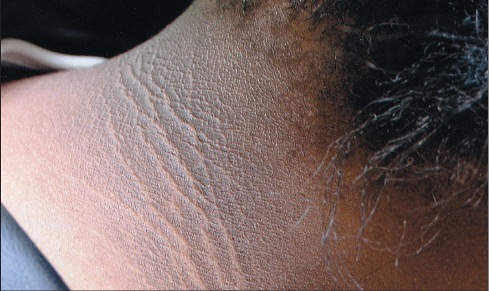
A 33-year-old man presents with a darkening of the skin on his neck over the past month. Past medical history is significant for primary hypothyroidism treated with levothyroxine. His vital signs include: blood pressure 130/80 mm Hg, pulse 84/min, respiratory rate 18/min, temperature 36.8°C (98.2°F). His body mass index is 35.3 kg/m2. Laboratory tests reveal a fasting blood glucose of 121 mg/dL and a thyroid-stimulating hormone level of 2.8 mcU/mL. The patient’s neck is shown in the exhibit. Which of the following is the best initial treatment for this patient?
A 33-year-old man presents to the emergency department with back pain. He is currently intoxicated but states that he is having severe back pain and is requesting morphine and lorazepam. The patient has a past medical history of alcohol abuse, drug seeking behavior, and IV drug abuse and does not routinely see a physician. His temperature is 102°F (38.9°C), blood pressure is 127/68 mmHg, pulse is 120/min, respirations are 17/min, and oxygen saturation is 98% on room air. Physical exam is notable for tenderness over the thoracic and lumbar spine. The pain is exacerbated with flexion of the spine. The patient’s laboratory values are notable for the findings below. Hemoglobin: 12 g/dL Hematocrit: 36% Leukocyte count: 16,500/mm^3 with normal differential Platelet count: 197,000/mm^3 Serum: Na+: 139 mEq/L Cl-: 100 mEq/L K+: 4.3 mEq/L HCO3-: 25 mEq/L BUN: 20 mg/dL Glucose: 99 mg/dL Creatinine: 1.1 mg/dL Ca2+: 10.2 mg/dL CRP: 5.2 mg/L Further imaging is currently pending. Which of the following is the most likely diagnosis?
A 35-year-old male with a history of hypertension presents with hematuria and abdominal discomfort. Ultrasound and CT scan reveal large, bilateral cysts in all regions of the kidney. What is the most likely diagnosis?
Practice by Chapter
GERD and esophageal disorders
Practice Questions
Peptic ulcer disease
Practice Questions
Helicobacter pylori infection
Practice Questions
Celiac disease
Practice Questions
Irritable bowel syndrome
Practice Questions
Diverticular disease
Practice Questions
GI bleeding (upper and lower)
Practice Questions
Small intestinal bacterial overgrowth
Practice Questions
Malabsorption syndromes
Practice Questions
Colorectal cancer screening
Practice Questions
Functional GI disorders
Practice Questions
Anorectal disorders
Practice Questions
GI motility disorders
Practice Questions
Want unlimited practice?
Get full access to all questions, explanations, and performance tracking.
Scan to download app