
Gastroenterology — MCQs

On this page
A 42-year-old man presents to clinic complaining of increasing difficulty climbing stairs and standing up from sitting in his chair. On exam you perceive his strength to be 5/5 distally, but only 3/5 in proximal muscle groups bilaterally. There is a distinctive rash on his upper eyelids and around his eyes. Examination of the fingers is most likely to reveal which of the following?
A 62-year-old man comes to the office complaining of dysphagia that started 4-5 months ago. He reports that he initially had difficulty swallowing only solid foods. More recently, he has noticed some trouble swallowing liquids. The patient also complains of fatigue, a chronic cough that worsens at night, and burning chest pain that occurs after he eats. He says that he has used over-the-counter antacids for "years" with mild relief. He denies any change in diet, but says he has "gone down a pant size or 2." The patient has hypertension and hyperlipidemia. He takes amlodipine and atorvastatin. He smoked 1 pack of cigarettes a day for 12 years while in the military but quit 35 years ago. He drinks 1-2 beers on the weekend while he is golfing with his friends. His diet consists mostly of pasta, pizza, and steak. The patient's temperature is 98°F (36.7°C), blood pressure is 143/91 mmHg, and pulse is 80/min. His BMI is 32 kg/m^2. Physical examination reveals an obese man in no acute distress. No masses or enlarged lymph nodes are appreciated upon palpation of the neck. Cardiopulmonary examination is unremarkable. An endoscopy is performed, which identifies a lower esophageal mass. Which of the following is the most likely diagnosis?
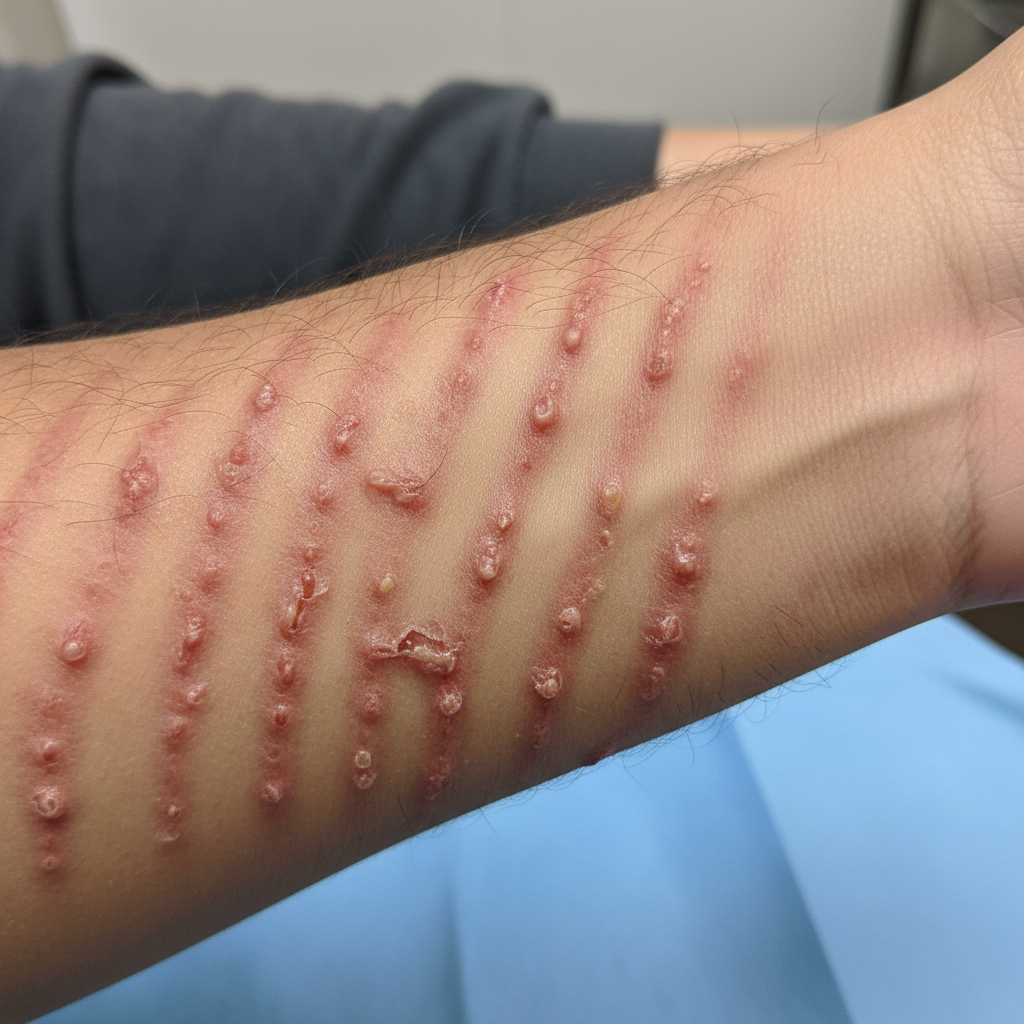
A 20-year-old man comes to the physician because of a 2-day history of a pruritic rash on both arms. He returned from a 2-week hiking trip in North Carolina 1 day ago. He has ulcerative colitis. He works as a landscape architect. His only medication is a mesalazine suppository twice daily. He has smoked a pack of cigarettes daily for 4 years and drinks one alcoholic beverage daily. He does not use illicit drugs. His temperature is 36.8°C (98.2°F), pulse is 65/min, respirations are 16/min, and blood pressure is 127/74 mm Hg. A photograph of the rash is shown. The remainder of the examination shows no abnormalities. Which of the following is the most appropriate next step in management?
A 40-year-old South Asian male presents to a primary care provider complaining of a chronic cough that is worse at night. Through a translator, he reports that he has had the cough for several years but that it has been getting worse over the last few months. He recently moved to the United States to work in construction. He attributes some weight loss of ten pounds in the last three months along with darker stools to difficulties adjusting to a Western diet. He denies any difficulty swallowing or feeling of food getting stuck in his throat. He drinks alcohol once or twice per week and has never smoked. He denies any family history of cancer. On physical exam, his lungs are clear to auscultation bilaterally without wheezing. His abdomen is soft and non-distended. He has no tenderness to palpation, and bowel sounds are present. He expresses concern that he will be fired from work if he misses a day and requests medication to treat his cough. Which of the following is the best next step in management?
A 17-year-old girl comes to the physician because of a 4-month history of fatigue. She has not had any change in weight. She had infectious mononucleosis 4 weeks ago. Menses occur at regular 28-day intervals and last 5 days with moderate flow. Her last menstrual period was 3 weeks ago. Her mother has Hashimoto thyroiditis. Examination shows pale conjunctivae, inflammation of the corners of the mouth, and brittle nails. The remainder of the examination shows no abnormalities. Laboratory studies show: Hemoglobin 10.3 g/dL Mean corpuscular volume 74 μm3 Platelet count 280,000/mm3 Leukocyte count 6,000/mm3 Which of the following is the most appropriate next step in evaluating this patient's illness?
A 56-year-old male with a history of hypertension, asthma, intravenous drug use, and recent incarceration 2 months ago presents to your office with an erythematous, itchy rash on his arms and chest. He does not recall exactly when the rash first started but he believes it was several days ago. Review of symptoms is notable for cough, runny nose, and diarrhea for several weeks. He is currently taking medications for a cough that he developed while he was incarcerated. He does not know the name of his medications and does not remember his diagnosis. Temperature is 99°F (37.2°C), blood pressure is 145/90 mmHg, pulse is 90/min, respirations are 20/min. He has difficulty remembering his history and appears thin. There is a scaly, symmetrical rash on his arms and neck with areas of dusky brown discoloration. He has mild abdominal tenderness to palpation but no rebound or guarding. Physical exam is otherwise unremarkable. Which of the following is associated with this disease syndrome?
A 71-year-old man presents to his primary care physician with complaints of fatigue, weight loss, and early satiety for 3 weeks. Before this, he felt well overall. He is a former smoker, but otherwise has no past medical history. On examination, the patient appears fatigued and thin; his stool is guaiac positive. He is referred to a gastroenterologist who performs an esophagogastroduodonoscopy that reveals a mass in the antrum of the stomach. Pathology consistent with adenocarcinoma. Which of the following is the most appropriate next step in management?
A 19-year-old recent ROTC male recruit presents to the university clinic with left foot pain. He reports that the pain started a week ago while running morning drills. The pain will improve with rest but will occur again during exercises or during long periods of standing. He denies any recent trauma. His medical history is significant for partial color blindness. He has no other chronic medical conditions and takes no medications. He denies any surgical history. His family history is significant for schizophrenia in his father and breast cancer in his mother. He denies tobacco, alcohol, or illicit drug use. On physical examination, there is tenderness to palpation of the second metatarsal of the left foot. A radiograph of the left foot shows no abnormalities. Which of the following is the best next step in management?
A 28-year-old male presents to his primary care physician with complaints of intermittent abdominal pain and alternating bouts of constipation and diarrhea. His medical chart is not significant for any past medical problems or prior surgeries. He is not prescribed any current medications. Which of the following questions would be the most useful next question in eliciting further history from this patient?
A 26-year-old female with AIDS (CD4 count: 47) presents to the emergency department in severe pain. She states that over the past week she has been fatigued and has had a progressively worse headache and fever. These symptoms have failed to remit leading her to seek care in the ED. A lumbar puncture is performed which demonstrates an opening pressure of 285 mm H2O, increased lymphocytes, elevated protein, and decreased glucose. The emergency physician subsequently initiates treatment with IV amphotericin B and PO flucytosine. What additional treatment in the acute setting may be warranted in this patient?
Practice by Chapter
GERD and esophageal disorders
Practice Questions
Peptic ulcer disease
Practice Questions
Helicobacter pylori infection
Practice Questions
Celiac disease
Practice Questions
Irritable bowel syndrome
Practice Questions
Diverticular disease
Practice Questions
GI bleeding (upper and lower)
Practice Questions
Small intestinal bacterial overgrowth
Practice Questions
Malabsorption syndromes
Practice Questions
Colorectal cancer screening
Practice Questions
Functional GI disorders
Practice Questions
Anorectal disorders
Practice Questions
GI motility disorders
Practice Questions
Want unlimited practice?
Get full access to all questions, explanations, and performance tracking.
Scan to download app