
Transcription/translation — MCQs

On this page
An investigator is studying the effects of zinc deprivation on cancer cell proliferation. It is hypothesized that because zinc is known to be a component of transcription factor motifs, zinc deprivation will result in slower tumor growth. To test this hypothesis, tumor cells are cultured on media containing low and high concentrations of zinc. During the experiment, a labeled oligonucleotide probe is used to identify the presence of a known transcription factor. The investigator most likely used which of the following laboratory techniques?
E. coli has the ability to regulate its enzymes to break down various sources of energy when available. It prevents waste by the use of the lac operon, which encodes a polycistronic transcript. At a low concentration of glucose and absence of lactose, which of the following occurs?
An investigator is following a 4-year-old boy with Duchenne muscular dystrophy. Western blot of skeletal muscle cells from this boy shows that the dystrophin protein is significantly smaller compared to the dystrophin protein of a healthy subject. Further evaluation shows that the boy's genetic mutation involves a sequence that normally encodes leucine. The corresponding mRNA codon has the sequence UUG. Which of the following codons is most likely present in this patient at the same position of the mRNA sequence?
A 62-year-old man with small cell lung cancer undergoes radiation therapy. His oncologist explains that radiation causes DNA damage and double strand breaks and this damage stops the cancer cells from growing because they can no longer replicate their DNA. One key mediator of this process is a cell cycle regulator called P53, which is upregulated after DNA damage and helps to trigger cell cycle arrest and apoptosis. One mechanism by which P53 activity is increased is a certain chromatin modification that loosens DNA coiling allowing for greater transcription of the proteins within that region of DNA. Which of the following enzymes most likely causes the chromatin modification described in this case?
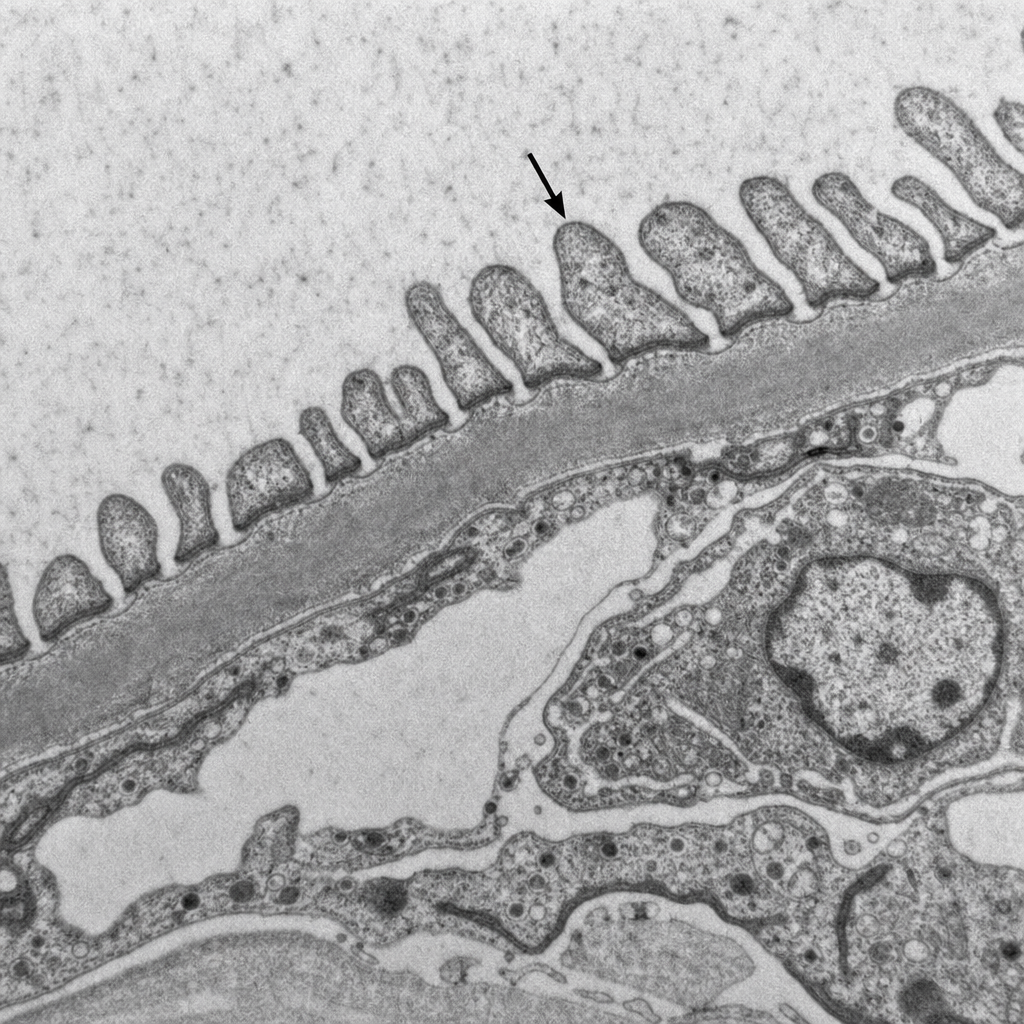
A 12-year-old male presents to the emergency department following several days of facial edema. A urinalysis confirms proteinuria and hematuria. Once admitted, a kidney biopsy is viewed under an electron microscope to confirm the diagnosis of minimal change disease. In the following electron micrograph, what process occurs in the structure marked with an arrow?
A group of investigators is studying the effects of aberrant protein isoforms on the pathogenesis of lung cancer. They observe that three protein isoforms are transcribed from the same 30,160 base-pair-long DNA segment on chromosome 13q. The canonical protein has a primary peptide sequence of 1186 amino acids. The second isoform has 419 amino acids and 100% amino acid sequence homology with the canonical protein. The third isoform has 232 amino acids and 92% amino acid sequence homology with the canonical protein. Which of the following is most likely responsible for the observed phenomenon?
An 8-year-old boy is brought to the physician by his parents for blurry vision for the past 2 months. He is at the 97th percentile for height and 25th percentile for weight. Physical examination shows joint hypermobility, a high-arched palate, and abnormally long, slender fingers and toes. Slit lamp examination shows superotemporal lens subluxation bilaterally. This patient's findings are most likely caused by a defect in which of the following structural proteins?
An investigator is studying gene expression in a mouse model. She inactivates the assembly of small nuclear ribonucleoproteins (snRNPs) in motor nerve cells. Which of the following processes is most likely to be affected as a result?
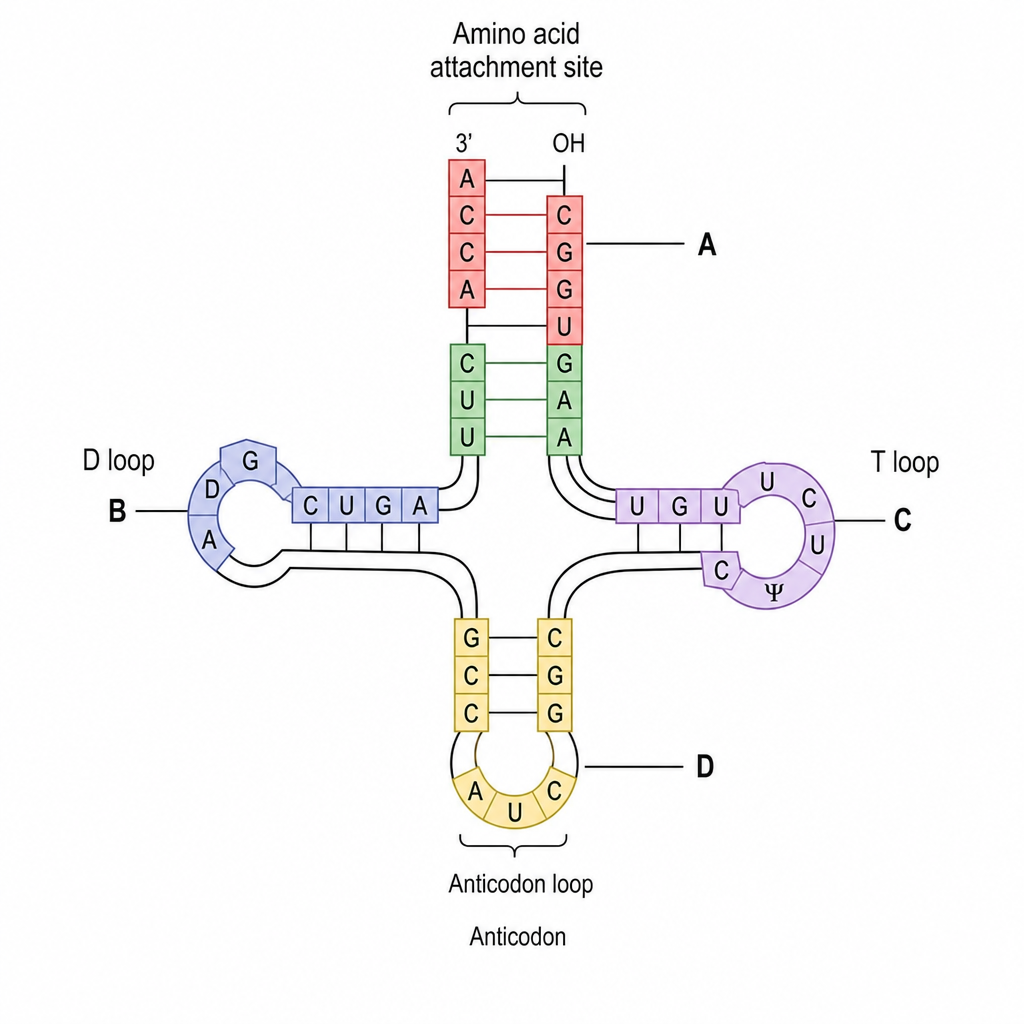
A group of scientists is studying the molecular mechanisms of protein synthesis. In the picture is the theoretical structure for tRNA. Where is the binding site for an amino acid?
A 24-year-old man is brought to the emergency department by his brother because of a 3-hour history of lethargy and confusion. The brother says that 2 days ago, the patient ate several large-capped mushrooms he had foraged in the woods. After eating the mushrooms, he developed severe, bloody diarrhea that has since resolved. His pulse is 140/min, respirations are 26/min, and blood pressure is 98/62 mm Hg. Examination shows dry mucous membranes and tenderness to deep palpation in the right upper quadrant. Serum studies show a serum AST concentration of 2335 U/L and ALT concentration of 2294 U/L. Inhibition of which of the following processes is the most likely cause of this patient's condition?
Practice by Chapter
RNA polymerase structure and function
Practice Questions
Promoters and transcription factors
Practice Questions
Initiation of transcription
Practice Questions
Elongation and termination of transcription
Practice Questions
Post-transcriptional modifications
Practice Questions
RNA splicing and alternative splicing
Practice Questions
Translation initiation
Practice Questions
Elongation and termination of translation
Practice Questions
Post-translational modifications
Practice Questions
Protein folding and chaperones
Practice Questions
Regulation of gene expression
Practice Questions
Epigenetic mechanisms
Practice Questions
RNA interference and microRNAs
Practice Questions
Want unlimited practice?
Get full access to all questions, explanations, and performance tracking.
Scan to download app