
Pediatric Surgery — MCQs

On this page
All are features of congenital megacolon except:
Congenital megacolon is confirmed by:
A newborn suffering from perforated necrotizing enterocolitis is having very poor general condition. He is currently stabilized on ventilator. Which of the following should be done in the management of this patient?
A 12-year-old male is admitted to the hospital with profuse rectal bleeding but appears to be free of any associated pain. Which of the following is the most common cause of severe rectal bleeding in the pediatric age group?
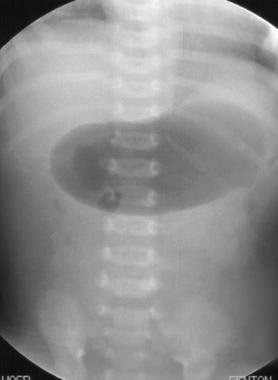
A 1-week-old previously healthy infant presents to the emergency room with the acute onset of bilious vomiting. The abdominal plain film in the emergency department (A) and the barium enema done after admission (B) are shown. Which of the following is the most likely diagnosis for this patient?
A 6 year old girl presents with Recurrent E.coli infection in urine. Ultrasound of abdomen shows Hydroureter and Hydronephrosis. Micturating cystourethrogram shows filling defect in urinary bladder. The likely diagnosis is –
A 6 year old boy has been complaining of headache, failing to notice objects on the sides for four months. On examination he is not mentally retarded, his grades at school are good, and visual acuity is diminished in both the eyes. Visual field testing showed significant field defect. CT scan of the head showed suprasellar mass with calcification. Which of the following is the most probable diagnosis?
Tumor involves inferior vena cava, what is the staging of Wilms tumour?
A 5-month old child rushed into hospital with complaint of colicky pain, bilious vomiting and red current jelly like appearance of stools. On examination, there was a sausage shaped mass in the right lumbar region. Which of the following is the preferred modality that is used as both diagnostic and therapeutic?
Most common cause of urinary obstruction in a male infant is -
Practice by Chapter
Neonatal Physiology
Practice Questions
Congenital Anomalies Overview
Practice Questions
Neonatal Intestinal Obstruction
Practice Questions
Necrotizing Enterocolitis
Practice Questions
Hirschsprung's Disease
Practice Questions
Anorectal Malformations
Practice Questions
Pediatric Hernias
Practice Questions
Pyloric Stenosis
Practice Questions
Biliary Atresia
Practice Questions
Pediatric Tumors
Practice Questions
Congenital Diaphragmatic Hernia
Practice Questions
Pediatric Trauma
Practice Questions
Want unlimited practice?
Get full access to all questions, explanations, and performance tracking.
Scan to download app