
Gastrointestinal Surgery — MCQs

On this page
A 38-year-old man with Crohn's disease presents with a 3-day history of increasing abdominal pain, distension, and inability to pass gas or stool. CT shows dilated small bowel loops with a transition point in the terminal ileum and bowel wall thickening. What factor most influences the decision between conservative and surgical management?
A 28-year-old woman presents with right lower quadrant pain, nausea, and fever. CT shows appendiceal wall thickening and fat stranding. Her white blood cell count is 13,000/μL with 85% neutrophils. However, she is 12 weeks pregnant. What is the most appropriate management considering the clinical scenario?
A 28-year-old pregnant woman at 32 weeks gestation presents with acute appendicitis. She is hemodynamically stable but has significant right lower quadrant pain and leukocytosis. The obstetric team is concerned about preterm labor risk, while the surgical team recommends immediate appendectomy. Synthesize the risks and benefits to determine the optimal management approach.
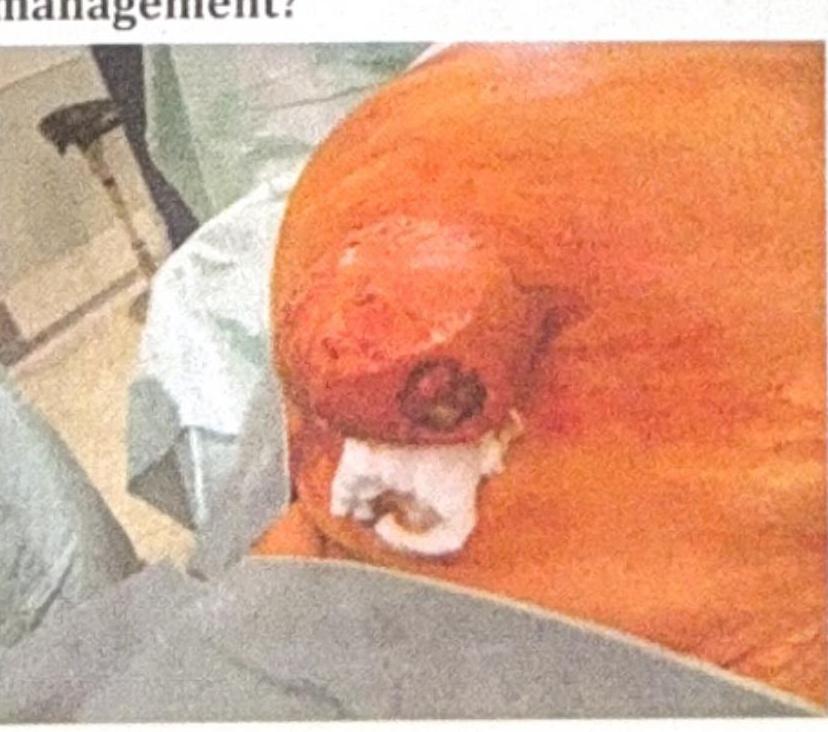
A patient presents with an umbilical mass, which was previously reducible but has now become irreducible with discharge coming out, as shown in the image. What is the most appropriate management?
Which of the following is not seen with ileal resections?
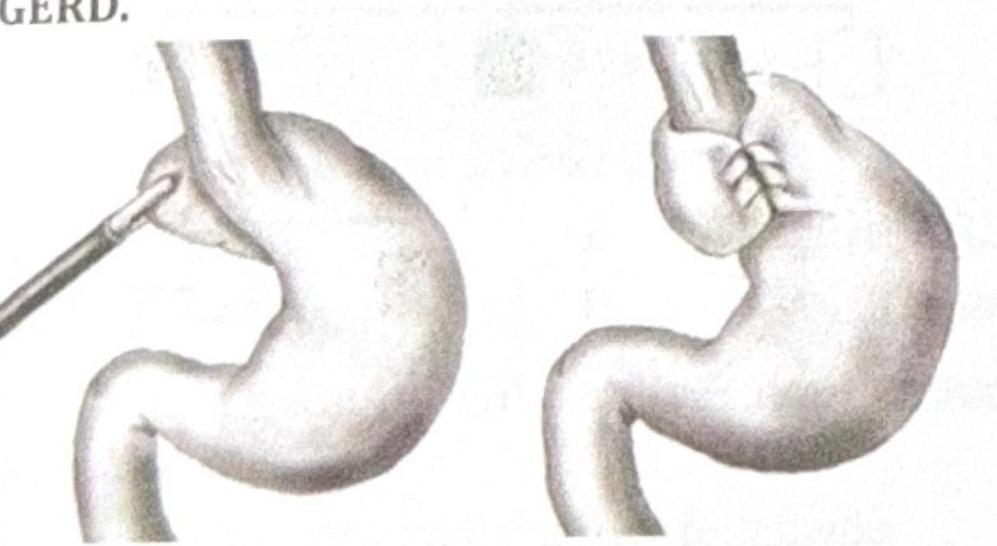
Identify the procedure shown in the image, which is performed in a patient with recurrent GERD.
Which of the following is the most commonly performed repair for a direct inguinal hernia?
A surgeon examined the case of hernia. Forcefully reduces the sac in abdominal cavity, without actually pushing back the contents. Identify the type of hernia.
A 23-year-old man presents to the emergency department with bloody vomitus. The patient is an alcoholic and has presented similarly before. He is given ondansetron; however, he continues to vomit. The patient complains of sudden substernal chest pain and dysphagia after another bout of vomiting. His temperature is 99°F (37.2°C), blood pressure is 117/60 mmHg, pulse is 122/min, respirations are 15/min, and oxygen saturation is 99% on room air. Physical exam is notable for an uncomfortable man with subcutaneous emphysema in the patient’s neck and supraclavicular areas. Which of the following is the most likely diagnosis?
A 25-year-old man presents to his gastroenterologist for trouble swallowing. The patient states that whenever he eats solids, he regurgitates them back up. Given this patient's suspected diagnosis, the gastroenterologist performs a diagnostic test. Several hours later, the patient presents to the emergency department with chest pain and shortness of breath. His temperature is 99.5°F (37.5°C), blood pressure is 130/85 mmHg, pulse is 60/min, respirations are 12/min, and oxygen saturation is 99% on room air. On physical exam, the patient demonstrates a normal cardiopulmonary exam. His physical exam demonstrates no tenderness of the neck, a normal oropharynx, palpable crepitus above the clavicles, and minor lymphadenopathy. Which of the following is the best next step in management?
Practice by Chapter
Esophageal Disorders
Practice Questions
Gastric Disorders
Practice Questions
Small Intestine Pathology
Practice Questions
Appendicitis
Practice Questions
Inflammatory Bowel Disease
Practice Questions
Intestinal Obstruction
Practice Questions
Gastrointestinal Bleeding
Practice Questions
Diverticular Disease
Practice Questions
Anorectal Disorders
Practice Questions
Colorectal Neoplasms
Practice Questions
Gastrointestinal Stomas
Practice Questions
Bariatric Surgery Principles
Practice Questions
Want unlimited practice?
Get full access to all questions, explanations, and performance tracking.
Scan to download app