Adrenal reserve is best tested by means of infusion with
What is the recommended time frame for completing a blood transfusion after initiation?
What is the recommended rate of correction for sodium deficit in patients with chronic hyponatremia?
Graham Steell murmur is associated with which of the following conditions?
Deep vein thrombosis most commonly occurs at which site?
Decreased CVP is seen in
What condition is associated with Lemierre's syndrome?
Absent P Wave is seen on an ECG in:
Torsades de pointes is seen in all except
Which of the following statements is true regarding the diagnostic criteria for Chronic Obstructive Pulmonary Disease (COPD)?
NEET-PG 2013 - Internal Medicine NEET-PG Practice Questions and MCQs
Question 101: Adrenal reserve is best tested by means of infusion with
- A. ACTH (Correct Answer)
- B. Metyrapone
- C. Corticosteroids
- D. LHRH
Explanation: ACTH - The **ACTH stimulation test**, also known as the **cosyntropin test**, is the most common dynamic test for assessing adrenal reserve. - Exogenous ACTH (cosyntropin) stimulates the adrenal glands to produce cortisol; a subnormal response indicates adrenal insufficiency. *Corticosteroids* - **Corticosteroids** are hormones (like cortisol) produced by the adrenal glands, or synthetic versions used as medications; they do not test adrenal reserve but rather *replace* adrenal function. - Administering corticosteroids would interfere with, rather than assess, the adrenal gland's ability to produce its own hormones. *LHRH* - **Luteinizing hormone-releasing hormone (LHRH)** is used to assess the function of the anterior pituitary gland and gonads, not the adrenal glands. - An LHRH stimulation test evaluates the pituitary's ability to release LH and FSH, which in turn stimulate gonadal hormone production. *Metyrapone* - The **metyrapone test** assesses the integrity of the **hypothalamic-pituitary-adrenal axis** by blocking cortisol synthesis, which should lead to an increase in ACTH and 11-deoxycortisol [1]. - While it evaluates a part of adrenal function, it is primarily used to differentiate between primary and secondary adrenal insufficiency, and not a direct measure of cortisol production capacity in response to stimulation.
Question 102: What is the recommended time frame for completing a blood transfusion after initiation?
- A. 1-4 hours (Correct Answer)
- B. 3-6 hours
- C. 4-8 hours
- D. 8-12 hours
Explanation: ***1-4 hours*** - This timeframe is recommended to **minimize the risk of bacterial growth** in the blood product, as bacteria can multiply quickly at room temperature. - Completing the transfusion within 4 hours also reduces the likelihood of **red blood cell degeneration** and loss of efficacy. *3-6 hours* - This period extends beyond the recommended maximum of 4 hours, increasing the risk of **bacterial proliferation** in the blood product. - Prolonged infusion times can also lead to a **decrease in the viability and function** of transfused cells. *4-8 hours* - Transfusing over 4-8 hours significantly elevates the risk of **bacterial contamination** and potential septic reactions. - The extended duration compromises the **quality and safety** of the blood product. *8-12 hours* - This timeframe is unacceptably long for a blood transfusion, posing a **critical risk of severe bacterial growth** and infection. - Blood products should not be administered beyond 4 hours due to the rapid decline in **cell integrity and increased adverse reaction potential**.
Question 103: What is the recommended rate of correction for sodium deficit in patients with chronic hyponatremia?
- A. 0.5 mmol/hour (Correct Answer)
- B. 1 mmol/hour
- C. 1.5 mmol/hour
- D. 2.0 mmol/hour
Explanation: ***0.5 mmol/hour*** [1] - This rate of correction is recommended to avoid **osmotic demyelination syndrome (ODS)**, also known as central pontine myelinolysis [1]. - The aim is to correct the sodium deficit gradually, with a maximum increase not exceeding **8-10 mmol/L in any 24-hour period** [1]. *1 mmol/hour* - This rate is generally considered too rapid for chronic hyponatremia and increases the risk of **osmotic demyelination syndrome**. - While acceptable in some acute severe cases, it is typically avoided in chronic settings where the brain has adapted to lower osmolality. *1.5 mmol/hour* - This rate would lead to an even faster correction of sodium, significantly elevating the risk of **osmotic demyelination syndrome**. - It would result in a correction of 36 mmol/L over 24 hours, far exceeding the recommended daily limit of 8-10 mmol/L. *2.0 mmol/hour* - Such a rapid correction rate is highly dangerous and almost guarantees the development of **osmotic demyelination syndrome**. - This aggressive correction would lead to severe brain injury due to rapid osmotic shifts.
Question 104: Graham Steell murmur is associated with which of the following conditions?
- A. Pulmonary Regurgitation (PR) (Correct Answer)
- B. Tricuspid Regurgitation (TR)
- C. Tricuspid Stenosis (TS)
- D. Pulmonary Stenosis (PS)
Explanation: ***Pulmonary Regurgitation (PR)*** - The **Graham Steell murmur** is a high-pitched, decrescendo early diastolic murmur heard best at the left sternal border associated with **pulmonary hypertension**. [1] - It results from dilation of the pulmonary artery due to **elevated pulmonary pressures**, leading to functional pulmonary valve regurgitation. [1] *Tricuspid Regurgitation (TR)* - TR typically presents as a **holosystolic murmur** best heard at the left lower sternal border, often increasing with inspiration (Carvallo's sign). - It is caused by improper coaptation of the tricuspid valve leaflets, often due to **right ventricular dilation**. *Tricuspid Stenosis (TS)* - TS is characterized by a **diastolic rumble** heard best at the lower left sternal border, often with an opening snap. [2] - It is relatively rare and often associated with **rheumatic heart disease**. *Pulmonary Stenosis (PS)* - PS typically produces a **systolic ejection murmur** heard at the upper left sternal border, often radiating to the back. - It is caused by **obstruction to blood flow** from the right ventricle to the pulmonary artery.
Question 105: Deep vein thrombosis most commonly occurs at which site?
- A. Femoral vein (Correct Answer)
- B. Subclavian vein
- C. External jugular vein
- D. Internal jugular vein
Explanation: ***Femoral vein*** - The **femoral vein**, along with the **popliteal** and **iliac veins**, are the most common sites for **deep vein thrombosis (DVT)** in the lower extremities [1]. - Due to their size and the dynamics of blood flow in these regions, they are prone to clot formation, especially in the presence of **Virchow's triad**. *Subclavian vein* - While DVT can occur in the subclavian vein (an **upper extremity DVT**), it is less common than in the lower extremities [1]. - Upper extremity DVTs are often associated with **central venous catheters** or **thoracic outlet syndrome**. *External jugular vein* - **External jugular vein thrombosis** is rare and usually associated with local trauma, infection, or central line placement, not typically primary DVT [1]. - It is a superficial vein and not considered a common site for typical deep vein thrombosis. *Internal jugular vein* - **Internal jugular vein thrombosis** is also uncommon as a primary DVT and often secondary to neck infections, malignancies, or indwelling catheters [1]. - Like the subclavian vein, it's considered an upper extremity DVT site, but less frequent than lower extremity sites.
Question 106: Decreased CVP is seen in
- A. PEEP
- B. Bacterial sepsis (Correct Answer)
- C. Heart failure
- D. Pneumothorax
Explanation: ***Bacterial sepsis*** - In **sepsis**, widespread **vasodilation** and increased capillary permeability lead to significant fluid redistribution out of the intravascular space [3]. - This results in a decrease in **venous return** and thus a lower **central venous pressure (CVP)** due to relative hypovolemia [2]. *Pneumothorax* - A **pneumothorax** causes increased intrathoracic pressure, compressing the great veins and heart. - This leads to **reduced venous return** and typically an *increase* in CVP, or at least a minimal change, due to obstructed outflow from the right atrium, not a decrease [2]. *PEEP* - **Positive end-expiratory pressure (PEEP)** increases intrathoracic pressure, which impedes venous return to the right atrium [2]. - This elevated pressure can artificially *increase* the measured CVP reading, and it does not typically cause a decrease in intrinsic CVP [2]. *Heart failure* - In **heart failure**, particularly right-sided heart failure or biventricular failure, the heart's pumping efficiency is reduced [1]. - This leads to **venous congestion** and an *increase* in CVP due to fluid overload and the inability of the right ventricle to effectively pump blood forward [2].
Question 107: What condition is associated with Lemierre's syndrome?
- A. Carotid sinus aneurysm
- B. Traumatic occlusion of IJV
- C. Any of the above
- D. Thrombophlebitis of IJV (Correct Answer)
Explanation: ***Thrombophlebitis of IJV*** - **Lemierre's syndrome** is classically defined as **septic thrombophlebitis of the internal jugular vein (IJV)** following an oropharyngeal infection [1]. - The infection, most commonly caused by *Fusobacterium necrophorum*, spreads from the pharynx to the parapharyngeal space, leading to IJV inflammation and thrombosis [1]. *Carotid sinus aneurysm* - A **carotid sinus aneurysm** is an abnormal focal dilation of the carotid sinus, often associated with atherosclerosis or connective tissue disorders. - It is not directly linked to the pathogenesis or complications of **Lemierre's syndrome**. *Traumatic occlusion of IJV* - **Traumatic occlusion of the IJV** results from direct injury to the neck, leading to vessel compression or damage. - While it affects the IJV, it does not involve the septic thrombophlebitis or preceding oropharyngeal infection characteristic of **Lemierre's syndrome**. *Any of the above* - This option is incorrect because **Lemierre's syndrome** is specifically associated with **septic thrombophlebitis of the IJV**, not with other unrelated vascular conditions affecting the neck.
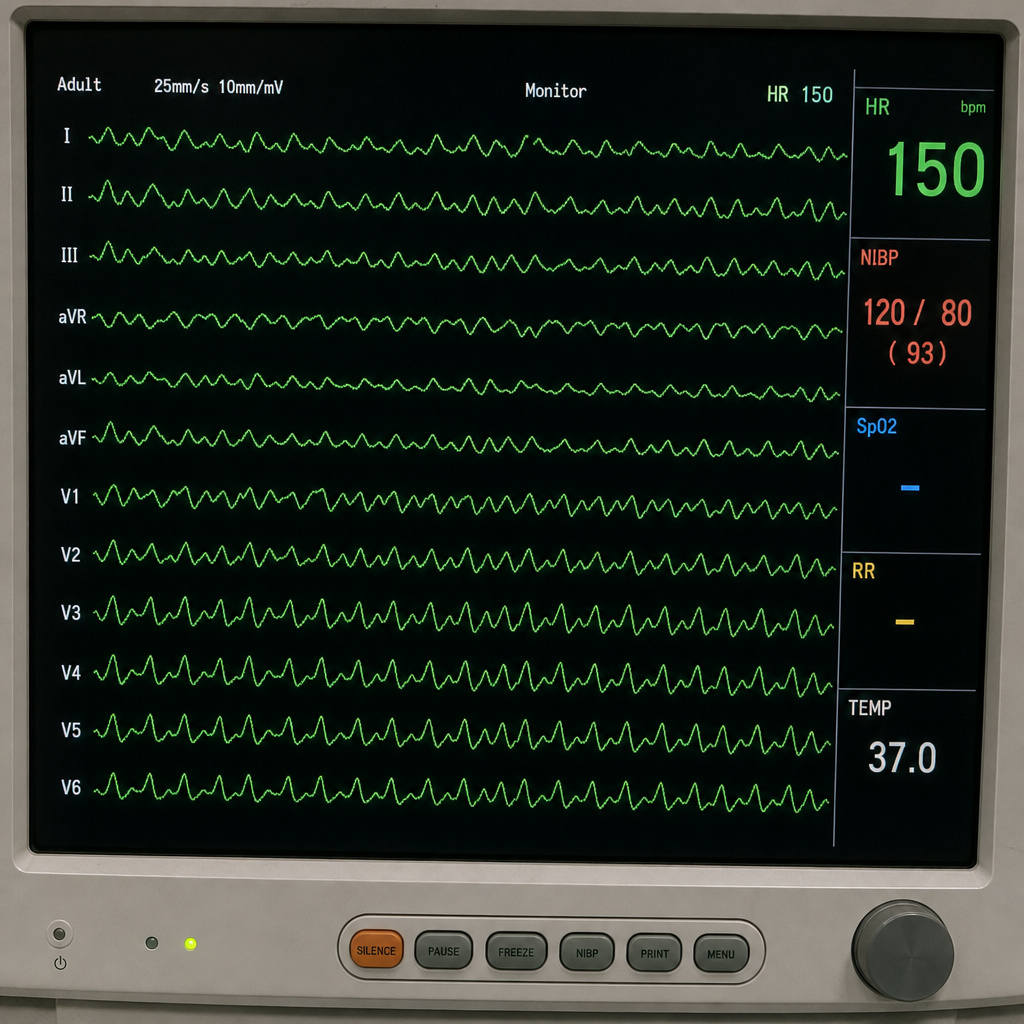
Question 108: Absent P Wave is seen on an ECG in:
- A. Cor Pulmonale
- B. Mitral Stenosis
- C. Chronic Obstructive Pulmonary Disease (COPD)
- D. Atrial Fibrillation (AF) (Correct Answer)
Explanation: ***Atrial Fibrillation (AF)*** - In **atrial fibrillation**, the atria beat chaotically and irregularly, leading to the absence of coordinated **atrial depolarization**, thus no distinct P wave is seen [1]. - The ECG characteristically shows an **irregularly irregular rhythm** with narrow QRS complexes and no discernible P waves. *Cor Pulmonale* - Cor pulmonale involves right ventricular hypertrophy and dilation due to lung disease, which can cause peaked **P waves (P pulmonale)** in leads II, III, aVF, indicating right atrial enlargement. - It does not typically lead to the absence of P waves but rather changes in their morphology. *Mitral Stenosis* - **Mitral stenosis** can cause left atrial enlargement, which typically manifests as a broad, notched **P wave (P mitrale)**, especially in lead II, and a prominent negative phase in V1. - P waves are present but altered in appearance due to the increased atrial pressure and volume. *Chronic Obstructive Pulmonary Disease (COPD)* - Patients with **COPD** often show signs of right atrial enlargement, similar to cor pulmonale, resulting in **P pulmonale** on the ECG due to increased pulmonary pressures. - While other ECG changes like low voltage and right axis deviation may be present, the P wave is generally present, though often peaked.
Question 109: Torsades de pointes is seen in all except
- A. Hyponatremia (Correct Answer)
- B. Hypomagnesemia
- C. Hypokalemia
- D. Hypocalcemia
Explanation: ***Hyponatremia*** - **Hyponatremia** (low sodium levels) primarily affects neuronal function and can lead to neurological symptoms like seizures and altered mental status [1]. - It does not directly cause **QT prolongation** or **Torsades de Pointes (TdP)**, which are typically associated with electrolyte imbalances affecting cardiac repolarization. *Hypocalcemia* - **Hypocalcemia** (low calcium levels) can prolong the **QT interval** on an electrocardiogram. - Prolongation of the QT interval increases the risk of developing **Torsades de Pointes**, a life-threatening polymorphic ventricular tachycardia [2]. *Hypomagnesemia* - **Hypomagnesemia** (low magnesium levels) is a common cause and aggravator of **Torsades de Pointes**. - Magnesium plays a crucial role in cardiac ion channel function, and its deficiency can lead to significant **QT prolongation** and ventricular arrhythmias. *Hypokalemia* - **Hypokalemia** (low potassium levels) can prolong the **QT interval** and increase the risk of developing ventricular arrhythmias, including **Torsades de Pointes** [1]. - Potassium channels are essential for cardiac repolarization, and their dysfunction due to low potassium can destabilize myocardial electrical activity [1].
Question 110: Which of the following statements is true regarding the diagnostic criteria for Chronic Obstructive Pulmonary Disease (COPD)?
- A. A post-bronchodilator FEV1/FVC ratio above the threshold indicates normal lung function.
- B. A post-bronchodilator FEV1/FVC ratio below the threshold indicates airflow limitation. (Correct Answer)
- C. Residual Volume (RV) is normal.
- D. Total Lung Capacity (TLC) is decreased.
Explanation: ***A post-bronchodilator FEV1/FVC ratio below the threshold indicates airflow limitation.*** [1] - This is the **hallmark diagnostic criterion** for COPD, confirming persistent **airflow obstruction** that is not fully reversible. [1] - The threshold typically used is **< 0.70** or below the **fifth percentile** of the lower limit of normal (LLN). *A post-bronchodilator FEV1/FVC ratio above the threshold indicates normal lung function.* - An FEV1/FVC ratio **above the threshold** indicates the absence of significant **airflow obstruction**, but does not automatically guarantee normal lung function as other parameters like **FEV1** could be affected. - This measurement would suggest a **restrictive lung disease** or **normal lung function**, depending on other spirometry values. *Residual Volume (RV) is normal.* - In COPD, **air trapping** due to airflow obstruction leads to an **increased Residual Volume (RV)**, not a normal RV. - An elevated RV reflects **hyperinflation** of the lungs, a characteristic feature of emphysema and chronic bronchitis. *Total Lung Capacity (TLC) is decreased.* - COPD is characterized by **hyperinflation**, which typically results in an **increased Total Lung Capacity (TLC)** as the lungs become more distended. - A **decreased TLC** would be indicative of a **restrictive lung disease**, which is different from obstructive patterns seen in COPD.