The commonest site of aspiration of a foreign body in the supine position is into the:
Which arteries supply the talus?
Identify the type of connective tissue present in the image.
Which nerve is primarily involved in cubital tunnel syndrome?
Unable to consolidate long-term memory. Which lobe of the brain is involved?
Which of the following statements about the popliteus muscle is false?
The tensor veli palatini muscle is innervated by which nerve?
In a 3 month fetus, characteristic feature seen is:
NEET-PG 2012 - Anatomy NEET-PG Practice Questions and MCQs
Question 91: The commonest site of aspiration of a foreign body in the supine position is into the:
- A. Right upper lobe apical
- B. Left basal
- C. Right middle lobe medial segment
- D. Right lower lobe superior segment (Correct Answer)
Explanation: ***Right lower lobe superior segment*** - When an individual is in the **supine position**, the most dependent portion of the lung (where gravity would pull aspirated material) is the **superior segment of the right lower lobe**. - This anatomical orientation, combined with the **wider and more vertical right main bronchus**, increases the likelihood of aspirated foreign bodies entering and settling in this specific segment. - The superior segment of the right lower lobe is **posteriorly located** and becomes the most dependent when lying supine. *Right upper lobe apical* - While the right upper lobe is on the favored side for aspiration due to the anatomy of the main bronchi, the **apical segment** is not the most dependent in the supine position. - Aspiration into the apical segment is generally less common than into more dependent segments when lying flat. *Left basal* - The **left main bronchus** is narrower and takes a more acute angle compared to the right, making aspiration into the left lung less common. - Even if aspiration were to occur in the left lung, the **basal segments** are not the most dependent in the supine position. *Right middle lobe medial segment* - The medial segment of the middle lobe is **not as posteriorly positioned** as the superior segment of the right lower lobe in the supine position. - While aspiration can occur into the middle lobe, it is **less common** than into the superior segment of the right lower lobe when supine due to the anatomical positioning and gravity effects.
Question 92: Which arteries supply the talus?
- A. Peroneal artery
- B. Posterior tibial artery
- C. Anterior tibial artery
- D. All of the options (Correct Answer)
Explanation: ***All of the options*** - The **talus** has a tenuous blood supply due to its limited muscular attachments, receiving contributions from multiple surrounding arteries to ensure adequate perfusion. - The **anterior tibial artery**, **posterior tibial artery**, and **peroneal artery** all contribute branches that form an anastomotic network around the talus. *Anterior tibial artery* - The **anterior tibial artery** contributes blood supply to the talus primarily through its **dorsal pedis branch** and ascending branches that supply the neck and head of the talus. - Its major role is in supplying the **anterior and superior talar surfaces**. *Posterior tibial artery* - The **posterior tibial artery** is a significant source of blood supply, particularly to the body and posterior aspect of the talus, via branches like the **artery of the tarsal canal** and the **deltoid branch**. - Its branches contribute to the **posterior talar artery network** which is crucial for the central part of the talus. *Peroneal artery* - The **peroneal artery** provides blood supply to the lateral and posterior parts of the talus through its **communicating branch** and perforating branches. - It contributes to the **tarsal artery network**, ensuring collateral circulation to the talus.
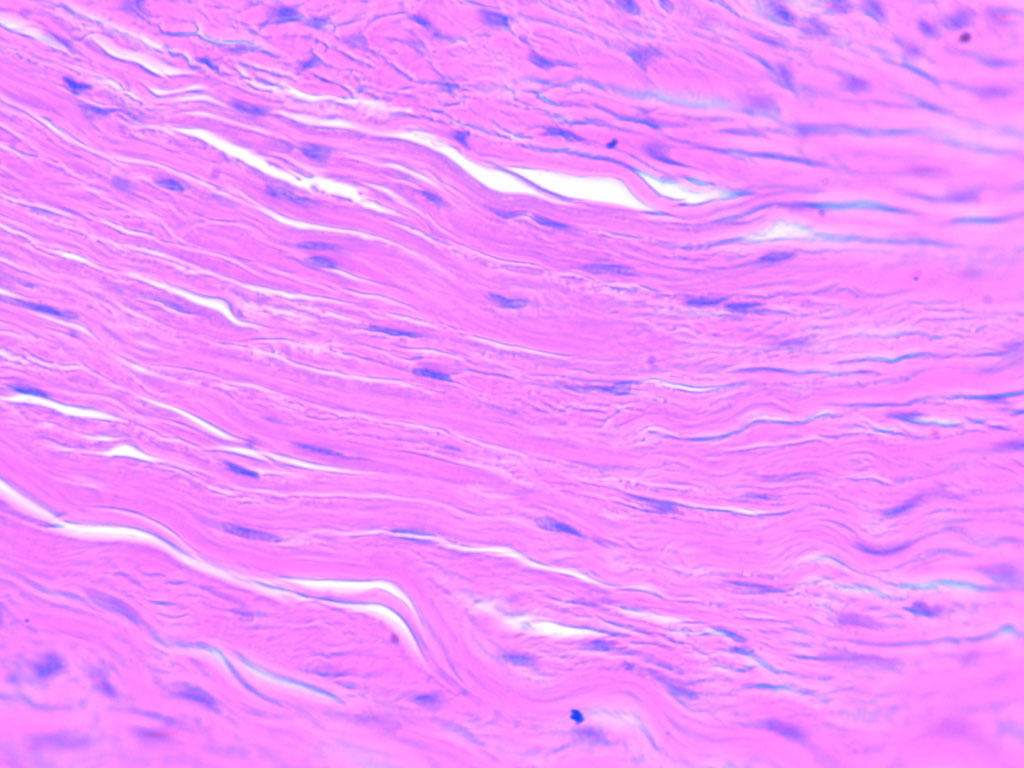
Question 93: Identify the type of connective tissue present in the image.
- A. Loose and irregular
- B. Specialized
- C. Dense irregular (Correct Answer)
- D. Dense regular
Explanation: ***Dense irregular*** - The image shows **densely packed collagen fibers** arranged in an **irregular, haphazard fashion**, characteristic of dense irregular connective tissue. - This type of tissue provides **strength** and resistance to stress from multiple directions, found in the **dermis of the skin** and organ capsules. *Loose and irregular* - **Loose connective tissue** would show more ground substance and fewer, loosely arranged fibers, whereas this image displays high fiber density. - While it is "irregular" in fiber arrangement, the density of fibers rules out the "loose" classification. *Specialized* - **Specialized connective tissues** include cartilage, bone, blood, and adipose tissue, which have distinct cellular and extracellular matrix components not seen here. - This tissue lacks the specific cellular and matrix characteristics that would classify it as specialized (e.g., chondrocytes in lacunae, osteocytes, blood cells). *Dense regular* - **Dense regular connective tissue** features collagen fibers arranged in parallel bundles, providing strength in one direction. - Examples include **tendons and ligaments**, which are structurally organized in an orderly, aligned manner, unlike the displayed irregular arrangement.
Question 94: Which nerve is primarily involved in cubital tunnel syndrome?
- A. Radial nerve
- B. Ulnar nerve (Correct Answer)
- C. Median nerve
- D. Axillary nerve
Explanation: Ulnar nerve - **Cubital tunnel syndrome** is a condition caused by compression of the **ulnar nerve** as it passes through the cubital tunnel at the medial epicondyle of the elbow. - Symptoms typically include numbness and tingling in the **little finger** and **half of the ring finger**, along with weakness of intrinsic hand muscles [2]. *Radial nerve* - The **radial nerve** is primarily involved in conditions like **radial tunnel syndrome** or radial nerve palsy (**wrist drop**), affecting primarily extensor muscles of the forearm and hand. - Its compression site is typically in the **radial tunnel** near the elbow, distinct from the cubital tunnel. *Median nerve* - The **median nerve** is involved in **carpal tunnel syndrome** at the wrist, causing numbness and tingling in the thumb, index, middle, and radial half of the ring finger [2]. - Compression around the elbow (e.g., pronator teres syndrome) can also affect the median nerve, but this is less common than cubital tunnel syndrome [1]. *Axillary nerve* - The **axillary nerve** is responsible for sensation over the deltoid region and motor function of the deltoid and teres minor muscles. - It is often injured with **shoulder dislocations** or fractures of the surgical neck of the humerus, unrelated to cubital tunnel syndrome.
Question 95: Unable to consolidate long-term memory. Which lobe of the brain is involved?
- A. Frontal
- B. Parietal
- C. Temporal (Correct Answer)
- D. Occipital
Explanation: ***Temporal*** - The **temporal lobe**, particularly the **hippocampus** within it, is critically involved in the formation and consolidation of new long-term memories [1]. - Damage to the temporal lobe can result in **anterograde amnesia**, the inability to form new memories after the injury [1]. *Frontal* - The **frontal lobe** is primarily responsible for executive functions, **planning**, decision-making, and working memory [1]. - While it contributes to memory retrieval and strategic memory processes, it is not the primary site for the consolidation of long-term memories. *Parietal* - The **parietal lobe** is involved in processing **sensory information**, spatial awareness, and navigation. - It plays a role in attention and short-term memory, but not in the consolidation of long-term memory. *Occipital* - The **occipital lobe** is dedicated to **visual processing** and interpretation of visual information. - It has no direct primary role in the consolidation of long-term memories.
Question 96: Which of the following statements about the popliteus muscle is false?
- A. Causes locking of knee (Correct Answer)
- B. Intracapsular origin
- C. Supplied by tibial nerve
- D. Flexor of knee
Explanation: ***Causes locking of knee*** - The popliteus muscle acts as the key to **unlocking the knee** from its fully extended, locked position, not causing it to lock. [1] - It achieves this by producing **internal rotation of the tibia** on the femur (or external rotation of the femur on the tibia) at the beginning of knee flexion. *Flexor of knee* - The popliteus muscle contributes to **flexion of the knee joint**, working in conjunction with the hamstrings. - This action is particularly important during the initial phases of knee flexion. *Intracapsular origin* - The popliteus muscle originates from the **lateral condyle of the femur**, specifically from an impression just anterior and inferior to the groove for the popliteal tendon. - This origin point is indeed **intracapsular**, lying within the fibrous capsule of the knee joint. *Supplied by tibial nerve* - The popliteus muscle receives its innervation from the **tibial nerve**, a branch of the sciatic nerve. - The nerve typically arises from the posterior aspect of the tibial nerve trunk as it passes through the popliteal fossa.
Question 97: The tensor veli palatini muscle is innervated by which nerve?
- A. Facial nerve
- B. Vagus nerve
- C. Glossopharyngeal nerve
- D. Mandibular nerve (Correct Answer)
Explanation: ***Mandibular nerve*** - The **tensor veli palatini** muscle plays a crucial role in tensing the **soft palate** and opening the **Eustachian tube**. - Its innervation is by a branch of the **mandibular division of the trigeminal nerve (V3)**, specifically the nerve to the medial pterygoid. *Facial nerve* - The **facial nerve (cranial nerve VII)** primarily innervates the muscles of **facial expression**, not the muscles of the soft palate. - It also supplies the **lacrimal, submandibular, and sublingual glands** and carries **taste sensation** from the anterior two-thirds of the tongue. *Vagus nerve* - The **vagus nerve (cranial nerve X)** innervates most muscles of the **pharynx and larynx**, and some muscles of the soft palate such as the **levator veli palatini**, **palatopharyngeus**, and **palatoglossus**. - It does not, however, innervate the **tensor veli palatini**. *Glossopharyngeal nerve* - The **glossopharyngeal nerve (cranial nerve IX)** innervates the **stylopharyngeus muscle** and provides sensation to the posterior one-third of the tongue. - While it has functions related to the pharynx, it does not directly innervate the **tensor veli palatini**.
Question 98: In a 3 month fetus, characteristic feature seen is:
- A. Meconium is present in the intestines.
- B. Nails are visible (Correct Answer)
- C. Anus formation begins.
- D. Limb buds are present.
Explanation: ***Nails are visible*** - By the end of the **third month** (approximately 12 weeks), the fingers and toes are fully formed, and the beginnings of fingernails and toenails usually become visible. - This marks a significant developmental milestone in fetal maturation during the first trimester. *Meconium is present in the intestines* - **Meconium** begins to form during the **second trimester**, typically around weeks 12-16, with significant accumulation in the latter part of the second and throughout the third trimester. - While some gut movements occur earlier, the presence of well-formed meconium for defecation happens later in fetal development. *Anus formation begins* - The formation of the anus is part of the development of the **cloaca**, which begins much earlier, around the **4th to 7th gestational weeks**. - By 3 months, the anorectal canal is already well-differentiated, so its formation has already been completed. *Limb buds are present* - **Limb buds** appear very early in embryonic development, around the **end of the 4th week**. [1] - By 3 months, the limbs are already well-developed with distinct fingers and toes, so these structures would have passed the "bud" stage.