
Ultrasound for Regional Anesthesia — MCQs

What is the primary instrument used for creating endodontic access cavity during endodontic procedures?
Which of the following is the best in-vivo screening choice for carotid artery stenosis?
What is the name of the nerve block technique shown in the image?
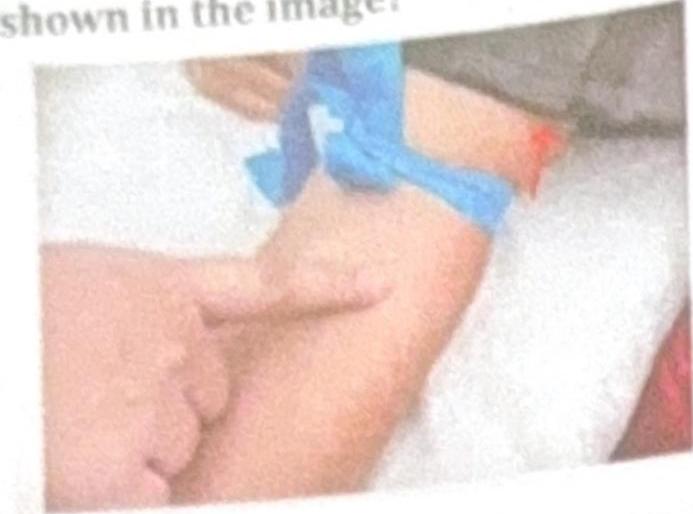
Intravenous regional anesthesia is suitable for :
Interscalene approach to brachial plexus block does not provide optimal surgical anaesthesia in the area of distribution of which of the following nerve?
During ultrasound-guided internal jugular vein cannulation, you observe the vein collapsing with minimal probe pressure while the artery remains patent. The vein appears enlarged and the artery-to-vein ratio is 1:3. A spontaneously breathing patient shows respiratory variation. Evaluate the most appropriate interpretation and management strategy.
A 55-year-old patient with previous lumbar spine surgery requires epidural catheter placement for postoperative analgesia. Pre-procedure ultrasound shows loss of normal posterior complex and irregular acoustic shadowing at L3-L4 and L4-L5 levels. The L2-L3 level shows preserved anatomy with a depth of 6 cm to the epidural space. Which technical modification would provide the best success rate?
A 65-year-old patient with BMI 32 kg/m² is scheduled for interscalene block. Ultrasound shows the brachial plexus roots appearing 4 cm deep. Which approach would be most appropriate?
Which ultrasound sign is used to identify the pleura during thoracic paravertebral block?
What is the optimal ultrasound frequency for performing neuraxial blocks in adults?
Want unlimited practice?
Get full access to all questions, explanations, and performance tracking.
Scan to download app