A patient presents with complaints of hair loss and behavioral changes noted by his wife. Upon examination, the doctor observes a loss of eyebrows. After further assessment, including an examination of the nails, what type of poisoning is suspected in this case?
Q3
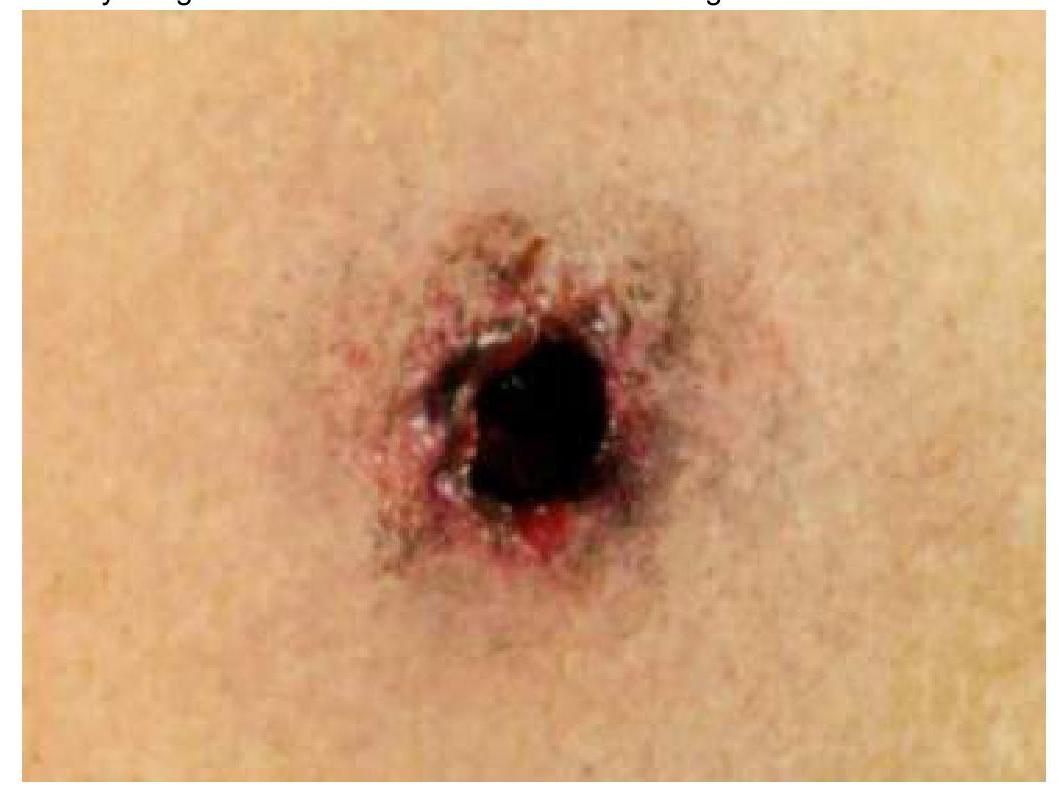
Based on the provided wound characteristics, identify the type of firearm used and the estimated range of the shot.
Q4
A 45-year-old female patient is told about the benefits and complications of a hysterectomy, and she agrees to the procedure. What kind of consent is this?
Q5
A surgeon is called to perform an emergency operation after attending a party. During the operation, the assisting staff notices the surgeon's hands shaking and instruments falling from his grasp. He eventually nicks an artery, leading to the patient's collapse and significant blood loss. Under which legal term is this incident most likely to be classified in Indian medical jurisprudence?
NEET-PG 2022 - Forensic Medicine NEET-PG Practice Questions and MCQs
Question 1: In which context are leading questions allowed?
A. Cross-examination (Correct Answer)
B. Direct examination
C. Re-examination
D. Dying declaration
Explanation: ***Cross-examination***
- Leading questions are permissible during **cross-examination** to challenge the witness's testimony and test credibility.
- The purpose is to **elicit specific details**, confirm facts, or highlight inconsistencies in prior statements.
*Direct examination*
- Leading questions are **generally not allowed** during direct examination because it is the phase where a party questions its own witness.
- The goal is for the witness to provide testimony in their **own words**, without suggestions from the attorney.
*Re-examination*
- Leading questions are **not allowed** during re-examination, which occurs after cross-examination to clarify points raised.
- The scope of re-examination is **limited to the matters** brought up during cross-examination, and leading questions would be inappropriate.
*Dying declaration*
- A dying declaration is a statement made by a person who believes they are about to die, concerning the cause of their death.
- The admissibility of a dying declaration as evidence is an **exception to the hearsay rule** and does not involve questioning by attorneys in a formal court setting at the time the declaration is made.
Question 2: A patient presents with complaints of hair loss and behavioral changes noted by his wife. Upon examination, the doctor observes a loss of eyebrows. After further assessment, including an examination of the nails, what type of poisoning is suspected in this case?
A. Thallium (Correct Answer)
B. Arsenic
C. Mercury
D. Lead
Explanation: ***Thallium***
- **Thallium poisoning** characteristically presents with **hair loss (alopecia)**, including loss of eyebrows, and **neurological symptoms** such as behavioral changes.
- It also causes nail changes like **Mees' lines** and is known for its **neurotoxic effects**.
*Arsenic*
- **Arsenic poisoning** primarily causes **gastrointestinal symptoms** (nausea, vomiting, diarrhea), **skin lesions** (hyperpigmentation, hyperkeratosis), and **neuropathy**.
- While it can cause nail changes (Mees' lines), significant alopecia and loss of eyebrows are less prominent compared to thallium.
*Mercury*
- **Mercury poisoning** often leads to **neurological symptoms** (tremors, ataxia, irritability), kidney damage, and **gingivostomatitis**.
- Hair loss and loss of eyebrows are not typical or prominent features of mercury toxicity.
*Lead*
- **Lead poisoning** is associated with **neurodevelopmental deficits** in children, **peripheral neuropathy**, **abdominal pain (lead colic)**, and **anemia**.
- Alopecia and loss of eyebrows are not characteristic symptoms of lead toxicity.
Question 3: Based on the provided wound characteristics, identify the type of firearm used and the estimated range of the shot.
A. Pistol, close shot (Correct Answer)
B. Shotgun, intermediate range
C. Shotgun, close range
D. Pistol, near shot
Explanation: ***Pistol, close shot***
- The wound shows **soot deposition (blackening/fouling)** around the entry point, which is characteristic of a **close shot** fired within the **flame distance** (~8 cm).
- **Close shots** produce both **soot blackening** and **powder tattooing (stippling)**, distinguishing them from near shots which show only tattooing.
*Shotgun, intermediate range*
- Shotgun wounds at intermediate range produce **multiple scattered pellet wounds** with a **dispersed pattern**, not a single entry wound.
- There would be **no soot or powder burns** at intermediate range due to the greater distance.
*Shotgun, close range*
- Close range shotgun wounds create **large, ragged wounds** with **extensive tissue destruction** due to the **shot column** and **wadding impact**.
- The wound pattern would be **much larger and more irregular** than the single projectile entry seen here.
*Pistol, near shot*
- **Near shots** (3-24 inches) show **powder tattooing only** without any **soot deposition** or blackening around the wound.
- The presence of **soot blackening** in this image rules out a near shot classification.
Question 4: A 45-year-old female patient is told about the benefits and complications of a hysterectomy, and she agrees to the procedure. What kind of consent is this?
A. Informed consent (Correct Answer)
B. Implied consent
C. Opt-out consent
D. Passive consent
Explanation: ***Informed consent***
- This type of consent occurs when a patient is fully educated about the proposed treatment, including its **benefits, risks, and alternatives**, and voluntarily agrees to proceed.
- It ensures the patient has adequate information to make an **autonomous decision** about their healthcare.
*Implied consent*
- This consent is inferred from a patient's **actions or conduct**, rather than being explicitly stated or written.
- Examples include extending an arm for a blood draw or arriving at an appointment for a specific test.
*Opt-out consent*
- This model assumes agreement unless the individual explicitly **refuses or declines** participation.
- It is commonly used in organ donation systems, where individuals are presumed donors unless they register otherwise.
*Passive consent*
- This usually refers to situations where explicit consent is not sought but also explicitly not denied, such as when parents are informed about a school health program and are given the opportunity to decline, but if they don't, consent is assumed.
- It is less formal than informed consent and typically used for **low-risk interventions** or data collection.
Question 5: A surgeon is called to perform an emergency operation after attending a party. During the operation, the assisting staff notices the surgeon's hands shaking and instruments falling from his grasp. He eventually nicks an artery, leading to the patient's collapse and significant blood loss. Under which legal term is this incident most likely to be classified in Indian medical jurisprudence?
A. Criminal negligence in medical practice (Correct Answer)
B. Civil negligence
C. Medical error
D. Informed consent violation
Explanation: ***Criminal negligence in medical practice***
- This incident involves **reckless disregard for patient safety** by performing surgery while clearly impaired, leading to severe harm.
- Under **IPC Section 304A (causing death by negligence)** and **Sections 337/338 (causing hurt by endangering life)**, operating while impaired constitutes **gross negligence** with criminal liability.
- The surgeon's actions demonstrate **wanton and willful omission** of duty by consciously choosing to operate despite obvious unfitness, which distinguishes this from simple civil negligence.
- Indian courts have held that such **reckless deviation from standard care** elevates negligence to the criminal level (*Kusum Sharma v. Batra Hospital, 2010*).
*Civil negligence*
- This typically involves a **breach of duty of care** without the same level of deliberate or reckless disregard for life.
- While civil liability would certainly apply, the **conscious decision to operate while impaired** elevates this beyond mere inadvertence or error in judgment.
- Civil negligence addresses compensation; criminal negligence addresses punishment for gross deviation from duty.
*Medical error*
- This refers to an **unintended act of commission or omission** in medical care, often without culpable mental state.
- While nicking an artery could be a technical error, the **context of obvious impairment** transforms this into negligence rather than a bona fide error.
- The surgeon's **unfitness to perform surgery** indicates a failure to meet even basic standards of care before attempting the procedure.
*Informed consent violation*
- This occurs when a patient has not been adequately informed about **risks, benefits, and alternatives** before consenting to a procedure.
- The primary issue here is the surgeon's **fitness and capability**, not the adequacy of information provided to the patient.
- While there may be consent issues if the patient wasn't informed of the surgeon's condition, the dominant legal issue is criminal negligence.