Hormonal influences on GFR US Medical PG Practice Questions and MCQs
Practice US Medical PG questions for Hormonal influences on GFR. These multiple choice questions (MCQs) cover important concepts and help you prepare for your exams.
Hormonal influences on GFR US Medical PG Question 1: A 54-year-old man comes to the physician for a follow-up examination. One week ago, he was treated in the emergency department for chest pain, palpitations, and dyspnea. As part of his regimen, he was started on a medication that irreversibly inhibits the synthesis of thromboxane A2 and prostaglandins. Which of the following is the most likely adverse effect of this medication?
- A. Tinnitus
- B. Gout attack
- C. Chronic rhinosinusitis
- D. Acute interstitial nephritis
- E. Gastrointestinal hemorrhage (Correct Answer)
Hormonal influences on GFR Explanation: ***Gastrointestinal hemorrhage***
- The medication described, which **irreversibly inhibits thromboxane A2 and prostaglandins**, is **aspirin**. Aspirin's inhibition of **prostaglandin synthesis** in the stomach reduces the protective mucous barrier, leading to an increased risk of **gastric ulcers** and **hemorrhage**.
- **Thromboxane A2 inhibition** by aspirin also impairs platelet aggregation, thereby increasing the risk of bleeding, including **gastrointestinal hemorrhage**.
- This is the **most common serious adverse effect** of chronic aspirin therapy, occurring in approximately 2-4% of patients on long-term low-dose aspirin for cardiovascular prophylaxis.
*Tinnitus*
- **Tinnitus** is a known adverse effect of **salicylate toxicity**, which usually occurs with higher doses of aspirin (>3-4 g/day). While possible, it's **uncommon with standard prophylactic doses** (81-325 mg/day) used for cardiovascular events.
- The question describes a regimen for a cardiac patient, implying a therapeutic dose rather than an overdose scenario.
*Gout attack*
- Aspirin's effect on **uric acid excretion** is dose-dependent: low doses (<1-2 g/day) can **decrease uric acid excretion**, potentially precipitating a gout attack, while high doses increase excretion.
- However, this effect is **less common** than GI complications, and aspirin is generally avoided in patients with known gout due to this complex effect and the availability of safer alternatives.
*Chronic rhinosinusitis*
- **Chronic rhinosinusitis** is not a direct adverse effect of aspirin. However, **aspirin-exacerbated respiratory disease (AERD)**, a condition involving asthma, nasal polyps, and chronic rhinosinusitis, can be triggered by aspirin in susceptible individuals.
- This is a **rare, specific syndrome** affecting approximately 7% of adults with asthma, not a general adverse effect for all patients on aspirin.
*Acute interstitial nephritis*
- **Acute interstitial nephritis** is more commonly associated with **non-steroidal anti-inflammatory drugs (NSAIDs)**, which also inhibit prostaglandin synthesis, but their effect on cyclooxygenase (COX) enzymes is typically reversible, unlike aspirin.
- While NSAIDs can cause AIN by acting as haptens and triggering an immune response, aspirin is **less frequently implicated** in this specific renal pathology compared to other NSAIDs.
Hormonal influences on GFR US Medical PG Question 2: A 70-year-old female with chronic kidney failure secondary to diabetes asks her nephrologist to educate her about the techniques used to evaluate the degree of kidney failure progression. She learns about the concept of glomerular filtration rate (GFR) and learns that it can be estimated by measuring the levels of some substances. The clearance of which of the following substances is the most accurate estimate for GFR?
- A. Paraaminohippurate (PAH)
- B. Sodium
- C. Inulin (Correct Answer)
- D. Creatinine
- E. Glucose
Hormonal influences on GFR Explanation: ***Inulin***
- **Inulin** is freely filtered by the glomeruli and is neither reabsorbed nor secreted by the renal tubules, making its clearance the **gold standard** for accurately measuring GFR.
- Due to its ideal physiological properties, inulin clearance perfectly reflects the rate at which plasma is filtered by the kidneys.
*Paraaminohippurate (PAH)*
- **PAH** is almost completely cleared from the blood by both glomerular filtration and **tubular secretion**, making its clearance an accurate measure of **renal plasma flow (RPF)**, not GFR.
- While important for assessing renal blood flow, it does not directly reflect the filtration capacity of the glomeruli.
*Sodium*
- **Sodium** is freely filtered at the glomerulus, but a significant portion (approximately **99%**) is **reabsorbed** by the renal tubules.
- Its clearance is highly variable and depends on various physiological factors, making it unsuitable for GFR estimation.
*Creatinine*
- **Creatinine** is freely filtered by the glomeruli and is also **modestly secreted** by the renal tubules, leading to an **overestimation of GFR** at lower kidney function levels.
- Despite being the most commonly used clinical marker due to its endogenous production, its tubular secretion makes it less accurate than inulin.
*Glucose*
- **Glucose** is freely filtered by the glomeruli but is almost **completely reabsorbed** by the renal tubules under normal physiological conditions.
- Its presence in urine (glycosuria) indicates a high plasma glucose level or tubular reabsorption defects, not a measure of GFR.
Hormonal influences on GFR US Medical PG Question 3: Activation of the renin-angiotensin-aldosterone system yields a significant physiological effect on renal blood flow and filtration. Which of the following is most likely to occur in response to increased levels of Angiotensin-II?
- A. Decreased renal plasma flow, decreased filtration fraction
- B. Decreased renal plasma flow, increased glomerular capillary oncotic pressure
- C. Increased renal plasma flow, decreased filtration fraction
- D. Increased renal plasma flow, increased filtration fraction
- E. Decreased renal plasma flow, increased filtration fraction (Correct Answer)
Hormonal influences on GFR Explanation: ***Decreased renal plasma flow, increased filtration fraction***
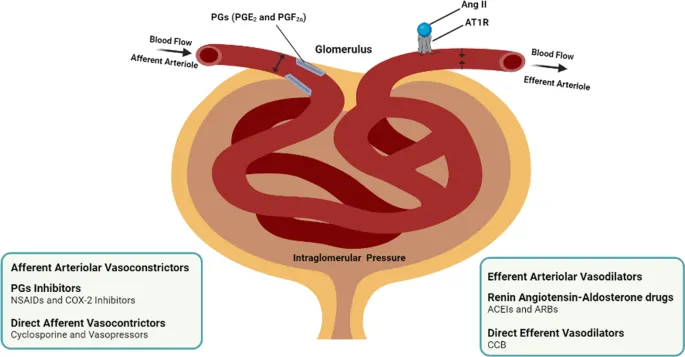
- **Angiotensin II** causes **efferent arteriolar constriction**, which reduces blood flow leaving the glomerulus, thereby **decreasing renal plasma flow**.
- This efferent constriction also increases **glomerular hydrostatic pressure** and reduces plasma flow distal to the glomerulus, leading to a **higher filtration fraction** (GFR/RPF).
*Decreased renal plasma flow, decreased filtration fraction*
- While **renal plasma flow decreases**, a **decreased filtration fraction** would imply that either GFR decreases disproportionately more than RPF or GFR does not increase despite the RPF reduction, which is not the typical response to **angiotensin II** due to its predominant effect on the **efferent arteriole**.
*Decreased renal plasma flow, increased glomerular capillary oncotic pressure*
- **Increased glomerular capillary oncotic pressure** is a consequence of increased filtration fraction, as more fluid is filtered out, leaving behind a more concentrated plasma. This option includes a correct element (decreased RPF) but pairs it with a less direct and defining outcome of acute Angiotensin II action as the primary physiological effect.
*Increased renal plasma flow, decreased filtration fraction*
- **Angiotensin II** causes **vasoconstriction**, predominantly of the efferent arteriole, which by definition would **decrease renal plasma flow**, not increase it.
- A **decreased filtration fraction** would be inconsistent with efferent arteriolar constriction which typically raises GFR relative to RPF.
*Increased renal plasma flow, increased filtration fraction*
- **Angiotensin II** causes **vasoconstriction**, leading to a **decrease in renal plasma flow**, not an increase.
- While **filtration fraction is increased**, the initial premise of increased renal plasma flow is incorrect.
Hormonal influences on GFR US Medical PG Question 4: A physician is choosing whether to prescribe losartan or lisinopril to treat hypertension in a 56-year-old male. Relative to losartan, one would expect treatment with lisinopril to produce which of the following changes in the circulating levels of these peptides?
- A. Aldosterone increase; bradykinin decrease
- B. Angiotensin II increase; bradykinin decrease
- C. Renin decrease; angiotensin I increase
- D. Bradykinin increase; angiotensin II decrease (Correct Answer)
- E. Renin decrease; angiotensin II increase
Hormonal influences on GFR Explanation: ***Bradykinin increase; angiotensin II decrease***
- **Lisinopril** is an **ACE inhibitor**, which directly blocks the conversion of **angiotensin I** to **angiotensin II**, leading to a decrease in circulating **angiotensin II** levels.
- ACE is also responsible for the breakdown of **bradykinin**, so inhibiting ACE with lisinopril will lead to an **increase in bradykinin** levels, contributing to vasodilation but also the characteristic cough.
*Aldosterone increase; bradykinin decrease*
- **Lisinopril** (an ACE inhibitor) decreases **angiotensin II**, which in turn leads to a **decrease in aldosterone** synthesis and release, not an increase.
- **Bradykinin** levels would increase due to ACE inhibition, as ACE is involved in its degradation.
*Angiotensin II increase; bradykinin decrease*
- **Lisinopril** directly inhibits the enzyme responsible for producing **angiotensin II**, thus leading to its **decrease**, not an increase.
- **Bradykinin** levels would increase because its degradation pathway (via ACE) is blocked, not decrease.
*Renin decrease; angiotensin I increase*
- **Lisinopril** reduces the negative feedback on **renin** release, leading to an **increase in renin** levels, not a decrease.
- While ACE is inhibited by lisinopril, this leads to an accumulation of its substrate, **angiotensin I**, resulting in an increase of angiotensin I.
*Renin decrease; angiotensin II increase*
- As an ACE inhibitor, lisinopril would lead to an **increase in renin** due to reduced negative feedback from angiotensin II, not a decrease.
- **Angiotensin II** levels would **decrease** because its production from angiotensin I is directly inhibited by lisinopril.
Hormonal influences on GFR US Medical PG Question 5: A 72-year-old man with type 2 diabetes mellitus, hypertension, and systolic heart failure comes to the physician because of a 5-day history of progressively worsening shortness of breath at rest. Physical examination shows jugular venous distention, diffuse crackles over the lower lung fields, and bilateral lower extremity edema. As a part of treatment, he is given a derivative of a hormone that acts by altering guanylate cyclase activity. This drug has been found to reduce pulmonary capillary wedge pressure and causes systemic hypotension as an adverse effect. The drug is most likely a derivative of which of the following hormones?
- A. Prostacyclin
- B. Aldosterone
- C. Somatostatin
- D. Brain natriuretic peptide (Correct Answer)
- E. Angiotensin II
Hormonal influences on GFR Explanation: ***Brain natriuretic peptide***
- **Brain natriuretic peptide (BNP)** derivatives, like nesiritide, activate **guanylate cyclase**, leading to increased cGMP, vasodilation, and reduced preload/afterload, alleviating heart failure symptoms.
- The patient's symptoms (shortness of breath, jugular venous distention, crackles, edema) are classic for **acute decompensated heart failure**, making a BNP derivative an appropriate treatment.
*Prostacyclin*
- **Prostacyclin** analogs (e.g., epoprostenol) are primarily used for **pulmonary hypertension** due to their potent vasodilatory effects in the pulmonary circulation.
- They activate **adenylyl cyclase** (increasing cAMP), not guanylate cyclase (which increases cGMP), representing a different mechanism of action.
*Aldosterone*
- **Aldosterone** is a mineralocorticoid that promotes **sodium and water retention** and potassium excretion, exacerbating heart failure symptoms.
- Its antagonists (e.g., spironolactone) are used in chronic heart failure but do not directly act via guanylate cyclase for acute symptom relief.
*Somatostatin*
- **Somatostatin** is a peptide hormone that **inhibits the secretion of various hormones**, including growth hormone, insulin, and glucagon.
- It is used in conditions like acromegaly or variceal bleeding and has no direct role in heart failure management via guanylate cyclase.
*Angiotensin II*
- **Angiotensin II** is a potent vasoconstrictor and a key component of the **renin-angiotensin-aldosterone system (RAAS)**, contributing to hypertension and heart failure progression.
- Drugs targeting angiotensin II (ACE inhibitors, ARBs) reduce its effects but do not act by directly altering guanylate cyclase activity; instead, they block its receptors or synthesis.
Hormonal influences on GFR US Medical PG Question 6: A 76-year-old woman presents to the office with a generalized weakness for the past month. She has a past medical history significant for uncontrolled hypertension and type 2 diabetes mellitus. Her temperature is 37.0°C (98.6°F), blood pressure is 135/82 mm Hg, pulse is 90/min, respiratory rate is 17/min, and oxygen saturation is 99% on room air. Physical exam shows no remarkable findings. Her last recorded glomerular filtration rate was 30 mL/min. A radiograph of the patient’s hand is given. Which of the following lab findings is most likely to be found in this patient?
- A. Increased PTH, decreased calcium, increased phosphate (Correct Answer)
- B. Increased PTH, decreased calcium, decreased phosphate
- C. Normal PTH, increased calcium, normal phosphate
- D. Increased PTH, increased calcium, decreased phosphate
- E. Increased PTH, increased calcium, increased phosphate
Hormonal influences on GFR Explanation: ***Increased PTH, decreased calcium, increased phosphate***
- The patient's **glomerular filtration rate (GFR) of 30 mL/min** indicates **Stage 4 chronic kidney disease (CKD)**. In CKD, the kidneys are unable to adequately excrete phosphate, leading to **hyperphosphatemia**.
- Hyperphosphatemia leads to the formation of calcium-phosphate complexes, causing a decrease in free calcium (hypocalcemia) by precipitating out. Additionally, damaged kidneys cannot convert vitamin D into its active form, which further reduces calcium absorption from the gut and bone, contributing to hypocalcemia. This persistent hypocalcemia stimulates the parathyroid glands to produce more **parathyroid hormone (PTH)**, resulting in **secondary hyperparathyroidism**.
*Increased PTH, decreased calcium, decreased phosphate*
- This pattern of laboratory findings is characteristic of **primary hyperparathyroidism**, where an adenoma or hyperplasia of the parathyroid glands leads to excessive PTH production.
- In primary hyperparathyroidism, elevated PTH causes increased bone resorption and renal phosphate excretion, typically resulting in **hypercalcemia** and **hypophosphatemia**.
*Normal PTH, increased calcium, normal phosphate*
- This combination is not typically seen in CKD-related mineral and bone disorder.
- While hypercalcemia can occur in some conditions, normal PTH with increased calcium often points toward conditions like **paraneoplastic syndromes** or **granulomatous diseases** producing PTH-related protein, or **vitamin D intoxication**.
*Increased PTH, increased calcium, decreased phosphate*
- This specific combination (high PTH, high calcium, low phosphate) is the classic hallmark of **primary hyperparathyroidism**.
- In contrast, secondary hyperparathyroidism due to CKD typically presents with **hypocalcemia** and **hyperphosphatemia** due to impaired renal function.
*Increased PTH, increased calcium, increased phosphate*
- This pattern is highly unusual and not characteristic of any common parathyroid or kidney disorder.
- While both PTH and phosphate can be increased in certain advanced stages of CKD, calcium levels are typically low or normal, not elevated in secondary hyperparathyroidism.
Hormonal influences on GFR US Medical PG Question 7: A 75-year-old woman is brought to a physician’s office by her son with complaints of diarrhea and vomiting for 1 day. Her stool is loose, watery, and yellow-colored, while her vomitus contains partially digested food particles. She denies having blood or mucus in her stools and vomitus. Since the onset of her symptoms, she has not had anything to eat and her son adds that she is unable to tolerate fluids. The past medical history is unremarkable and she does not take any medications regularly. The pulse is 115/min, the respiratory rate is 16/min, the blood pressure is 100/60 mm Hg, and the temperature is 37.0°C (98.6°F). The physical examination shows dry mucous membranes and slightly sunken eyes. The abdomen is soft and non-tender. Which of the following physiologic changes in glomerular filtration rate (GFR), renal plasma flow (RPF), and filtration fraction (FF) are expected?
- A. Decreased GFR, decreased RPF, decreased FF
- B. Decreased GFR, decreased RPF, no change in FF
- C. Increased GFR, increased RPF, increased FF
- D. Increased GFR, decreased RPF, increased FF
- E. Decreased GFR, decreased RPF, increased FF (Correct Answer)
Hormonal influences on GFR Explanation: ***Decreased GFR, decreased RPF, increased FF***
- Due to **dehydration** from diarrhea and vomiting, there is a decrease in blood volume leading to decreased renal blood flow and **renal plasma flow (RPF)**.
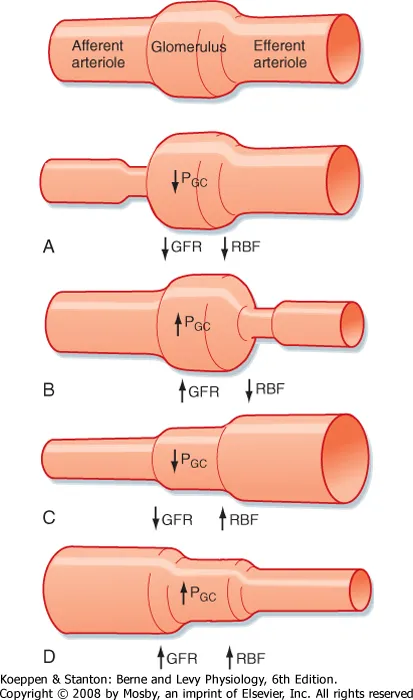
- The body responds to hypovolemia by activating the renin-angiotensin-aldosterone system (RAAS) and sympathetic nervous system, which cause **preferential efferent arteriolar constriction** (more than afferent constriction). This helps maintain glomerular hydrostatic pressure despite reduced renal perfusion.
- As a result, **GFR decreases** but proportionally **less than RPF decreases**, causing the **filtration fraction (FF = GFR/RPF) to increase**.
- In this patient with significant dehydration (tachycardia, hypotension, dry mucous membranes), both GFR and RPF are reduced, but FF is elevated due to compensatory mechanisms.
*Decreased GFR, decreased RPF, decreased FF*
- While GFR and RPF will decrease due to dehydration, the **filtration fraction is expected to increase**, not decrease.
- A decreased FF would imply GFR fell proportionally more than RPF, which contradicts the physiologic response where efferent arteriolar constriction helps preserve GFR relative to RPF.
*Decreased GFR, decreased RPF, no change in FF*
- With significant fluid loss and compensatory mechanisms (efferent arteriolar constriction via angiotensin II), a change in **filtration fraction** is expected.
- The body actively alters arteriolar tone to prioritize GFR maintenance, which directly increases FF.
*Increased GFR, increased RPF, increased FF*
- This pattern suggests **hypervolemia** or increased renal perfusion, which directly contradicts the patient's severe dehydration.
- Both GFR and RPF are expected to decrease in volume depletion, not increase.
*Increased GFR, decreased RPF, increased FF*
- An increase in GFR is physiologically impossible given the patient's severe volume depletion and reduced renal perfusion.
- While FF does increase in dehydration, this occurs in the context of **both GFR and RPF being decreased**, not with an increased GFR.
Hormonal influences on GFR US Medical PG Question 8: A 9-year-old boy is brought to the physician's office by his mother because of facial swelling for the past 2 days. The mother says that her son has always been healthy and active but is becoming increasingly lethargic and now has a puffy face. Upon inquiry, the boy describes a foamy appearance of his urine, but denies having blood in the urine, urinary frequency at night, or pain during urination. He has no history of renal or urinary diseases. Physical examination is unremarkable, except for generalized swelling of the face and pitting edema on the lower limbs. Dipstick analysis reveals 4+ proteinuria. An abdominal ultrasound shows normal kidney size and morphology. A renal biopsy yields no findings under light and fluorescence microscopy; however, glomerular podocyte foot effacement is noted on electron microscopy. Which of the following changes in Starling forces occurs in this patient's condition?
- A. Decreased oncotic pressure in the Bowman's capsule
- B. Increased hydrostatic pressure in the Bowman's capsule
- C. Decreased hydrostatic pressure in the Bowman's capsule
- D. Decreased glomerular oncotic pressure (Correct Answer)
- E. Increased glomerular hydrostatic pressure
Hormonal influences on GFR Explanation: ***Decreased glomerular oncotic pressure***
- The patient presents with **nephrotic syndrome**, characterized by severe proteinuria (4+ on dipstick), edema, and **minimal change disease** (podocyte foot effacement on electron microscopy without changes on light or fluorescence microscopy).
- In nephrotic syndrome, large amounts of plasma proteins, particularly **albumin**, are lost in the urine, leading to **hypoalbuminemia** and a significant decrease in the **oncotic pressure of the plasma** (and thus the glomerular capillaries).
*Decreased oncotic pressure in the Bowman's capsule*
- The Bowman's capsule normally has a **very low oncotic pressure** due to the almost complete absence of proteins in the filtrate.
- While theoretically a massive increase in protein filtration could increase it, the primary Starling force affected by protein loss in nephrotic syndrome is the **plasma oncotic pressure**.
*Increased hydrostatic pressure in the Bowman's capsule*
- This condition is not typically associated with nephrotic syndrome and would rather **impair filtration**.
- Increased hydrostatic pressure in the Bowman's capsule is usually seen in conditions causing **urinary tract obstruction**, which is not present here.
*Decreased hydrostatic pressure in the Bowman's capsule*
- This would tend to **increase glomerular filtration rate** by favoring filtration, which is not the primary physiological change driving edema in nephrotic syndrome.
- There is no clinical indication for such a change in this patient's presentation.
*Increased glomerular hydrostatic pressure*
- While sometimes seen in specific glomerular diseases, this is not the primary or defining Starling force change in nephrotic syndrome leading to systemic edema.
- Increased glomerular hydrostatic pressure would tend to **increase filtration**, potentially worsening proteinuria, but the fundamental issue in nephrotic syndrome is the **loss of oncotic pressure due to protein leakage**.
Hormonal influences on GFR US Medical PG Question 9: A 73-year-old male is brought in by ambulance after he was found to be lethargic and confused. He has not been routinely seeing a physician and is unable to recall how he came to be in the hospital. His temperature is 99°F (37°C), blood pressure is 150/95 mmHg, pulse is 75/min, and respirations are 18/min. His past medical history is significant for poorly controlled diabetes and longstanding hypertension, and he says that he has not been taking his medications recently. Labs are obtained and shown below:
Serum:
Na+: 142 mEq/L
Cl-: 105 mEq/L
K+: 5 mEq/L
HCO3-: 16 mEq/L
Urea nitrogen: 51 mg/dL
Glucose: 224 mg/dL
Creatinine: 2.6 mg/dL
Which of the following changes would most likely improve the abnormal parameter that is responsible for this patient's symptoms?
- A. Increased Bowman's space hydrostatic pressure
- B. Decreased filtration coefficient
- C. Increased Bowman's space oncotic pressure
- D. Decreased glomerular capillary hydrostatic pressure
- E. Increased glomerular capillary hydrostatic pressure (Correct Answer)
Hormonal influences on GFR Explanation: ***Increased glomerular capillary hydrostatic pressure***
- This patient presents with **acute kidney injury (AKI)** evidenced by **elevated creatinine (2.6 mg/dL)** and **BUN (51 mg/dL)**, causing uremic symptoms of **lethargy and confusion**
- The "abnormal parameter" is the **reduced GFR** causing azotemia and uremia
- To improve AKI and restore adequate filtration, **GFR must be increased**
- **Increasing glomerular capillary hydrostatic pressure** increases the net filtration pressure: **NFP = (PGC - PBS) - (πGC - πBS)**, where PGC is the primary driving force for filtration
- In prerenal AKI (likely in this patient with poor medication compliance for hypertension), restoring adequate renal perfusion pressure is the therapeutic goal
- While chronic hyperfiltration can contribute to long-term diabetic/hypertensive nephropathy, the **acute management priority** is restoring adequate GFR to clear uremic toxins
*Decreased glomerular capillary hydrostatic pressure*
- This would **decrease the net filtration pressure**, thereby **reducing GFR**
- Lower GFR would worsen azotemia and uremic symptoms
- This is the opposite of what's needed to improve acute kidney injury
*Increased Bowman's space hydrostatic pressure*
- This **opposes filtration** by increasing back-pressure against the glomerular capillaries
- Would **decrease GFR** and worsen the AKI
- Occurs pathologically in urinary tract obstruction
*Decreased filtration coefficient*
- The filtration coefficient (Kf) represents the permeability and surface area of the glomerular capillaries
- **Decreasing Kf reduces GFR**, worsening kidney function
- This represents glomerular damage, not a therapeutic intervention
*Increased Bowman's space oncotic pressure*
- This would theoretically **increase net filtration pressure** and GFR
- However, this is **physiologically implausible** as Bowman's space normally contains minimal protein (filtrate is protein-free)
- Significant protein in Bowman's space indicates severe glomerular damage with proteinuria, not a mechanism to improve function
More Hormonal influences on GFR US Medical PG questions available in the OnCourse app. Practice MCQs, flashcards, and get detailed explanations.