Hypothermia Indian Medical PG Practice Questions and MCQs
Practice Indian Medical PG questions for Hypothermia. These multiple choice questions (MCQs) cover important concepts and help you prepare for your exams.
Hypothermia Indian Medical PG Question 1: Hypothermia is used in all except:
- A. Hyperthermia
- B. Arrhythmia (Correct Answer)
- C. Neonatal asphyxia
- D. Cardiac surgery
Hypothermia Explanation: ***Arrhythmia***
- While sometimes used in specific cardiac procedures or to protect organs during cardioplegia, **therapeutic hypothermia** is not a primary treatment for general cardiac arrhythmias due to its potential to exacerbate certain rhythm disturbances.
- **Hypothermia** can paradoxically induce **arrhythmias** itself, particularly bradycardia and ventricular fibrillation, making it unsuitable for general arrhythmia management [1].
*Hyperthermia*
- **Therapeutic hypothermia** is used to reduce high body temperatures in conditions like **malignant hyperthermia** and **heatstroke** to prevent organ damage [2].
- By actively cooling the body, hypothermia counteracts the harmful effects of sustained, extreme elevations in body temperature.
*Neonatal asphyxia*
- **Therapeutic hypothermia** is a standard treatment for **neonatal hypoxic-ischemic encephalopathy** (HIE) to reduce brain injury.
- Cooling the infant's body temperature helps to slow down damaging metabolic processes after oxygen deprivation.
*Cardiac surgery*
- **Hypothermia** is commonly employed during **cardiac surgery** to protect organs, especially the brain and heart, from ischemia during periods of reduced blood flow.
- **Moderate to deep hypothermia** can significantly reduce metabolic demands, extending the safe duration of cardiopulmonary bypass and aortic cross-clamping [3].
Hypothermia Indian Medical PG Question 2: All the following are criteria for SIRS, except
- A. Heart rate >90/min
- B. Systolic blood pressure <90 mmHg (Correct Answer)
- C. Respiratory rate >20 bpm
- D. Temperature >38 degree Celsius or <36 degree Celsius
Hypothermia Explanation: ***Systolic blood pressure <90 mmHg***
- This criterion is associated with **septic shock** or **hypotension**, indicating organ dysfunction, which is a more severe stage beyond **SIRS**.
- While low blood pressure can be seen in severe infections, it is not a direct diagnostic criterion for **SIRS** itself.
*Heart rate >90/min*
- An elevated **heart rate** (tachycardia) is a common physiological response to systemic stress and inflammation.
- This criterion fulfills one of the four clinical parameters to diagnose **SIRS**.
*Respiratory rate >20 bpm*
- An increased **respiratory rate** (tachypnea) reflects the body's attempt to compensate for metabolic acidosis or increased oxygen demand during a systemic inflammatory response.
- This criterion is one of the four clinical parameters used to diagnose **SIRS**.
*Temperature >38 degree Celsius or <36 degree Celsius*
- Both **fever** (>38°C) and **hypothermia** (<36°C) are indicators of a systemic inflammatory response, as the body's thermoregulation is affected [1].
- This criterion is one of the four principal parameters used to diagnose **SIRS** [1].
Hypothermia Indian Medical PG Question 3: After successful resuscitation,when stable spontaneous circulation is achieved, what should be done next?
- A. Assess spontaneous respiratory effort
- B. Assess volume status
- C. Check CNS involvement (Correct Answer)
- D. Measure blood glucose
Hypothermia Explanation: ***Check CNS involvement***
- Following **Return of Spontaneous Circulation (ROCS)**, the physician should carefully assess the patient's **neurological status** [2]. This is because neurological damage is a common and critical complication after cardiac arrest [3].
- This assessment involves checking **pupillary reflexes**, **GCS scoring**, and other **neurological signs** specifically to determine the extent of brain injury and guide further treatment [3].
*Assess spontaneous respiratory effort*
- While critical, observing respiratory effort in patients who have achieved ROSC is secondary to assessing CNS function, as **respiratory compromise** is often due to **neurological impairment**.
- **Ventilatory support** and airway management are usually continued during the initial post-ROSC period, rather than immediately relying on spontaneous breathing.
*Assess volume status*
- **Volume status** is important to prevent hypovolemia or hypervolemia, which could negatively impact the recovering heart and organs [3].
- However, the immediate priority after ROSC is often the **brain**, as inadequate cerebral perfusion or reperfusion injury can quickly worsen outcomes.
*Measure blood glucose*
- **Hyperglycemia or hypoglycemia** can affect brain recovery and overall patient outcome.
- While important part of comprehensive post-resuscitation care, it takes lower priority than immediate **neurological assessment**, which directly impacts treatment decisions for brain protection [1], [3].
Hypothermia Indian Medical PG Question 4: Adverse effects of hypothermia are all except:
- A. Decreased peripheral resistance (Correct Answer)
- B. Cardiac arrhythmias
- C. Renal failure
- D. Reversible coagulopathy
Hypothermia Explanation: ***Decreased peripheral resistance***
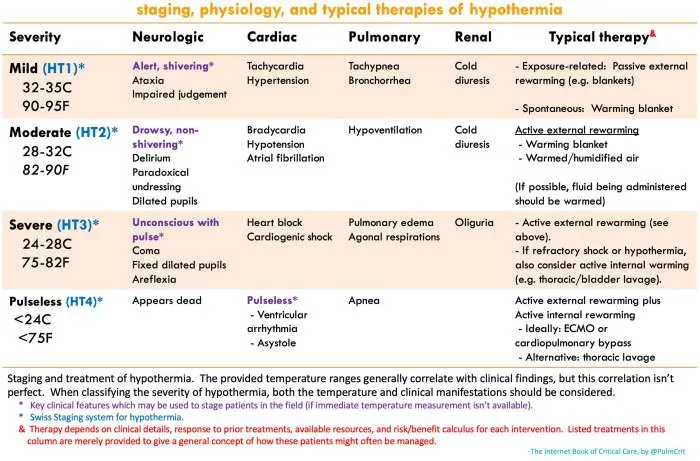
- Hypothermia causes **vasoconstriction** in the periphery, which leads to **increased peripheral resistance**, not decreased.
- This effect helps redirect blood flow to vital organs during cold exposure.
*Cardiac arrhythmias*
- Hypothermia significantly increases the risk of **cardiac arrhythmias**, especially **ventricular fibrillation**, as myocardial excitability changes [1].
- The most common ECG changes include a **prolonged PR interval**, **widened QRS complex**, and the presence of **J (Osborn) waves** [2].
*Renal failure*
- Severe hypothermia can lead to **acute kidney injury** or **renal failure** due to reduced renal blood flow, direct cellular damage, and rhabdomyolysis [1], [3].
- Decreased kidney function can also impair the excretion of drugs and metabolic waste products.
*Reversible coagulopathy*
- Hypothermia causes a **reversible coagulopathy** due to impaired platelet function, decreased activity of coagulation factors, and increased fibrinolysis.
- This can manifest as increased bleeding tendencies, particularly in trauma patients.
Hypothermia Indian Medical PG Question 5: Osborne waves in an ECG are seen in
- A. Hypothermia (Correct Answer)
- B. Hypokalemia
- C. Hypothyroidism
- D. Hypocalcemia
Hypothermia Explanation: ***Hypothermia***
- **Osborne waves**, also known as **J waves**, are characteristic ECG findings in **hypothermia**, appearing as a hump or positive deflection at the junction between the QRS complex and the ST segment.
- They become more prominent as the **body temperature drops**, reflecting delayed ventricular repolarization [2].
*Hypokalemia*
- Hypokalemia is associated with **U waves** on the ECG, which are typically small deflections following the T wave, not Osborne waves [1].
- Other ECG changes include **flattened T waves** and **ST-segment depression**.
*Hypothyroidism*
- Hypothyroidism can lead to **sinus bradycardia** and **low voltage QRS complexes** on an ECG.
- It does not specifically cause Osborne waves.
*Hypocalcemia*
- Hypocalcemia primarily manifests as a **prolonged QT interval** on the ECG due to delayed ventricular repolarization.
- **Osborne waves** are not a typical finding in hypocalcemia.
Hypothermia Indian Medical PG Question 6: What is the most consistent cardiovascular effect of hypothermia in elderly patients?
- A. May cause myocardial infarction
- B. Decreased heart rate (Correct Answer)
- C. Decreased cardiac output
- D. All of the options
Hypothermia Explanation: ***Decreased heart rate***
- In elderly patients, **hypothermia consistently leads to a decrease in heart rate (bradycardia)**, a physiological response to conserve energy and reduce metabolic demand
- This **bradycardia** is a hallmark sign of hypothermia across various age groups, but it is particularly pronounced and dangerous in the elderly due to their reduced physiological reserve
- **Heart rate decreases by approximately 3-5 beats per minute for every 1°C drop in core temperature** below 35°C, making it the most predictable and consistent cardiovascular finding
*May cause myocardial infarction*
- While severe hypothermia can precipitate **myocardial ischemia or infarction** due to increased myocardial oxygen demand from shivering, catecholamine release, and coronary vasoconstriction, it is not the *most consistent* cardiovascular effect across all degrees of hypothermia
- **Myocardial infarction** is a serious complication, but occurs less predictably than bradycardia and depends on pre-existing coronary artery disease
*Decreased cardiac output*
- **Cardiac output** does generally decrease in hypothermia due to the combined effects of **bradycardia and reduced myocardial contractility**
- However, the initial and most consistent direct effect is the **slowing of the heart rate**, which then contributes to the overall decrease in cardiac output
- Cardiac output falls by approximately **25-40% at core temperatures below 32°C**
*All of the options*
- While hypothermia can contribute to myocardial infarction and does decrease cardiac output, the **most consistent and universal cardiovascular effect is bradycardia**
- Not all hypothermic patients will develop MI, and the decrease in cardiac output is a *consequence* of bradycardia and reduced contractility rather than a primary direct effect
Hypothermia Indian Medical PG Question 7: Most common cause of death in electric AC current burns is
- A. Hemorrhagic stroke
- B. Cardiac arrest (Correct Answer)
- C. Septic shock
- D. Myoglobinuria leading to ARF
Hypothermia Explanation: ***Cardiac arrest***
- **Alternating current (AC)** is particularly lethal because it can induce **ventricular fibrillation** at relatively low voltages, directly disrupting the heart's electrical activity.
- The constant muscle contraction and relaxation caused by AC current can lead to prolonged exposure to electricity and increased risk of **arrhythmias** and cardiac arrest.
*Hemorrhagic stroke*
- While electrical injuries can sometimes lead to cerebrovascular events, **hemorrhagic stroke** is not the most common immediate cause of death from AC burns.
- Neurological complications are generally less immediate and frequent than direct cardiac effects in acute deaths from electric shock.
*Septic shock*
- **Septic shock** is a complication of severe burns, including electrical burns, but it typically occurs in the **later stages** as a result of infection.
- It is not the most immediate or common cause of death following the initial electric shock.
*Myoglobinuria leading to ARF*
- **Myoglobinuria** and subsequent **acute renal failure (ARF)** can occur due to extensive muscle damage from electrical burns.
- This is a significant complication of severe electrical injury but tends to develop in the **hours to days** following the injury, rather than being the most common immediate cause of death, which is typically cardiac.
Hypothermia Indian Medical PG Question 8: Which wave is seen in the given EEG recording?
- A. Alpha waves
- B. Beta waves
- C. Epsilon wave
- D. Delta waves (Correct Answer)
Hypothermia Explanation: ***Delta waves***
- The highlighted EEG activity shows **large amplitude, low-frequency waves** (typically 0.5-4 Hz), which are characteristic of delta waves.
- Delta waves are normally associated with **deep sleep** (NREM stage 3) or **pathological conditions** in awake adults, indicating significant brain dysfunction.
*Alpha waves*
- Alpha waves have a frequency range of **8-13 Hz** and typically appear when an individual is in a relaxed, awake state with eyes closed.
- The waves in the image are much slower and higher in amplitude than typical alpha waves.
*Beta waves*
- Beta waves are characterized by a higher frequency range of **14-30 Hz** and are associated with active thinking, alertness, and concentration.
- The observed activity is significantly slower and higher in amplitude than beta waves.
*Epsilon wave*
- The term "epsilon wave" is not a standard classification for EEG brain waves in the context of normal or common pathological activity, unlike alpha, beta, theta, and delta waves.
- In cardiology, "epsilon wave" refers to a specific finding on an ECG in **Arrhythmogenic Right Ventricular Cardiomyopathy (ARVC)**, not an EEG.
Hypothermia Indian Medical PG Question 9: The lead of ECG marked as $X$ is called:
- A. Lewis lead (Correct Answer)
- B. V4R
- C. aVR
- D. V_{a}
Hypothermia Explanation: ***Lewis lead***
- This image displays the placement of electrodes for a **Lewis lead** ECG, used to enhance the detection of **atrial activity**, particularly for P waves.
- The Lewis lead involves placing the right arm electrode (usually from a standard ECG setup) at the **right sternal border in the second intercostal space**, and the left arm electrode at the **right parasternal border in the fourth intercostal space**.
*V4R*
- **V4R** is a right-sided precordial lead used to detect **right ventricular infarction** and is placed in the fifth intercostal space at the right midclavicular line.
- The electrode placement shown in the image is not consistent with V4R.
*aVR*
- **aVR** is an augmented unipolar limb lead that records electrical activity from the **right arm** relative to the average of the left arm and left leg electrodes.
- It is not a chest lead placement, and therefore does not correspond to the image.
*V_{a}*
- **V_{a}** is not a standard or recognized ECG lead designation in clinical practice.
- The commonly used precordial leads are denoted as V1 through V6.
Hypothermia Indian Medical PG Question 10: Regarding haemorrhagic shock, which one of the following statements is correct?
- A. Tachycardia presents in 100% of hypovolemic patients
- B. Clinically manifested when > 10% of loss of total blood volume occurs
- C. Loss of 40% of circulating volume is life threatening (Correct Answer)
- D. In acute stage of shock, systemic vasodilation becomes evident
Hypothermia Explanation: ***Loss of 40% of circulating volume is life threatening***
- A loss of **40% or more** of circulating blood volume corresponds to **Class IV haemorrhagic shock**, which is a severe, life-threatening condition requiring immediate and aggressive resuscitation.
- At this stage, the body's compensatory mechanisms are overwhelmed, leading to profound systemic hypoperfusion, **organ dysfunction**, and a high risk of mortality.
*Tachycardia presents in 100% of hypovolemic patients*
- While **tachycardia** is a common compensatory mechanism in hypovolemia, it is not present in 100% of patients due to factors such as **beta-blocker use** or **pacemaker rhythm**.
- In some early stages of blood loss, especially in young, healthy individuals, sufficient compensatory mechanisms may delay the onset of significant tachycardia.
*Clinically manifested when > 10% of loss of total blood volume occurs*
- Haemorrhagic shock is typically **clinically manifest** when there is a blood loss greater than **15%** (Class I shock), which represents approximately 750 mL in an average adult.
- A loss of **less than 10%** often does not produce overt clinical signs as the body's compensatory mechanisms can effectively maintain vital signs within normal ranges.
*In acute stage of shock, systemic vasodilation becomes evident*
- In the acute stage of hemorrhagic shock, the body's primary compensatory mechanism is **systemic vasoconstriction**, not vasodilation, to maintain central blood pressure and perfuse vital organs.
- **Vasodilation** can occur in the later, decompensated stages of shock, particularly in instances of **septic or neurogenic shock**, leading to a further drop in blood pressure.
More Hypothermia Indian Medical PG questions available in the OnCourse app. Practice MCQs, flashcards, and get detailed explanations.