Neuromuscular Junction Indian Medical PG Practice Questions and MCQs
Practice Indian Medical PG questions for Neuromuscular Junction. These multiple choice questions (MCQs) cover important concepts and help you prepare for your exams.
Neuromuscular Junction Indian Medical PG Question 1: Which of the following is a characteristic feature of myasthenia gravis?
- A. Decreased levels of myosin in muscle fibers
- B. Absence of troponin C in muscle fibers
- C. Increased transmission at the myoneural junction
- D. Presence of antibodies against acetylcholine receptors (Correct Answer)
Neuromuscular Junction Explanation: ***Presence of antibodies against acetylcholine receptors***
- **Myasthenia gravis** is an **autoimmune disorder** characterized by the production of **antibodies against acetylcholine receptors** at the neuromuscular junction [1].
- These antibodies block, alter, or destroy the acetylcholine receptors, leading to impaired nerve-to-muscle communication and **muscle weakness** [2].
*Decreased levels of myosin in muscle fibers*
- Myosin is a **motor protein** crucial for muscle contraction, and its decreased levels are not a primary feature of myasthenia gravis, but rather other **myopathies** or muscle wasting conditions.
- The disease mechanism in myasthenia gravis is primarily at the **neuromuscular junction**, not within the muscle fibers themselves.
*Absence of troponin C in muscle fibers*
- **Troponin C** is a component of the troponin complex essential for **calcium-mediated muscle contraction**, found inside muscle fibers.
- Its absence would lead to severe and widespread muscle dysfunction, unlike the specific and fluctuating weakness seen in **myasthenia gravis**.
*Increased transmission at the myoneural junction*
- Myasthenia gravis is characterized by **decreased** or **impaired transmission** at the myoneural (neuromuscular) junction due to the destruction or blockade of acetylcholine receptors [2].
- Increased transmission would lead to **muscle hyperactivity** or spasms, which is contrary to the **fatigable weakness** observed in myasthenia gravis.
Neuromuscular Junction Indian Medical PG Question 2: Acetylcholine release can be increased from presynaptic membrane by:
- A. Blocking voltage gated K+ channels on presynaptic membrane (Correct Answer)
- B. Blocking voltage gated Cl- channels on presynaptic membrane
- C. Blocking voltage gated Na+ channels on presynaptic membrane
- D. Blocking voltage gated Ca2+ channels on presynaptic membrane
Neuromuscular Junction Explanation: ***Blocking voltage gated K+ channels on presynaptic membrane***
- Blocking **voltage-gated K+ channels** prevents repolarization, prolonging the **action potential** duration and keeping the presynaptic membrane depolarized for a longer time.
- This extended depolarization leads to increased opening of **voltage-gated Ca2+ channels**, allowing more Ca2+ influx and thus enhancing **acetylcholine release**.
*Blocking voltage gated Cl- channels on presynaptic membrane*
- **Chloride channels** primarily contribute to establishing the **resting membrane potential** or mediating inhibitory postsynaptic potentials, and their direct blocking does not primarily enhance acetylcholine release.
- An increase in intracellular Cl- concentration could lead to depolarization, but specific voltage-gated Cl- channels are not the primary regulators of **neurotransmitter release**.
*Blocking voltage gated Na+ channels on presynaptic membrane*
- **Voltage-gated Na+ channels** are essential for the **initiation and propagation of action potentials**; blocking them would prevent depolarization.
- Preventing depolarization would inhibit, rather than increase, the opening of voltage-gated Ca2+ channels and subsequently **acetylcholine release**.
*Blocking voltage gated Ca2+ channels on presynaptic membrane*
- **Voltage-gated Ca2+ channels** are directly responsible for the influx of Ca2+ into the presynaptic terminal, which is the crucial trigger for **neurotransmitter release**.
- Blocking these channels would **reduce or abolish Ca2+ influx**, thereby *decreasing* rather than increasing acetylcholine release.
Neuromuscular Junction Indian Medical PG Question 3: Which receptors are blocked in Myasthenia Gravis?
- A. ACh receptors (Correct Answer)
- B. Opioid receptors
- C. Na+ receptors
- D. Ca++ receptors
Neuromuscular Junction Explanation: ***Ach receptors***
- Myasthenia Gravis is an **autoimmune disease** where **antibodies** block, alter, or destroy the **nicotinic acetylcholine receptors** at the **neuromuscular junction** [1], [2].
- This blockage prevents **acetylcholine** from binding to the receptors, leading to impaired muscle contraction and **muscle weakness** [1].
*Ca++ receptors*
- **Calcium channels** (not "receptors" in this context) are involved in the release of **acetylcholine** from the presynaptic terminal, but they are not the primary target in Myasthenia Gravis [1].
- While calcium influx is crucial for neurotransmitter release, the problem in Myasthenia Gravis lies postsynaptically, at the **acetylcholine receptor** [2].
*Na+ receptors*
- **Sodium channels** are essential for generating and propagating **action potentials** in muscle fibers after acetylcholine binds and opens the acetylcholine receptor.
- They are not directly targeted by autoantibodies in Myasthenia Gravis; the issue occurs upstream, preventing the initial depolarization signal [2].
*Opioid receptors*
- **Opioid receptors** are involved in pain modulation and other central nervous system functions, primarily binding endorphins and exogenous opioids.
- They have no role in the pathophysiology of Myasthenia Gravis, which is a disorder of the **neuromuscular junction** [2].
**References:**
[1] Kumar V, Abbas AK, et al.. Robbins and Cotran Pathologic Basis of Disease. 9th ed. Diseases of the Immune System, pp. 213-214.
[2] Kumar V, Abbas AK, et al.. Robbins and Cotran Pathologic Basis of Disease. 9th ed. Peripheral Nerves and Skeletal Muscles, pp. 1237-1239.
Neuromuscular Junction Indian Medical PG Question 4: Retinal cells which secrete acetylcholine are:
- A. Bipolar cells
- B. Ganglion cells
- C. Amacrine cells (Correct Answer)
- D. Horizontal cells
Neuromuscular Junction Explanation: ***Amacrine cells***
- A subpopulation of **amacrine cells** in the retina is known to be **cholinergic**, meaning they synthesize and release **acetylcholine**.
- These cholinergic amacrine cells play a role in **directional selectivity** and spatial processing within the retina.
*Bipolar cells*
- **Bipolar cells** primarily act as interneurons that transmit signals from photoreceptors to ganglion cells in the retina.
- They typically release **glutamate** as their neurotransmitter, not acetylcholine.
*Ganglion cells*
- **Ganglion cells** are the output neurons of the retina, whose axons form the **optic nerve**.
- While they receive input from cholinergic amacrine cells, ganglion cells themselves do not secrete acetylcholine; they are primarily glutamatergic.
*Horizontal cells*
- **Horizontal cells** are interneurons that provide lateral inhibition in the outer plexiform layer of the retina.
- They primarily release **GABA** (gamma-aminobutyric acid) as their neurotransmitter, not acetylcholine.
Neuromuscular Junction Indian Medical PG Question 5: What is the neurotransmitter primarily involved in muscle contraction?
- A. Glutamate
- B. Acetylcholine (Correct Answer)
- C. Dopamine
- D. Serotonin
Neuromuscular Junction Explanation: ***Acetylcholine***
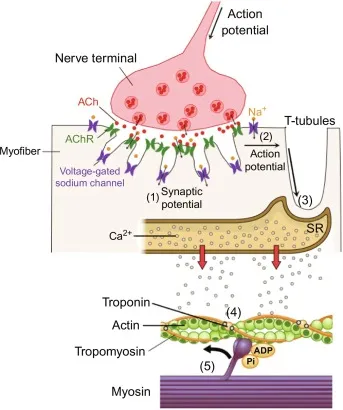
- **Acetylcholine (ACh)** acts at the **neuromuscular junction** to initiate muscle contraction by binding to nicotinic receptors on the muscle fiber membrane.
- This binding causes depolarization and triggers the release of **calcium** from the sarcoplasmic reticulum, essential for the interaction of actin and myosin filaments.
*Glutamate*
- **Glutamate** is the primary **excitatory neurotransmitter** in the central nervous system, mainly involved in synaptic transmission, learning, and memory.
- It does not mediate signal transmission at the **neuromuscular junction** for skeletal muscle contraction.
*Dopamine*
- **Dopamine** is a neurotransmitter involved in reward, motivation, and motor control pathways within the **central nervous system** (basal ganglia).
- It does not play a direct role in the peripheral process of **skeletal muscle contraction** at the neuromuscular junction.
*Serotonin*
- **Serotonin** primarily regulates mood, sleep, appetite, and gastrointestinal function in the **central nervous system**.
- It is not involved in directly signaling **skeletal muscle fibers** for contraction at the neuromuscular junction.
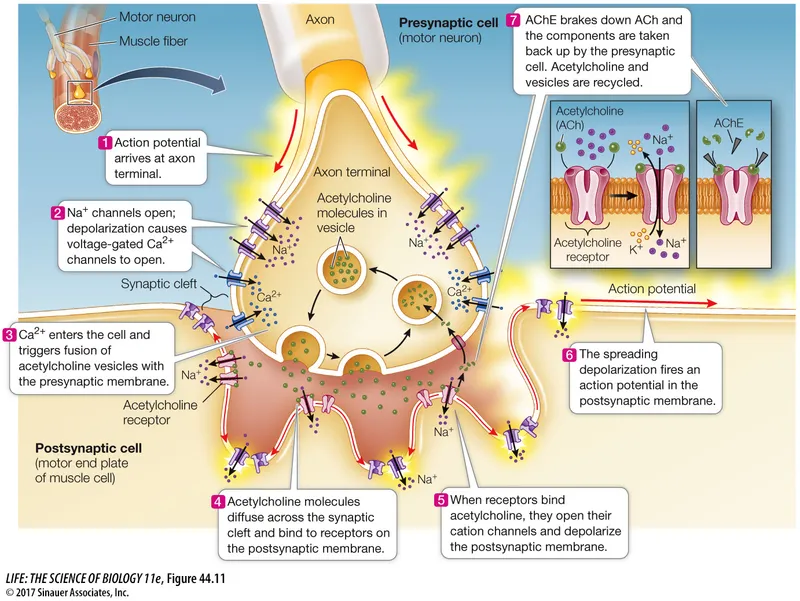
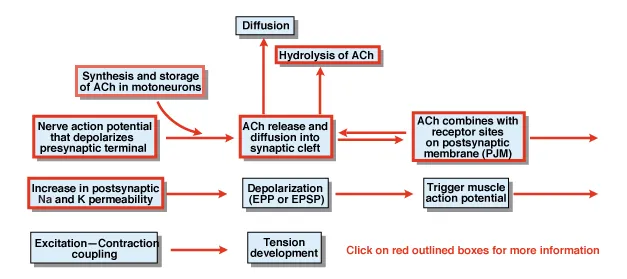
Neuromuscular Junction Indian Medical PG Question 6: Sequence the events in neuromuscular action potential conduction:
1. Sodium channels open in the end plate
2. Calcium enters at the nerve terminal
3. Release of acetylcholine
- A. $1 \rightarrow 2 \rightarrow 3$
- B. $1 \rightarrow 3 \rightarrow 2$
- C. $3 \rightarrow 2 \rightarrow 1$
- D. $2 \rightarrow 3 \rightarrow 1$ (Correct Answer)
Neuromuscular Junction Explanation: ***Correct: $2 \rightarrow 3 \rightarrow 1$***
- **Calcium entry at the nerve terminal** is the initial trigger - when an action potential reaches the presynaptic nerve terminal, voltage-gated calcium channels open, allowing Ca²⁺ influx
- **Acetylcholine release** follows - the increased intracellular calcium causes synaptic vesicles containing acetylcholine to fuse with the presynaptic membrane and release the neurotransmitter into the synaptic cleft
- **Sodium channels open in the end plate** last - acetylcholine binds to nicotinic receptors on the motor end plate, opening ligand-gated sodium channels, which depolarizes the muscle membrane and triggers muscle contraction
*Incorrect: $1 \rightarrow 2 \rightarrow 3$*
- Places sodium channel opening first, which is physiologically impossible
- Sodium channels at the motor end plate only open in response to acetylcholine binding
- Cannot occur before acetylcholine is released from the nerve terminal
*Incorrect: $1 \rightarrow 3 \rightarrow 2$*
- Incorrectly sequences sodium channel opening before calcium entry
- Violates the fundamental principle that calcium influx is required for neurotransmitter release
- Acetylcholine cannot be released without prior calcium entry
*Incorrect: $3 \rightarrow 2 \rightarrow 1$*
- Places acetylcholine release before calcium entry, which is impossible
- Calcium-triggered exocytosis is an absolute requirement for neurotransmitter release
- Without calcium influx, vesicles cannot fuse with the presynaptic membrane
Neuromuscular Junction Indian Medical PG Question 7: In the context of muscle physiology, which structure is described as a threadlike component that extends along the length of a muscle fiber?
- A. Sarcomere
- B. Sarcolemma
- C. Myofibril (Correct Answer)
- D. Myofilament
Neuromuscular Junction Explanation: ***Myofibril***
- A **myofibril** is a cylindrical organelle that runs longitudinally inside a muscle fiber and contains **contractile proteins**.
- Myofibrils are composed of repeating units called **sarcomeres**, which are the fundamental units of muscle contraction.
*Sarcomere*
- A **sarcomere** is the basic contractile unit of a muscle fiber, extending from one Z-disc to the next.
- While it is a key component for muscle contraction, it is a **segment within a myofibril**, not the threadlike component that extends the entire length of the fiber.
*Sarcolemma*
- The **sarcolemma** is the cell membrane of a muscle fiber, responsible for transmitting nerve impulses to the muscle cell.
- It encloses the muscle fiber but is not an internal, threadlike contractile component.
*Myofilament*
- **Myofilaments** are the individual protein filaments (actin and myosin) that make up a sarcomere within a myofibril.
- They are the **smallest contractile elements**, but they are not the threadlike structure that extends along the entire muscle fiber.
Neuromuscular Junction Indian Medical PG Question 8: A person was given a muscle relaxant that competitively blocks nicotinic receptors. Which of the following drugs is used for reversal of muscle relaxation after surgery?
- A. Succinylcholine
- B. Physostigmine
- C. Carbachol
- D. Neostigmine (Correct Answer)
Neuromuscular Junction Explanation: ***Neostigmine***
- **Neostigmine** is an **acetylcholinesterase inhibitor** that increases the amount of **acetylcholine** at the neuromuscular junction, allowing it to compete more effectively with the muscle relaxant for **nicotinic receptors**.
- By increasing the concentration of endogenous acetylcholine, it can reverse the effects of **competitive neuromuscular blockers**.
*Succinylcholine*
- **Succinylcholine** is a **depolarizing neuromuscular blocker** that initially activates and then desensitizes nicotinic receptors, causing transient fasciculations followed by paralysis.
- It would worsen muscle relaxation rather than reversing it, as it acts as an **agonist at nicotinic receptors**.
*Physostigmine*
- **Physostigmine** is an **acetylcholinesterase inhibitor** that readily crosses the **blood-brain barrier** and is primarily used for its central nervous system effects, such as reversing anticholinergic toxicity.
- While it prolongs the action of acetylcholine, its primary site of action and clinical uses are different from reversing peripheral muscle relaxation.
*Carbachol*
- **Carbachol** is a **direct-acting cholinergic agonist** that stimulates both **muscarinic** and **nicotinic receptors**.
- While it acts on nicotinic receptors, it would not be a suitable choice for reversing a competitive neuromuscular block as it also has significant **muscarinic side effects** and its direct agonism would not effectively overcome the competitive block.
Neuromuscular Junction Indian Medical PG Question 9: The electromyogram (EMG) is least useful for the diagnosis of:
- A. Myasthenia gravis
- B. Charcot-Marie-Tooth disease
- C. Spinal muscular atrophy
- D. Cerebral palsy (Correct Answer)
Neuromuscular Junction Explanation: ***Cerebral palsy***
- Cerebral palsy is a **disorder of movement and posture** caused by non-progressive brain damage, primarily affecting the **upper motor neurons**.
- While EMG can assess muscle activity, its primary role is in evaluating **lower motor neuron diseases** and **neuromuscular junction disorders**, making it less directly useful for diagnosing a central nervous system disorder like cerebral palsy.
*Myasthenia gravis*
- EMG, particularly **repetitive nerve stimulation**, is highly useful for diagnosing myasthenia gravis by revealing a **decremental response** in the compound muscle action potential due to impaired neuromuscular transmission [1].
- It directly assesses the function of the **neuromuscular junction**, which is the site of pathology in myasthenia gravis [1].
*Charcot-Marie-Tooth disease*
- EMG and **nerve conduction studies (NCS)** are crucial for diagnosing Charcot-Marie-Tooth disease by demonstrating **abnormal nerve conduction velocities** (demyelinating forms) or **reduced amplitude** of compound muscle action potentials (axonal forms) which indicate peripheral nerve damage.
- The findings help characterize the type and severity of **peripheral neuropathy**, a hallmark of this condition.
*Spinal muscular atrophy*
- EMG is essential for diagnosing spinal muscular atrophy by showing **denervation and reinnervation changes** in muscles, such as **fibrillations**, **positive sharp waves**, and **large-amplitude, long-duration motor unit potentials** [1].
- These findings reflect the loss of **anterior horn cells** and subsequent attempts by surviving motor neurons to reinnervate muscle fibers.
Neuromuscular Junction Indian Medical PG Question 10: Intense local pain, swelling, ecchymoses, and oozing of hemolyzed blood from the site of a snake bite is most likely to occur with a bite from which species of snake?
- A. Cobra
- B. Viper (Correct Answer)
- C. Sea snakes
- D. None of the options
Neuromuscular Junction Explanation: Viper
- **Viper** venoms are primarily **hemotoxic**, leading to significant local tissue damage, including **intense pain, swelling**, and **ecchymosis** due to capillary damage and hemorrhage [1].
- The **hemolyzed blood oozing** from the bite site is a classic sign of the proteolytic and coagulopathic effects of viper venom [1].
Cobra
- **Cobra** venom is predominantly **neurotoxic**, causing neurological symptoms like **paralysis, ptosis**, and respiratory failure, rather than severe local tissue destruction [1].
- While some local swelling can occur, it is generally **less pronounced** and not associated with extensive ecchymoses or hemolyzed blood oozing compared to viper bites [1].
Sea snakes
- **Sea snake** venom is mainly **myotoxic**, leading to **muscle paralysis** and breakdown (rhabdomyolysis), which can cause muscle aches [1].
- Local symptoms at the bite site are often **minimal or absent**, and severe local pain, swelling, and ecchymosis are not typical features [1].
*None of the options*
- This option is incorrect because **vipers** specifically cause the described symptoms.
More Neuromuscular Junction Indian Medical PG questions available in the OnCourse app. Practice MCQs, flashcards, and get detailed explanations.