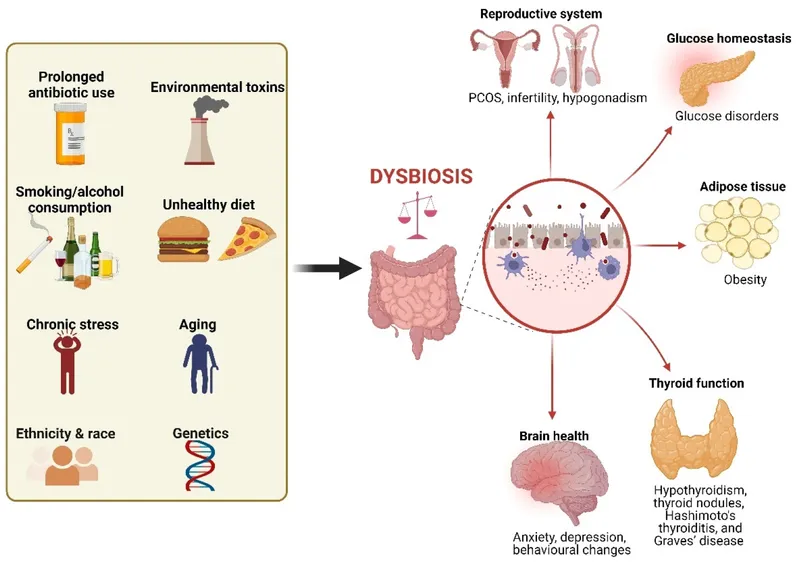
Gut Microbiome Indian Medical PG Practice Questions and MCQs
Practice Indian Medical PG questions for Gut Microbiome. These multiple choice questions (MCQs) cover important concepts and help you prepare for your exams.
Gut Microbiome Indian Medical PG Question 1: What is the physiological reflex responsible for post-meal defecation in children?
- A. Gastro colic reflex (Correct Answer)
- B. Gastro gastric reflex
- C. Vasovagal reflex
- D. Colonoileal reflex
Gut Microbiome Explanation: ***Gastro colic reflex***
- This reflex is a **physiological response** to stomach distention by food, leading to increased motility in the **colon**.
- It explains why bowel movements, especially in infants and young children, often occur shortly **after eating**.
*Gastro gastric reflex*
- This reflex primarily involves communication **between different parts of the stomach**, controlling gastric motility and emptying.
- It does not directly induce colonic contractions or defecation after a meal.
*Vasovagal reflex*
- The vasovagal reflex is a systemic response involving the **vagus nerve** that can cause a drop in heart rate and blood pressure, leading to fainting.
- While it can be triggered by various stimuli, it is not the mechanism responsible for post-meal defecation.
*Colonoileal reflex*
- This reflex occurs when the colon is distended, slowing the movement of chyme from the **ileum into the colon**.
- Its primary function is to prevent overloading the colon, not to stimulate post-meal defecation.
Gut Microbiome Indian Medical PG Question 2: Sudha, a 20-year-old female, developed antibiotic-associated pseudomembranous colitis caused by Clostridium difficile. Among the following drugs, which is most likely to be effective in the treatment of this disease?
- A. Metronidazole (Correct Answer)
- B. Ampicillin
- C. Clindamycin
- D. Chloramphenicol
Gut Microbiome Explanation: ***Metronidazole***
- Among the options listed, **Metronidazole** is the most effective for treating **Clostridioides difficile infection (CDI)**.
- It works by disrupting bacterial DNA synthesis and is highly effective against **anaerobic bacteria** like *C. difficile*.
- **Note:** Current guidelines (IDSA/SHEA 2021) recommend **oral vancomycin or fidaxomicin as first-line therapy**, with metronidazole reserved for situations where preferred agents are unavailable. However, among the drugs listed here, metronidazole remains the correct choice.
*Ampicillin*
- **Ampicillin** is a penicillin-class antibiotic and is **ineffective** against *Clostridioides difficile*.
- It is one of the antibiotics that can **trigger** antibiotic-associated pseudomembranous colitis by disrupting normal gut flora and promoting *C. difficile* overgrowth.
*Clindamycin*
- **Clindamycin** is notorious for being a common cause of **antibiotic-associated pseudomembranous colitis** due to *Clostridioides difficile*.
- It would **exacerbate** rather than treat the condition, making it an inappropriate choice.
*Chloramphenicol*
- **Chloramphenicol** is a broad-spectrum antibiotic that is **not effective** for treating *Clostridioides difficile* infection.
- Its use is limited due to significant side effects, including **bone marrow suppression** (aplastic anemia), and it is not a recommended treatment for CDI.
Gut Microbiome Indian Medical PG Question 3: Which of the following organisms is an obligate intracellular bacterium that commonly causes sexually transmitted infections?
- A. Mycoplasma
- B. Chlamydia (Correct Answer)
- C. Rickettsia
- D. Prion
Gut Microbiome Explanation: ***Chlamydia***
- **Chlamydia trachomatis** is a classic example of an **obligate intracellular bacterium** that is a leading cause of sexually transmitted infections (STIs).
- It has a unique biphasic developmental cycle, alternating between an infectious **elementary body** and a replicative **reticulate body** within host cells.
*Rickettsia*
- **Rickettsia** species are also **obligate intracellular bacteria** but are primarily transmitted via **arthropod vectors** (e.g., ticks, fleas, lice), causing diseases like **Rocky Mountain spotted fever** and **typhus**.
- They are not typically associated with **sexually transmitted infections** in humans.
*Mycoplasma*
- **Mycoplasma** species are bacteria characterized by the **absence of a cell wall**, but they are generally **extracellular** or **intracellular but not obligate**.
- While some *Mycoplasma* species can cause STIs (e.g., *Mycoplasma genitalium*), they do not fit the description of an **obligate intracellular bacterium** in the same way *Chlamydia* does (which requires host cell machinery for energy production).
*Prion*
- A **prion** is an **infectious protein particle** that lacks genetic material (DNA or RNA) and causes transmissible spongiform encephalopathies (TSEs), such as **Creutzfeldt-Jakob disease**.
- It is not a bacterium and is not associated with **sexually transmitted infections**.
Gut Microbiome Indian Medical PG Question 4: The differentiating feature between IBS and organic GI disease is:
- A. Pain abdomen
- B. Mucus in stools
- C. Diarrhea
- D. Presence of inflammation indicated by elevated stool calprotectin (Correct Answer)
Gut Microbiome Explanation: ***Presence of inflammation indicated by elevated stool calprotectin***
- Elevated **stool calprotectin** is a reliable biomarker for **gastrointestinal inflammation**, indicating an **organic GI disease** such as inflammatory bowel disease (IBD).
- **Irritable bowel syndrome (IBS)** is a functional disorder and typically does not involve **inflammation**, so stool calprotectin levels would be normal.
*Diarrhea*
- **Diarrhea** can be a symptom of both **IBS** (specifically IBS-D) and various **organic GI diseases** (e.g., Crohn's disease, ulcerative colitis, celiac disease) [1].
- Therefore, its presence alone does not differentiate between a functional and an organic cause [1].
*Pain abdomen*
- **Abdominal pain** is a cardinal symptom of **IBS**, specifically related to bowel movements [1].
- It is also a very common symptom in many **organic GI diseases**, making it a non-specific differentiating feature.
*Mucus in stools*
- **Mucus in stools** can occur in **IBS**, often due to increased colonic transit or irritation, but without underlying inflammation [1].
- It can also be present in **organic GI diseases**, particularly those involving inflammation or structural changes in the bowel.
Gut Microbiome Indian Medical PG Question 5: Which cells are referred to as "Pacemaker cells" with relation to "BER"?
- A. SA node
- B. AV node
- C. Interstitial cells of Cajal (Correct Answer)
- D. Pyramidal cells
Gut Microbiome Explanation: ***Interstitial cells of Cajal***
- The **Interstitial cells of Cajal (ICC)** are specialized cells in the gastrointestinal tract that act as the **pacemaker cells** for the **Basic Electrical Rhythm (BER)**.
- They generate slow waves of **depolarization** and **repolarization**, which determine the frequency and rhythm of smooth muscle contractions.
*SA node*
- The **sinoatrial (SA) node** is the natural pacemaker of the **heart**, initiating the cardiac electrical impulse.
- It controls the heart rate, not the **BER** of the gastrointestinal tract.
*AV node*
- The **atrioventricular (AV) node** is part of the heart's electrical conduction system, responsible for delaying and transmitting impulses from the atria to the ventricles.
- It does not regulate the **BER** of the gastrointestinal system.
*Pyramidal cells*
- **Pyramidal cells** are a type of neuron found in various parts of the brain, particularly the cerebral cortex and hippocampus.
- They are involved in cognitive functions and motor control, and have no role in generating the **BER** in the gut.
Gut Microbiome Indian Medical PG Question 6: Inhibition of myenteric plexus results in
- A. Hyperacidity
- B. Diarrhea
- C. Decreased gut motility (Correct Answer)
- D. Increased secretions
Gut Microbiome Explanation: ***Decreased gut motility***
- The **myenteric plexus** (Auerbach's plexus) is primarily responsible for regulating **gastrointestinal motility**, including peristalsis and muscle contraction.
- Its inhibition would therefore lead to **reduced peristaltic movements** and **decreased gut motility**.
*Hyperacidity*
- **Gastric acid secretion** is mainly regulated by the vagus nerve (via acetylcholine), gastrin, and histamine, not directly by the myenteric plexus.
- While gut motility can indirectly affect acid exposure, a primary and direct consequence of myenteric plexus inhibition is not hyperacidity.
*Diarrhea*
- **Diarrhea** is typically caused by increased gut motility, increased secretion, or decreased absorption.
- Inhibition of the myenteric plexus would lead to **decreased motility**, making diarrhea an unlikely outcome.
*Increased secretions*
- **Gastrointestinal secretions** are largely controlled by the submucosal plexus (Meissner's plexus) and hormonal factors.
- While the myenteric plexus has some indirect influence, its primary role is motility, and its inhibition would not directly lead to increased secretions.
Gut Microbiome Indian Medical PG Question 7: Slow wave potential originates in which of the following structures in the intestine:
- A. Interstitial cells of Cajal (Correct Answer)
- B. Smooth muscle cells
- C. Myenteric plexus
- D. Parasympathetic neurons
Gut Microbiome Explanation: ***Interstitial cells of Cajal***
- The **interstitial cells of Cajal (ICCs)** are specialized **pacemaker cells** located throughout the gastrointestinal tract.
- They generate spontaneous rhythmic depolarizations and repolarizations of the cell membrane, known as **slow waves**, which set the pace for smooth muscle contractions.
*Smooth muscle cells*
- While smooth muscle cells are the target of slow waves and contract in response to them, they do not **spontaneously generate** the slow waves themselves.
- Their contractions are primarily regulated by the **electrical activity** transmitted from the ICCs.
*Myenteric plexus*
- The **myenteric plexus (Auerbach's plexus)** is a network of neurons that primarily controls **gastrointestinal motility**.
- It modulates the frequency and amplitude of contractions but does not originate the fundamental rhythm of slow waves.
*Parasympathetic neurons*
- **Parasympathetic neurons** regulate various gastrointestinal functions, including motility and secretion, by releasing **neurotransmitters** like acetylcholine.
- They can modulate the activity of ICCs and smooth muscle cells but are not the source of the electrical slow wave potentials themselves.
Gut Microbiome Indian Medical PG Question 8: Primary component of nonadrenergic noncholinergic nerve transmission in gut is:
- A. VIP and Substance P
- B. VIP and CCK
- C. VIP and NO (Correct Answer)
- D. VIP and Motilin
Gut Microbiome Explanation: ***VIP and NO***
- **Vasoactive Intestinal Peptide (VIP)** and **Nitric Oxide (NO)** are the primary neurotransmitters mediating the **nonadrenergic noncholinergic (NANC) transmission** in the gut.
- The NANC system is crucial for **gut motility, secretion, and relaxation of smooth muscle** beyond the actions of adrenergic and cholinergic systems.
*VIP and substance*
- While **VIP** is a key NANC neurotransmitter, **Substance P** primarily mediates excitatory effects, particularly in pain transmission and inflammatory responses in the gut, rather than being a primary NANC inhibitory transmitter.
- Substance P is often co-released with acetylcholine or acts independently to **stimulate smooth muscle contraction** and secretion, not relaxation.
*VIP and CCK*
- Although **VIP** is a significant NANC neurotransmitter, **Cholecystokinin (CCK)** is a peptide hormone primarily involved in stimulating gallbladder contraction and pancreatic enzyme secretion, and it acts as a neuromodulator rather than a primary NANC neurotransmitter.
- CCK plays a significant role in **digestion and satiety**, but its role in NANC transmission is not as central as NO for smooth muscle relaxation.
*VIP and Motilin*
- **VIP** is a critical NANC neurotransmitter, but **Motilin** is a peptide hormone that primarily stimulates **gastric and intestinal motility** during fasting (migrating motor complex).
- Motilin's main function is related to cyclical contractions of the gut, and it is not considered a primary direct neurotransmitter in the NANC system.
Gut Microbiome Indian Medical PG Question 9: Which hormone is secreted by the "Delta cells" of the stomach?
- A. Cholecystokinin
- B. Gastrin-releasing peptide
- C. Somatostatin (Correct Answer)
- D. Secretin
Gut Microbiome Explanation: ***Somatostatin***
- **Delta cells (D cells)** in the stomach and pancreas secrete **somatostatin**, a potent inhibitory hormone.
- Somatostatin **inhibits the release of gastrin**, histamine, secretin, cholecystokinin, and gastric acid secretion, acting as a "universal off switch."
*Cholecystokinin*
- **Cholecystokinin (CCK)** is primarily secreted by **I cells** in the duodenum and jejunum.
- Its main functions include stimulating gallbladder contraction and pancreatic enzyme secretion.
*Gastrin-releasing peptide*
- **Gastrin-releasing peptide (GRP)**, also known as **bombesin**, is a neuropeptide released from **enteric neurons**.
- It stimulates the release of **gastrin** from G cells.
*Secretin*
- **Secretin** is secreted by **S cells** in the duodenum in response to acidic chyme entering the small intestine.
- Its primary role is to stimulate the pancreas to release **bicarbonate-rich fluid** to neutralize gastric acid.
Gut Microbiome Indian Medical PG Question 10: A 50-year-old woman with long-standing diabetes presents with severe, watery diarrhea that wakes her at night. Stool studies show normal osmotic gap and negative stool cultures. Colonoscopy is normal. Trial of fasting does not improve diarrhea. Gastric emptying study shows delayed emptying. What neurotransmitter deficiency in the enteric nervous system best explains both her gastric and colonic dysmotility?
- A. Acetylcholine
- B. Serotonin
- C. Vasoactive intestinal peptide
- D. Substance P
- E. Nitric oxide (Correct Answer)
Gut Microbiome Explanation: ***Nitric oxide***
- In diabetic autonomic neuropathy, the loss of **nitric oxide (NO)**-producing neurons impairs **inhibitory signals**, leading to uncoordinated gastric contractions and delayed gastric emptying (**gastroparesis**).
- NO deficiency in the colon disrupts normal **segmental contractions**, potentially leading to rapid transit and **secretory diarrhea** that persists during fasting and occurs nocturnally.
*Acetylcholine*
- This is the primary **excitatory neurotransmitter** in the enteric nervous system, responsible for stimulating bowel contraction and secretions.
- A deficiency would typically cause **atony** or paralytic ileus rather than the specific combination of gastroparesis and secretory diarrhea described.
*Serotonin*
- Serotonin (5-HT) is involved in initiating **peristaltic reflexes** and modulating visceral sensation via enterochromaffin cells.
- While altered levels are linked to irritable bowel syndrome, it is not the classic inhibitory neurotransmitter lost in **diabetic autonomic neuropathy**.
*Vasoactive intestinal peptide*
- VIP is an inhibitory neurotransmitter that promotes **smooth muscle relaxation** and stimulates intestinal fluid secretion.
- An excess of VIP (e.g., VIPoma) causes secretory diarrhea, but a **deficiency** would not explain the dysmotility and secretory patterns seen in diabetes as effectively as NO loss.
*Substance P*
- Substance P is a co-transmitter with **acetylcholine** that mediates excitatory signals and smooth muscle contraction.
- Deficiency would primarily lead to decreased **motor activity** rather than the loss of inhibitory coordination characteristic of diabetic enteric neuropathy.
More Gut Microbiome Indian Medical PG questions available in the OnCourse app. Practice MCQs, flashcards, and get detailed explanations.