Cardiac Output and Its Regulation Indian Medical PG Practice Questions and MCQs
Practice Indian Medical PG questions for Cardiac Output and Its Regulation. These multiple choice questions (MCQs) cover important concepts and help you prepare for your exams.
Cardiac Output and Its Regulation Indian Medical PG Question 1: All of the following are the causes of High output cardiac failure, except?
- A. Systemic AV shunt
- B. Beri beri
- C. Anemia
- D. Cor pulmonale (Correct Answer)
Cardiac Output and Its Regulation Explanation: ***Cor pulmonale***
- **Cor pulmonale** is **right-sided heart failure** [1] caused by **pulmonary hypertension**, which is typically a low-output state unless accompanied by other contributing factors.
- While it affects cardiac function, it fundamentally involves increased pulmonary vascular resistance leading to ventricular dysfunction, not an increase in **cardiac output**.
*Systemic AV shunt*
- A **systemic AV shunt** can cause high-output heart failure by diverting a significant volume of blood directly from the arterial to the venous system, bypassing the capillary beds.
- This significantly **increases venous return** and **cardiac preload**, requiring the heart to pump more blood to maintain adequate systemic perfusion.
*Beri beri*
- **Beri-beri heart disease**, caused by severe **thiamine (vitamin B1) deficiency**, leads to high-output cardiac failure due to **peripheral vasodilation**.
- This vasodilation markedly **reduces systemic vascular resistance**, increasing venous return and necessitating a higher cardiac output to maintain blood pressure.
*Anemia*
- **Severe anemia** causes high-output cardiac failure because the reduced oxygen-carrying capacity of the blood forces the heart to significantly **increase cardiac output** to meet the body's metabolic demands.
- This compensatory mechanism involves both an **increased heart rate** and **stroke volume** to ensure adequate tissue oxygenation despite lower hemoglobin levels.
Cardiac Output and Its Regulation Indian Medical PG Question 2: What physiological mechanism leads to an increase in cardiac output?
- A. Inhalation
- B. Increased myocardial contractility (Correct Answer)
- C. Increased parasympathetic activity
- D. Transitioning from a supine to a standing position
Cardiac Output and Its Regulation Explanation: ***Increased myocardial contractility***
- **Increased myocardial contractility** directly leads to a greater **stroke volume** (the amount of blood pumped with each beat), thus increasing cardiac output (Cardiac Output = Stroke Volume × Heart Rate).
- This can be stimulated by factors such as **sympathetic nervous system activation** or positive inotropic agents.
*Inhalation*
- While inhalation can temporarily affect venous return and intrathoracic pressure, it does not directly or consistently lead to a sustained increase in **cardiac output**.
- Its primary effect is on **respiration**, not cardiac performance.
*Increased parasympathetic activity*
- Increased parasympathetic activity, primarily via the **vagus nerve**, acts to **decrease heart rate** and myocardial contractility.
- This effect would typically **reduce cardiac output**, not increase it.
*Transitioning from a supine to a standing position*
- Transitioning to a standing position usually causes a **temporary decrease in venous return** and a brief drop in cardiac output as blood pools in the lower extremities.
- The body then compensates by increasing heart rate and peripheral vascular resistance to maintain blood pressure, but the initial effect on cardiac output is generally a transient decrease.
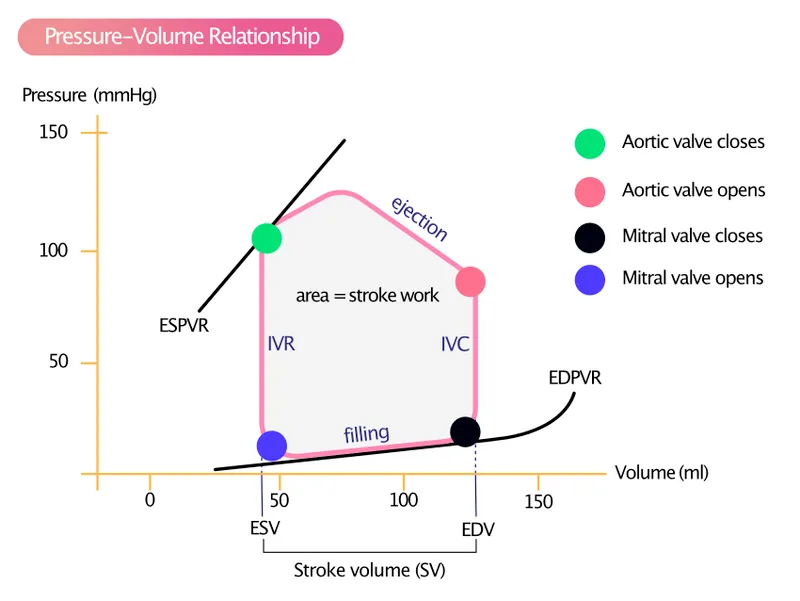
Cardiac Output and Its Regulation Indian Medical PG Question 3: From the given pressure-volume curve, identify the end-diastolic volume (EDV) and end-systolic volume (ESV), then calculate the ejection fraction using the formula EF = (EDV - ESV)/EDV × 100%.
- A. 40%
- B. 50%
- C. 55%
- D. 60% (Correct Answer)
Cardiac Output and Its Regulation Explanation: ***60%***
- From the pressure-volume loop, the **end-diastolic volume (EDV)** is the volume at point 'a', which is **130 mL**.
- The **end-systolic volume (ESV)** is the volume at point 'd', which is **50 mL**.
- Using the formula EF = (EDV - ESV) / EDV × 100% = (130 mL - 50 mL) / 130 mL × 100% = 80 mL / 130 mL × 100% = **61.5%**, which rounds to **60%** (the closest option).
*40%*
- To obtain an ejection fraction of 40%, the ESV would need to be higher, or the EDV lower, than what is indicated by the points 'a' and 'd' on the graph.
- (130 - ESV) / 130 = 0.40 => 130 - ESV = 52 => ESV = 78 mL. This isn't consistent with the graph.
*50%*
- An ejection fraction of 50% would mean that the heart ejected half of its EDV.
- (130 - ESV) / 130 = 0.50 => 130 - ESV = 65 => ESV = 65 mL. This value for ESV is not depicted at point 'd'.
*55%*
- For an ejection fraction of 55%, the calculation would yield a different ESV than what is presented in the curve.
- (130 - ESV) / 130 = 0.55 => 130 - ESV = 71.5 => ESV = 58.5 mL. This is not the ESV at point 'd'.
Cardiac Output and Its Regulation Indian Medical PG Question 4: What is the primary cardiovascular compensatory mechanism in acute hemorrhage?
- A. Decreased myocardial contractility
- B. Increased respiratory rate
- C. Decreased heart rate
- D. Increased heart rate (Correct Answer)
Cardiac Output and Its Regulation Explanation: ***Increased heart rate***
- In acute hemorrhage, the body senses a decrease in **blood volume** and **blood pressure**, triggering the **baroreceptor reflex**.
- This reflex leads to increased sympathetic nervous system activity, causing an immediate compensatory **increase in heart rate** to maintain **cardiac output** and tissue perfusion.
*Decreased myocardial contractility*
- A decrease in myocardial contractility would worsen the situation in hemorrhage by further reducing **cardiac output** and is not a primary compensatory mechanism.
- While prolonged severe hemorrhage can lead to myocardial depression due to ischemia, it is a pathological consequence, not a compensatory response.
*Decreased heart rate*
- A decrease in heart rate would reduce **cardiac output** and further compromise blood flow to vital organs during hemorrhage, which is precisely the opposite of what the body needs.
- This response is usually seen with vagal stimulation, not in response to hypovolemic shock.
*Increased respiratory rate*
- An **increased respiratory rate** is a compensatory mechanism for conditions like **metabolic acidosis** (which can occur in severe shock due to lactic acid accumulation) or to improve oxygenation, but it is not the primary cardiovascular compensatory mechanism for maintaining blood pressure and cardiac output in acute hemorrhage.
- While it often accompanies hemorrhage, it acts to regulate oxygen and CO2 levels, not directly blood volume or pressure.
Cardiac Output and Its Regulation Indian Medical PG Question 5: Best guide for the management of Resuscitation is:
- A. Saturation of Oxygen
- B. CVP
- C. Blood pressure
- D. Urine output (Correct Answer)
Cardiac Output and Its Regulation Explanation: ***Urine output***
- **Urine output** is considered the **gold standard** for assessing adequacy of resuscitation as it directly reflects **end-organ perfusion** and **tissue oxygenation**. A target of **0.5-1 mL/kg/hour** indicates adequate renal perfusion and overall circulatory status.
- It serves as a reliable **endpoint of resuscitation** in trauma and critical care protocols, providing objective evidence that fluid resuscitation has achieved adequate **tissue perfusion** and **microcirculatory flow**.
*Saturation of Oxygen*
- While **oxygen saturation** is crucial for ensuring adequate **oxygen delivery** to tissues, it represents only one component of the oxygen delivery equation and doesn't reflect **tissue perfusion** adequacy.
- Maintaining normal oxygen saturation does not guarantee adequate **end-organ perfusion** if cardiac output or tissue perfusion is compromised during resuscitation.
*CVP*
- **Central venous pressure** has poor correlation with actual **intravascular volume status** and **cardiac preload**, making it an unreliable guide for fluid resuscitation.
- CVP measurements are influenced by multiple factors including **ventilator settings**, **tricuspid valve function**, and **chest wall compliance**, limiting its utility as a resuscitation endpoint.
*Blood pressure*
- While **blood pressure** provides immediate feedback on **circulatory status** and is emphasized in current **ACLS** and **ATLS** protocols as an immediate target, it may not accurately reflect **microcirculatory perfusion**.
- Blood pressure can be maintained through **vasoconstriction** while **end-organ perfusion** remains inadequate, making it less reliable than urine output for assessing true resuscitation adequacy.
Cardiac Output and Its Regulation Indian Medical PG Question 6: All are cardiovascular system changes in pregnancy except.
- A. Increase in blood volume
- B. Increase in heart rate
- C. Increase in peripheral resistance (Correct Answer)
- D. Increase in cardiac output
Cardiac Output and Its Regulation Explanation: ***Increase in peripheral resistance***
- During normal pregnancy, **peripheral vascular resistance actually decreases** due to the effects of hormones like progesterone and the presence of the low-resistance uteroplacental circulation.
- This decrease in resistance helps accommodate the increased blood volume and cardiac output.
*Increase in cardiac output*
- **Cardiac output increases significantly** during pregnancy (by 30-50%) to meet the metabolic demands of the growing fetus and maternal tissues.
- This is primarily achieved through an increase in both stroke volume and heart rate.
*Increase in blood volume*
- **Blood volume increases substantially** (by 30-50%) during pregnancy, with plasma volume increasing more than red blood cell mass.
- This expansion supports the increased cardiac output and placental perfusion.
*Increase in heart rate*
- **Heart rate increases** during pregnancy, typically by 10-20 beats per minute, contributing to the overall increase in cardiac output.
- This physiological adaptation helps maintain adequate circulation.
Cardiac Output and Its Regulation Indian Medical PG Question 7: During heavy exercise the cardiac output (CO) increases up to five fold while pulmonary arterial pressure rises very little. This physiological ability of the pulmonary circulation is best explained by
- A. Large amount of smooth muscle in pulmonary arterioles
- B. Increase in the number of open capillaries (Correct Answer)
- C. Sympathetically mediated greater distensibility of pulmonary vessels
- D. Smaller surface area of pulmonary circulation
Cardiac Output and Its Regulation Explanation: ***Increase in the number of open capillaries***
- During heavy exercise, the significant increase in cardiac output is accommodated by the **recruitment of previously closed pulmonary capillaries**.
- This recruitment, along with **distension of existing capillaries**, reduces overall pulmonary vascular resistance, allowing blood flow to increase without a substantial rise in pulmonary arterial pressure.
*Large amount of smooth muscle in pulmonary arterioles*
- While pulmonary arterioles do contain smooth muscle, their primary role is in **regulating regional blood flow** and response to hypoxia, not facilitating large increases in overall blood flow during exercise.
- The pulmonary circulation is characterized by **low resistance** and high capacitance compared to the systemic circulation, meaning it has less smooth muscle tone at baseline.
*Sympathetically mediated greater distensibility of pulmonary vessels*
- The pulmonary vasculature has **limited sympathetic innervation** compared to systemic vessels, and sympathetic activity plays a minor role in its distensibility during exercise.
- Changes in pulmonary vascular resistance during exercise are primarily due to **mechanical factors** (recruitment and distension) rather than neurogenic control.
*Smaller surface area of pulmonary circulation*
- The pulmonary circulation actually has a **vast capillary surface area** crucial for efficient gas exchange.
- A smaller surface area would lead to **higher resistance** and a greater pressure increase for a given flow, which contradicts the observation during exercise.
Cardiac Output and Its Regulation Indian Medical PG Question 8: A shift of posture from supine to upright posture is associated with cardiovascular adjustments. Which of the following is NOT true in this context?
- A. Rise in heart rate
- B. Decrease in cardiac output
- C. Decrease in central venous pressure
- D. Rise in central venous pressure (Correct Answer)
Cardiac Output and Its Regulation Explanation: ***Rise in central venous pressure***
- When a person moves from a supine to an upright posture, gravity causes **blood pooling in the lower extremities**, leading to a *decrease* in venous return to the heart, not a rise in central venous pressure.
- A decrease in central venous pressure is an expected physiological response to orthostasis due to the aforementioned venous pooling.
*Decrease in central venous pressure*
- This statement is physiologically *true* because gravity causes blood to pool in the lower limbs, reducing venous return and subsequently lowering the central venous pressure.
- The **baroreflex** responds to this fall, attempting to restore blood pressure.
*Rise in heart rate*
- This is a normal physiological response to orthostatic stress, mediated by the **baroreflex**, to maintain cardiac output and blood pressure against gravity.
- The sympathetic nervous system increases **heart rate** and contractility to compensate for reduced venous return.
*Decrease in cardiac output*
- Upon standing, the initial reduction in venous return leads to a transient decrease in **stroke volume**, which, despite the compensatory rise in heart rate, often results in a net *decrease* in cardiac output.
- This is a normal and expected cardiovascular adjustment as the body adapts to the upright position.
Cardiac Output and Its Regulation Indian Medical PG Question 9: The following data were obtained from a man weighing 70 kg: Aorta oxygen (O2) content is 20.0 vol%, femoral vein O2 content is 16 vol%, coronary sinus O2 content is 10 vol%, and pulmonary artery O2 content is 15 vol%. What is the cardiac output of this man, given a total body O2 consumption of 400 ml/min?
- A. 10 L/min
- B. 8 L/min (Correct Answer)
- C. 6 L/min
- D. 5 L/min
Cardiac Output and Its Regulation Explanation: ***8 L/min***
- The cardiac output is calculated using the **Fick principle**: CO = Total body O2 consumption / (Arterial O2 content - Mixed venous O2 content).
- In this case, **Arterial O2 content is 20 vol%** and **Mixed venous O2 content (pulmonary artery) is 15 vol%**. So, CO = 400 ml/min / (20 vol% - 15 vol%) = 400 ml/min / 5 ml O2/100 ml blood = 400 / 0.05 = 8000 ml/min = **8 L/min**.
*10 L/min*
- This result would be obtained if the arteriovenous oxygen difference was smaller, specifically 4 vol% (400 / 0.04 = 10000 ml/min).
- This calculation does not correctly use the given **mixed venous O2 content** from the pulmonary artery.
*6 L/min*
- This result would be obtained if the arteriovenous oxygen difference was larger, specifically 6.67 vol% (400 / 0.0667 ≈ 6000 ml/min).
- This calculation misrepresents the **actual O2 extraction** from the arterial blood.
*5 L/min*
- This result would be obtained if the arteriovenous oxygen difference was 8 vol% (400 / 0.08 = 5000 ml/min).
- This choice indicates an incorrect application of the **Fick principle** or misidentification of the relevant oxygen content values.
Cardiac Output and Its Regulation Indian Medical PG Question 10: If the contractility of the heart is decreased, which of the following is seen ?
- A. Increased ejection fraction
- B. Increased stroke work
- C. Decreased stroke volume (Correct Answer)
- D. Increased cardiac output
Cardiac Output and Its Regulation Explanation: ***Decreased stroke volume***
- A decrease in the **contractility** of the heart directly reduces the force of myocardial contraction.
- This weaker contraction results in less blood being ejected from the ventricle per beat, leading to a **decreased stroke volume**.
*Increased ejection fraction*
- **Ejection fraction** is the percentage of blood ejected from the ventricle with each beat, calculated as (stroke volume / end-diastolic volume) x 100.
- When contractility decreases, **stroke volume** decreases, which would typically lead to a *decreased* ejection fraction, not an increased one.
*Increased stroke work*
- **Stroke work** is a measure of the work done by the ventricle to eject blood, and it depends on both stroke volume and aortic pressure.
- With decreased contractility, **stroke volume** falls, which would *decrease* the stroke work, assuming afterload remains constant.
*Increased cardiac output*
- **Cardiac output** is the product of stroke volume and heart rate (CO = SV x HR).
- Since decreased contractility leads to a **decreased stroke volume**, without a compensatory increase in heart rate, cardiac output would *decrease*, not increase.
More Cardiac Output and Its Regulation Indian Medical PG questions available in the OnCourse app. Practice MCQs, flashcards, and get detailed explanations.