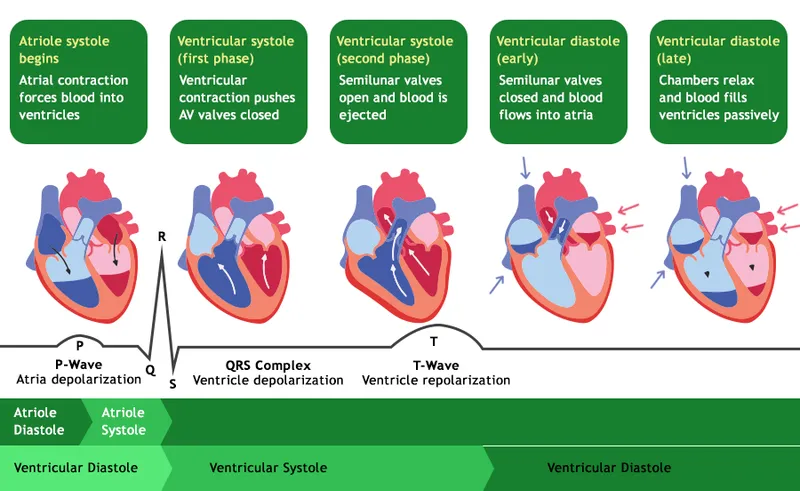
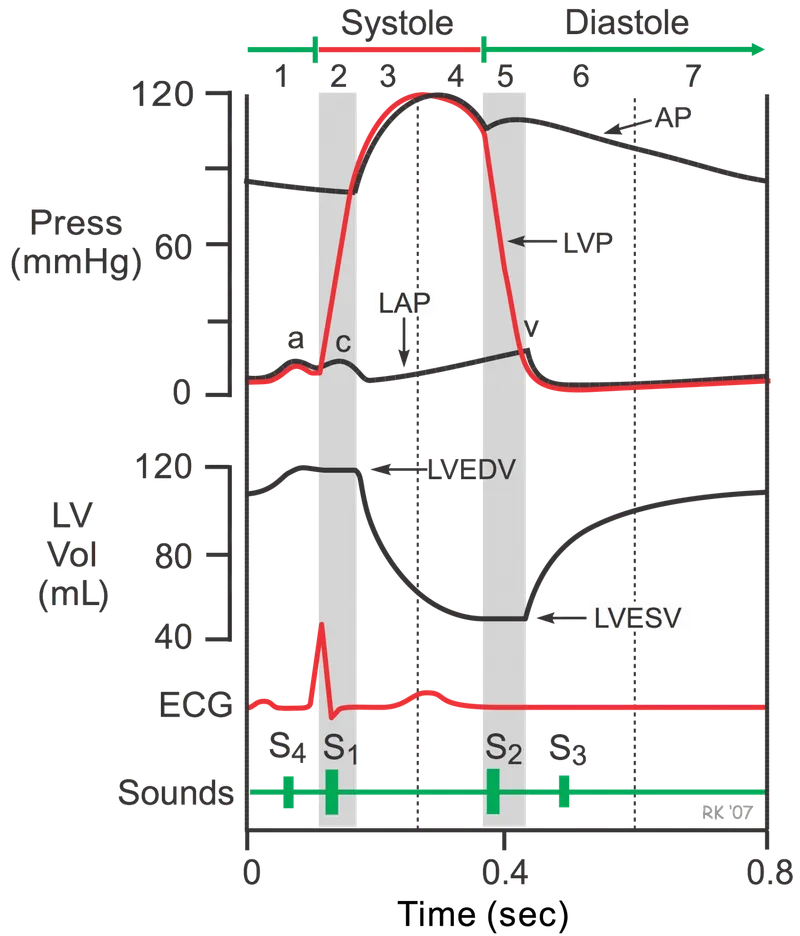
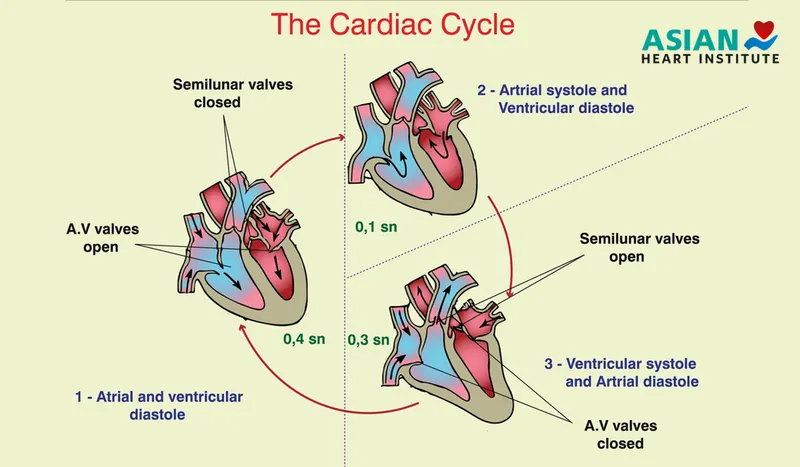
Cardiac Cycle Indian Medical PG Practice Questions and MCQs
Practice Indian Medical PG questions for Cardiac Cycle. These multiple choice questions (MCQs) cover important concepts and help you prepare for your exams.
Cardiac Cycle Indian Medical PG Question 1: Cardiac event at the end of isometric relaxation phase:
- A. Atrioventricular valves open (Correct Answer)
- B. Corresponds to T wave in ECG
- C. Atrioventricular valves close
- D. Corresponds to peak of C wave in JVP
Cardiac Cycle Explanation: ***Atrioventricular valves open***
- This event marks the end of isometric relaxation, where ventricular pressure has dropped below atrial pressure, allowing the **mitral and tricuspid valves** to open and ventricular filling to begin.
- During **isometric relaxation**, the ventricles relax without changing volume, causing a rapid drop in intraventricular pressure until it is overcome by atrial pressure.
*Corresponds to T wave in ECG*
- The **T wave** on an ECG represents **ventricular repolarization**, which occurs during the early part of ventricular diastole, *before* the end of isometric relaxation when the AV valves open.
- The opening of AV valves occurs a bit later, as ventricular filling phase commences.
*Atrioventricular valves close*
- The closing of the **atrioventricular valves** (mitral and tricuspid) occurs at the beginning of **isovolumetric contraction (systole)**, not at the end of isometric relaxation (diastole).
- This event marks the start of ventricular systole and is associated with the **first heart sound (S1)**.
*Corresponds to peak of C wave in JVP*
- The **C wave** in the jugular venous pressure (JVP) tracing corresponds to the bulging of the **tricuspid valve** into the right atrium during early ventricular systole, immediately after the AV valves close.
- This event is distinct from the end of isometric relaxation, which occurs later in diastole, *before* atrial filling.
Cardiac Cycle Indian Medical PG Question 2: Aortic valve closure occurs in which part of cardiac cycle?
- A. Beginning of isovolumetric contraction
- B. During rapid ventricular filling
- C. Beginning of ventricular ejection
- D. Beginning of isovolumetric relaxation (Correct Answer)
Cardiac Cycle Explanation: ***Beginning of isovolumetric relaxation***
- Aortic valve closure marks the end of **ventricular systole** and the start of **isovolumetric relaxation**, as blood ceases to be ejected and the ventricle begins to relax while remaining closed.
- This event corresponds to the **second heart sound (S2)** and signifies the beginning of a period where ventricular volume remains constant, but pressure drops.
*Beginning of isovolumetric contraction*
- This phase begins with the closure of the **mitral and tricuspid valves** (first heart sound, S1), as ventricular pressure rises but volume remains constant before ejection.
- The aortic valve is still closed at this point, as ventricular pressure is not yet high enough to open it.
*Beginning of ventricular ejection*
- This phase begins when the **aortic valve opens** as ventricular pressure exceeds aortic pressure, allowing blood to be ejected from the left ventricle.
- Aortic valve closure occurs *after* ejection, not at its beginning.
*During rapid ventricular filling*
- Rapid ventricular filling occurs when the **mitral valve opens** (following isovolumetric relaxation), allowing blood to flow from the atria into the ventricles.
- During this phase, the aortic valve is closed, but its closure happened earlier, at the beginning of isovolumetric relaxation.
Cardiac Cycle Indian Medical PG Question 3: Identify the diagnosis based on the provided ECG image.
- A. VT
- B. PSVT (Correct Answer)
- C. AT
- D. Ventricular fibrillation
Cardiac Cycle Explanation: ***PSVT***
- The ECG shows a **narrow complex tachycardia** with a regular rhythm and a high heart rate, characteristic of **paroxysmal supraventricular tachycardia (PSVT)**.
- P waves are often **buried within the QRS complex** or T waves, or may be retrograde, which can be seen as small deflections or changes in the baseline in some leads.
*VT*
- **Ventricular tachycardia** is characterized by a **wide QRS complex** (>0.12 seconds), which is not observed in this ECG.
- While VT can be regular, the primary distinguishing feature is the QRS duration.
*AT*
- **Atrial tachycardia (AT)** is another form of supraventricular tachycardia, but it typically shows **distinct P waves** with an abnormal morphology, often separate from the T wave, which are not clearly visible or consistently distinct in this tracing.
- While it can present with narrow complex tachycardia, the mechanism differs from re-entrant PSVT.
*Ventricular fibrillation*
- **Ventricular fibrillation** is characterized by **chaotic, irregular electrical activity** with no distinguishable P waves, QRS complexes, or T waves, representing disorganized ventricular depolarization.
- The ECG in the image shows a consistent, regular rhythm with identifiable, albeit narrow, QRS complexes.
Cardiac Cycle Indian Medical PG Question 4: All of the following statements about the third heart sound (S3) are true, except:
- A. Seen in Atrial Septal Defect (ASD)
- B. Seen in Ventricular Septal Defect (VSD)
- C. Occurs due to rapid filling of the ventricles during early diastole.
- D. Seen in Constrictive Pericarditis (Correct Answer)
Cardiac Cycle Explanation: ***Seen in Constrictive Pericarditis***
- While constrictive pericarditis can lead to a diastolic sound, it's typically a **pericardial knock**, which is sharper and occurs earlier than an S3, due to abrupt halting of ventricular filling.
- A true S3 is a low-pitched sound caused by turbulent blood flow into an overly compliant or volume-overloaded ventricle, which is not the primary mechanism in constrictive pericarditis.
*Occurs due to rapid filling of the ventricles during early diastole.*
- The S3 heart sound is precisely caused by the **rapid inflow of blood** into a dilated or poorly compliant ventricle during the early, rapid filling phase of diastole [1].
- This rapid distension causes vibrations in the ventricular wall, audible as S3, and is often associated with conditions causing **volume overload** or **ventricular dysfunction**.
*Seen in Atrial Septal Defect (ASD)*
- Patients with a large ASD have increased blood flow through the tricuspid valve, leading to **right ventricular volume overload** [2].
- This increased volume can cause an **S3** sound, particularly a **right ventricular S3**, due to rapid filling of the overloaded right ventricle [2].
*Seen in Ventricular Septal Defect (VSD)*
- A significant VSD leads to a **left-to-right shunt**, increasing blood flow to the pulmonary circulation and subsequently returning to the left atrium and left ventricle.
- This **left ventricular volume overload** can result in an audible **left ventricular S3**, reflecting rapid filling of the dilated left ventricle.
Cardiac Cycle Indian Medical PG Question 5: If the contractility of the heart is decreased, which of the following is seen ?
- A. Increased ejection fraction
- B. Increased stroke work
- C. Decreased stroke volume (Correct Answer)
- D. Increased cardiac output
Cardiac Cycle Explanation: ***Decreased stroke volume***
- A decrease in the **contractility** of the heart directly reduces the force of myocardial contraction.
- This weaker contraction results in less blood being ejected from the ventricle per beat, leading to a **decreased stroke volume**.
*Increased ejection fraction*
- **Ejection fraction** is the percentage of blood ejected from the ventricle with each beat, calculated as (stroke volume / end-diastolic volume) x 100.
- When contractility decreases, **stroke volume** decreases, which would typically lead to a *decreased* ejection fraction, not an increased one.
*Increased stroke work*
- **Stroke work** is a measure of the work done by the ventricle to eject blood, and it depends on both stroke volume and aortic pressure.
- With decreased contractility, **stroke volume** falls, which would *decrease* the stroke work, assuming afterload remains constant.
*Increased cardiac output*
- **Cardiac output** is the product of stroke volume and heart rate (CO = SV x HR).
- Since decreased contractility leads to a **decreased stroke volume**, without a compensatory increase in heart rate, cardiac output would *decrease*, not increase.
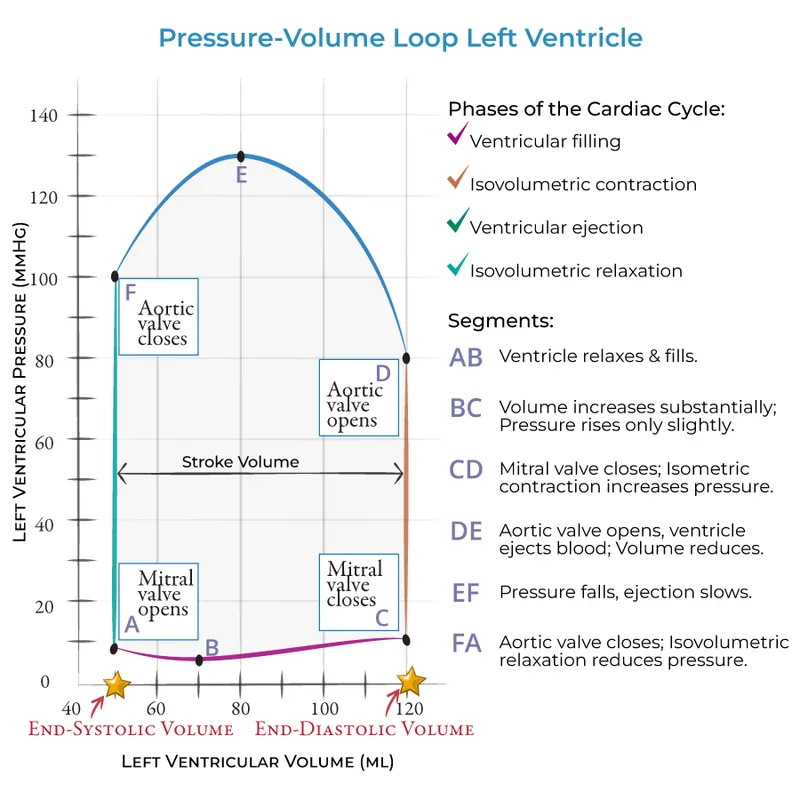
Cardiac Cycle Indian Medical PG Question 6: Pressure-Volume loop of cardiac cycle is shown below. What does point C represent?
- A. Aortic valve closes
- B. Mitral valve closes
- C. Aortic valve opens (Correct Answer)
- D. Mitral valve opens
Cardiac Cycle Explanation: ***Aortic valve opens***
- Point C represents the critical moment when the **left ventricular pressure** surpasses the **aortic pressure**, causing the aortic valve to open.
- This event marks the beginning of the **ejection phase**, where blood is pumped from the left ventricle into the aorta.
*Mitral valve opens*
- The mitral valve opens at point A, signaling the start of **ventricular filling** as blood flows from the left atrium into the left ventricle.
- At this point, the left ventricular pressure is at its lowest, and the volume begins to increase.
*Mitral valve closes*
- The mitral valve closes at point B, indicating the end of **ventricular filling** and the start of **isovolumetric contraction**.
- This closure prevents backflow of blood into the left atrium as the ventricle begins to contract.
*Aortic valve closes*
- The aortic valve closes at point F, which signifies the end of **ejection** and the beginning of **isovolumetric relaxation**.
- At this point, the left ventricular pressure falls below aortic pressure, and the ventricle begins to relax without changing volume.
Cardiac Cycle Indian Medical PG Question 7: What is the correct sequence of phases that follows isovolumic contraction in the cardiac cycle?
- A. Ejection, Isovolumic relaxation (Correct Answer)
- B. Rapid filling, Diastasis
- C. Atrial systole, Isovolumic contraction
- D. Diastasis, Atrial systole
Cardiac Cycle Explanation: ***Ejection, Isovolumic relaxation***
- Following **isovolumic contraction**, ventricular pressure exceeds aortic pressure, causing the aortic valve to open and blood to be ejected from the ventricle.
- After ejection, the aortic valve closes, and the ventricle relaxes without a change in volume, leading to **isovolumic relaxation**.
*Rapid filling, Diastasis*
- These phases occur during **ventricular diastole**, specifically after isovolumic relaxation, when the mitral valve opens and blood flows from the atria into the ventricles.
- They represent the filling stages of the cardiac cycle, not the immediate phases after isovolumic contraction.
*Diastasis, Atrial systole*
- **Diastasis** is a late phase of ventricular filling, where blood flows slowly into the ventricles.
- **Atrial systole** (atrial contraction) occurs at the very end of ventricular diastole, just before isovolumic contraction, to push the final volume of blood into the ventricles.
*Atrial systole, Isovolumic contraction*
- **Atrial systole** precedes **isovolumic contraction** in the cardiac cycle.
- Isovolumic contraction is the phase where ventricular pressure rapidly increases while volume remains constant, just before blood is ejected.
Cardiac Cycle Indian Medical PG Question 8: Which of the following is correct about the pressure volume loop of left ventricle?
- A. 1 to 2 indicates isovolumetric relaxation
- B. 2 to 3 indicates ventricular diastole
- C. Aortic valve opens at 2 (Correct Answer)
- D. Pulmonic valve opens at 3
Cardiac Cycle Explanation: ***Aortic valve opens at 2***
- Point 2 marks the moment when **left ventricular pressure exceeds aortic pressure**, causing the aortic valve to open.
- This is the transition point between **isovolumetric contraction** (1→2) and **ventricular ejection** (2→3).
- From point 2 onwards, blood is actively ejected from the left ventricle into the aorta during **systole**.
*1 to 2 indicates isovolumetric relaxation*
- The phase from point 1 to point 2 shows an increase in **pressure at constant volume**, which represents **isovolumetric contraction**, not relaxation.
- During **isovolumetric contraction**, both the mitral and aortic valves are closed, and the ventricle contracts without changing volume, building up pressure.
- **Isovolumetric relaxation** occurs from point 3 to point 4, where pressure drops at constant volume after the aortic valve closes.
*2 to 3 indicates ventricular diastole*
- The period from point 2 to point 3 represents **ventricular ejection**, which is part of **ventricular systole**, not diastole.
- During this phase, the aortic valve is open, and blood is being ejected from the left ventricle into the aorta while ventricular volume decreases.
- **Ventricular diastole** includes isovolumetric relaxation (3→4) and ventricular filling (4→1).
*Pulmonic valve opens at 3*
- Point 3 represents the **closure of the aortic valve** at the end of ventricular ejection, not its opening.
- The **pulmonic valve** is part of the right ventricular circuit, not the left ventricle; it opens during right ventricular ejection into the pulmonary artery.
- This question specifically addresses the **left ventricular** pressure-volume loop.
Cardiac Cycle Indian Medical PG Question 9: The recording of cardiac cycle is drawn below. Which of the following is correct about $X$ and $Y$ shown in the image?
- A. $X=$ Pre-ejection period and $Y=$ LV ejection time (Correct Answer)
- B. $X=$ Pre-ejection period and $Y=$ Electromechanical systole
- C. $X=$ LV ejection time and $Y=$ Pre-ejection period
- D. $X=$ Electromechanical systole and $Y=$ LV ejection time
Cardiac Cycle Explanation: ***X = Pre-ejection period and Y = LV ejection time***
- **X** corresponds to the **pre-ejection period (PEP)**, which is the time from the onset of ventricular depolarization (Q wave on ECG) to the opening of the aortic valve (AO). It includes the **isovolumetric contraction time**.
- **Y** corresponds to the **left ventricular (LV) ejection time (LVET)**, which is the interval from the opening of the aortic valve (AO) to its closure (AC), during which blood is ejected into the aorta.
*X = Pre-ejection period and Y = Electromechanical systole*
- While X correctly represents the **pre-ejection period**, Y is not the **electromechanical systole**.
- **Electromechanical systole** is the total time from the Q wave on the ECG to the closure of the aortic valve (AC), encompassing both PEP and LVET.
*X = LV ejection Time and Y = Pre-ejection period*
- This option incorrectly identifies X as **LV ejection time** and Y as the **pre-ejection period**.
- The diagram clearly shows X precedes Y, with X representing the initial phase of ventricular contraction before ejection.
*X = Electromechanical systole and Y = LV ejection time*
- This option incorrectly identifies X as **electromechanical systole**. X is only a part of the electromechanical systole (the pre-ejection period).
- While Y correctly identifies the **LV ejection time**, the initial part of the statement is incorrect.
Cardiac Cycle Indian Medical PG Question 10: Which of the following is correct about the 'X' marking in Arterial Waveform?
- A. Closure of mitral valve
- B. Closure of aortic valve (Correct Answer)
- C. Closure of tricuspid valve
- D. Rapid filling of left ventricle
Cardiac Cycle Explanation: ***Closure of aortic valve***
- The "X" marking in the arterial waveform, also known as the **dicrotic notch**, represents the brief reversal of blood flow in the aorta due to the **closure of the aortic valve**.
- This event signifies the end of systole and the beginning of diastole in the arterial pressure waveform.
*Closure of mitral valve*
- The closure of the mitral valve occurs at the **beginning of ventricular systole** and is not directly represented as a dicrotic notch on an arterial pressure waveform.
- Mitral valve closure is associated with the first heart sound (S1) and changes in left ventricular pressure, not a notch in the arterial waveform.
*Closure of tricuspid valve*
- The closure of the tricuspid valve also occurs at the **beginning of ventricular systole**, similar to the mitral valve, only on the right side of the heart.
- This event is not reflected as a dicrotic notch in the systemic arterial pressure waveform.
*Rapid filling of left ventricle*
- Rapid filling of the left ventricle occurs during **early diastole**, when the mitral valve is open.
- This phase is associated with changes in ventricular pressure, but not with the dicrotic notch, which signifies arterial pressure changes due to aortic valve closure.
More Cardiac Cycle Indian Medical PG questions available in the OnCourse app. Practice MCQs, flashcards, and get detailed explanations.