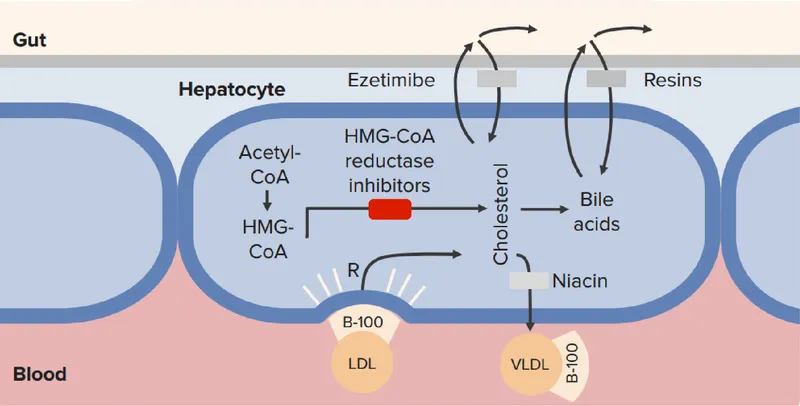
Lipid-Lowering Drugs Indian Medical PG Practice Questions and MCQs
Practice Indian Medical PG questions for Lipid-Lowering Drugs. These multiple choice questions (MCQs) cover important concepts and help you prepare for your exams.
Lipid-Lowering Drugs Indian Medical PG Question 1: Which among the following is the false statement regarding statins?
- A. These drugs should not be stopped even in severe conditions like injury, surgery etc.
- B. Although HMG-CoA reductase inhibitors substantially reduce the risk of cardiovascular events, there is mild increase in lipoprotein a (Lpa) levels.
- C. With the long term use, there is slight increase in the incidence of type 2 diabetes mellitus.
- D. They can be given with verapamil and other enzyme inhibitors (Correct Answer)
Lipid-Lowering Drugs Explanation: ***They can be given with verapamil and other enzyme inhibitors***
- This statement is **FALSE** and is the correct answer because **verapamil** (a moderate CYP3A4 inhibitor) and other potent CYP3A4 inhibitors like **clarithromycin** or **azole antifungals** can significantly increase statin concentrations, raising the risk of adverse effects like **myopathy** and **rhabdomyolysis**.
- **Co-administration** of statins with these inhibitors generally requires careful dose adjustments or avoidance, as they increase the systemic exposure to most statins (especially **simvastatin**, **atorvastatin**, and **lovastatin**).
*These drugs should not be stopped even in severe conditions like injury, surgery etc.*
- This statement could be considered false in certain contexts, as statins **can be temporarily held** in acute, severe conditions like sepsis, major trauma, or complex surgery, especially if there's a concern for **acute kidney injury** or **rhabdomyolysis** [1].
- However, in most routine surgical situations, statins are typically continued due to their cardiovascular protective effects.
*Although HMG-CoA reductase inhibitors substantially reduce the risk of cardiovascular events, there is mild increase in lipoprotein a (Lpa) levels.*
- This statement is **TRUE**. Statins are associated with a **modest increase in Lp(a) levels** (approximately 10-20%), which has been consistently demonstrated in clinical studies [2].
- While statins effectively lower **LDL cholesterol**, Lp(a) levels are largely **genetically determined** and may paradoxically increase with statin therapy, though this effect is generally considered clinically insignificant compared to the overall cardiovascular benefits [2].
*With the long term use, there is slight increase in the incidence of type 2 diabetes mellitus.*
- This statement is **TRUE**. Long-term statin use is associated with a **small but statistically significant increase** in the risk of developing **type 2 diabetes mellitus** (approximately 9-12% increased risk), particularly in individuals with pre-existing risk factors like **metabolic syndrome**.
- This risk, however, is generally **outweighed by the cardiovascular benefits** of statin therapy in at-risk patients, making it an acceptable trade-off.
Lipid-Lowering Drugs Indian Medical PG Question 2: A patient being treated for hypertriglyceridemia developed flushing, gout, hyperglycemia, and raised liver enzymes. Which drug is the most likely cause?
- A. Atorvastatin
- B. Fenofibrate
- C. Nicotinic acid (Correct Answer)
- D. Ezetimibe
- E. Gemfibrozil
Lipid-Lowering Drugs Explanation: ***Nicotinic acid***
- **Nicotinic acid (Niacin)** is known to cause **flushing** due to prostaglandin release.
- It also commonly leads to **hyperglycemia**, **hyperuricemia** (which can precipitate gout), and **elevated liver enzymes** as side effects.
*Atorvastatin*
- While atorvastatin can cause **elevated liver enzymes** and, less commonly, **myopathy**, it does not typically cause flushing, gout, or hyperglycemia.
- Its primary role is to lower **LDL cholesterol**, with a lesser effect on triglycerides.
*Fenofibrate*
- **Fenofibrate** is used to treat hypertriglyceridemia and can rarely cause **elevated liver enzymes** and **gallstones**.
- It is not associated with significant flushing, hyperglycemia, or gout.
*Gemfibrozil*
- **Gemfibrozil** is another fibrate used for hypertriglyceridemia treatment.
- While it can cause **elevated liver enzymes** and **myopathy** (especially when combined with statins), it does not cause the characteristic flushing or hyperglycemia seen with nicotinic acid.
*Ezetimibe*
- **Ezetimibe** primarily inhibits cholesterol absorption and is generally well-tolerated.
- Common side effects are mild and include abdominal pain and diarrhea, with no association to flushing, gout, or hyperglycemia.
Lipid-Lowering Drugs Indian Medical PG Question 3: Which of the following statements about LDL is false?
- A. More dense than chylomicron
- B. Transports maximum amount of lipid (Correct Answer)
- C. Contains maximum cholesterol
- D. Smaller than VLDL
Lipid-Lowering Drugs Explanation: ***Transports maximum amount of lipid***
- This statement is false because **chylomicrons**, not LDL, are primarily responsible for transporting the **maximum amount of dietary lipids** (triglycerides) from the intestines to various tissues.
- While LDL does transport lipids, its primary role is to deliver **cholesterol** to cells, and it contains a lower proportion of triglyceride compared to chylomicrons and VLDL.
*More dense than chylomicron*
- This statement is true; **LDL is denser than chylomicrons** because it has a higher protein-to-lipid ratio.
- **Chylomicrons** are the least dense lipoproteins due to their very high triglyceride content.
*Smaller than VLDL*
- This statement is true; **LDL is smaller than VLDL** (Very Low-Density Lipoprotein).
- VLDL particles are larger and contain more triglycerides, which are gradually removed, leading to the formation of smaller LDL particles.
*Contains maximum cholesterol*
- This statement is true; **LDL contains the highest proportion of cholesterol** (specifically, **cholesterol esters**) among the lipoproteins.
- This characteristic makes LDL the primary carrier for delivering cholesterol to peripheral tissues.
Lipid-Lowering Drugs Indian Medical PG Question 4: Which antilipidemic drug reduces cholesterol levels by inhibiting cholesterol absorption?
- A. Ezetimibe (Correct Answer)
- B. Orlistat
- C. Cholestyramine
- D. Statins
Lipid-Lowering Drugs Explanation: ***Ezetimibe***
- **Ezetimibe** selectively inhibits the **Niemann-Pick C1-Like 1 (NPC1L1) protein**, which is responsible for plant sterol and cholesterol absorption in the small intestine.
- This action leads to a reduction in **LDL-C** levels by decreasing the amount of cholesterol available to the liver.
*Orlistat*
- **Orlistat** is a **lipase inhibitor** that prevents the absorption of dietary fats by inhibiting gastric and pancreatic lipases.
- While it aids in weight loss and can indirectly improve lipid profiles, its primary mechanism is *not* direct inhibition of cholesterol absorption.
*Cholestyramine*
- **Cholestyramine** is a **bile acid sequestrant** that binds to bile acids in the intestine, preventing their reabsorption.
- This increases the excretion of bile acids, prompting the liver to synthesize more bile acids from cholesterol, thereby lowering cholesterol levels, but it does *not* directly inhibit cholesterol absorption.
*Statins*
- **Statins** (HMG-CoA reductase inhibitors) are considered first-line agents for lowering cholesterol by inhibiting the **rate-limiting step in cholesterol synthesis** in the liver.
- Their primary action is to reduce endogenous cholesterol production, not to block cholesterol absorption from the gut.
Lipid-Lowering Drugs Indian Medical PG Question 5: Atorvastatin is used as an anti-dyslipidemic drug. These drugs inhibit their target enzyme by:-
- A. Noncompetitive inhibition
- B. Competitive inhibition (Correct Answer)
- C. Irreversible inhibition
- D. Uncompetitive inhibition
Lipid-Lowering Drugs Explanation: ***Competitive inhibition***
- Atorvastatin is a **statin**, which acts as a **competitive inhibitor** of **HMG-CoA reductase**, the rate-limiting enzyme in cholesterol synthesis.
- It competes with the natural substrate, HMG-CoA, for binding to the **active site of the enzyme**, thereby reducing cholesterol production.
*Uncompetitive*
- **Uncompetitive inhibitors** bind only to the **enzyme-substrate complex**, not to the free enzyme.
- This type of inhibition is characterized by a decrease in both **apparent Vmax** and **apparent Km**.
*Noncompetitive inhibition*
- **Noncompetitive inhibitors** bind to an allosteric site on the enzyme, distinct from the active site, and can bind to either the **free enzyme or the enzyme-substrate complex**.
- This leads to a decrease in the **apparent Vmax** but does not affect Km.
*Irreversible inhibition*
- **Irreversible inhibitors** form a **strong covalent bond** with the enzyme, permanently inactivating it.
- Statins do not form covalent bonds with HMG-CoA reductase; their inhibition is **reversible** upon drug discontinuation.
Lipid-Lowering Drugs Indian Medical PG Question 6: Which of the following is NOT a side effect of amiodarone?
- A. Corneal microdeposits
- B. Photosensitivity
- C. Tachycardia (Correct Answer)
- D. Pulmonary fibrosis
Lipid-Lowering Drugs Explanation: ***Tachycardia***
- **Amiodarone** is an antiarrhythmic drug primarily used to treat and prevent **tachyarrhythmias**, meaning it generally slows down heart rate and is not associated with causing tachycardia.
- Its main effect is to prolong the **refractory period** in myocardial cells, which helps to stabilize abnormal heart rhythms, rather than inducing them.
*Pulmonary fibrosis*
- **Amiodarone** is well-known for its potential to cause **pulmonary toxicity**, including **interstitial lung disease** and **pulmonary fibrosis**, which can be severe and even fatal.
- This side effect is thought to be dose-dependent and can manifest as shortness of breath and cough, requiring careful monitoring.
*Corneal microdeposits*
- **Corneal microdeposits**, often described as **whorl keratopathy** or **cornea verticillata**, are a very common and usually benign side effect of **amiodarone**.
- These deposits typically do not affect vision but can cause blurred vision or halos around lights in some patients.
*Photosensitivity*
- **Photosensitivity** is a common dermatological side effect of **amiodarone**, leading to an exaggerated sunburn reaction or a grayish-blue skin discoloration in sun-exposed areas.
- Patients are advised to use **sunscreen** and protective clothing while on **amiodarone** to minimize this risk.
Lipid-Lowering Drugs Indian Medical PG Question 7: A 50-year-old patient with premature atherosclerosis has deranged lipid profile. On examination there is development of plane xanthomas in palmar creases. All are useful for this patient except:
- A. Diet control
- B. Niacin
- C. Fenofibrate
- D. Colestipol (Correct Answer)
Lipid-Lowering Drugs Explanation: ***Colestipol***
- The patient has **premature atherosclerosis** and **plane xanthomas in palmar creases**, which is suggestive of a genetic lipid disorder like **Familial Dysbetalipoproteinemia** (Type III Hyperlipoproteinemia). This condition primarily involves elevated **chylomicron remnants** and **VLDL remnants**. [1]
- **Colestipol** is a **bile acid sequestrant**. It primarily lowers LDL cholesterol by binding bile acids in the intestine, leading to increased hepatic synthesis of bile acids from cholesterol. It is generally not effective for reducing the remnants in this specific disorder and can sometimes even worsen hypertriglyceridemia, which is characteristic of Type III. [1]
*Diet control*
- **Diet modification**, particularly reducing fat and simple carbohydrates, is a cornerstone of management for all dyslipidemias, including Familial Dysbetalipoproteinemia. [1]
- It helps to lower **chylomicron and VLDL remnants**, which are the primary lipid abnormalities in this condition. [1]
*Niacin*
- **Niacin** (nicotinic acid) is very effective in lowering **VLDL** and **triglycerides**, and raising **HDL cholesterol**. [1]
- It is considered a particularly beneficial treatment for **Familial Dysbetalipoproteinemia** due to its impact on remnant lipoproteins. [1]
*Fenofibrate*
- **Fibrates**, like fenofibrate, are highly effective in reducing **triglycerides** and increasing **HDL cholesterol** by activating PPAR-alpha. [1]
- They are specifically indicated and very useful in the treatment of **Familial Dysbetalipoproteinemia** as they promote the catabolism of VLDL and chylomicron remnants. [1]
Lipid-Lowering Drugs Indian Medical PG Question 8: Statins act on:
- A. HMG CoA synthetase
- B. HMG CoA reductase (Correct Answer)
- C. HMG CoA hydratase
- D. Squalene epoxidase
Lipid-Lowering Drugs Explanation: ***HMG CoA reductase*** - **HMG-CoA reductase inhibitors** (statins) are the most effective and widely used class of hypolipidemic agents [1, 2, 3]. - This enzyme is the **rate-limiting step** in cholesterol biosynthesis in the liver [1, 2, 3]. *HMG CoA synthetase* - HMG-CoA synthetase is involved in the synthesis of **HMG-CoA** from acetyl-CoA and acetoacetyl-CoA. - This enzyme precedes the HMG-CoA reductase step and is **not the primary target** for cholesterol-lowering drugs. *Squalene epoxidase* - Squalene epoxidase is an enzyme involved in the later stages of the **cholesterol synthesis pathway**, specifically in converting squalene to squalene epoxide. - While inhibition of this enzyme would reduce cholesterol synthesis, it is **not the main target** of current widely used hypolipidemic agents. *HMG CoA hydratase* - HMG-CoA hydratase (also known as HMG-CoA lyase) is involved in the breakdown of HMG-CoA into **acetyl-CoA and acetoacetate** in ketogenesis. - It is **not directly involved** in the main pathway of cholesterol synthesis that is targeted by current hypolipidemic drugs.
Lipid-Lowering Drugs Indian Medical PG Question 9: Which of the following statements about hypolipidemic drugs is false?
- A. Gemfibrozil causes myopathy
- B. Gemfibrozil can increase myopathy caused by statins
- C. Lovastatin can cause hepatic dysfunction
- D. Cholesterol reducing drugs are contraindicated in child less than 8 years (Correct Answer)
Lipid-Lowering Drugs Explanation: ***Cholesterol reducing drugs are contraindicated in child less than 8 years***
- While cholesterol-lowering drugs are generally avoided in young children, there are specific **genetic dyslipidemias** where treatment may be initiated earlier under specialist supervision [1].
- The statement is **false** because some genetic conditions may necessitate earlier treatment, making a blanket contraindication for all children under 8 inaccurate [1].
*Gemfibrozil causes myopathy*
- **Gemfibrozil** (a fibric acid derivative) can indeed cause **myopathy**, especially when used alone or in combination with other lipid-lowering agents [2].
- This adverse effect is thought to be due to its mechanism of action affecting fatty acid metabolism and muscle integrity.
*Gemfibrozil can increase myopathy caused by statins*
- The co-administration of **gemfibrozil** with **statins** significantly increases the risk of **myopathy** and **rhabdomyolysis** [2].
- This is primarily due to gemfibrozil inhibiting the **glucuronidation** of statins, which increases statin plasma concentrations [2].
*Lovastatin can cause hepatic dysfunction*
- **Statins**, including **lovastatin**, can cause **elevations in liver transaminases** and, in rare cases, lead to **drug-induced liver injury** [1].
- Regular monitoring of liver function tests is recommended when initiating statin therapy and during follow-up [2].
Lipid-Lowering Drugs Indian Medical PG Question 10: Dofetilide is which class of antiarrhythmic drug?
- A. Class I
- B. Class II
- C. Class III (Correct Answer)
- D. Class IV
Lipid-Lowering Drugs Explanation: **Explanation:**
The classification of antiarrhythmic drugs is based on the **Vaughan Williams classification**, which categorizes drugs according to their primary mechanism of action on the cardiac action potential.
**Why Class III is correct:**
**Dofetilide** is a pure **Class III antiarrhythmic**. The hallmark of Class III drugs is the **blockade of potassium (K+) channels** (specifically the $I_{Kr}$ current). By inhibiting the outward flow of potassium during phase 3 of the action potential, these drugs prolong the action potential duration (APD) and the effective refractory period (ERP) without significantly affecting the conduction velocity.
**Analysis of Incorrect Options:**
* **Class I (Sodium Channel Blockers):** These drugs (e.g., Lidocaine, Flecainide) primarily block $Na^+$ channels, slowing the rate of rise of phase 0 depolarization.
* **Class II (Beta-Blockers):** These drugs (e.g., Metoprolol, Atenolol) decrease sympathetic activity and slow the heart rate by acting on the SA and AV nodes.
* **Class IV (Calcium Channel Blockers):** These drugs (e.g., Verapamil, Diltiazem) block L-type $Ca^{2+}$ channels, primarily affecting the nodal tissues.
**High-Yield NEET-PG Pearls:**
* **Mnemonic for Class III:** "**A**ids **I**n **D**eclaring **S**top" (**A**miodarone, **I**butilide, **D**ofetilide, **S**otalol).
* **ECG Change:** Class III drugs cause **QT interval prolongation**.
* **Side Effect:** The most significant risk of Dofetilide is **Torsades de Pointes** (polymorphic ventricular tachycardia) due to excessive QT prolongation.
* **Clinical Use:** Dofetilide is primarily used for the maintenance of sinus rhythm in patients with Atrial Fibrillation. Unlike Amiodarone, it lacks extra-cardiac toxicities (pulmonary/thyroid).
More Lipid-Lowering Drugs Indian Medical PG questions available in the OnCourse app. Practice MCQs, flashcards, and get detailed explanations.