Interstitial Lung Diseases Indian Medical PG Practice Questions and MCQs
Practice Indian Medical PG questions for Interstitial Lung Diseases. These multiple choice questions (MCQs) cover important concepts and help you prepare for your exams.
Interstitial Lung Diseases Indian Medical PG Question 1: Which of the following is not an obstructive lung disease?
- A. Emphysema
- B. Interstitial fibrosis (Correct Answer)
- C. Asthma
- D. Bronchitis
Interstitial Lung Diseases Explanation: ***Interstitial fibrosis***
- **Interstitial fibrosis** is a **restrictive lung disease**, characterized by **reduced lung elasticity** and lung volumes, rather than airway obstruction [1].
- In this condition, the **lung tissue becomes scarred and stiff**, making it difficult to expand fully during inspiration [1].
*Emphysema*
- **Emphysema** is a classic **obstructive lung disease** caused by the destruction of the **alveolar walls**, leading to enlarged air spaces and loss of elastic recoil [3].
- This destruction results in **airflow limitation**, particularly during exhalation, as airways collapse prematurely.
*Asthma*
- **Asthma** is an **obstructive lung disease** characterized by **reversible airway inflammation**, bronchoconstriction, and increased mucus production [2].
- These factors lead to **episodic airflow obstruction**, making it difficult to breathe, especially during exacerbations [2].
*Bronchitis*
- **Bronchitis**, particularly **chronic bronchitis**, is an **obstructive lung disease** defined by chronic inflammation of the bronchi.
- This inflammation causes **mucus hypersecretion** and narrowing of the airways, leading to persistent cough and airflow limitation.
Interstitial Lung Diseases Indian Medical PG Question 2: A 45-year-old patient working in a factory for past 20 years presents with breathlessness. HRCT chest shows pleural thickening and fibrosis. What is the most likely diagnosis?
- A. Asbestosis (Correct Answer)
- B. Coal worker pneumoconiosis
- C. Silicosis
- D. Cotton fiber
Interstitial Lung Diseases Explanation: ***Asbestosis***
- **Asbestosis** is a chronic lung disease caused by inhaling **asbestos fibers**, common in industrial settings like factories, leading to **pleural thickening** and **fibrosis** in the lungs [1].
- The long latency period (20 years) and presentation with breathlessness are consistent with **asbestos exposure**, which also increases the risk of **mesothelioma** [1].
*Coal worker pneumoconiosis*
- This condition is caused by inhaling **coal dust**, leading to lung fibrosis and inflammation, but typically does not present with prominent **pleural thickening** [1].
- While it can cause breathlessness, the characteristic HRCT finding of **pleural thickening** points away from coal worker pneumoconiosis as the primary diagnosis [1].
*Silicosis*
- **Silicosis** results from inhaling **silica dust**, causing nodular fibrosis in the upper lobes of the lungs and is common in mining, quarrying, and sandblasting [2].
- While it causes lung fibrosis and breathlessness, **pleural thickening** is not a hallmark feature of silicosis, unlike asbestosis [1].
*Cotton fiber*
- Inhaling **cotton dust** can cause **byssinosis**, characterized by chest tightness and breathlessness, particularly on the first day back to work after a break.
- Unlike asbestosis, byssinosis does not typically lead to significant **pleural thickening** or **fibrosis** on HRCT.
**References:**
[1] Kumar V, Abbas AK, et al.. Robbins and Cotran Pathologic Basis of Disease. 9th ed. The Lung, pp. 698-699.
[2] Kumar V, Abbas AK, et al.. Robbins and Cotran Pathologic Basis of Disease. 9th ed. The Lung, p. 697.
Interstitial Lung Diseases Indian Medical PG Question 3: A female patient with clinical symptoms of systemic sclerosis presents with shortness of breath and bilateral basal rales. Her chest X-ray showed reticular opacities in bilateral basal fields. What is the next best step?
- A. Do 2D echocardiography
- B. Do Pulmonary Function Test
- C. Do CECT
- D. Do HRCT (Correct Answer)
Interstitial Lung Diseases Explanation: ***Do HRCT***
- **High-resolution computed tomography (HRCT)** is the gold standard for evaluating **interstitial lung disease (ILD)**, a common and serious complication of systemic sclerosis, characterized by **reticular opacities** seen on chest X-ray.
- HRCT provides detailed images of the lung parenchyma, allowing for accurate characterization of ILD patterns (e.g., usual interstitial pneumonia and non-specific interstitial pneumonia) and assessment of disease extent and severity, which is crucial for determining prognosis and guiding treatment.
*2D echocardiography*
- This test is primarily used to assess **cardiac function** and evaluate for conditions like **pulmonary hypertension** or **congestive heart failure**, which can cause shortness of breath.
- While pulmonary hypertension can be associated with systemic sclerosis, the **reticular opacities** and **basal rales** on chest X-ray strongly point towards a primary lung parenchymal pathology, making HRCT a more direct and immediate diagnostic step for the observed lung findings.
*Do Pulmonary Function Test*
- **Pulmonary function tests (PFTs)** measure lung volumes, airflow, and gas exchange and are essential for quantifying the extent of lung impairment in conditions like ILD.
- While PFTs are crucial for monitoring disease progression and response to therapy, they do not provide the detailed anatomical information needed for the initial diagnosis and characterization of the **interstitial lung changes** suggested by the chest X-ray, which is better served by HRCT.
*Do CECT*
- **Contrast-enhanced computed tomography (CECT)** is primarily used to evaluate for **vascular abnormalities**, **masses**, or **lymphadenopathy** within the chest.
- While it can provide some information about lung parenchyma, **contrast** is not typically necessary or beneficial for the initial assessment of **interstitial lung disease (ILD)** and may even pose risks if the patient has renal impairment, making HRCT a more appropriate choice for this specific clinical presentation.
Interstitial Lung Diseases Indian Medical PG Question 4: What is the most common symptom of interstitial lung disease?
- A. Hemoptysis
- B. Dyspnea (Correct Answer)
- C. Wheezing
- D. Substernal discomfort
Interstitial Lung Diseases Explanation: ***Dyspnea***
- **Dyspnea** (shortness of breath) is the hallmark symptom of interstitial lung disease (ILD), as the progressive fibrosis impairs gas exchange and lung compliance [1].
- It typically starts as **exertional dyspnea** and worsens over time, eventually becoming present even at rest [1], [2].
*Hemoptysis*
- While hemoptysis can occur in some lung conditions, it is **not a common or primary symptom** of most forms of interstitial lung disease.
- It might point towards other diagnoses like **lung cancer**, **bronchiectasis**, or **tuberculosis**.
*Substernal discomfort*
- **Substernal discomfort** can be associated with various conditions, including cardiac issues or gastroesophageal reflux disease, but it is **not a classic symptom** of ILD.
- Chest pain or discomfort in ILD is usually **pleuritic** if present.
*Wheezing*
- **Wheezing** is indicative of **airway obstruction** (e.g., asthma, COPD) and is generally **not a feature of interstitial lung disease**.
- ILD primarily affects the **parenchymal tissue** rather than the airways, so patients usually do not present with wheezing [1].
Interstitial Lung Diseases Indian Medical PG Question 5: Which finding best indicates poor prognosis in interstitial lung disease?
- A. Honeycombing on HRCT (Correct Answer)
- B. Ground glass opacity
- C. Restrictive PFT pattern
- D. Clubbing
Interstitial Lung Diseases Explanation: ***Honeycombing on HRCT***
- **Honeycombing** on High-Resolution Computed Tomography (HRCT) indicates **irreversible fibrosis and architectural distortion** of the lung parenchyma, representing end-stage lung disease.
- Its presence is a strong predictor of **worse prognosis and increased mortality** in various interstitial lung diseases, particularly **idiopathic pulmonary fibrosis (IPF)**.
*Ground glass opacity*
- **Ground glass opacity (GGO)** represents inflammation and early fibrosis, which can be **reversible** with treatment in some interstitial lung diseases.
- While GGO indicates lung involvement, it does not necessarily signify irreversible damage or poor prognosis as definitively as honeycombing.
*Restrictive PFT pattern*
- A **restrictive pattern on pulmonary function tests (PFTs)** (reduced total lung capacity and vital capacity) is characteristic of all interstitial lung diseases.
- While indicative of the disease, it is a **diagnostic hallmark rather than a specific prognostic indicator** for the severity of fibrosis or future outcome.
*Clubbing*
- **Clubbing** (thickening of the distal phalanges) is a common sign in many chronic lung diseases, including interstitial lung disease.
- While its presence suggests chronic oxygen deprivation, it is a **non-specific finding** and does not directly correlate with disease progression or prognosis as strongly as imaging findings like honeycombing.
Interstitial Lung Diseases Indian Medical PG Question 6: What is the most common cause of death in idiopathic pulmonary fibrosis (IPF)?
- A. Respiratory failure (Correct Answer)
- B. Pulmonary edema
- C. Cancer
- D. Pulmonary arterial hypertension (PAH)
- E. Acute exacerbation of IPF
Interstitial Lung Diseases Explanation: ***Respiratory failure***
- **Progressive fibrosis** of the lung tissue in idiopathic pulmonary fibrosis (IPF) directly impairs gas exchange, leading to **hypoxemia** and hypercapnia.
- This deterioration ultimately culminates in **respiratory failure**, which is the primary cause of mortality in most IPF patients.
*Pulmonary edema*
- While pulmonary edema can occur in systemic conditions, it is not the **primary or most common cause of death** specifically in IPF.
- IPF is characterized by **fibrotic remodeling**, not primarily fluid overload in the alveoli.
*Cancer*
- Patients with IPF have an **increased risk of lung cancer**, but it is not the most common cause of death compared to respiratory failure.
- The development of cancer is a **complication**, not the direct mechanism by which most IPF patients succumb to the disease.
*Pulmonary arterial hypertension (PAH)*
- PAH can be a significant complication of IPF, contributing to increased morbidity and mortality, but it is typically a **secondary contributor to death**, often by worsening respiratory mechanics.
- Its presence usually **compounds respiratory failure**, rather than being the standalone, most common cause of death.
*Acute exacerbation of IPF*
- Acute exacerbations represent episodes of **rapid clinical deterioration** with worsening dyspnea and hypoxemia, often idiopathic or triggered by infections.
- While they are a **significant cause of mortality** (accounting for a substantial proportion of IPF deaths), the underlying mechanism still relates to respiratory failure, making chronic progressive respiratory failure the most common overall cause of death.
Interstitial Lung Diseases Indian Medical PG Question 7: Most common cause of idiopathic interstitial pneumonia is
- A. Idiopathic pulmonary fibrosis (Correct Answer)
- B. Organizing pneumonia
- C. Sarcoidosis
- D. Lipoid pneumonia
Interstitial Lung Diseases Explanation: ***Idiopathic pulmonary fibrosis (IPF)***
- This is the **most common** form of idiopathic interstitial pneumonia, accounting for approximately **50-60% of all IIP cases**
- Represents the **most severe** IIP subtype with poor prognosis
- Characterized by progressive **usual interstitial pneumonia (UIP) pattern** with fibroblastic foci and honeycombing
- Presents with progressive dyspnea, dry cough, and restrictive lung disease
*Organizing pneumonia*
- While **Cryptogenic Organizing Pneumonia (COP)** is a form of idiopathic interstitial pneumonia, it is **much less common than IPF** [1]
- Characterized by **intra-alveolar granulation tissue (Masson bodies)** [1]
- Better prognosis and steroid-responsive compared to IPF [1]
*Sarcoidosis*
- This is **NOT classified as an idiopathic interstitial pneumonia**
- It is a separate **multisystem granulomatous disease** with **non-caseating granulomas**
- Has a distinct etiology related to altered immune response
- Does not belong to the IIP classification system
*Lipoid pneumonia*
- This is **NOT an idiopathic interstitial pneumonia**
- Results from **aspiration of lipid substances** causing exogenous lipoid pneumonia
- Has a **known extrinsic cause**, therefore not "idiopathic"
- Not part of the IIP classification
**References:**
[1] Cross SS. Underwood's Pathology: A Clinical Approach. 6th ed. Common Clinical Problems From Respiratory Tract Disease, pp. 330-331.
Interstitial Lung Diseases Indian Medical PG Question 8: Ferruginous bodies are seen in:
- A. Silicosis
- B. Asbestosis (Correct Answer)
- C. Byssinosis
- D. Bagassosis
Interstitial Lung Diseases Explanation: ***Asbestosis***
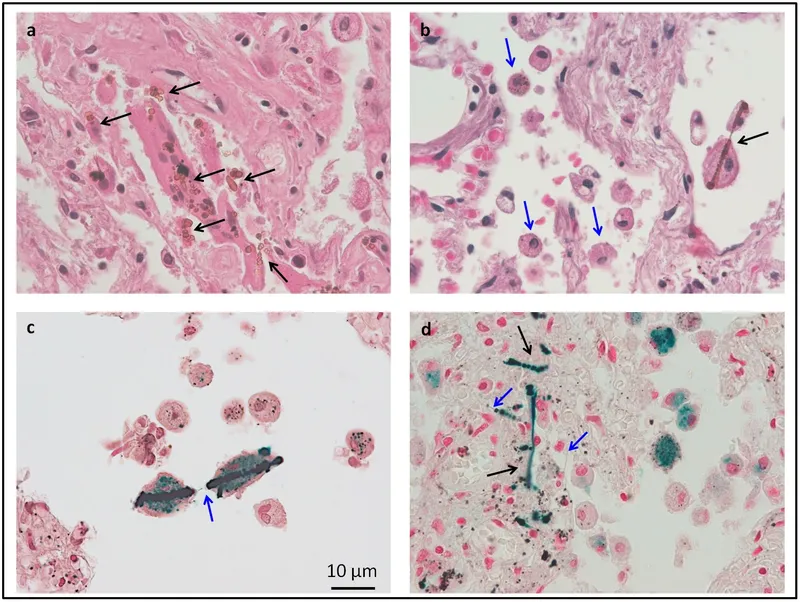
- Ferruginous bodies are specifically associated with **exposure to asbestos**, which leads to asbestosis [1].
- These bodies are seen as **siderophilic structures** resembling a "dumbbell" shape under the microscope, which are indicative of this condition [1].
*Bagassosis*
- Caused by exposure to **bagasse dust**, primarily from sugarcane, leading to allergic alveolitis rather than ferruginous bodies [1].
- Histopathology typically shows **lymphocytic infiltration** and non-caseating granulomas, not ferruginous bodies.
*Byssinosis*
- This is associated with inhalation of **cotton dust** and primarily results in **bronchoconstriction** and respiratory symptoms rather than ferruginous bodies.
- Characterized by a **respiratory illness** that worsens at the beginning of the work week, missing the key features of asbestosis.
*Silicosis*
- Resulting from exposure to **silica dust**, this condition leads to macules and nodules in the lungs instead of ferruginous bodies [1].
- The hallmark findings are **hyaline nodules** on imaging and not the abnormal iron-containing structures seen in asbestosis.
**References:**
[1] Kumar V, Abbas AK, et al.. Robbins and Cotran Pathologic Basis of Disease. 9th ed. The Lung, pp. 695, 698-699.
Interstitial Lung Diseases Indian Medical PG Question 9: A 35-year-old woman with a long history of dyspnea, chronic cough, sputum production, and wheezing dies of respiratory failure following a bout of lobar pneumonia. She was not a smoker or an alcoholic. Which of the following underlying conditions is most likely associated with the pathologic changes shown in the lung autopsy?
- A. Antibodies against type 4 collagen (associated with Goodpasture syndrome)
- B. Cystic fibrosis (a genetic disorder affecting the lungs)
- C. Mutation in dynein arms (associated with primary ciliary dyskinesia)
- D. Alpha-1 antitrypsin deficiency (Correct Answer)
Interstitial Lung Diseases Explanation: ***Alpha 1 antitrypsin deficiency***
- This condition leads to **accumulation of abnormal protein** in the liver and lungs, resulting in emphysema, which is consistent with chronic cough and dyspnea [1].
- Patients often develop **lung pathology** similar to what is seen in smokers, making it plausible given the patient's background [1].
*Mutation in dynein arms*
- This is associated with **primary ciliary dyskinesia**, which presents with recurrent respiratory infections but is not typical in non-smokers or in the context of **dyspnea with chronic cough**.
- Usually linked to **situs inversus** and **recurrent infections**, neither of which is highlighted here.
*Antibodies against type 4 collagen*
- This condition is related to **Goodpasture syndrome**, which typically results in **hemoptysis** and **renal failure**, rather than chronic cough and sputum production.
- The predominant involvement in this syndrome does not align with the clinical presentation of **chronic lung disease** noted in this patient.
*Cystic fibrosis*
- While it causes **chronic respiratory symptoms**, it is usually seen in younger patients and is associated with **pancreatic insufficiency** and **salty sweat**.
- The age of the patient and symptom progression does not fit well with a diagnosis of cystic fibrosis.
**References:**
[1] Kumar V, Abbas AK, et al.. Robbins and Cotran Pathologic Basis of Disease. 9th ed. The Lung, pp. 683-684.
Interstitial Lung Diseases Indian Medical PG Question 10: Small deposits of neuroendocrine cell hyperplasia in scarred lungs are known as:
- A. Teratoma
- B. Tumorlet (Correct Answer)
- C. Carcinoid
- D. Hamartoma
Interstitial Lung Diseases Explanation: ***Tumorlet***
- Small deposits of **neuroendocrine cell hyperplasia** in scarred lungs are specifically referred to as tumorlets, which can be associated with various lung diseases.
- Tumorlets are typically benign, comprising **small clusters of neuroendocrine cells** that are usually found in pulmonary scars.
*Teratoma*
- Teratomas are **germ cell tumors** that typically contain tissue from all three embryonic layers and are not associated with neuroendocrine cell hyperplasia.
- They usually occur in **gonadal** sites or mediastinum and do not relate to scarring in lung tissue.
*Carcinoid*
- Carcinoids are **neuroendocrine tumors** but larger and more defined than tumorlets, often causing obstruction or symptoms.
- Unlike tumorlets, carcinoids present as **solitary masses**, typically found in the gastrointestinal tract or lungs but not as small deposits in scarred tissue.
*Hamartoma*
- Hamartomas are benign tumors made of **disorganized tissue** native to the organ in which they arise, but they do not involve neuroendocrine cells specifically [1].
- They are generally characterized as **well-circumscribed** nodules and do not correlate with neuroendocrine hyperplasia in scarred lungs [1].
**References:**
[1] Kumar V, Abbas AK, et al.. Robbins and Cotran Pathologic Basis of Disease. 9th ed. The Lung, pp. 727-728.
More Interstitial Lung Diseases Indian Medical PG questions available in the OnCourse app. Practice MCQs, flashcards, and get detailed explanations.