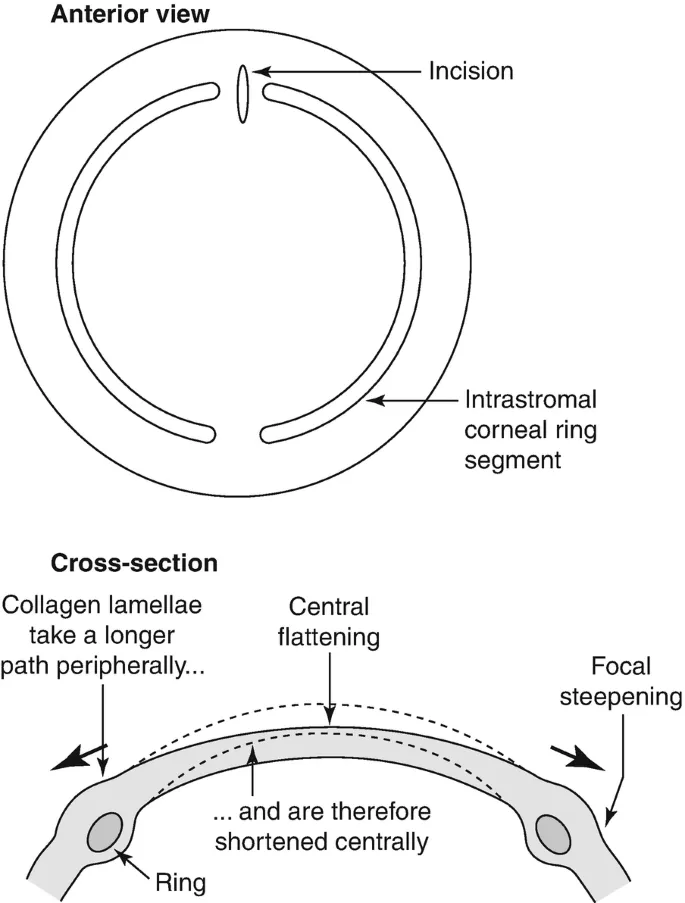
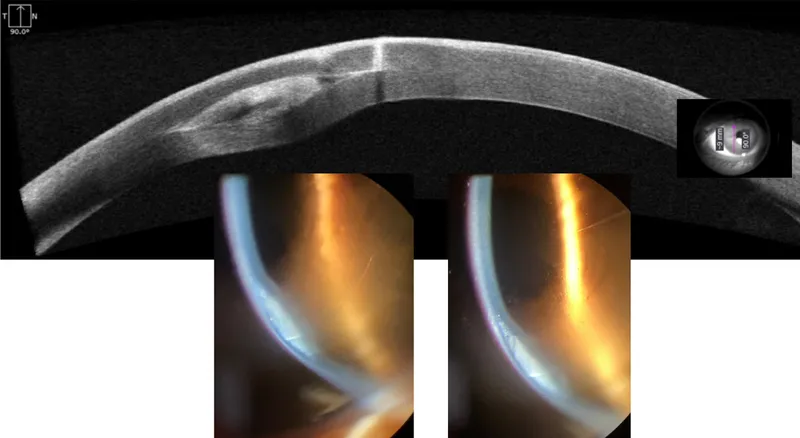
Intrastromal Corneal Ring Segments Indian Medical PG Practice Questions and MCQs
Practice Indian Medical PG questions for Intrastromal Corneal Ring Segments. These multiple choice questions (MCQs) cover important concepts and help you prepare for your exams.
Intrastromal Corneal Ring Segments Indian Medical PG Question 1: Scleral Expansion Bands are used in the management of:
- A. Astigmatism
- B. Keratoconus
- C. Presbyopia (Correct Answer)
- D. Myopia
Intrastromal Corneal Ring Segments Explanation: ***Presbyopia***
- **Scleral expansion bands** are a surgical treatment strategy designed to restore the eye's ability to accommodate by altering the biomechanics of the sclera and ciliary body.
- They aim to improve the range of motion of the ciliary body, thereby allowing the **lens to change shape** more effectively for near vision in **presbyopic** patients.
*Astigmatism*
- **Astigmatism** is primarily caused by an **irregularly shaped cornea** or lens, leading to blurred vision at all distances.
- It is typically managed with corrective lenses (glasses or contact lenses) or refractive surgeries like **LASIK** or **PRK**, which reshape the cornea.
*Keratoconus*
- **Keratoconus** is a progressive eye disease where the **cornea thins** and bulges into a cone-like shape, causing distorted vision.
- Treatments include rigid gas permeable contact lenses, **corneal collagen cross-linking** to halt progression, and in severe cases, corneal transplant.
*Myopia*
- **Myopia**, or nearsightedness, occurs when the eye focuses images in front of the retina, often due to an **elongated eyeball** or excessive corneal curvature.
- It is commonly corrected with concave lenses, contact lenses, or refractive surgeries such as **LASIK** or **PRK** to flatten the cornea.
Intrastromal Corneal Ring Segments Indian Medical PG Question 2: Rigid gas permeable (RGP) lenses are made from which of the following combinations of materials?
- A. Hydroxymethylmethacrylate
- B. Cellulose acetate Butyrate
- C. Polymethylmethacrylate
- D. Copolymer of PMMA, Silicon containing monomer & cellulose acetyl butyrate (Correct Answer)
Intrastromal Corneal Ring Segments Explanation: ***Copolymer of PMMA, Silicon containing monomer & cellulose acetyl butyrate***
- **Rigid gas permeable (RGP) lenses** are designed to be permeable to oxygen, which is achieved through the incorporation of **silicon-containing monomers**.
- The combination of **PMMA** (for rigidity), **silicon** (for oxygen permeability), and **cellulose acetyl butyrate** (for improved wettability and flexibility) provides the desired mechanical and optical properties.
*Polymethylmethacrylate*
- **PMMA** was the primary material for the earliest **hard contact lenses** but offered virtually no oxygen permeability.
- This lack of oxygen permeability led to significant corneal hypoxia issues and limited wear time.
*Hydroxymethylmethacrylate*
- **Hydroxymethylmethacrylate (HEMA)** is a key material in **hydrogel soft contact lenses**, known for its ability to absorb water.
- HEMA is not used in RGP lenses because it would make the lens soft and flexible, contrary to the "rigid" characteristic.
*Cellulose acetate Butyrate*
- **Cellulose acetate butyrate (CAB)** was an early material used for **gas permeable lenses**, offering some oxygen permeability.
- While it was an improvement over PMMA, it did not achieve the high level of oxygen permeability seen with newer silicon-containing materials.
Intrastromal Corneal Ring Segments Indian Medical PG Question 3: What is the most likely complication of the condition shown in the image below?
- A. Exposure Keratitis (Correct Answer)
- B. Difficulty in eye movement
- C. Cataract
- D. Glaucoma
Intrastromal Corneal Ring Segments Explanation: ***Exposure Keratitis***
- The image shows **proptosis** (exophthalmos) of the right eye, where the eyeball protrudes forward. This condition often leads to incomplete eyelid closure (lagophthalmos).
- **Exposure keratitis** occurs when the cornea is inadequately covered by the eyelids, leading to drying and damage due to constant exposure to air and environmental factors.
*Difficulty in eye movement*
- While **proptosis** can sometimes be associated with restricted eye movements (e.g., in severe Graves' ophthalmopathy due to muscle swelling), it is not the **most likely direct complication** of the exposure itself.
- The image primarily depicts the physical displacement of the globe, which predisposes to corneal issues, not necessarily oculomotor dysfunction as the primary complication.
*Cataract*
- **Cataracts** are opacities of the lens and are typically associated with aging, trauma, or certain systemic conditions (e.g., diabetes, steroid use).
- They are not a direct or common complication of **proptosis** or the resulting **exposure of the ocular surface**.
*Glaucoma*
- **Glaucoma** is a group of conditions characterized by damage to the optic nerve, often due to elevated intraocular pressure.
- While severe **proptosis** leading to orbital congestion can theoretically increase intraocular pressure, it is not the most direct or prevalent complication compared to **exposure keratitis**, which is a direct consequence of inadequate globe protection.
Intrastromal Corneal Ring Segments Indian Medical PG Question 4: Which of the following is a true statement regarding the human eye?
- A. Lens will not reflect light
- B. Even after cataract surgery UV rays do not penetrate
- C. Normal eye medium will permit wavelengths of 400-700 nm (Correct Answer)
- D. Cornea cuts off wavelengths up to 400 nm
Intrastromal Corneal Ring Segments Explanation: ***Normal eye medium will permit wavelength of 400- 700 nm***
- The **normal human eye** can perceive light in the **visible spectrum**, which ranges approximately from **400 nm (violet)** to **700 nm (red)**.
- This range of wavelengths is efficiently transmitted through the ocular media (cornea, aqueous humor, lens, vitreous humor) to reach the retina.
*Lens will not reflect light*
- The human **lens** does **reflect some light**, contributing to phenomena like **glare** and internal reflections, especially if there are opacities like cataracts.
- While its primary function is to transmit and refract light, it is not perfectly non-reflective.
*Even after cataract surgery UV rays are not penetrated*
- Modern **intraocular lenses (IOLs)** implanted during **cataract surgery** are designed to **block UV light (UVA and UVB)** to protect the retina.
- However, the natural lens also blocks UV light, and before the development of UV-blocking IOLs, patients sometimes experienced increased retinal exposure to UV post-surgery.
*Cornea cut off wavelength upto 400 nm*
- The **cornea** primarily absorbs and blocks **UVB (280-315 nm)** and **UVC (100-280 nm)** radiation, protecting the anterior segment structures and retina from harmful short-wavelength light.
- It does **not cut off wavelengths up to 400 nm**; it primarily transmits wavelengths longer than approximately 300-310 nm into the eye.
Intrastromal Corneal Ring Segments Indian Medical PG Question 5: A 20-year-old male complains of repeated changes in glasses prescription. This is most likely caused by:
- A. Keratoconus (Correct Answer)
- B. Cataract
- C. Glaucoma
- D. Pathological myopia
Intrastromal Corneal Ring Segments Explanation: ***Keratoconus***
- **Keratoconus** is a progressive disorder where the cornea thins and protrudes into a cone shape, leading to irregular astigmatism and frequent changes in glasses prescription.
- This condition commonly presents in young adults and is characterized by **rapid, repeated changes** in both spherical and cylindrical components due to progressive corneal distortion.
- The irregular corneal shape makes it difficult to achieve stable, satisfactory vision correction with glasses alone.
*Cataract*
- A **cataract** is a clouding of the eye's natural lens, which causes blurred vision, glare, and difficulty seeing at night.
- While it can cause a "myopic shift" leading to prescription changes, it is more common in older individuals (>50 years) and the changes are typically slower and less frequent than in keratoconus.
*Glaucoma*
- **Glaucoma** is a group of eye conditions that damage the optic nerve, often due to high intraocular pressure, leading to peripheral vision loss and eventually blindness.
- It does not cause changes in refractive error or require frequent updates to glasses prescriptions.
- Visual changes are related to field defects, not refractive changes.
*Pathological myopia*
- **Pathological myopia** is a severe form of nearsightedness where the eye elongates excessively, leading to progressive increases in myopic refractive error.
- While it can cause prescription changes in young adults, the progression is typically more **gradual and predictable** (mainly increasing spherical myopia) compared to the **rapid, irregular changes** seen in keratoconus.
- Keratoconus is distinguished by frequent changes in astigmatism due to irregular corneal shape, whereas pathological myopia mainly affects spherical power.
Intrastromal Corneal Ring Segments Indian Medical PG Question 6: Which of the following is a known complication of vernal keratoconjunctivitis?
- A. Keratoconus (Correct Answer)
- B. Retinal detachment
- C. Vitreous hemorrhage
- D. Cataract
Intrastromal Corneal Ring Segments Explanation: ***Keratoconus***
- **Vernal keratoconjunctivitis (VKC)** is a chronic allergic eye condition associated with persistent eye rubbing, which can lead to thinning and bulging of the cornea, a condition known as **keratoconus**.
- Long-term inflammation and mechanical stress from allergic reactions and *eye rubbing* contribute to the corneal structural changes seen in keratoconus.
- This is the **most common and well-recognized complication** of VKC.
*Cataract*
- While cataracts can occur in VKC patients (particularly from **chronic topical steroid use** or severe disease with shield ulcers), they are **less common than keratoconus** as a direct complication.
- Keratoconus remains the more characteristic and frequently encountered complication specifically associated with the mechanical trauma of eye rubbing in VKC.
*Retinal detachment*
- **Retinal detachment** is a condition where the retina separates from its underlying support tissues and is typically associated with trauma, high myopia, or diabetic retinopathy, not VKC.
- VKC primarily affects the conjunctiva and cornea, and its inflammatory processes do not directly cause retinal detachment.
*Vitreous hemorrhage*
- **Vitreous hemorrhage** involves bleeding into the gel-like substance that fills the eye and is commonly caused by conditions like diabetic retinopathy or retinal tears, not VKC.
- VKC does not involve the posterior segment of the eye in a way that would lead to vitreous hemorrhage.
Intrastromal Corneal Ring Segments Indian Medical PG Question 7: Maximum correction of myopia can be done by?
- A. Radial keratotomy
- B. LASIK (Correct Answer)
- C. Photorefractive keratectomy
- D. Orthokeratology
Intrastromal Corneal Ring Segments Explanation: ***LASIK***
- **LASIK (Laser-Assisted In Situ Keratomileusis)** allows for significant correction of high myopia by reshaping the cornea with an excimer laser.
- It involves creating a **corneal flap** and then ablating tissue underneath, offering precise and stable vision correction for a wide range of refractive errors.
- Among the given corneal refractive procedures, LASIK can correct myopia up to **-10 to -12 D**.
*Radial keratotomy*
- **Radial keratotomy (RK)** involves making radial incisions in the cornea to flatten it, primarily used for low to moderate myopia (up to -3 to -4 D).
- It has a higher risk of **unpredictable outcomes**, induced astigmatism, and glare compared to modern laser procedures.
*Photorefractive keratectomy*
- **Photorefractive keratectomy (PRK)** involves direct ablation of the corneal surface without creating a flap, which is suitable for moderate myopia (up to -8 to -10 D).
- While effective, PRK typically has a **longer recovery period** and more post-operative pain than LASIK.
*Orthokeratology*
- **Orthokeratology (Ortho-K)** uses specially designed rigid contact lenses worn overnight to temporarily reshape the cornea and correct myopia.
- The effect is **temporary**, requiring continuous lens wear to maintain vision correction, and is generally limited to low to moderate myopia (up to -4 to -6 D).
Intrastromal Corneal Ring Segments Indian Medical PG Question 8: Phacoemulsification incision is at what location?
- A. Sclera
- B. Sclero-corneal junction
- C. Cornea (Correct Answer)
- D. None of the options
Intrastromal Corneal Ring Segments Explanation: ***Correct: Cornea***
- The standard incision for **modern phacoemulsification** is a small (2.2-2.8mm), self-sealing **clear corneal incision**.
- This incision is typically placed **1-2mm anterior to the limbus** in the temporal quadrant.
- **Advantages:** Quicker healing, minimal induced astigmatism, reduced bleeding, sutureless technique, and excellent visualization.
- Clear corneal incisions have become the **gold standard** for phacoemulsification since the 1990s.
*Incorrect: Sclero-corneal junction*
- While historically used for **limbal incisions** in traditional extracapsular cataract extraction (ECCE), this location is less common for modern phacoemulsification.
- **Disadvantages:** Increased risk of bleeding from limbal vessels, potentially higher induced astigmatism, and longer healing time.
- Some surgeons still use limbal or near-limbal approaches, but clear corneal incisions are preferred.
*Incorrect: Sclera*
- A primary incision through the **sclera alone** is not standard for phacoemulsification.
- Scleral incisions may be used as **secondary port incisions** for instrument access or in specific surgical situations (e.g., combined procedures).
- **Disadvantages:** Increased bleeding risk, poor visualization (non-transparent tissue), and typically requires suturing.
*Incorrect: None of the options*
- This is incorrect as **cornea** is definitively the correct location for standard phacoemulsification incisions in modern cataract surgery.
Intrastromal Corneal Ring Segments Indian Medical PG Question 9: Which of the following is used for the treatment of Myopia?
- A. Nd–YAG LASER
- B. Excimer Laser (Correct Answer)
- C. Carbamazepine
- D. SSRI
Intrastromal Corneal Ring Segments Explanation: **Explanation:**
**Correct Answer: B. Excimer Laser**
The **Excimer laser** (Argon-Fluoride gas, 193 nm wavelength) is the gold standard for corneal refractive surgeries like **LASIK, PRK, and SMILE**. It works via **photoablation**, a process where high-energy ultraviolet light breaks molecular bonds in the corneal stroma without generating heat (cold laser). In myopia, the Excimer laser is used to flatten the central cornea, thereby reducing its refractive power so that light focuses accurately on the retina.
**Incorrect Options:**
* **A. Nd:YAG Laser (1064 nm):** This is a solid-state laser used for **photodisruption**. Its primary uses in ophthalmology include Posterior Capsulotomy (for PCO) and Peripheral Iridotomy (for Angle-Closure Glaucoma). It is not used for reshaping the cornea.
* **C. Carbamazepine:** This is an anticonvulsant and the first-line treatment for **Trigeminal Neuralgia**. It has no role in treating refractive errors.
* **D. SSRIs (Selective Serotonin Reuptake Inhibitors):** These are antidepressants. In ophthalmology, they are clinically significant because they can occasionally cause mydriasis and precipitate acute angle-closure glaucoma, but they do not treat myopia.
**High-Yield Clinical Pearls for NEET-PG:**
1. **Laser Wavelengths:** Excimer (193 nm), Nd:YAG (1064 nm), Argon (514 nm - used for photocoagulation in diabetic retinopathy).
2. **Femtosecond Laser:** Used in "Bladeless LASIK" to create the corneal flap; it operates at 1053 nm.
3. **Contraindications for LASIK:** Thin cornea (<450-480 μm), Keratoconus, and unstable refractive error.
4. **SMILE (Small Incision Lenticule Extraction):** The newest refractive procedure that uses only a Femtosecond laser, eliminating the need for a corneal flap.
Intrastromal Corneal Ring Segments Indian Medical PG Question 10: Which of the following are treatment modalities for myopia?
- A. Radial keratotomy
- B. LASER Keratomileusis
- C. Epikeratophaki
- D. LASER Keratoplasty (Correct Answer)
Intrastromal Corneal Ring Segments Explanation: **Explanation:**
The treatment of myopia focuses on decreasing the refractive power of the eye, typically by flattening the central cornea. **LASER Keratoplasty** (specifically Excimer laser-based procedures like PRK and LASIK) is the gold standard for surgical correction. It works by photoablative decomposition, where the laser breaks molecular bonds to reshape the corneal stroma with extreme precision, effectively reducing the corneal curvature to focus light directly on the retina.
**Analysis of Options:**
* **Radial Keratotomy (RK):** While historically used for myopia, it involves making deep radial incisions in the peripheral cornea to flatten the center. It is largely obsolete due to complications like diurnal vision fluctuation and globe instability.
* **LASER Keratomileusis:** This is a component of LASIK (Laser-Assisted In Situ Keratomileusis). While technically used, "Keratoplasty" is the broader, more encompassing term used in clinical nomenclature for corneal reshaping surgeries in this context.
* **Epikeratophakia:** This involves suturing a pre-lathed donor corneal lenticule onto the surface of the patient's cornea. It was primarily used for aphakia or high myopia in children but is rarely performed today due to poor predictability.
**High-Yield Clinical Pearls for NEET-PG:**
* **Excimer Laser:** Uses Argon-Fluoride (ArF) gas, emitting UV light at **193 nm**.
* **LASIK Criteria:** Stable refraction for 1 year, age >18 years, and a residual stromal bed thickness of at least **250 µm** to prevent corneal ectasia.
* **Femtosecond Laser:** Used in "Bladeless LASIK" to create the corneal flap and in **SMILE** (Small Incision Lenticule Extraction) for flapless myopia correction.
More Intrastromal Corneal Ring Segments Indian Medical PG questions available in the OnCourse app. Practice MCQs, flashcards, and get detailed explanations.