Endemic Mycoses Indian Medical PG Practice Questions and MCQs
Practice Indian Medical PG questions for Endemic Mycoses. These multiple choice questions (MCQs) cover important concepts and help you prepare for your exams.
Endemic Mycoses Indian Medical PG Question 1: A 55-year-old woman presents with persistent cough, fever, and hemoptysis. Sputum shows branching septate hyphae. What is the likely pathogen?
- A. Aspergillus fumigatus (Correct Answer)
- B. Candida albicans
- C. Histoplasma capsulatum
- D. Mucor species
Endemic Mycoses Explanation: ***Aspergillus fumigatus***
- The presence of **branching septate hyphae** in sputum, along with symptoms of **persistent cough, fever, and hemoptysis**, is highly characteristic of an *Aspergillus* infection, particularly in immunocompromised patients or those with pre-existing lung conditions.
- This fungus often colonizes the respiratory tract and can cause various diseases, including **allergic bronchopulmonary aspergillosis (ABPA)**, **aspergilloma** (fungus ball), or **invasive aspergillosis**.
- The hyphae branch at **acute angles (45°)** and are **septate**, which is the key distinguishing feature.
*Candida albicans*
- While *Candida albicans* is a common fungal pathogen, it typically presents as **yeast** or **pseudohyphae** on microscopy, not branching septate hyphae.
- It usually causes **mucocutaneous infections** like thrush or candidemia, with pulmonary involvement being less common and usually presenting differently from the described symptoms.
*Histoplasma capsulatum*
- *Histoplasma capsulatum* is a **dimorphic fungus** that appears as **small intracellular yeast forms** within macrophages in tissue or sputum, not branching septate hyphae.
- It is endemic to certain regions (e.g., Ohio and Mississippi River valleys) and typically causes **pulmonary histoplasmosis**, which can mimic tuberculosis, but microscopic findings differ significantly.
*Mucor species*
- **Mucor species** are characterized by **broad, ribbon-like, aseptate (non-septate) hyphae** with irregular branching at right angles, which is distinct from the branching septate hyphae described.
- These fungi typically cause **mucormycosis** (zygomycosis), an aggressive infection often seen in immunocompromised individuals, especially diabetics with ketoacidosis, and can involve the rhinocerebral region, lungs, or skin.
Endemic Mycoses Indian Medical PG Question 2: A young man presents with skin lesions as shown in the image below. All of the following organisms can spread through dermal and subcutaneous lymphatics, except
- A. Sporothrix schenckii
- B. Staphylococcus aureus (Correct Answer)
- C. Nocardia asteroides
- D. Mycobacterium marinum
Endemic Mycoses Explanation: ***Staphylococcus aureus***
- While *Staphylococcus aureus* can cause various skin infections, it primarily spreads through **direct extension** or the **bloodstream**, not typically through the dermal and subcutaneous lymphatics in a pattern like the one shown.
- Infections like cellulitis, abscesses, and impetigo caused by *Staphylococcus aureus* are usually localized or spread via contiguous tissue, rather than forming **linear nodular lesions** along lymphatic channels.
*Sporothrix schenckii*
- This fungus is a classic cause of **sporotrichosis**, which often presents with **lymphocutaneous spread** following traumatic inoculation.
- The image shows **linearly arranged subcutaneous nodules** proximally along the arm, characteristic of lymphatic dissemination, often seen in sporotrichosis.
*Nocardia asteroides*
- **Nocardia infections** can also cause **lymphocutaneous disease** with a similar appearance to sporotrichosis, especially in immunocompromised individuals.
- It can lead to a **chain of subcutaneous nodules and abscesses** tracking along lymphatic vessels from the initial site of infection.
*Mycobacterium marinum*
- **Mycobacterium marinum** causes **fish tank granuloma** or **swimming pool granuloma** following skin trauma in contaminated water.
- It characteristically produces **ascending lymphocutaneous nodules** along lymphatic channels, similar to sporotrichosis, creating a **sporotrichoid pattern**.
- The infection typically starts as a papule at the inoculation site and spreads proximally along lymphatics.
Endemic Mycoses Indian Medical PG Question 3: What is the drug of choice for treating Mycoplasma infections?
- A. Cefadroxil
- B. Erythromycin
- C. Chloramphenicol
- D. Azithromycin (Correct Answer)
Endemic Mycoses Explanation: ***Azithromycin***
- **Azithromycin** is a macrolide antibiotic, which is highly effective against **Mycoplasma species** due to its mechanism of inhibiting bacterial protein synthesis.
- **Mycoplasma** lacks a cell wall, rendering beta-lactam antibiotics ineffective; macrolides like azithromycin are therefore a primary choice.
*Cefadroxil*
- **Cefadroxil** is a **cephalosporin antibiotic** (a type of beta-lactam), which targets bacterial cell wall synthesis.
- **Mycoplasma** species intrinsically lack a cell wall, making them resistant to all beta-lactam antibiotics, including cefadroxil.
*Erythromycin*
- **Erythromycin** is an older macrolide antibiotic that, while effective against Mycoplasma, has a **less favorable pharmacokinetic profile** (e.g., more frequent dosing) and often more gastrointestinal side effects compared to newer macrolides like azithromycin.
- **Azithromycin** is generally preferred due to its **once-daily dosing** and better tolerability, making it the more common "drug of choice" among macrolides for Mycoplasma infections.
*Chloramphenicol*
- **Chloramphenicol** is a broad-spectrum antibiotic that inhibits bacterial protein synthesis, but it is typically reserved for **life-threatening infections** due to its potential for serious side effects, such as **bone marrow suppression** (aplastic anemia).
- While active against Mycoplasma, its toxicity profile makes it **not a first-line drug of choice** when safer and equally effective alternatives like macrolides are available.
Endemic Mycoses Indian Medical PG Question 4: Which of the following conditions is NOT caused by Aspergillus?
- A. Otomycosis
- B. Dermatophytosis (Correct Answer)
- C. Allergic sinusitis
- D. Bronchopulmonary allergy
Endemic Mycoses Explanation: ***Dermatophytosis***
- This condition is caused by **dermatophytes** (e.g., *Trichophyton*, *Microsporum*, *Epidermophyton*), which are a specific group of fungi that metabolize keratin.
- *Aspergillus* species are generally **opportunistic molds** but do not typically cause dermatophytosis, which is a superficial fungal infection of the skin, hair, or nails.
*Otomycosis*
- **Otomycosis** is a fungal infection of the external ear canal, and *Aspergillus* species are a common cause, particularly *Aspergillus niger*.
- It can lead to ear pain, discharge, itching, and hearing impairment.
*Allergic sinusitis*
- **Allergic fungal sinusitis (AFS)** is a common form of fungal sinusitis where *Aspergillus* species are significant contributors, often leading to a thick, tenacious allergic mucin.
- This condition is an IgE-mediated hypersensitivity reaction to the fungal elements in the nasal and sinus cavities.
*Bronchopulmonary allergy*
- **Allergic bronchopulmonary aspergillosis (ABPA)** is a hypersensitivity reaction to *Aspergillus fumigatus* antigens that colonize the airways, particularly in individuals with asthma or cystic fibrosis.
- It results in recurrent episodes of wheezing, cough, and transient pulmonary infiltrates, and can lead to bronchiectasis if left untreated.
Endemic Mycoses Indian Medical PG Question 5: An otherwise healthy male presents with a creamy curd like white patch on the tongue. The probable diagnosis is
- A. Histoplasmosis
- B. Aspergillosis
- C. Lichen Planus
- D. Candidiasis (Correct Answer)
Endemic Mycoses Explanation: ***Candidiasis***
- The classic presentation of **oral candidiasis** (thrush) is a **creamy, curd-like white patch** on the mucous membranes, including the tongue, which can often be scraped off.
- This common fungal infection, caused by *Candida albicans*, can occur in otherwise healthy individuals, especially after antibiotic use, or with mild immunosuppression.
*Histoplasmosis*
- This fungal infection is typically associated with **pulmonary involvement** in endemic areas (e.g., Ohio and Mississippi River valleys).
- Oral lesions, if present, are usually **firm, nodular, or ulcerative**, not creamy white patches, and often signify disseminated disease in immunocompromised individuals.
*Aspergillosis*
- Primarily a **pulmonary infection**, especially in immunocompromised patients, with symptoms like fever, cough, and dyspnea. [1]
- Oral manifestations are rare and typically present as **necrotic ulcers** or plaques, not creamy white patches, and are usually seen in severely immunocompromised patients. [1]
*Lichen Planus*
- Oral lichen planus presents with **white reticular (lace-like) patterns** (Wickham's striae), plaques, or erosions on the buccal mucosa, tongue, or gingiva.
- These lesions are typically **non-scrapable** and can be associated with pain or burning, differing significantly from the "creamy curd-like" description.
Endemic Mycoses Indian Medical PG Question 6: A 40-year-old gardener presents with several subcutaneous nodules on his right hand, where he had cut himself on rose thorns, and physical examination reveals several erythematous fluctuant lesions. Which organism is most likely responsible for his condition?
- A. Aspergillus
- B. Malassezia
- C. Sporothrix (Correct Answer)
- D. Histoplasma
Endemic Mycoses Explanation: ***Sporothrix***
- The gardener's history of a cut from rose thorns and the development of **subcutaneous nodules** are classic presentations of **sporotrichosis** (rose gardener's disease), caused by *Sporothrix schenckii*.
- *Sporothrix schenckii* is a **dimorphic fungus** found in soil and on plant matter, causing localized cutaneous or subcutaneous lesions that typically follow **lymphatic spread** (lymphocutaneous pattern).
*Aspergillus*
- *Aspergillus* species typically cause **invasive pulmonary infections** (aspergillosis) in immunocompromised individuals or allergic bronchopulmonary aspergillosis.
- While it can cause cutaneous infections, these are rare and usually occur in severely immunocompromised patients, without the classic "rose thorn" association.
*Malassezia*
- *Malassezia* species are yeasts that are normal skin flora and are primarily associated with **pityriasis versicolor**, **seborrheic dermatitis**, and **folliculitis**.
- They do not typically cause deep subcutaneous nodules or are associated with puncture wounds from plants.
*Histoplasma*
- *Histoplasma capsulatum* is a **dimorphic fungus** that primarily causes **pulmonary infections** through inhalation of spores from soil contaminated with bird or bat droppings.
- While it can rarely cause cutaneous lesions (especially in disseminated disease in immunocompromised patients), it is not associated with traumatic inoculation from plant material or the lymphocutaneous pattern seen here.
Endemic Mycoses Indian Medical PG Question 7: A patient from the Ohio River valley presents with granulomatous prostatitis showing broad-based budding organisms on microscopy. What is the most likely infecting organism?
- A. Escherichia coli
- B. Histoplasma capsulatum
- C. Pseudomonas aeruginosa
- D. Blastomyces dermatitidis (Correct Answer)
Endemic Mycoses Explanation: ***Blastomyces dermatitidis***
- This organism is endemic to the **Ohio River valley** and is known to cause **granulomatous inflammation**, including in the prostate.
- Its characteristic morphology is **broad-based budding yeast** on microscopy, fitting the description.
*Escherichia coli*
- While *E. coli* is a common cause of **bacterial prostatitis**, it does not present as granulomatous inflammation.
- It is a **bacterium**, not a fungus, and would not show broad-based budding organisms.
*Histoplasma capsulatum*
- **Histoplasma** is also endemic to the Ohio River valley and causes granulomatous disease, but its yeast forms are **small**, intracellular, and do not exhibit broad-based budding.
- It is often associated with a history of exposure to **bat or bird droppings** and commonly affects the lungs.
*Pseudomonas aeruginosa*
- *Pseudomonas aeruginosa* causes **bacterial infections**, often in immunocompromised individuals or associated with catheter use, and is not a fungus.
- It causes **acute inflammation**, not chronic granulomatous inflammation, and does not show broad-based budding.
Endemic Mycoses Indian Medical PG Question 8: All are correct about the image shown except:
- A. Cryptococcus neoformans
- B. Primary site of infection is CNS (Correct Answer)
- C. Thick polysaccharide capsule
- D. Mucicarmine stain can be used
Endemic Mycoses Explanation: ***Primary site of infection is CNS***
- While *Cryptococcus neoformans* is well-known for causing **meningitis** (a CNS infection), the **primary site of infection** is typically the **lungs**, acquired through inhalation of spores. Dissemination to the CNS occurs subsequently, especially in immunocompromised individuals.
*Cryptococcus neoformans*
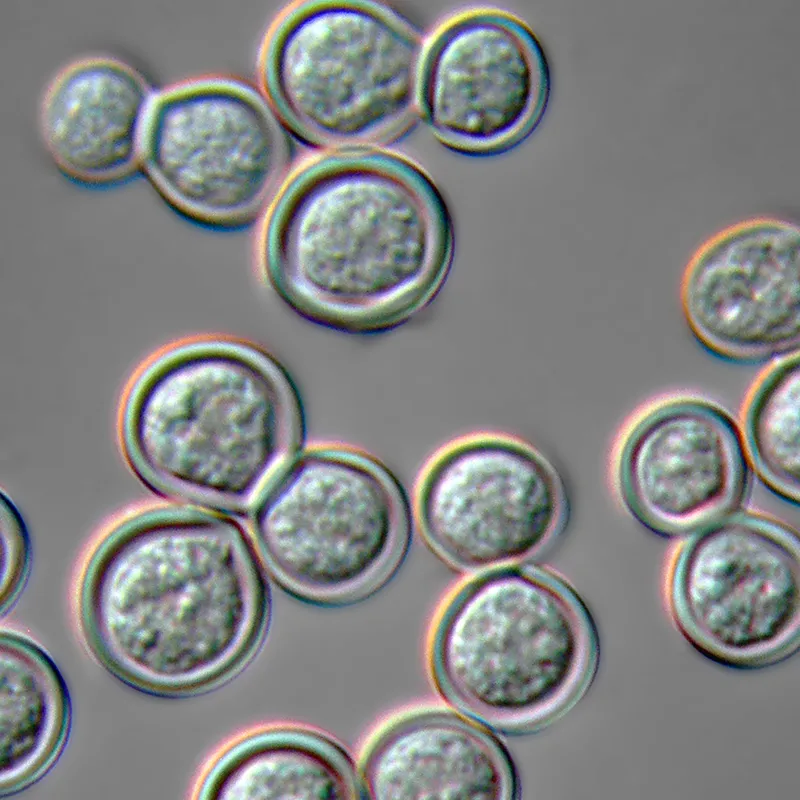
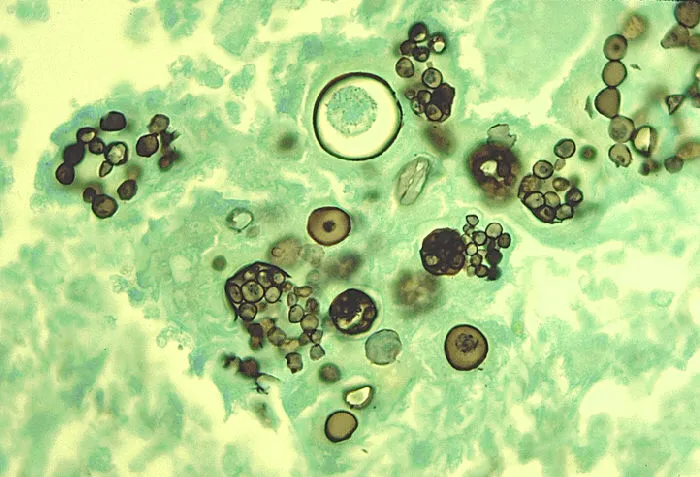
- The image, showing encapsulated yeast cells with varying sizes and budding, is characteristic of **Cryptococcus neoformans** under India ink stain, where the capsule excludes the ink, creating a halo effect.
- This fungus is known for its distinctive **thick polysaccharide capsule** and its tendency to be found in environments contaminated with bird droppings.
*Thick polysaccharide capsule*
- The clear halo around the yeast cells in the image directly demonstrates the presence of a **thick polysaccharide capsule**, which is a key virulence factor distinguishing *Cryptococcus neoformans*.
- This capsule is responsible for the organism's unique appearance in **India ink preparations** and plays a crucial role in immune evasion.
*Mucicarmine stain can be used*
- The **mucicarmine stain** specifically stains the **polysaccharide capsule** of *Cryptococcus neoformans* bright red, aiding in its identification in tissue samples.
- This stain is a valuable diagnostic tool, particularly when dealing with tissue biopsies where the capsule might not be as distinctly visible with India ink due to cellular debris.
Endemic Mycoses Indian Medical PG Question 9: Which of the following is correct about the vegetative fungal spores?
- A. A = Arthrospores, B= Blastospores, C= Chlamydospores
- B. A = Blastospores, B= Arthrospores, C= Chlamydospores (Correct Answer)
- C. A = Blastospores, B= Chlamydospores, C= Arthrospores
- D. A = Chlamydospores, B= Arthrospores, C= Blastospores
Endemic Mycoses Explanation: **A = Blastospores, B= Arthrospores, C= Chlamydospores**
- Image A depicts **blastospores**, which are asexually produced spores formed by **budding** from a parent cell, giving them a distinct tear-drop or oval shape.
- Image B illustrates **arthrospores**, which are formed by the **fragmentation** of a hyphal cell into barrel-shaped segments.
- Image C shows **chlamydospores**, characterized by their **thick-walled**, resistant, and usually spherical or oval structure within a hypha.
*A = Arthrospores, B= Blastospores, C= Chlamydospores*
- This option incorrectly identifies image A as arthrospores, which are typically barrel-shaped and result from hyphal fragmentation, not the budding pattern seen in image A.
- Image B is incorrectly labeled as blastospores, but the fragmentation pattern is characteristic of arthrospores.
*A = Blastospores, B= Chlamydospores, C= Arthrospores*
- While image A is correctly identified as blastospores, this option misidentifies image B as chlamydospores.
- Image C does not show arthrospores; the thick-walled structure is characteristic of chlamydospores, not the barrel-shaped arthrospores.
*A = Chlamydospores, B= Arthrospores, C= Blastospores*
- This option incorrectly identifies image A as chlamydospores, which are thick-walled resistant structures, not the budding spores visible in the image.
- It also incorrectly labels image C as blastospores; the thick-walled appearance is typical of chlamydospores, not budded blastospores.
Endemic Mycoses Indian Medical PG Question 10: Which of the following conditions is not typically associated with Ureaplasma urealyticum?
- A. Non gonococcal urethritis
- B. Epididymitis
- C. Bacterial vaginosis (Correct Answer)
- D. Pelvic inflammatory disease (including salpingitis)
Endemic Mycoses Explanation: ***Bacterial vaginosis***
- **Bacterial vaginosis (BV)** is primarily associated with an imbalance in the vaginal microbiota, characterized by an overgrowth of anaerobic bacteria like *Gardnerella vaginalis* and *Prevotella* species, and a decrease in protective *Lactobacillus* species.
- While *Ureaplasma urealyticum* can be present in the vaginal flora, it is not considered a primary causative agent of **bacterial vaginosis**, which has a distinct microbiological profile.
*Non gonococcal urethritis*
- **Non-gonococcal urethritis (NGU)** is a well-established clinical condition where *Ureaplasma urealyticum* is a common cause, often presenting with dysuria, urethral discharge, and itching.
- Along with *Chlamydia trachomatis*, *Mycoplasma genitalium*, and *Trichomonas vaginalis*, *Ureaplasma urealyticum* is recognized as a significant pathogen in NGU.
*Pelvic inflammatory disease (including salpingitis)*
- *Ureaplasma urealyticum* has been implicated in the etiology of **pelvic inflammatory disease (PID)**, including conditions like **salpingitis**, which involves inflammation of the fallopian tubes.
- The organism can ascend from the lower genital tract, causing inflammation and damage to the reproductive organs, particularly in cases where typical pathogens like *Neisseria gonorrhoeae* or *Chlamydia trachomatis* are not identified.
*Epididymitis*
- **Epididymitis**, especially in men under 35, is often caused by sexually transmitted infections (STIs), and *Ureaplasma urealyticum* is recognized as a potential pathogen.
- It can lead to inflammation of the **epididymis**, causing pain, swelling, and tenderness in the scrotum, particularly in cases of non-gonococcal, non-chlamydial epididymitis.
More Endemic Mycoses Indian Medical PG questions available in the OnCourse app. Practice MCQs, flashcards, and get detailed explanations.


oka
