Systemic Lupus Erythematosus Indian Medical PG Practice Questions and MCQs
Practice Indian Medical PG questions for Systemic Lupus Erythematosus. These multiple choice questions (MCQs) cover important concepts and help you prepare for your exams.
Systemic Lupus Erythematosus Indian Medical PG Question 1: Which of the following cannot be diagnosed without positive ANA?
- A. Sjogren syndrome
- B. SLE (Correct Answer)
- C. Drug induced lupus
- D. None of the above
Systemic Lupus Erythematosus Explanation: ***SLE***
- A positive **Antinuclear Antibody (ANA)** test is a mandatory classification criterion for **Systemic Lupus Erythematosus (SLE)**; without it, the diagnosis cannot be made [1].
- While other criteria exist, a **negative ANA** essentially rules out SLE in almost all cases due to its high sensitivity [2].
*Sjogren syndrome*
- Although **ANA** is often positive in **Sjögren's syndrome** (especially in a speckled pattern, associated with **anti-Ro/SSA** and **anti-La/SSB**), it is not an absolute requirement for diagnosis [1].
- Diagnosis can be made based on clinical features (dry eyes, dry mouth), positive minor salivary gland biopsy, and other autoantibodies.
*Drug induced lupus*
- **Drug-induced lupus** also typically presents with a **positive ANA**, frequently with a **homogenous pattern** and often associated with **anti-histone antibodies**.
- However, like Sjögren's, a positive ANA is very common but not an absolute prerequisite; clinical context and resolution upon drug cessation are also crucial.
*None of the above*
- This option is incorrect because **SLE** specifically requires a positive **ANA** for diagnosis according to established classification criteria.
Systemic Lupus Erythematosus Indian Medical PG Question 2: Indications for use of cyclophosphamide in SLE are:
- A. Arthritis
- B. Diffuse proliferative glomerulonephritis (Correct Answer)
- C. Oral ulcers
- D. Anti D NA antibody +ive patients
Systemic Lupus Erythematosus Explanation: Diffuse proliferative glomerulonephritis
- **Cyclophosphamide** is a potent immunosuppressant often used in severe manifestations of **systemic lupus erythematosus (SLE)**, particularly **lupus nephritis**.
- **Diffuse proliferative glomerulonephritis (class IV lupus nephritis)** is a severe form of kidney involvement in SLE, characterized by significant inflammation and immune complex deposition, for which cyclophosphamide is a first-line treatment due to its ability to induce remission and prevent progression to end-stage renal disease.
*Arthritis*
- **Arthritis** in SLE is typically managed with less aggressive therapies such as **NSAIDs**, **hydroxychloroquine**, or low-dose **corticosteroids** [1].
- Cyclophosphamide is generally reserved for life-threatening or organ-threatening manifestations due to its significant side effects.
*Oral ulcers*
- **Oral ulcers** in SLE are usually a mild cutaneous manifestation and are managed with topical treatments, **hydroxychloroquine**, or occasionally low-dose **systemic corticosteroids**.
- The use of cyclophosphamide for oral ulcers would be inappropriate given its toxicity profile.
*Anti D NA antibody +ive patients*
- While **anti-dsDNA antibodies** are characteristic of SLE and often correlate with disease activity, particularly **lupus nephritis**, their presence alone does not indicate the need for cyclophosphamide [2].
- The decision to use cyclophosphamide is based on the presence of severe organ-threatening disease, not solely on antibody positivity.
Systemic Lupus Erythematosus Indian Medical PG Question 3: Most specific test for SLE
- A. ds- DNA
- B. ss DNA
- C. Anti- smith antibody (Correct Answer)
- D. Histone
Systemic Lupus Erythematosus Explanation: ***Anti-smith antibody***
- **Anti-Smith (anti-Sm) antibodies** are highly specific for **Systemic Lupus Erythematosus (SLE)**, meaning their presence strongly indicates the disease [1].
- While only present in about 20-30% of SLE patients, they are rarely found in other conditions, making them a key diagnostic marker [1].
*ds-DNA*
- **Anti-dsDNA antibodies** are highly specific for SLE and often correlate with **disease activity**, especially **lupus nephritis**.
- However, their specificity is slightly lower than anti-Sm antibodies, as they can sometimes be found in other autoimmune conditions (e.g., drug-induced lupus).
*ss DNA*
- **Anti-ssDNA antibodies** are less specific for SLE and can be found in various other **autoimmune diseases**, infections, and even in healthy individuals.
- Therefore, their presence alone is not sufficient for a diagnosis of SLE.
*Histone*
- **Anti-histone antibodies** are most commonly associated with **drug-induced lupus (DIL)**, found in about 95% of patients with DIL.
- While they can be present in some cases of SLE, they are not specific for spontaneous SLE and are a better indicator of DIL.
Systemic Lupus Erythematosus Indian Medical PG Question 4: Which of the following is not a feature of Systemic Lupus Erythematosus (SLE)?
- A. Recurrent abortion
- B. Sterility (Correct Answer)
- C. Psychosis
- D. Coomb's positive hemolytic anemia
Systemic Lupus Erythematosus Explanation: ***Sterility***
- While SLE can affect fertility due to **gonadal dysfunction** or **treatment-related factors**, it is not a *direct* or *defining feature* of the disease itself.
- Sterility is a less common manifestation compared to the widespread organ system involvement that characterizes SLE [2].
*Recurrent abortion*
- **Recurrent abortions** are a well-recognized complication in SLE, particularly when associated with **antiphospholipid syndrome**, which frequently co-occurs with SLE [1].
- **Antiphospholipid antibodies** can lead to thrombosis in placental vessels, causing fetal loss.
*Psychosis*
- **Psychosis** is a significant neuropsychiatric manifestation of SLE, classified under **neuropsychiatric lupus (NPSLE)**.
- It can result from **inflammation**, **autoantibody effects**, or **ischemia** within the central nervous system.
*Coomb's positive hemolytic anemia*
- **Coomb's positive hemolytic anemia** is a common hematological complication in SLE, indicating the presence of **autoantibodies** against red blood cells [3].
- This **autoimmune destruction** of red blood cells leads to anemia, and a positive direct Coombs test confirms antibody sensitization [3].
Systemic Lupus Erythematosus Indian Medical PG Question 5: Deposition of Anti ds DNA Ab in kidney, skin, choroid plexus and joints is seen in:
- A. Good pasture
- B. Raynauds disease
- C. SLE (Correct Answer)
- D. Scleroderma
Systemic Lupus Erythematosus Explanation: ### SLE
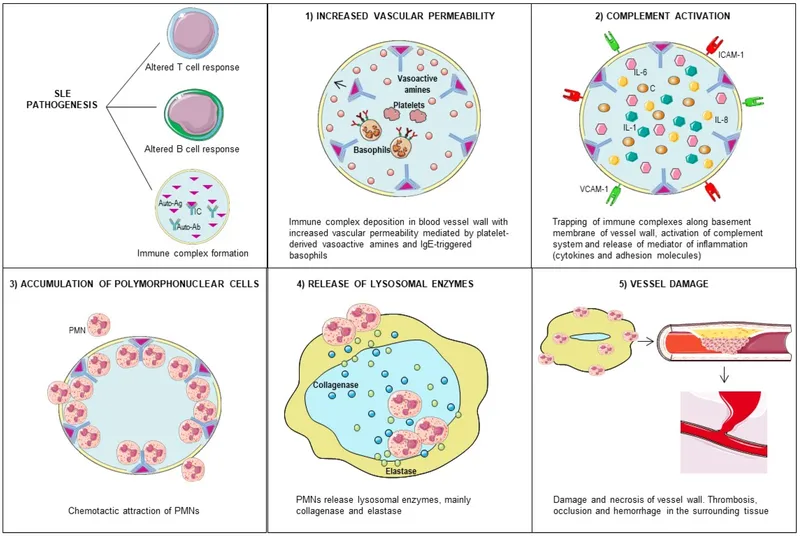
- **Anti-dsDNA antibodies** are highly specific for **Systemic Lupus Erythematosus (SLE)** and are involved in the pathophysiology of organ damage in this autoimmune disease [2].
- The deposition of these antibodies and immune complexes in various tissues like the **kidney (lupus nephritis)**, **skin (malar rash, discoid lupus)**, **choroid plexus (neuropsychiatric lupus)**, and **joints (arthralgia/arthritis)** is characteristic of SLE [1].
### Good pasture
- Goodpasture syndrome is characterized by **anti-glomerular basement membrane (anti-GBM) antibodies** that primarily target the **kidneys** and **lungs**.
- It does not involve the deposition of anti-dsDNA antibodies or affect the skin, choroid plexus, or joints in the same manner as SLE.
### Raynauds disease
- Raynaud's disease is a **vasospastic disorder** affecting small arteries, typically in the fingers and toes, leading to episodic color changes (white, blue, red).
- It is not an autoimmune disease characterized by antibody deposition in organs, although it can be a symptom of underlying connective tissue diseases like SLE [1].
### Scleroderma
- Scleroderma (systemic sclerosis) is an autoimmune disease characterized by **fibrosis** of the skin and internal organs, and **vascular dysfunction**.
- While it can involve **autoantibodies (e.g., anti-topoisomerase I, anti-centromere)**, it is not primarily associated with anti-dsDNA antibody deposition or the specific pattern of organ involvement seen in SLE [2].
Systemic Lupus Erythematosus Indian Medical PG Question 6: A child with history of fever, photosensitivity, rash sparing nasolabial fold presents to OP. Identify the condition?
- A. SLE (Correct Answer)
- B. Polymorphous light eruption
- C. Discoid lupus
- D. Skin tuberculosis
Systemic Lupus Erythematosus Explanation: ***SLE***
- The combination of **fever**, **photosensitivity**, and a **rash sparing the nasolabial folds** (malar rash or butterfly rash) is highly characteristic of Systemic Lupus Erythematosus (SLE).
- Childhood-onset SLE can present with similar mucocutaneous and systemic features as adult-onset disease.
*Polymorphous light eruption*
- This condition is primarily characterized by **photosensitive skin lesions** but typically does not involve systemic symptoms like fever.
- While it presents with rash in sun-exposed areas, it generally lacks the distinct malar rash appearance and systemic involvement seen in SLE.
*Discoid lupus*
- Discoid lupus is a form of **cutaneous lupus** characterized by chronic, scaly, disfiguring plaques, often on the face and scalp.
- It usually **lacks systemic symptoms** like fever and does not present as a widespread malar rash sparing nasal folds.
*Skin tuberculosis*
- Skin tuberculosis (lupus vulgaris or scrofuloderma) presents with **nodular, plaque-like lesions** or cold abscesses, often with ulceration and scarring.
- It is not typically associated with **photosensitivity** or a malar rash, and fever, if present, is usually due to systemic Mycobacterium infection.
Systemic Lupus Erythematosus Indian Medical PG Question 7: A patient given one of the following drug develops low grade fever, muscle and joint ache, chest pain and skin rashes. Lab investigations showed presence of antihistone antibodies. Symptoms however subsided after discontinuation of the drug. Which is the drug that caused the reaction?
- A. Paracetamol
- B. Furosemide
- C. Rifampicin
- D. Hydralazine (Correct Answer)
Systemic Lupus Erythematosus Explanation: ***Hydralazine***
- This drug is a well-known cause of **drug-induced lupus erythematosus (DILE)**, which presents with symptoms like fever, myalgia, arthralgia, pleuritic chest pain, and skin rashes.
- The presence of **antihistone antibodies** is a hallmark laboratory finding in DILE, and symptoms typically resolve upon discontinuation of the causative drug.
*Paracetamol*
- Paracetamol (acetaminophen) is an **analgesic** and **antipyretic** and is generally well-tolerated.
- It does not typically cause a lupus-like syndrome or induce the formation of antihistone antibodies.
*Furosemide*
- Furosemide is a **loop diuretic** primarily used for treating edema and hypertension.
- While it can cause side effects like electrolyte imbalances, it is not associated with drug-induced lupus or antihistone antibodies.
*Rifampicin*
- Rifampicin is an **antibiotic** used to treat tuberculosis and other bacterial infections.
- Its side effects can include hepatotoxicity, gastrointestinal disturbances, and reddish discoloration of body fluids, but not typically a lupus-like syndrome with antihistone antibodies.
Systemic Lupus Erythematosus Indian Medical PG Question 8: In a patient presenting with symptoms of drug-induced lupus erythematosus, which antibody is most commonly found?
- A. Ds-DNA
- B. Anti-Sm
- C. Anti-histone antibody (Correct Answer)
- D. Anti-Ro
Systemic Lupus Erythematosus Explanation: ***Anti-histone antibody***
- **Anti-histone antibodies** are present in approximately 90-95% of patients with **drug-induced lupus erythematosus**.
- Their presence, especially with a history of exposure to an inducing drug such as **hydralazine** or **procainamide**, strongly suggests this diagnosis.
*Anti-Ro*
- **Anti-Ro antibodies** are more commonly associated with **Sjogren's syndrome** and **neonatal lupus**, rather than drug-induced lupus [1].
- While they can be present in systemic lupus erythematosus, they are not the hallmark antibody for the drug-induced form.
*Ds-DNA*
- **Anti-double-stranded DNA (anti-dsDNA) antibodies** are highly specific for **systemic lupus erythematosus (SLE)** and often correlate with disease activity, particularly **lupus nephritis**.
- They are typically **negative** or present in very low titers in drug-induced lupus erythematosus.
*Anti-Sm*
- **Anti-Smith (anti-Sm) antibodies** are highly specific for **systemic lupus erythematosus (SLE)** and are considered a diagnostic marker for the disease [1].
- They are rarely found in patients with drug-induced lupus erythematosus.
Systemic Lupus Erythematosus Indian Medical PG Question 9: All of the following are found in SLE except
- A. Psychosis
- B. Discoid rash
- C. Oral ulcers
- D. Leucocytosis (Correct Answer)
Systemic Lupus Erythematosus Explanation: ***Leucocytosis***
- **Leucopenia** (decreased white blood cell count) is a common hematological manifestation in SLE, not **leucocytosis**.
- A persistent white blood cell count of **less than 4,000/mm³** on two or more occasions in the absence of other causes is a criterion for SLE.
*Psychosis*
- **Neuropsychiatric manifestations**, including psychosis, are recognized as a serious complication of SLE, categorized under **neuropsychiatric SLE (NPSLE)**.
- These symptoms result from **inflammation, autoantibody production**, and other immune-mediated processes affecting the central nervous system [1].
*Oral ulcers*
- **Oral or nasopharyngeal ulcers** are a common mucocutaneous manifestation of SLE.
- These ulcers are typically **painless** and can be found on the **hard palate** or buccal mucosa.
*Discoid rash*
- A **discoid rash** is a specific skin manifestation of cutaneous lupus, often chronic and causing scarring [1].
- It presents as **erythematous raised patches with adherent keratotic scaling** and follicular plugging, which can lead to scarring alopecia [1].
Systemic Lupus Erythematosus Indian Medical PG Question 10: Drug Induced Lupus is caused by all except
- A. Hydralazine
- B. Sulphonamides
- C. Isoniazid
- D. Procaine (Correct Answer)
Systemic Lupus Erythematosus Explanation: ***Procaine***
- While **procainamide**, a derivative of procaine, is a known cause of **drug-induced lupus (DIL)**, **procaine** itself is not typically implicated.
- Procaine is a **local anesthetic** and its mechanism of action does not commonly lead to the immunological reactions seen in DIL.
*Hydralazine*
- **Hydralazine** is a well-established cause of **drug-induced lupus (DIL)**, particularly with higher doses and prolonged use.
- It frequently results in the development of **anti-histone antibodies**, a hallmark of DIL.
*Sulphonamides*
- Various **sulphonamide antibiotics** (e.g., sulfasalazine, sulfamethoxazole) are known to induce **lupus-like syndromes**.
- These drugs can trigger immune responses leading to symptoms characteristic of **systemic lupus erythematosus (SLE)**.
*Isoniazid*
- **Isoniazid**, an anti-tuberculosis medication, is a recognized cause of **drug-induced lupus (DIL)**.
- It often leads to the formation of **anti-histone antibodies** and clinical manifestations resembling spontaneous lupus.
More Systemic Lupus Erythematosus Indian Medical PG questions available in the OnCourse app. Practice MCQs, flashcards, and get detailed explanations.