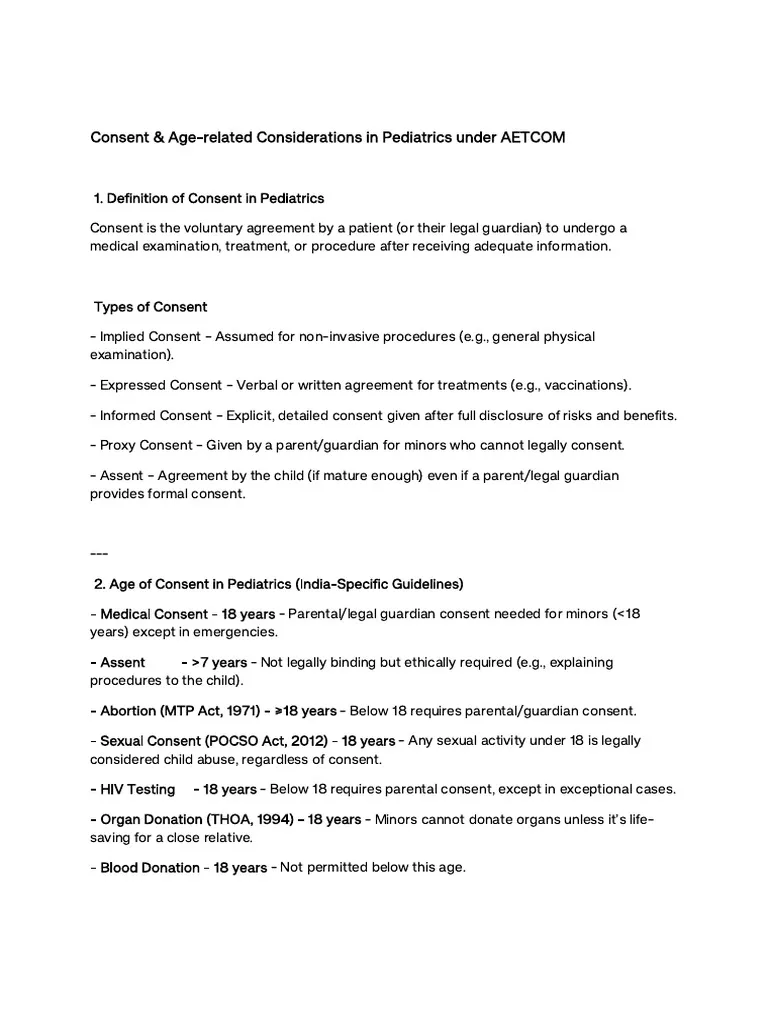
Child Sexual Abuse Indian Medical PG Practice Questions and MCQs
Practice Indian Medical PG questions for Child Sexual Abuse. These multiple choice questions (MCQs) cover important concepts and help you prepare for your exams.
Child Sexual Abuse Indian Medical PG Question 1: As per Indian guidelines, what is the recommended age for a woman to begin screening for cervical cancer?
- A. 25 years
- B. 21 years
- C. 30 years (Correct Answer)
- D. 18 years
Child Sexual Abuse Explanation: ***30 years***
- **Indian guidelines** from the **Ministry of Health & Family Welfare (MoHFW)** and the **Indian Council of Medical Research (ICMR)** recommend initiating cervical cancer screening at **age 30 years** or within 3 years of first sexual contact.
- The recommended screening methods in India include **VIA (Visual Inspection with Acetic Acid)**, **HPV DNA testing**, or **Pap smear**, performed every 5 years until age 65.
- This approach is tailored to the **Indian healthcare setting** and resource availability.
*21 years*
- This is the recommended screening age according to **US guidelines (ACOG/USPSTF)**, not Indian guidelines.
- While appropriate for the US context, Indian guidelines start screening later at age 30, considering **epidemiological data**, **disease prevalence**, and **healthcare infrastructure** specific to India.
*25 years*
- Some **European countries** and the **UK** recommend starting screening at age 25.
- This is **not the recommended age** for cervical cancer screening according to Indian national guidelines.
- In India, screening typically begins at age 30 years.
*18 years*
- Initiating cervical cancer screening at age 18 is **not recommended** by any major international or Indian guidelines.
- Screening before age 21 (in US guidelines) or 30 (in Indian guidelines) often leads to **unnecessary procedures and anxiety**, as **HPV infections** and mild dysplasias in adolescents usually resolve spontaneously.
Child Sexual Abuse Indian Medical PG Question 2: Disputed maternity can be solved by using the following tests, EXCEPT:
- A. Blood grouping
- B. HLA typing
- C. DNA fingerprinting
- D. Precipitin test (Correct Answer)
Child Sexual Abuse Explanation: ***Precipitin test***
- The **precipitin test** is used to determine the origin of a **blood sample**, specifically whether it is **human or animal blood**, by detecting species-specific proteins. It is not used for assessing maternity.
- This test is primarily employed in **forensic serology** to differentiate between blood from different animal species, making it irrelevant for paternity or maternity disputes.
*Blood grouping*
- **Blood grouping** (e.g., ABO and Rh systems) can be used to **exclude paternity or maternity** by comparing the blood types of the child, mother, and alleged father.
- If the child's blood type is incompatible with the alleged parents based on Mendelian inheritance, one or both can be excluded.
*HLA typing*
- **HLA typing** (Human Leukocyte Antigen) is a more powerful genetic marker system than ABO/Rh for determining paternity or maternity.
- It involves analyzing highly polymorphic genes on chromosome 6 that encode cell surface proteins, providing a more definitive means of **inclusion or exclusion**.
*DNA fingerprinting*
- **DNA fingerprinting** (also known as **DNA profiling**) is the **most accurate and widely accepted method** for resolving paternity and maternity disputes.
- It analyzes highly variable regions of DNA unique to each individual, providing a statistically strong basis for **inclusion or exclusion** by comparing genetic profiles.
Child Sexual Abuse Indian Medical PG Question 3: Which of the following is false about Rape
- A. It is considered as rape even if the act is done with consent of female, if she is less than 18 years old
- B. Complete vaginal penetration is necessary to call it rape (Correct Answer)
- C. It is punished under 376 IPC
- D. It is defined under 375 IPC
Child Sexual Abuse Explanation: ***Complete vaginal penetration is necessary to call it rape***
- This statement is **false**. Under Indian law (IPC Section 375), **penetration by the penis to any extent** into the vagina, mouth, urethra, or anus, or any other part of a woman, or causing a woman to do so to herself or another, constitutes rape.
- Complete vaginal penetration is **not a prerequisite** for the act to be legally classified as rape; even partial penetration is sufficient.
*It is considered as rape even if the act is done with consent of female, if she is less than 18 years old*
- This statement is **true**. Under IPC Section 375, if a female is **under 18 years of age**, her consent is legally **irrelevant and void** in cases of sexual intercourse.
- Any sexual act with a minor under the age of 18, even with her apparent consent, is considered statutory rape.
*It is punished under 376 IPC*
- This statement is **true**. **Section 376 of the Indian Penal Code (IPC)** specifically deals with the **punishment for rape**.
- It outlines various degrees of punishment depending on the circumstances, such as gang rape, rape by a person in authority, or rape of a minor.
*It is defined under 375 IPC*
- This statement is **true**. **Section 375 of the Indian Penal Code (IPC)** provides the legal **definition of rape**.
- It specifies the acts that constitute rape and the circumstances under which an act of sexual intercourse is considered against the woman's will or without her valid consent.
Child Sexual Abuse Indian Medical PG Question 4: Under the POCSO Act, 2012, which of the following does NOT qualify as aggravated penetrative sexual assault?
- A. Assault by a police officer on duty
- B. Assault during communal or sectarian violence
- C. Assault committed by a group of persons (gang assault)
- D. Assault committed by a child below 18 years of age (Correct Answer)
Child Sexual Abuse Explanation: ***Assault committed by a child below 18 years of age***
- The **POCSO Act, 2012**, defines **aggravated penetrative sexual assault** based on the **perpetrator's status** (e.g., in a position of trust or authority), **circumstances of the assault** (e.g., gang assault, during conflict), or **vulnerability of the victim**.
- While an assault committed by a child is still a serious offense, the **age of the perpetrator** (if below 18) typically leads to different legal proceedings and juvenile justice provisions rather than classifying it as aggravated penetrative sexual assault under the specific criteria for aggravation in POCSO.
*Assault by a police officer on duty*
- This scenario triggers **aggravated penetrative sexual assault** because the perpetrator is a **person in a position of authority** or public servant, and the act is committed while on duty, exploiting their power.
- The Act specifically lists such individuals as those whose actions constitute aggravation due to the **abuse of power and trust**.
*Assault during communal or sectarian violence*
- This situation constitutes **aggravated penetrative sexual assault** because the assault occurs in a context of **widespread societal disruption and violence**, often targeting specific groups.
- The Act includes offenses committed during such conflicts as aggravated due to the severe impact on the victim and the community, often involving **multiple perpetrators** or extreme cruelty.
*Assault committed by a group of persons (gang assault)*
- A **gang assault** is explicitly defined as **aggravated penetrative sexual assault** under the POCSO Act.
- The involvement of **multiple perpetrators** significantly increases the victim's trauma, fear, and vulnerability, making it an aggravated offense.
Child Sexual Abuse Indian Medical PG Question 5: An 11-year-old female in the school was brought to the principal by a teacher because she is always crying, unattentive, and not taking an interest in any activity. On further investigation, the girl revealed that she was inappropriately touched by her uncle on her private parts at her home. To whom should the principal report this incident?
- A. Child welfare
- B. Parents
- C. Police (Correct Answer)
- D. Magistrate
Child Sexual Abuse Explanation: ***Police***
- Under the **POCSO Act (Protection of Children from Sexual Offences Act), 2012, Section 19(1)**, the principal and teacher are **mandated reporters** who have a legal obligation to report any knowledge or suspicion of child sexual abuse to the **local police or Special Juvenile Police Unit**.
- Failure to report such cases is a punishable offense under POCSO Act, with imprisonment up to 6 months and/or fine.
- The police are responsible for **immediate investigation** of the criminal offense and ensuring the child's safety.
- The police will then coordinate with the Child Welfare Committee (CWC) as required under the Juvenile Justice Act.
*Child welfare*
- While the **Child Welfare Committee (CWC)** plays an important role in child protection under the Juvenile Justice Act, 2015, the **primary and immediate legal obligation** under POCSO is to report to the **police**.
- The CWC becomes involved either through police referral or parallel reporting, but they are **not the first point of contact** for reporting criminal sexual offenses.
- Child welfare agencies work on rehabilitation and protection, whereas police handle the criminal investigation.
*Parents*
- Since the perpetrator is the **uncle (family member)**, reporting to parents first could compromise the investigation or further endanger the child.
- Parents may be in denial, protective of the family member, or unaware of the severity.
- POCSO Act mandates reporting to **authorities (police)**, not to family members.
*Magistrate*
- A magistrate is a **judicial officer** involved in legal proceedings after police investigation and filing of chargesheet.
- They issue orders, record statements under Section 164 CrPC, and conduct trials.
- They are **not the appropriate authority** for the initial mandatory report of child sexual abuse.
Child Sexual Abuse Indian Medical PG Question 6: Incest is defined as sexual intercourse between which individuals?
- A. Closely related individuals (Correct Answer)
- B. Individuals other than spouse
- C. Humans and animals
- D. Unrelated individuals of same gender
Child Sexual Abuse Explanation: ***Closely related individuals***
- **Incest** refers to sexual intercourse between individuals who are considered too **closely related** by lineage or kinship to marry each other legally.
- The definition of "closely related" varies across cultures and legal systems but generally includes **immediate family members** such as parents, children, and siblings.
*Individuals other than spouse*
- This definition describes **adultery** or **extramarital affairs**, which are distinct from incest.
- While both involve sexual acts outside of legally or socially accepted norms, they differ significantly in the relationship between the involved parties.
*Humans and animals*
- This describes **bestiality** or **zoophilia**, which is a form of sexual activity involving humans and animals.
- This is a separate and distinct concept from incest, which specifically concerns sexual relations between humans within a prohibited degree of kinship.
*Unrelated individuals of same gender*
- This describes **homosexual** sexual acts between adults, which are not inherently illegal or considered incestuous.
- Incest is defined specifically by the **familial relationship** between the individuals, not their gender or lack of marital ties.
Child Sexual Abuse Indian Medical PG Question 7: Which of the following is NOT considered a phase of child sexual abuse?
- A. Engagement
- B. Secrecy
- C. Bargaining (Correct Answer)
- D. Sexual interaction
Child Sexual Abuse Explanation: ***Bargaining***
- **Bargaining** is typically a phase associated with the Kubler-Ross model of grief (denial, anger, bargaining, depression, acceptance) and is not recognized as a distinct phase in the cycle or process of child sexual abuse.
- While a child might attempt to bargain in some contexts for safety or to stop the abuse, it is not a universally accepted or described phase of the abuse process itself.
*Engagement*
- The **engagement** phase often involves the perpetrator grooming the child, building trust, and isolating them from protective factors.
- This phase is crucial for the abuser to gain the child's compliance and reduce the likelihood of disclosure.
*Secrecy*
- **Secrecy** is a core component of child sexual abuse, where the perpetrator often instills fear or manipulates the child to keep the abuse hidden.
- This phase typically involves threats, intimidation, or emotional manipulation to prevent the child from disclosing the abuse to others.
*Sexual interaction*
- The **sexual interaction** phase refers to the actual abusive acts and physical contact that define child sexual abuse.
- This is the explicit act of sexual exploitation or assault that the perpetrator inflicts upon the child.
Child Sexual Abuse Indian Medical PG Question 8: Rape is defined under:
- A. Sec. 320 IPC
- B. Sec. 375 IPC (Correct Answer)
- C. Sec. 351 IPC
- D. Sec. 376 IPC
Child Sexual Abuse Explanation: ***Sec. 375 IPC***
- **Section 375 of the Indian Penal Code (IPC)** specifically defines **rape**. It outlines the various circumstances under which a sexual act is considered rape, focusing on the absence of consent.
- The section has been amended several times to broaden its scope and strengthen protections for victims, particularly after significant legal reforms.
*Sec. 320 IPC*
- **Section 320 IPC** defines **"Grievous Hurt,"** which includes severe injuries like emasculation or deprivation of any joint or part of the body.
- This section deals with the classification of serious bodily harm, not sexual offenses.
*Sec. 351 IPC*
- **Section 351 IPC** defines **"Assault."** It refers to making any gesture or preparation intending or knowing it to be likely that such gesture or preparation will cause any person present to apprehend that he who makes it is about to use criminal force to him.
- This section addresses acts that create an apprehension of immediate criminal force, not the act of rape itself.
*Sec. 376 IPC*
- **Section 376 IPC** deals with the **"Punishment for Rape."** While it is directly related to rape, it specifies the penalties for the offense, not its definition.
- This section lays down the various terms of imprisonment and fines that can be imposed on a person convicted of rape, including aggravated forms of the crime.
Child Sexual Abuse Indian Medical PG Question 9: A private doctor refusing to treat a case of sexual offence and referring to government hospital is
- A. Punishable under 327(c) CrPC
- B. Not an offence
- C. Punishable under 357(c) CrPC
- D. Punishable under 166B IPC (Correct Answer)
Child Sexual Abuse Explanation: ***Punishable under 166B IPC***
- **Section 166B of the Indian Penal Code (IPC)** specifically addresses the failure of a medical professional to treat victims of certain crimes, including sexual offenses.
- It mandates that every hospital (private or public) and its medical staff are legally obligated to provide immediate medical assistance to victims of such offenses.
- **This section was introduced through the Criminal Law (Amendment) Act, 2013**, making refusal to treat a sexual offense victim a punishable offense with imprisonment up to 1 year and/or fine.
*Punishable under 327(c) CrPC*
- This section refers to **Section 327 of the Code of Criminal Procedure (CrPC)**, which deals with the **procedure for trials** and concerns the conduct of court proceedings in cases involving sexual offenses (specifically regarding in-camera trials).
- It does not directly impose a penalty on doctors for refusing treatment.
*Not an offence*
- This option is **incorrect** as refusing treatment to a victim of a sexual offense is indeed a **legally punishable offense** under Section 166B IPC.
- The law recognizes the vulnerability of victims and the urgency of medical intervention, making it mandatory for all medical professionals to provide immediate care.
- Some may mistakenly believe private doctors have discretion, but the legal obligation extends to both government and private medical facilities.
*Punishable under 357(c) CrPC*
- **Section 357 of the CrPC** focuses on **compensation to victims of crime**, particularly referring to the use of fine money for compensation, or granting compensation in cases where no fine is imposed.
- This section deals with **victim compensation mechanisms** and not the penal provisions for non-treatment by medical professionals.
Child Sexual Abuse Indian Medical PG Question 10: Most reliable sign of sexual intercourse in a married woman examined after 48 hours?
- A. Sperm detection (Correct Answer)
- B. Acid phosphatase
- C. Hymenal tears
- D. Vaginal tears
Child Sexual Abuse Explanation: ***Sperm detection***
- **Viable sperm** can be detected in the cervical mucus for up to 5 days, and sometimes longer, making it the most reliable indicator of recent intercourse even after 48 hours.
- The presence of **spermatozoa**, even non-motile ones, provides direct evidence of male ejaculate in the female genital tract.
- Sperm can persist in the vaginal canal for 3-5 days and in cervical mucus for up to 7 days post-intercourse.
*Acid phosphatase*
- While a component of seminal fluid, **acid phosphatase** degrades rapidly and its detection is generally reliable only within 24-36 hours post-intercourse.
- Post 48 hours, the levels of acid phosphatase would likely be too low to be reliably used as conclusive evidence.
- It is more useful for recent intercourse detection within 24 hours.
*Hymenal tears*
- **Hymenal tears** are not a reliable sign of recent intercourse within a marriage context, as some women may not experience tearing, or tears may have healed.
- In a married woman, previous intercourse would have likely already altered the hymen, making new tears less indicative of recent activity.
- The hymen shows significant variation and may be absent or already disrupted.
*Vaginal tears*
- **Vaginal tears** are typically associated with forceful or traumatic intercourse, or in cases of sexual assault, rather than consensual marital intercourse.
- The absence of vaginal tears does not rule out consensual sexual activity, nor does its presence definitively confirm it in this specific context after 48 hours.
- Not a reliable marker for consensual intercourse.
More Child Sexual Abuse Indian Medical PG questions available in the OnCourse app. Practice MCQs, flashcards, and get detailed explanations.