Occupational Lung Diseases Indian Medical PG Practice Questions and MCQs
Practice Indian Medical PG questions for Occupational Lung Diseases. These multiple choice questions (MCQs) cover important concepts and help you prepare for your exams.
Occupational Lung Diseases Indian Medical PG Question 1: A 45-year-old male reports several years of asbestos exposure while working in the construction industry. He reports smoking 2 packs of cigarettes per day for over 20 years. Smoking and asbestos exposure increase the incidence of which of the following diseases?
- A. Emphysema
- B. Malignant pulmonary mesothelioma
- C. Multiple myeloma
- D. Bronchogenic carcinoma (Correct Answer)
- E. Chronic bronchitis
Occupational Lung Diseases Explanation: ***Bronchogenic carcinoma***
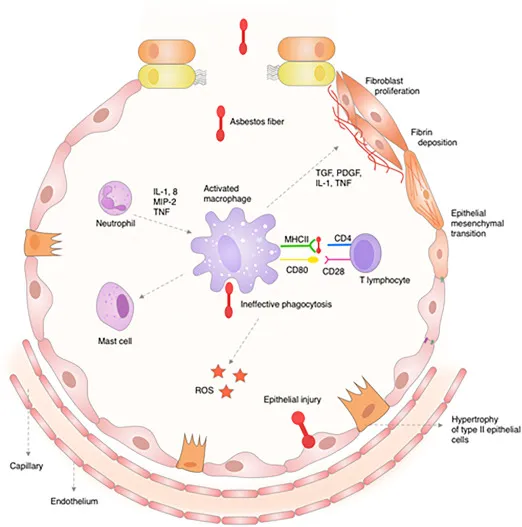
- **Smoking** is the leading cause of **bronchogenic carcinoma**, and **asbestos exposure** significantly *multiplies* its risk, rather than simply adding to it.
- This synergistic effect means that smokers exposed to asbestos have a **much higher incidence** of lung cancer compared to those with either exposure alone.
*Emphysema*
- Primarily linked to **smoking** and chronic exposure to irritants, but asbestos exposure does not significantly increase its incidence.
- While both smoking and asbestos can cause pulmonary issues, their primary mechanisms for emphysema are distinct.
*Malignant pulmonary mesothelioma*
- **Malignant mesothelioma** is strongly associated with **asbestos exposure**, but its incidence is *not significantly increased* by smoking.
- Smoking is a risk factor for lung cancer, but not a primary risk factor for mesothelioma itself.
*Multiple myeloma*
- This is a **hematologic malignancy** (cancer of plasma cells) and has no established link with either **smoking** or **asbestos exposure**.
- Its risk factors are largely genetic and related to other environmental factors, but not directly linked to respiratory toxins.
*Chronic bronchitis*
- **Chronic bronchitis** is primarily caused by **smoking** and exposure to environmental pollutants.
- While asbestos exposure can cause lung damage, it doesn't directly or significantly increase the incidence of chronic bronchitis.
Occupational Lung Diseases Indian Medical PG Question 2: Which of the following types of hypersensitivity reactions is primarily involved in Farmer's lung?
- A. Type III
- B. Type IV (Correct Answer)
- C. Type I
- D. Type II
Occupational Lung Diseases Explanation: ***cd***
- Farmer's lung is primarily a **Type III hypersensitivity** reaction [1], which involves the formation of **immune complexes** from inhaled organic antigens, leading to inflammation.
- The exposure to moldy hay or organic dust results in **alveolitis**, which characterizes this condition [2].
*ac*
- Type I hypersensitivity is **IgE-mediated**, typically causing **immediate allergic reactions**, such as asthma or anaphylaxis.
- It does not manifest as chronic lung conditions like Farmer's lung, which has different immunological mechanisms.
*ab*
- Type II hypersensitivity involves **IgG or IgM antibodies** targeting specific cell surface antigens, leading to cell destruction or dysfunction.
- Conditions like hemolytic anemia or autoimmune disorders are examples but are unrelated to Farmer's lung.
*bd*
- Type IV hypersensitivity is a **cell-mediated response** involving T cells, commonly seen in infections or contact dermatitis.
- While it plays a role in certain lung conditions [2], it does not correlate with the immune complex involvement seen in Farmer's lung.
**References:**
[1] Kumar V, Abbas AK, et al.. Robbins and Cotran Pathologic Basis of Disease. 9th ed. Diseases of the Immune System, pp. 214-215.
[2] Kumar V, Abbas AK, et al.. Robbins and Cotran Pathologic Basis of Disease. 9th ed. The Lung, pp. 701-702.
Occupational Lung Diseases Indian Medical PG Question 3: Which of the following is false regarding transfusion-associated anaphylactic reactions?
- A. Different from allergy
- B. Epinephrine is the drug of choice
- C. Washed blood products prevent it
- D. Seen in IgG deficient individuals (Correct Answer)
Occupational Lung Diseases Explanation: ***Seen in IgG deficient individuals***
- Transfusion-associated **anaphylactic reactions** are most commonly seen in **IgA-deficient individuals** who develop **anti-IgA antibodies** and receive blood products containing IgA.
- Anaphylaxis occurs when these pre-formed IgA antibodies react with donor IgA, leading to mast cell degranulation and severe allergic symptoms.
*Different from allergy*
- Transfusion-associated **anaphylactic reactions** are a severe form of allergic reaction, often distinguished by their **rapid onset** and life-threatening nature [1].
- While all allergies involve an immune response to an allergen, anaphylaxis represents the most extreme systemic manifestation.
*Epinephrine is the drug of choice*
- **Epinephrine** is indeed the **first-line treatment** for acute anaphylaxis, regardless of its cause, including transfusion-associated reactions [2].
- It acts rapidly to counteract the systemic effects of histamine and other mediators by acting on α and β adrenergic receptors [3].
*Washed blood products prevent it*
- **Washing blood products** (e.g., packed red blood cells or platelets) is an effective strategy to **remove plasma proteins**, including IgA.
- This is particularly crucial for patients with a known **IgA deficiency and anti-IgA antibodies** to prevent severe anaphylactic reactions.
Occupational Lung Diseases Indian Medical PG Question 4: Which of the following is more prone to produce mesothelioma?
- A. Crocidolite (Correct Answer)
- B. Anthophyllite
- C. Chrysotile
- D. Amosite (Brown asbestos)
Occupational Lung Diseases Explanation: ***Crocidolite***
- Crocidolite, or **blue asbestos**, is the most hazardous type of asbestos linked to **mesothelioma** [1][2].
- Its **fibrous nature** and high durability result in significant inhalation exposure, increasing cancer risk.
*Chrysolite*
- Also known as **white asbestos**; is the least carcinogenic and less associated with mesothelioma compared to other asbestos types.
- Primarily used in **ceiling tiles** and insulation, exposure levels are typically lower.
*Anthophyllite*
- Rarely used commercially and associated with a **lower incidence** of cancer compared to crocidolite or amosite.
- Its exposure is more commonly linked to **contaminated talc**, not significant for mesothelioma.
*Amosite*
- Known as **brown asbestos**; while associated with lung cancer, it is less frequently linked to mesothelioma than crocidolite.
- It poses risks primarily through prolonged exposure in industrial settings, but is not the most potent carcinogen for mesothelioma.
**References:**
[1] Kumar V, Abbas AK, et al.. Robbins and Cotran Pathologic Basis of Disease. 9th ed. The Lung, pp. 697-698.
[2] Cross SS. Underwood's Pathology: A Clinical Approach. 6th ed. Common Clinical Problems From Respiratory Tract Disease, pp. 339-340.
Occupational Lung Diseases Indian Medical PG Question 5: A factory is setting up measures to prevent occupational lung disease among its workers. What is the most important primary prevention strategy?
- A. Regular health check-ups
- B. Use of personal protective equipment (Correct Answer)
- C. Medical treatment
- D. Lifestyle modification
Occupational Lung Diseases Explanation: ***Use of personal protective equipment***
- **Primary prevention** aims to prevent a disease or injury before it ever occurs, and in the context of occupational lung disease, this means preventing exposure to harmful agents.
- **Personal protective equipment (PPE)**, such as respirators and masks, directly reduces the inhalation of airborne particles and chemicals, thus preventing lung damage.
*Regular health check-ups*
- **Regular health check-ups** are a form of **secondary prevention**, as they aim for early detection of a disease after it has begun, but before symptoms appear.
- While important for monitoring health, check-ups do not prevent the initial exposure that causes occupational lung disease.
*Medical treatment*
- **Medical treatment** is a form of **tertiary prevention**, focusing on managing an existing disease to slow its progression and improve quality of life.
- It addresses symptoms or established disease, rather than preventing its onset.
*Lifestyle modification*
- **Lifestyle modifications** are generally related to personal choices (e.g., smoking cessation, diet) that impact overall health but do not directly prevent exposure to occupational hazards.
- While good for general health, they are not the primary means of preventing an occupational lung disease caused by workplace exposure.
Occupational Lung Diseases Indian Medical PG Question 6: Which of the following is an occupational lung disease but not a pneumoconiosis?
- A. Silicosis
- B. Brucellosis
- C. Anthracosis
- D. Byssinosis (Correct Answer)
Occupational Lung Diseases Explanation: ***Byssinosis***
- This is an **occupational lung disease** seen in textile workers exposed to cotton, flax, or hemp dust, but it is **NOT a true pneumoconiosis**.
- Unlike pneumoconioses which involve **irreversible fibrosis** from inorganic dust accumulation, byssinosis causes **reversible airway obstruction** and bronchospasm.
- It presents with characteristic **chest tightness and dyspnea** that worsen on the **first day back at work** (Monday morning syndrome) and improve over the work week.
- The pathophysiology involves **endotoxin-mediated bronchoconstriction**, not dust deposition leading to fibrosis.
*Silicosis*
- This is a classic **pneumoconiosis** caused by inhalation of **crystalline silica dust** in occupations like mining, sandblasting, and stone cutting.
- It leads to **nodular fibrosis** and progressive lung damage from inorganic dust accumulation.
*Anthracosis*
- This is a **pneumoconiosis** resulting from inhalation of **coal dust**, commonly seen in coal miners.
- It involves accumulation of carbon particles leading to pulmonary fibrosis (coal worker's pneumoconiosis).
*Brucellosis*
- While this is an **occupational infection** (veterinarians, farm workers, slaughterhouse workers), it is **not primarily a lung disease**.
- It is a **systemic bacterial infection** caused by *Brucella* species affecting the reticuloendothelial system.
- Main symptoms include undulant fever, sweats, arthralgia, and hepatosplenomegaly, not pulmonary manifestations.
Occupational Lung Diseases Indian Medical PG Question 7: Which one of the following occupational diseases is the most common cause of permanent disability and mortality?
- A. Byssinosis
- B. Anthracosis
- C. Silicosis (Correct Answer)
- D. Asbestosis
Occupational Lung Diseases Explanation: ***Silicosis***
- **Silicosis** is the **most common serious occupational lung disease worldwide**, caused by inhaling **crystalline silica dust** from mining, quarrying, stone-cutting, and construction work.
- It leads to **progressive massive fibrosis** with severe impairment of lung function, resulting in the **highest global burden of occupational disability and mortality** among pneumoconioses.
- Particularly prevalent in **developing countries** including India, where exposure remains widespread in unregulated industries.
- Increases risk of **tuberculosis, COPD, and lung cancer**, further contributing to mortality.
*Byssinosis*
- Caused by exposure to **cotton dust** in textile workers, leading to chest tightness and airway obstruction.
- Generally **reversible in early stages** if exposure is eliminated.
- Significantly **lower rates of permanent disability and mortality** compared to silicosis.
*Anthracosis*
- Also known as **coal worker's pneumoconiosis**, caused by inhaling coal dust.
- Can progress to complicated pneumoconiosis, but is generally **less fibrogenic than silicosis**.
- Lower global prevalence due to improved mining safety and decline of coal mining in many regions.
*Asbestosis*
- Caused by inhaling **asbestos fibers**, leading to diffuse pulmonary fibrosis.
- While highly serious and associated with **mesothelioma and lung cancer**, its prevalence has **decreased significantly** due to asbestos bans in many countries.
- Silicosis surpasses it in **overall global burden** due to continued widespread silica exposure.
Occupational Lung Diseases Indian Medical PG Question 8: Inhalation of sugarcane dust could cause
- A. Bagassosis (Correct Answer)
- B. Farmer's Lungs
- C. Tobacosis
- D. Byssinosis
Occupational Lung Diseases Explanation: ***Bagassosis (Correct Answer)***
- **Bagassosis** is a form of **extrinsic allergic alveolitis (hypersensitivity pneumonitis)** specifically caused by inhaling dust from **bagasse**, the fibrous residue left after crushing sugarcane.
- The causative agents are **thermophilic actinomycetes** (*Thermoactinomyces sacchari* and *T. vulgaris*) that grow in stored, moldy bagasse.
- This is an **occupational lung disease** seen in workers in sugarcane processing industries.
*Farmer's Lung (Incorrect)*
- This is also a form of **extrinsic allergic alveolitis** but is caused by inhaling dust from **moldy hay**, not sugarcane.
- The allergens are thermophilic actinomycetes found in agricultural hay and grain, such as *Micropolyspora faeni* and *Thermoactinomyces vulgaris*.
- Occurs in agricultural workers, not sugarcane industry workers.
*Tobacosis (Incorrect)*
- **Tobacosis** refers to lung disease associated with exposure to **tobacco dust**, affecting workers in tobacco processing industries.
- It is distinct from conditions caused by sugarcane dust exposure.
*Byssinosis (Incorrect)*
- Also known as **"brown lung disease"**, byssinosis is an occupational lung disease caused by inhaling dust from **cotton, flax, or hemp**.
- Characteristically presents with symptoms that worsen on the **first day back to work** after a weekend break (Monday fever).
- Not related to sugarcane dust exposure.
Occupational Lung Diseases Indian Medical PG Question 9: Among the following, which pulmonary tumor is most likely to occur in children?
- A. Carcinoid (Correct Answer)
- B. Small cell carcinoma
- C. Squamous cell carcinoma
- D. Adenocarcinoma
Occupational Lung Diseases Explanation: ***Carcinoid***
- **Bronchial carcinoid tumors** are the most common primary lung tumors found in children and adolescents, accounting for a significant percentage of pediatric pulmonary neoplasms.
- These tumors arise from **neuroendocrine cells** and generally have a low-grade malignant potential.
*Small cell carcinoma*
- **Small cell lung carcinoma (SCLC)** is strongly associated with smoking and is highly aggressive, almost exclusively occurring in adults.
- It is exceedingly rare in children, making it an unlikely diagnosis in this age group.
*Adenocarcinoma*
- **Adenocarcinoma** is the most common histological type of lung cancer in adults who do not smoke but is still extremely rare in children.
- Although it can occur in non-smokers and younger adults, it is not the most likely primary pulmonary tumor in the pediatric population.
*Squamous cell carcinoma*
- **Squamous cell carcinoma** is primarily linked to extensive smoking history and is predominantly seen in older adult patients.
- It is virtually unheard of in children, making it a highly improbable diagnosis.
Occupational Lung Diseases Indian Medical PG Question 10: A plant prick can produce sporotrichosis. Which of the following statements about sporotrichosis is false?
- A. Enlarged lymph nodes extending centripetally as a beaded chain are a characteristic finding
- B. Most cases are acquired via cutaneous inoculation
- C. It is an occupational disease of butchers, doctors (Correct Answer)
- D. Is a chronic mycotic disease that typically involves skin, subcutaneous tissue and regional lymphatics
Occupational Lung Diseases Explanation: ***It is an occupational disease of butchers, doctors***
- Sporotrichosis is an **occupational hazard for gardeners, florists, and agricultural workers** due to exposure to decaying plant matter, not typically for butchers or doctors.
- The disease is caused by **direct inoculation** of the fungus *Sporothrix schenckii* into the skin, often through a thorn prick or minor trauma.
*Most cases are acquired via cutaneous inoculation*
- This statement is **true** as sporotrichosis is primarily caused by **traumatic implantation** of fungal spores into the skin.
- Common sources include **thorns, splinters, sphagnum moss**, and other plant materials.
*Enlarged lymph nodes extending centripetally as a beaded chain are a characteristic finding*
- This statement is **true** and describes the classic **lymphocutaneous sporotrichosis**, where lesions and **nodular lymphangitis** track along lymphatic channels.
- The "beaded chain" appearance refers to the multiple subcutaneous nodules formed along the lymphatic vessels.
*Is a chronic mycotic disease that typically involves skin, subcutaneous tissue and regional lymphatics*
- This statement is **true** because sporotrichosis is a **slow-progressing fungal infection** that primarily affects the skin, the tissue just beneath the skin, and the lymphatics draining the infected area.
- While systemic dissemination can occur in immunocompromised individuals, the **cutaneous and lymphocutaneous forms** are most common.
More Occupational Lung Diseases Indian Medical PG questions available in the OnCourse app. Practice MCQs, flashcards, and get detailed explanations.