Congenital Neck Lesions Indian Medical PG Practice Questions and MCQs
Practice Indian Medical PG questions for Congenital Neck Lesions. These multiple choice questions (MCQs) cover important concepts and help you prepare for your exams.
Congenital Neck Lesions Indian Medical PG Question 1: The most common site of the branchial cyst is:
- A. Posterior border of sternocleidomastoid
- B. Anterior border of sternocleidomastoid (Correct Answer)
- C. Digastric muscle
- D. Omohyoid muscle
Congenital Neck Lesions Explanation: ***Anterior border of sternocleidomastoid***
- Branchial cysts most commonly present as a mass along the **anterior border of the sternocleidomastoid muscle**, typically in the upper to middle third of the neck [3].
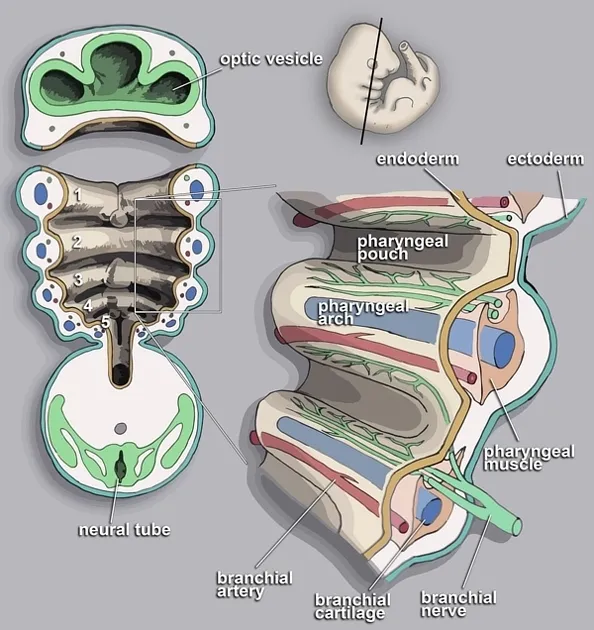
- This location corresponds to the embryological remnants of the **second branchial cleft**.
*Posterior border of sternocleidomastoid*
- Cysts or masses in this region are less likely to be branchial cysts and might indicate other conditions like **lymphadenopathy** or a **cystic hygroma** [1].
- The posterior border is not the typical embryological location for branchial cleft remnants to form cysts.
*Digastric muscle*
- While the digastric muscle is located in the neck, cysts directly associated with this muscle are rare and usually of **different embryological origin** (e.g., salivary gland cysts or submandibular space infections).
- Branchial cysts are specifically tied to the branchial apparatus remnants.
*Omohyoid muscle*
- The omohyoid muscle crosses the lower neck, and masses in its vicinity are typically not branchial cysts but could involve **thyroid pathology**, **lymph nodes**, or **vascular anomalies** [2].
- This location is anatomically distinct from the typical presentation of a branchial cleft cyst.
Congenital Neck Lesions Indian Medical PG Question 2: A 23-year-old male patient presents with midline swelling in the neck. The swelling moves with deglutition and protrusion of the tongue. What is the likely diagnosis?
- A. Brachial cyst
- B. Thyroglossal cyst (Correct Answer)
- C. Plunging ranula
- D. Dermoid cyst
Congenital Neck Lesions Explanation: ***Thyroglossal cyst***
- A **thyroglossal cyst** is a congenital anomaly that arises from the persistent **thyroglossal duct**, a remnant of the thyroid's embryologic descent.
- Its classic diagnostic feature is its movement with **deglutition** (due to attachment to the hyoid bone, which moves during swallowing) and **protrusion of the tongue** (as the thyroglossal duct is connected to the base of the tongue).
*Brachial cyst*
- A **brachial cyst** is a congenital neck mass that typically presents as a lateral neck swelling, often located along the anterior border of the **sternocleidomastoid muscle**.
- Unlike a thyroglossal cyst, it does not typically move with **deglutition** or **tongue protrusion**.
*Plunging ranula*
- A **plunging ranula** is a type of mucocele that arises from the **sublingual gland** and extends below the mylohyoid muscle into the neck.
- It presents as a cervical mass but is typically located in the floor of the mouth or submandibular region and does not move with **deglutition** or **tongue protrusion**.
*Dermoid cyst*
- A **dermoid cyst** is a congenital cyst that can occur anywhere on the body, including the head and neck, often presenting as a painless mass.
- It arises from sequestered embryonic ectoderm and mesoderm, containing skin appendages, but it does not move with **deglutition** or **tongue protrusion**.
Congenital Neck Lesions Indian Medical PG Question 3: A 2 -month-old child presents with the following condition as shown in the image. What is the ideal management protocol?
- A. Operate immediately
- B. Surgery after 6 months of age
- C. Surgery after 2 years of age
- D. Medical management (Correct Answer)
- E. Refer to pediatric ophthalmology for evaluation
Congenital Neck Lesions Explanation: ***Medical management***
- The image shows **epicanthal folds**, which are normal in many Asian infants and children. They are **congenital, benign skin folds** that cover the inner corner of the eye.
- In a 2-month-old child, these folds are a normal variant and typically **recede with age**. No medical intervention, surgical or otherwise, is usually required.
*Operate immediately*
- **No medical indication** for immediate surgery as epicanthal folds are not a pathological condition requiring urgent correction.
- Surgical intervention for cosmetic purposes is typically considered much later in life, if at all, when facial features are more developed.
*Surgery after 6 months of age*
- Epicanthal folds are **still a normal finding** in infants up to 6 months of age and often persist for several years.
- Premature surgical correction could be unnecessary as the folds may resolve naturally with the development of the **nasal bridge**.
*Surgery after 2 years of age*
- While epicanthal folds can still be present at 2 years of age, surgery is **rarely indicated** unless they cause significant vision problems (e.g., pseudostrabismus) or severe cosmetic concerns that persist into later childhood.
- By this age, many children will have developed a more prominent nasal bridge, which can lessen the appearance of the folds naturally.
*Refer to pediatric ophthalmology for evaluation*
- While specialist referral might be considered if there are concerns about **vision impairment or true strabismus**, isolated epicanthal folds in a 2-month-old infant are a **normal anatomical variant** that does not require specialist evaluation.
- Referral would be appropriate only if there were functional concerns beyond the cosmetic appearance of the folds.
Congenital Neck Lesions Indian Medical PG Question 4: The most common site for a thyroglossal cyst is
- A. Suprahyoid
- B. Subhyoid (Correct Answer)
- C. Floor of mouth
- D. Level of cricoid
Congenital Neck Lesions Explanation: ***Subhyoid***
- The **thyroglossal duct** normally descends from the foramen cecum at the base of the tongue to the future thyroid gland location, usually in front of the trachea [1], [2].
- The most common site for a **thyroglossal cyst** to persist due to incomplete regression of this duct is in the **subhyoid region**, just below the hyoid bone.
- Accounts for approximately **65-75%** of all thyroglossal cysts.
*Suprahyoid*
- While thyroglossal cysts can occur anywhere along the embryological descent path of the thyroid gland, the **suprahyoid region** (above the hyoid bone) is the second most common location, accounting for about 20-25% of cases [2].
- Cysts in this region might be closer to the base of the tongue but are not the most frequent site.
*Floor of mouth*
- A thyroglossal cyst would be an **extremely rare finding** in the floor of the mouth, as this is significantly higher than the typical path of the thyroglossal duct [3].
- Lesions in the floor of the mouth are more commonly ranulas or dermoid cysts.
*Level of cricoid*
- Cysts at the **level of the cricoid cartilage** would be considered a less common presentation for a thyroglossal cyst.
- This location is lower than the usual subhyoid presentation, although still along the general path of the descending thyroid gland.
Congenital Neck Lesions Indian Medical PG Question 5: Which of the following statements about branchial cyst is FALSE?
- A. It is usually lined by squamous epithelium.
- B. Treatment involves complete excision.
- C. It develops from the remnants of 2nd branchial cleft.
- D. It is found at the anterior border of lower third of sternocleidomastoid muscle. (Correct Answer)
Congenital Neck Lesions Explanation: ***It is found at the anterior border of lower third of sternocleidomastoid muscle.***
- Branchial cysts are typically found at the **anterior border of the upper or middle third** of the sternocleidomastoid muscle.
- Their classical location is near the **angle of the mandible** and anterior to the sternocleidomastoid.
*It is usually lined by squamous epithelium.*
- Branchial cleft cysts most commonly arise from the second branchial cleft and are indeed typically lined by **stratified squamous epithelium**.
- In some cases, columnar or ciliated epithelium may also be present, especially if there's an internal sinus tract.
*Treatment involves complete excision.*
- The definitive treatment for a branchial cyst is **complete surgical excision** to prevent recurrence and potential complications.
- Incomplete removal can lead to recurrence, infection, or the development of a chronic draining sinus.
*It develops from the remnants of 2nd branchial cleft.*
- Over 90% of branchial cysts originate from the **incomplete obliteration of the second branchial cleft**.
- This developmental anomaly results in a persistent epithelial-lined tract or cyst in the neck.
Congenital Neck Lesions Indian Medical PG Question 6: The patient is presenting with the deformity of the finger as shown. The PIP is involved but the DIP is spared
- A. Osteoarthritis
- B. Rheumatoid arthritis (Correct Answer)
- C. Psoriatic Arthritis
- D. Ankylosing spondylitis
Congenital Neck Lesions Explanation: ***Rheumatoid arthritis***
- The image shows a **Boutonniere deformity**, characterized by **flexion of the PIP joint** and hyperextension of the DIP joint, which is classic for rheumatoid arthritis.
- **Rheumatoid arthritis** typically affects the small joints of the hands and feet, particularly the **PIP joints and MCP joints**, sparing the DIP joints.
*Osteoarthritis*
- Osteoarthritis commonly involves the **DIP joints (Heberden's nodes)** and **PIP joints (Bouchard's nodes)**, but the depicted deformity (Boutonniere) is not typical.
- It is primarily a degenerative joint disease, not inflammatory, and tends to spare the MCP joints until very late in the disease.
*Psoriatic Arthritis*
- Psoriatic arthritis often involves the **DIP joints and causes dactylitis (sausage digits)**, which is not clearly depicted, although Boutonniere can occur.
- The key differentiator is usually the presence of **psoriasis skin lesions or nail changes**, which are not mentioned or visible in the image.
*Ankylosing spondylitis*
- This condition primarily affects the **axial skeleton**, particularly the **sacroiliac joints** and spine, leading to stiffness and pain.
- While peripheral joint involvement can occur, it is generally not characterized by specific hand deformities like Boutonniere deformity.
Congenital Neck Lesions Indian Medical PG Question 7: A 29-year-old patient presents with focal seizures. MRI shows frontal and temporal enhancement. What is the most probable diagnosis?
- A. Herpes simplex encephalitis (Correct Answer)
- B. Enterovirus encephalitis
- C. Japanese encephalitis
- D. Meningococcal meningitis
Congenital Neck Lesions Explanation: ***Herpes simplex encephalitis***
- **Herpes simplex encephalitis (HSE)** characteristically causes inflammation and damage in the **frontal** and **temporal lobes**, leading to focal neurological deficits and seizures [1].
- MRI findings of **enhancement** in these specific brain regions are highly suggestive of HSE.
*Enterovirus encephalitis*
- **Enterovirus encephalitis** typically affects a broader range of brain regions and less commonly presents with the focal frontal and temporal enhancement seen in HSE.
- While it can cause seizures, the MRI findings are not as specific for this diagnosis.
*Japanese encephalitis*
- **Japanese encephalitis** is geographically restricted to parts of Asia and is transmitted by mosquitoes. The clinical presentation typically includes diffuse encephalitic symptoms rather than focal frontal/temporal involvement and enhancement on MRI.
- This diagnosis would be unlikely without a relevant travel history and exposure.
*Meningococcal meningitis*
- **Meningococcal meningitis** is an infection of the **meninges**, the membranes surrounding the brain and spinal cord, not primarily the brain tissue itself.
- MRI would typically show inflammation and enhancement of the meninges, rather than focal parenchymal (brain tissue) enhancement in the frontal and temporal lobes.
Congenital Neck Lesions Indian Medical PG Question 8: Apple jelly nodule on diascopy is a feature of:
- A. Aspergillosis
- B. Lupus vulgaris (Correct Answer)
- C. Erysipelas
- D. Rhinoscleroma
Congenital Neck Lesions Explanation: ***Lupus vulgaris***
- An **apple jelly nodule** on diascopy is a classic clinical sign of **lupus vulgaris**, a severe form of cutaneous tuberculosis.
- Diascopy reveals the characteristic yellowish-brown discoloration due to **tuberculous granulomas** in the dermis.
*Aspergillosis*
- This is a fungal infection that typically affects the **respiratory tract** and less commonly the skin, especially in immunocompromised individuals.
- Skin lesions in aspergillosis are usually **necrotic ulcers** or plaques, not apple jelly nodules on diascopy.
*Erysipelas*
- This is a **superficial bacterial infection** of the skin and subcutaneous tissue, typically caused by *Streptococcus pyogenes*.
- It presents as a bright red, swollen, raised lesion with a **distinct border**, and does not produce apple jelly nodules.
*Rhinoscleroma*
- This is a chronic, progressive granulomatous disease affecting the **upper respiratory tract**, caused by *Klebsiella rhinoscleromatis*.
- It leads to **hard, nodular masses** in the nose and pharynx, often described as ligneous, but does not present as apple jelly nodules on diascopy.
Congenital Neck Lesions Indian Medical PG Question 9: Consider the following in respect of Salmon patch :
1. It is a hemangioma.
2. Its usual site is nape of neck.
3. It is common in children.
4. It needs surgical excision. Which of the statements given above are correct ?
- A. 1, 3 and 4
- B. 1, 2 and 4
- C. 2 and 3 (Correct Answer)
- D. 1, 2 and 3
Congenital Neck Lesions Explanation: ***2 and 3***
- **Salmon patches**, also known as nevus simplex or stork bites, are common capillary malformations occurring in up to 70% of newborns, making them common in children.
- They frequently appear on the **nape of the neck**, eyelids, glabella, and forehead.
*1, 3 and 4*
- Salmon patches are **capillary malformations**, not true hemangiomas, which are benign vascular tumors.
- They are typically benign and resolve spontaneously, and therefore **do not require surgical excision**.
*1, 2 and 4*
- Salmon patches are **capillary malformations**, not hemangiomas, and are common in children and usually found on the nape of the neck.
- They are benign and **do not require surgical excision**, as most fade spontaneously.
*1, 2 and 3*
- Salmon patches are a type of **capillary malformation**, distinct from hemangiomas.
- While they are common in children and often found on the nape of the neck, they are not hemangiomas.
Congenital Neck Lesions Indian Medical PG Question 10: Which of the following cardiac lesions is least likely to occur in Congenital Rubella syndrome?
- A. VSD
- B. Pulmonary Stenosis
- C. ASD (Correct Answer)
- D. PDA
Congenital Neck Lesions Explanation: ***ASD***
- While **atrial septal defects (ASDs)** can occur in congenital heart disease, they are **rarely associated with congenital rubella syndrome**.
- The classic cardiac defects linked to congenital rubella are related to persistent fetal circulation structures or underdeveloped outflow tracts.
*VSD*
- **Ventricular septal defects (VSDs)** are among the **most common congenital heart defects** and can be associated with congenital rubella syndrome.
- Rubella infection can interfere with septal development, leading to these **shunt lesions**.
*Pulmonary Stenosis*
- **Pulmonary artery stenosis**, particularly **peripheral pulmonary artery stenosis**, is a **characteristic cardiovascular anomaly** in congenital rubella syndrome.
- The rubella virus can affect the development of the pulmonary arteries and valves.
*PDA*
- **Patent ductus arteriosus (PDA)** is the **most common cardiac lesion** seen in congenital rubella syndrome due to the virus's interference with ductal closure.
- The infection leads to abnormal development and persistence of the communication between the aorta and pulmonary artery.
More Congenital Neck Lesions Indian Medical PG questions available in the OnCourse app. Practice MCQs, flashcards, and get detailed explanations.