Salivary Gland Tumors Indian Medical PG Practice Questions and MCQs
Practice Indian Medical PG questions for Salivary Gland Tumors. These multiple choice questions (MCQs) cover important concepts and help you prepare for your exams.
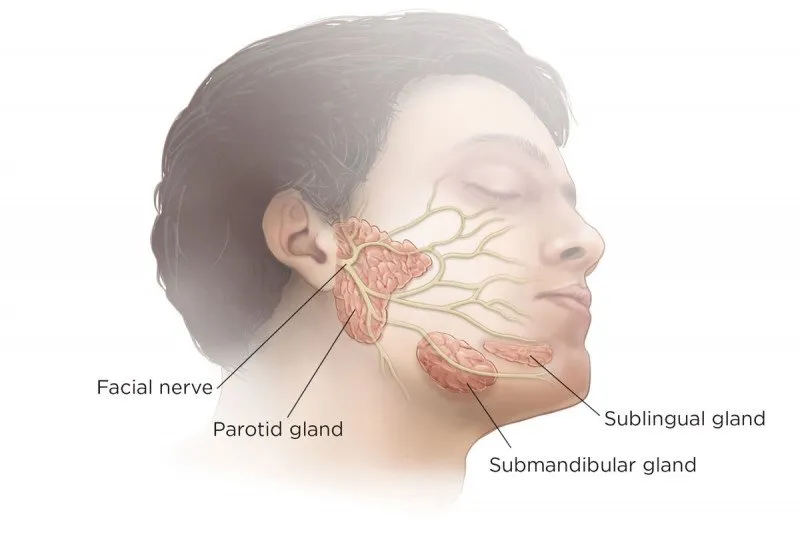
Salivary Gland Tumors Indian Medical PG Question 1: Pleomorphic adenomas arising from the minor salivary glands can be treated with
- A. Chemotherapy
- B. Local excision with 2mm margin
- C. Local excision with 5mm margin (Correct Answer)
- D. Radiotherapy
Salivary Gland Tumors Explanation: ***Local excision with 5mm margin***
- **Pleomorphic adenomas** are **benign tumors**, but they have a tendency for recurrence if not adequately excised due to their irregular, often lobulated shape and microscopic extensions.
- A **5mm margin** is generally recommended for complete removal and to minimize the risk of recurrence, especially for tumors arising from minor salivary glands.
*Chemotherapy*
- **Chemotherapy** is generally reserved for **malignant tumors** and systemic diseases, not for benign lesions like pleomorphic adenomas.
- It carries significant side effects and is unnecessary for a localized, benign tumor that can be surgically removed.
*Local excision with 2mm margin*
- While local excision is the correct approach, a **2mm margin** may be insufficient for pleomorphic adenomas.
- Such a small margin increases the risk of leaving behind microscopic tumor extensions, leading to a higher chance of **local recurrence**.
*Radiotherapy*
- **Radiotherapy** is primarily used for **malignant tumors** or in cases where surgery is not an option, or as an adjuvant therapy.
- It is not the standard primary treatment for **benign pleomorphic adenomas** due to potential side effects and the efficacy of surgical excision.
Salivary Gland Tumors Indian Medical PG Question 2: Which of the following statements about parotid tumors are correct?
a) Pleomorphic adenoma is the most common variety
b) Malignant disease is the most common variety
c) Facial nerve involvement indicates malignancy
d) Superficial parotidectomy is the treatment of choice
- A. Only statements a and c are correct
- B. Only statements a, c, and d are correct (Correct Answer)
- C. All statements are correct
- D. Only statements b and d are correct
Salivary Gland Tumors Explanation: ***Only statements a, c, and d are correct***
- **Pleomorphic adenoma** is indeed the most common parotid tumor (60-70% of all parotid tumors)
- **Facial nerve involvement** is a strong clinical indicator of malignancy, as benign tumors typically displace rather than invade the nerve
- **Superficial parotidectomy** with facial nerve preservation is the standard surgical treatment for most parotid tumors
- Statement b is false: approximately **80% of parotid tumors are benign**, with malignant tumors representing only ~20%
*Only statements a and c are correct*
- While this correctly identifies that pleomorphic adenoma is most common and facial nerve involvement suggests malignancy, it incorrectly excludes statement d
- Superficial parotidectomy is indeed the standard treatment for most parotid tumors
*All statements are correct*
- This is incorrect because statement b is false
- Malignant disease is NOT the most common variety; benign tumors (especially pleomorphic adenomas) predominate
*Only statements b and d are correct*
- This is incorrect because statement b is false
- Malignant disease represents only ~20% of parotid tumors, not the most common variety
Salivary Gland Tumors Indian Medical PG Question 3: A 26-year-old male presents to the outpatient department with a discrete thyroid swelling. On neck ultrasound, an isolated cystic swelling of the gland is seen. What is the risk of malignancy associated with this finding?
- A. 48%
- B. 12%
- C. 24%
- D. 3% (Correct Answer)
Salivary Gland Tumors Explanation: ***3%***
- **Purely cystic thyroid nodules** (as described in this case with "isolated cystic swelling") have a **very low risk of malignancy**, typically **2-3%** or less.
- According to **ATA guidelines** and **TIRADS classification**, purely cystic nodules are considered **low suspicion** lesions.
- The cystic nature suggests a **benign process** such as a degenerated adenoma, colloid cyst, or simple cyst.
- **Fine needle aspiration (FNA)** may still be considered if the nodule is >2 cm or has any suspicious solid components, but is often not required for purely cystic lesions.
*48%*
- This percentage is **significantly higher** than the actual malignancy risk for a purely cystic thyroid swelling.
- Such a **high risk** would typically be associated with **solid nodules** exhibiting highly suspicious ultrasound features such as:
- Microcalcifications
- Irregular or spiculated margins
- Taller-than-wide shape
- Marked hypoechogenicity
- Extrathyroidal extension
*24%*
- This percentage represents a **moderate to high risk** of malignancy, which is **not characteristic** of an isolated purely cystic thyroid swelling.
- A risk in this range might be seen with:
- **Mixed solid-cystic nodules** with predominantly solid components
- Solid nodules with **intermediate suspicious features** on ultrasound
*12%*
- While lower than 24% or 48%, 12% is still **considerably higher** than the generally accepted malignancy risk for purely cystic thyroid nodules.
- This risk level could be plausible for:
- **Predominantly cystic nodules** with some eccentric solid components
- Solid nodules with **mildly suspicious** features on ultrasound
Salivary Gland Tumors Indian Medical PG Question 4: Which of the following statements about pleomorphic adenoma is false?
- A. Most commonly involves the parotid gland
- B. It is also called a mixed tumor
- C. Has a tendency to invade perineural space (Correct Answer)
- D. Most common tumor of salivary glands
Salivary Gland Tumors Explanation: ***Has a tendency to invade perineural space***
- Pleomorphic adenoma typically shows **benign behavior** and does not usually invade surrounding tissues [1].
- It is characterized by **well-defined margins**, making perineural invasion uncommon compared to malignant tumors.
*Most common tumor of salivary glands*
- This statement is true; pleomorphic adenoma is indeed the **most common benign tumor** of the salivary glands.
- It primarily occurs in the **parotid gland**, comprising about 60-70% of all salivary gland tumors [1].
*It is also called a mixed tumor*
- This statement is correct as pleomorphic adenoma is frequently referred to as a **mixed tumor**, reflecting its composition of both epithelial and mesenchymal elements [2].
- The term emphasizes its **epithelial and stromal components**, which vary significantly.
*Most commonly involves the parotid gland*
- This is a true statement, as the parotid gland is the most commonly affected site for pleomorphic adenoma [1].
- It can also appear in minor salivary glands, but the **parotid gland** accounts for the majority of cases.
**References:**
[1] Kumar V, Abbas AK, et al.. Robbins and Cotran Pathologic Basis of Disease. 9th ed. Head and Neck, pp. 751-753.
[2] Kumar V, Abbas AK, et al.. Robbins and Cotran Pathologic Basis of Disease. 9th ed. Diseases of the Immune System, pp. 274-276.
Salivary Gland Tumors Indian Medical PG Question 5: A patient presents with a gradually progressive, painless mass persisting for 10 years. The mass is firm to nodular and shows variable consistency within different areas of the swelling. What is the most probable diagnosis?
- A. Dermoid cyst
- B. Malignancy
- C. Sebaceous cyst
- D. Pleomorphic adenoma (Correct Answer)
Salivary Gland Tumors Explanation: ***Pleomorphic adenoma***
- A **gradually progressive**, **painless mass** that has been present for 10 years, with a **firm to nodular** consistency and variability at different sites, is highly characteristic of a pleomorphic adenoma.
- This benign tumor of salivary glands is known for its **slow growth** and **variable histological composition**, leading to its characteristic consistency.
*Dermoid cyst*
- Dermoid cysts are typically **present from birth** or early childhood and tend to be **soft and doughy** in consistency, rather than firm or nodular with variable consistency.
- While painless, their growth pattern and texture differ from the described mass.
*Malignancy*
- A mass that has been present for **10 years** and is still described as **gradually progressive** but painless is less likely to be a malignancy, as most malignant tumors tend to grow more rapidly and often present with pain or other symptoms over such a long period.
- Malignancies usually demonstrate a more infiltrative and aggressive growth pattern.
*Sebaceous cyst*
- A sebaceous cyst (epidermoid cyst) typically presents as a **smooth, movable, dome-shaped lump** and contains a cheesy, malodorous material, which is not consistent with a firm to nodular mass with varying consistency.
- While they can be long-standing and painless, their characteristic feel and contents are different.
Salivary Gland Tumors Indian Medical PG Question 6: Which of the following is false about parotid tumor
- A. Facial nerve involvement indicates malignancy
- B. Malignant disease is most common variety (Correct Answer)
- C. Pleomorphic adenoma is most common
- D. Superficial parotidectomy is the treatment
Salivary Gland Tumors Explanation: ***Malignant disease is most common variety***
- This statement is false because the vast majority (approximately 80%) of **parotid gland tumors** are **benign**, with **pleomorphic adenoma** being the most common type.
- Only about 20% of parotid tumors are **malignant**, making them a less common variety than benign tumors.
*Facial nerve involvement indicates malignancy*
- **Facial nerve palsy** or weakness in the presence of a parotid mass is a significant red flag and a strong indicator of **malignancy** within the parotid gland.
- Malignant tumors can **infiltrate** and damage the facial nerve, leading to its dysfunction.
*Pleomorphic adenoma is most common*
- **Pleomorphic adenoma**, also known as mixed tumor, is indeed the **most common benign tumor** of the parotid gland, accounting for the large majority of all parotid neoplasms.
- It typically presents as a slow-growing, painless mass.
*Superficial parotidectomy is the treatment*
- For tumors confined to the **superficial lobe** of the parotid gland (where most parotid tumors are located), a **superficial parotidectomy** is the standard surgical treatment.
- This procedure removes the superficial lobe while preserving the **facial nerve**, which runs within the gland.
Salivary Gland Tumors Indian Medical PG Question 7: Which of the following is the initial investigation of choice for a patient presenting with a solitary nodule of the thyroid?
- A. Thyroid function test
- B. FNAC (Correct Answer)
- C. Radionuclide scan
- D. MRI
Salivary Gland Tumors Explanation: ***FNAC***
- **Fine needle aspiration cytology (FNAC)** is the most important initial investigation for a solitary thyroid nodule to determine if it is benign or malignant. [1]
- It offers a highly accurate and minimally invasive method for **cytological analysis** to guide further management.
*Thyroid function test*
- While important for assessing **thyroid hormone levels** and diagnosing hyper or hypothyroidism, it does not directly evaluate the **malignant potential** of a nodule. [1]
- Normal thyroid function does **not rule out malignancy** within a nodule.
*Radionuclide scan*
- A **radionuclide scan** is useful for assessing the **functional status** of a nodule (hot or cold). [1]
- However, non-functional (**cold**) nodules are more suspicious for malignancy, but the scan doesn't provide **histological diagnosis**.
*MRI*
- **MRI** provides detailed anatomical imaging of the thyroid and surrounding structures but is generally not the **initial diagnostic test of choice** for evaluating a solitary nodule. [1]
- It is typically reserved for assessing **nodule extension** or **lymph node involvement** once malignancy is suspected or confirmed. [1]
Salivary Gland Tumors Indian Medical PG Question 8: Most common site for mucoepidermoid carcinoma is
- A. Submandibular gland
- B. Sublingual gland
- C. Parotid gland (Correct Answer)
- D. Minor salivary gland
Salivary Gland Tumors Explanation: ***Parotid gland***
- The **parotid gland** is the most frequent site for all salivary gland tumors, including **mucoepidermoid carcinoma**.
- Approximately **60-70%** of mucoepidermoid carcinomas originate in this major salivary gland.
*Submandibular gland*
- While it can occur in the submandibular gland, it is **less common** than in the parotid gland.
- Tumors in this gland are more likely to be **malignant** compared to parotid tumors, but mucoepidermoid carcinoma is not the predominant type here.
*Sublingual gland*
- **Sublingual gland** tumors are rare overall, and mucoepidermoid carcinoma is also **uncommon** in this location.
- When tumors do occur in the sublingual gland, they tend to be malignant.
*Minor salivary gland*
- Mucoepidermoid carcinoma is the **most common malignant tumor** of the minor salivary glands, but these glands collectively account for a smaller proportion of overall cases compared to the parotid gland.
- They are found in various locations such as the **palate**, lips, and buccal mucosa.
Salivary Gland Tumors Indian Medical PG Question 9: What is the most common malignant tumor of the parotid gland?
- A. Oncocytoma
- B. Adenoid cystic carcinoma
- C. Mucoepidermoid carcinoma (Correct Answer)
- D. Warthin's tumor
Salivary Gland Tumors Explanation: ***Mucoepidermoid carcinoma***
- This is the **most common malignant tumor** of the **major and minor salivary glands**, including the parotid gland [1].
- It arises from **ductal and myoepithelial cells** and presents with a wide range of histological grades (low, intermediate, high).
*Oncocytoma*
- This is a **rare, benign tumor** composed of oncocytes, which are large epithelial cells with abundant granular eosinophilic cytoplasm.
- It is **not malignant** and does not represent the most common parotid malignancy.
*Warthin's tumor*
- Also known as papillary cystadenoma lymphomatosum, this is the **second most common benign parotid tumor** [1] after pleomorphic adenoma.
- It is **benign** and primarily affects older men, often smokers.
*Adenoid cystic carcinoma*
- While a **malignant tumor**, it is **less common** than mucoepidermoid carcinoma in the parotid gland [1].
- It is known for its characteristic **perineural invasion** and a high propensity for distant metastases, even years after resection [1].
**References:**
[1] Kumar V, Abbas AK, et al.. Robbins and Cotran Pathologic Basis of Disease. 9th ed. Head and Neck, pp. 753-755.
Salivary Gland Tumors Indian Medical PG Question 10: A 45-year-old patient complained of pain on one side of the neck. She is afraid of eating food as it worsens the pain. An ultrasound of the salivary glands is shown below. What is the most likely diagnosis?
- A. Sialolithiasis (Correct Answer)
- B. Salivary gland foreign body
- C. Cervical lymphadenopathy
- D. Osteoma of the floor of the mouth
Salivary Gland Tumors Explanation: ***Sialolithiasis***
- The ultrasound image shows an **echogenic focus** with clear **posterior acoustic shadowing** within the salivary gland, which is characteristic of a salivary gland stone.
- The patient's symptoms of **pain on one side of the neck** and **worsening pain with eating** (likely due to salivary stimulation) are classic for **sialolithiasis**, as the stone obstructs salivary flow.
*Salivary gland foreign body*
- While a foreign body could present with similar pain, it would typically appear as a distinct object on ultrasound, but its echogenicity and shading characteristics might differ depending on the material.
- The history of a foreign body ingestion or insertion would be crucial, which is not mentioned here.
*Cervical lymphadenopathy*
- **Lymph nodes** on ultrasound typically appear as oval-shaped structures with a **hypoechoic cortex** and an **echogenic hilum**; they do not usually show significant acoustic shadowing unless calcified.
- While cervical lymphadenopathy can cause neck pain, it is not typically exacerbated by eating in the same way an obstructed salivary gland would be.
*Osteoma of the floor of the mouth*
- An **osteoma** is a **benign bone tumor** that would present as a very **dense, highly echogenic mass** with severe posterior acoustic shadowing on ultrasound, originating from bony structures.
- While an osteoma could cause pain, its location (floor of the mouth) and nature would not typically explain pain worsening specifically with eating due to salivary gland obstruction.
More Salivary Gland Tumors Indian Medical PG questions available in the OnCourse app. Practice MCQs, flashcards, and get detailed explanations.