Starvation Adaptation Indian Medical PG Practice Questions and MCQs
Practice Indian Medical PG questions for Starvation Adaptation. These multiple choice questions (MCQs) cover important concepts and help you prepare for your exams.
Starvation Adaptation Indian Medical PG Question 1: Major source of energy for brain in fasting/starvation?
- A. Glucose
- B. Glycogen
- C. Fatty acids
- D. Ketone bodies (Correct Answer)
Starvation Adaptation Explanation: ***Ketone bodies***
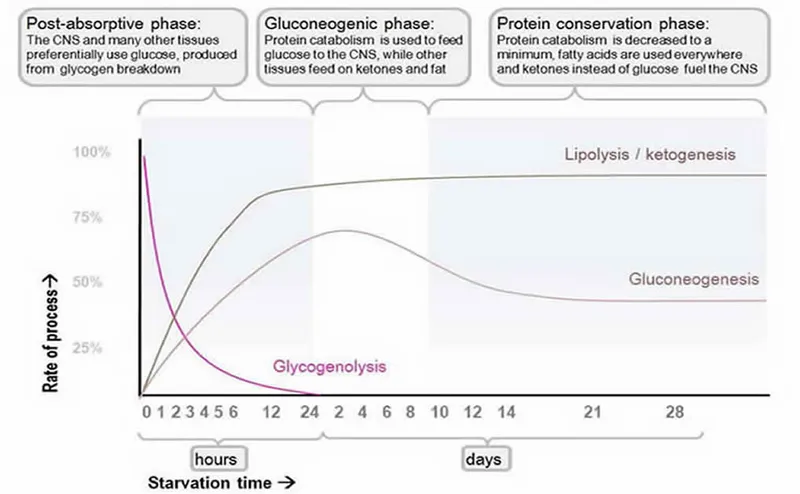
- During **prolonged fasting or starvation**, the body depletes its **glycogen stores** and begins to break down fatty acids. The liver converts these fatty acids into **ketone bodies**, such as **acetoacetate and beta-hydroxybutyrate**.
- These **ketone bodies** can cross the **blood-brain barrier** and be used by the brain as an alternative energy source when glucose becomes scarce, preventing protein breakdown for gluconeogenesis.
*Glucose*
- While **glucose** is the primary and preferred energy source for the brain under normal physiological conditions, its availability significantly decreases during **prolonged fasting or starvation**.
- The brain requires a continuous supply of glucose, but in states of severe caloric restriction, the body must conserve glucose for other critical functions and adapt by using alternative fuels.
*Glycogen*
- **Glycogen** is a stored form of glucose found predominantly in the **liver and muscles**.
- The brain itself has minimal **glycogen stores**, which are rapidly depleted during fasting, and thus cannot be a major long-term energy source.
*Fatty acids*
- **Fatty acids** are a major energy source for many tissues in the body, especially during fasting, but they **cannot directly cross the blood-brain barrier** in significant amounts to fuel the brain.
- Instead, **fatty acids** are metabolized into **ketone bodies** in the liver, which then serve as the brain's alternative fuel.
Starvation Adaptation Indian Medical PG Question 2: In a patient who has been in a state of starvation for 72 hours, which of the following is the primary mechanism for maintaining blood glucose levels?
- A. Increased gluconeogenesis (Correct Answer)
- B. Increased protein degradation
- C. Increased glycogenolysis
- D. Increased ketosis due to breakdown of fats
Starvation Adaptation Explanation: ***Increased gluconeogenesis***
- After 72 hours of starvation, **hepatic glycogen stores** are completely depleted, making gluconeogenesis the primary and essential mechanism to maintain **blood glucose levels**.
- This process synthesizes glucose from non-carbohydrate precursors like **amino acids** (mainly alanine and glutamine), **lactate**, and **glycerol** to supply glucose for obligate glucose-dependent tissues like **red blood cells** and the **renal medulla**, and provides baseline glucose for the brain.
- Gluconeogenesis occurs primarily in the **liver** and to a lesser extent in the **kidney cortex** during prolonged fasting.
*Increased protein degradation*
- While **protein degradation** does occur to supply amino acids for gluconeogenesis, the body actively minimizes this to preserve muscle mass, especially after prolonged starvation.
- The initial phase of starvation (first 24-48 hours) sees more significant protein breakdown, but its rate decreases substantially after 72 hours as the body becomes increasingly **protein-sparing** and shifts to fatty acid oxidation and ketone body production.
*Increased glycogenolysis*
- **Hepatic glycogen stores** are typically depleted within **12-24 hours** of starvation.
- After 72 hours, there is essentially no glycogen remaining to break down, so **glycogenolysis** cannot contribute to maintaining blood glucose at this stage.
*Increased ketosis due to breakdown of fats*
- **Ketosis** does dramatically increase after 72 hours of starvation as the body shifts to using **fatty acids** for energy and producing **ketone bodies** (β-hydroxybutyrate and acetoacetate) for the brain and other tissues.
- However, while ketone bodies serve as an alternative fuel source for the brain (providing up to 60-70% of its energy needs), they **cannot replace glucose entirely** because certain tissues (red blood cells, renal medulla) are obligate glucose users and cannot utilize ketones.
- The question specifically asks about maintaining **blood glucose levels**, which requires gluconeogenesis, not ketone production.
Starvation Adaptation Indian Medical PG Question 3: Ketone body formation without glycosuria is seen in ?
- A. Diabetes mellitus
- B. Diabetes insipidus
- C. Starvation (Correct Answer)
- D. Obesity
Starvation Adaptation Explanation: ***Starvation***
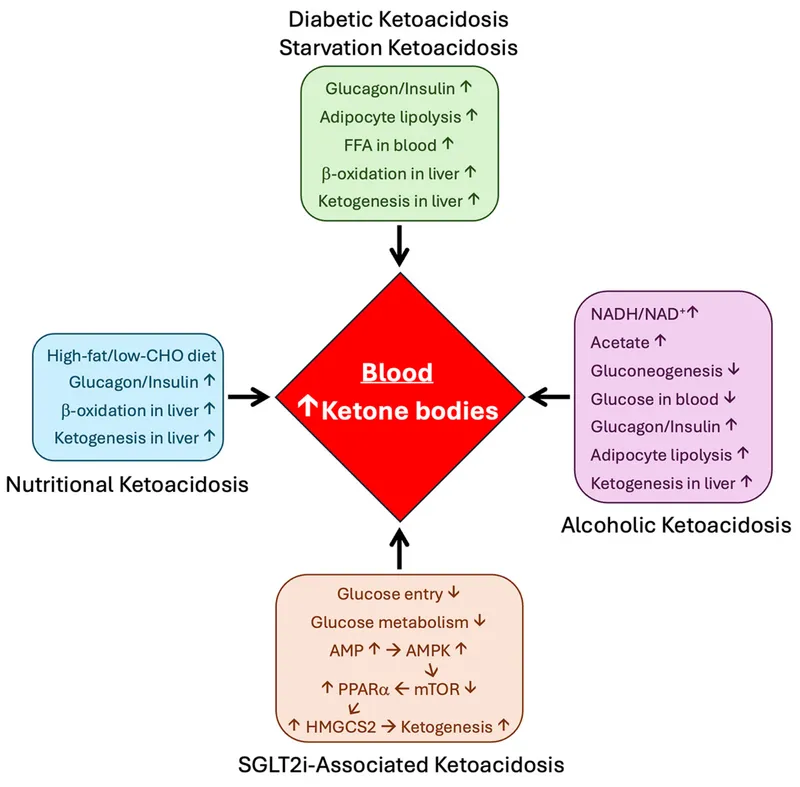
- During **starvation**, the body depletes its **glycogen stores** and begins to break down **fat for energy**. This process leads to the production of **ketone bodies** (acetoacetate, beta-hydroxybutyrate, and acetone) as an alternative fuel source for the brain and other tissues.
- Since there is no underlying problem with **insulin production** or action, blood glucose levels are typically low or normal, and therefore, **glycosuria** (glucose in the urine) is absent.
*Diabetes mellitus*
- In **uncontrolled diabetes mellitus**, especially Type 1, the body cannot effectively use **glucose** due to lack of insulin, leading to high blood glucose levels (**hyperglycemia**) and subsequently **glycosuria**.
- The body then compensates by breaking down **fats**, leading to the formation of **ketone bodies** (**diabetic ketoacidosis**), which results in both **ketonuria** and **glycosuria**.
*Diabetes insipidus*
- **Diabetes insipidus** is a condition characterized by the inability to conserve water due to insufficient **antidiuretic hormone (ADH)** production or action, leading to excessive urination and thirst.
- It does not involve abnormalities in **glucose metabolism** or **ketone body production** and therefore does not typically present with ketonuria or glycosuria.
*Obesity*
- While **obesity** can lead to **insulin resistance** and is a risk factor for Type 2 Diabetes, it does not directly cause **ketone body formation** in the absence of metabolic derangements such as those seen in uncontrolled diabetes or prolonged starvation.
- In most cases of obesity without diabetes, **glucose metabolism** is still adequate enough to prevent significant reliance on **fat breakdown** for energy, meaning there is usually no ketonuria or glycosuria.
Starvation Adaptation Indian Medical PG Question 4: Energy source used by brain in later days of starvation is
- A. Glucose
- B. Ketone bodies (Correct Answer)
- C. Glycogen
- D. Fatty acids
Starvation Adaptation Explanation: ***Ketone bodies***
- During **prolonged starvation**, the liver produces **ketone bodies** (acetoacetate and β-hydroxybutyrate) from fatty acid breakdown.
- The brain adapts to utilize these ketone bodies as a primary energy source, reducing its reliance on **glucose**.
*Glucose*
- While **glucose** is the primary energy source for the brain under normal conditions, its availability diminishes significantly during prolonged starvation.
- The brain attempts to conserve glucose for essential functions by switching to alternative fuels.
*Glycogen*
- The brain stores very limited amounts of **glycogen**, which are rapidly depleted within minutes of glucose deprivation.
- It is not a sustainable or significant energy source during extended periods of starvation.
*Fatty acids*
- **Fatty acids** cannot directly cross the **blood-brain barrier** to a significant extent, thus they are not a direct fuel source for brain cells.
- They are, however, used by the liver to synthesize ketone bodies, which then serve as brain fuel.
Starvation Adaptation Indian Medical PG Question 5: Statement 1 - A 59-year-old patient presents with flaccid bullae. Histopathology shows a suprabasal acantholytic split.
Statement 2 - The row of tombstones appearance is diagnostic of Pemphigus vulgaris.
- A. Statements 1 & 2 are correct, 2 is not explaining 1 (Correct Answer)
- B. Statements 1 and 2 are correct and 2 is the correct explanation for 1
- C. Statements 1 and 2 are incorrect
- D. Statement 1 is incorrect
Starvation Adaptation Explanation: ***Correct: Statements 1 & 2 are correct, 2 is not explaining 1***
**Analysis of Statement 1:**
- A 59-year-old patient with **flaccid bullae** and **suprabasal acantholytic split** on histopathology is the classic presentation of **Pemphigus vulgaris**
- The flaccid (easily ruptured) nature of bullae distinguishes it from tense bullae seen in bullous pemphigoid
- The suprabasal location of the split (just above the basal layer) with acantholysis (loss of cell-to-cell adhesion) is pathognomonic
- **Statement 1 is CORRECT** ✓
**Analysis of Statement 2:**
- The **"row of tombstones" or "tombstone appearance"** is indeed a diagnostic histopathological feature of Pemphigus vulgaris
- This appearance results from basal keratinocytes remaining attached to the basement membrane while suprabasal cells separate due to acantholysis
- The intact basal cells standing upright resemble a row of tombstones
- **Statement 2 is CORRECT** ✓
**Does Statement 2 explain Statement 1?**
- Statement 2 describes a **histopathological appearance** (tombstone pattern) that is a **consequence** of the suprabasal split
- However, it does NOT explain the **underlying cause** of the flaccid bullae or the suprabasal split
- The true explanation involves **IgG autoantibodies against desmoglein 3 (and desmoglein 1)**, which attack intercellular adhesion structures (desmosomes), causing **acantholysis**
- Therefore, **Statement 2 does NOT explain Statement 1** ✗
*Incorrect: Statement 2 is the correct explanation for Statement 1*
- While both statements describe features of Pemphigus vulgaris, the tombstone appearance is a descriptive finding, not an explanatory mechanism
*Incorrect: Statements 1 and 2 are incorrect*
- Both statements are medically accurate descriptions of Pemphigus vulgaris features
*Incorrect: Statement 1 is incorrect*
- Statement 1 correctly describes the cardinal clinical and histopathological features of Pemphigus vulgaris
Starvation Adaptation Indian Medical PG Question 6: A judge can ask clarifying questions when:
- A. At any time during the proceedings (Correct Answer)
- B. Before cross-examination
- C. During witness testimony only
- D. After cross-examination
Starvation Adaptation Explanation: ***At any time during the proceedings***
- A judge's primary role is to ensure **justice** and clarity in the courtroom. Therefore, they are permitted to ask **clarifying questions** at any juncture.
- This ensures they understand the evidence, testimony, and arguments presented by all parties for a fair adjudication.
*Before cross-examination*
- While a judge can ask questions at this stage, limiting it to "before cross-examination" is **too restrictive** and does not accurately reflect their inherent authority throughout a trial.
- Their ability to seek clarification is not bound by specific procedural intervals like the start of cross-examination.
*During witness testimony only*
- This option is **too narrow** as a judge may need to clarify points made during opening statements, closing arguments, or even legal motions, not just during direct or cross-examination of a witness.
- Limiting it to witness testimony would **impede their ability** to fully understand all aspects of the case.
*After cross exam*
- This is also an **incomplete** statement, as waiting until after cross-examination could mean missing opportunities to clarify earlier ambiguities that might affect subsequent testimony or arguments.
- A judge's power to clarify is **continuous** and not confined to the end of a specific examination phase.
Starvation Adaptation Indian Medical PG Question 7: Which of the following are supportive proteins?
- A. Titin
- B. Dystropin
- C. All of the options (Correct Answer)
- D. Desmin
Starvation Adaptation Explanation: ***Correct: All of the options***
- **Titin**, **Dystrophin**, and **Desmin** are all well-known supportive proteins within muscle tissue, playing crucial roles in maintaining structural integrity and function.
- These proteins contribute to the elasticity, stability, and transmission of force within muscle fibers.
**Titin**
- A giant sarcomeric protein responsible for muscle elasticity and maintaining the structural integrity of myofibrils.
- Acts as a molecular spring, anchoring myosin thick filaments to the Z-disk and contributing to passive muscle force.
**Dystrophin**
- Provides a critical link between the muscle cytoskeleton and the extracellular matrix.
- Its absence or malfunction leads to muscle degeneration, as seen in **Duchenne muscular dystrophy**.
**Desmin**
- An intermediate filament protein that forms a scaffold around sarcomeres.
- Connects sarcomeres to each other, to the sarcolemma, and to organelles like mitochondria.
- Essential for maintaining alignment and mechanical integration of myofibrils within muscle cells.
Starvation Adaptation Indian Medical PG Question 8: Which amino acid is common to both the urea cycle and the TCA cycle?
- A. Aspartate (Correct Answer)
- B. Alanine
- C. Asparagine
- D. Glutamate
Starvation Adaptation Explanation: ### Explanation
The correct answer is **Aspartate**.
**Why Aspartate is the Correct Answer:**
The Urea cycle and the TCA cycle are interconnected through what is known as the **"Kreb’s Bicycle"** or the **Aspartate-Argininosuccinate Shunt**.
1. **In the Urea Cycle:** Aspartate enters the cycle by reacting with citrulline to form argininosuccinate (catalyzed by argininosuccinate synthetase). It provides the second nitrogen atom required for urea synthesis.
2. **In the TCA Cycle:** Oxaloacetate (a TCA intermediate) can be converted into Aspartate via **transamination** (catalyzed by AST/GOT). Conversely, the fumarate produced in the urea cycle can be recycled back into oxaloacetate to regenerate aspartate.
**Why the Other Options are Incorrect:**
* **Alanine:** Primarily involved in the **Cahill cycle** (Glucose-Alanine cycle) for transporting nitrogen from muscles to the liver. It is not a direct intermediate or substrate in the urea cycle.
* **Asparagine:** While structurally related to aspartate, it must first be hydrolyzed to aspartate by asparaginase to enter these metabolic pathways.
* **Glutamate:** Although glutamate provides the first nitrogen (via oxidative deamination to produce ammonia) and is the donor for transamination to form aspartate, it is not a direct component of the TCA cycle itself (its keto-acid, **α-ketoglutarate**, is).
**High-Yield NEET-PG Pearls:**
* **Fumarate** is the other molecule connecting the two cycles; it is produced in the urea cycle and enters the TCA cycle.
* **ATP Requirement:** The synthesis of one molecule of urea consumes **4 high-energy phosphates** (3 ATP are used, but one is cleaved to AMP + PPi).
* **Rate-limiting step:** Carbamoyl phosphate synthetase I (CPS-I) is the rate-limiting enzyme of the urea cycle, activated by **N-acetylglutamate (NAG)**.
Starvation Adaptation Indian Medical PG Question 9: A 26-year-old woman undertakes a prolonged fast for religious reasons. Which of the following metabolites will be most elevated in her blood plasma after 3 days?
- A. Glucose
- B. Glycogen
- C. Ketone bodies (Correct Answer)
- D. Non-esterified fatty acids
Starvation Adaptation Explanation: **Explanation:**
The metabolic response to fasting occurs in distinct phases to maintain energy homeostasis. After approximately 24–48 hours of fasting, hepatic glycogen stores are completely exhausted. To provide an alternative fuel source for the brain and conserve muscle protein, the liver shifts into intensive **ketogenesis**.
**Why Ketone Bodies are the Correct Answer:**
By day 3 of a fast (prolonged fasting/early starvation), the body enters a state of "glucose sparing." Low insulin and high glucagon levels stimulate the release of fatty acids from adipose tissue. These fatty acids undergo $\beta$-oxidation in the liver, producing excess Acetyl-CoA, which is converted into **ketone bodies** (acetoacetate and $\beta$-hydroxybutyrate). Their plasma concentration rises exponentially during this period, eventually becoming the primary fuel for the brain.
**Analysis of Incorrect Options:**
* **A. Glucose:** Plasma glucose levels are maintained at a low-normal range via gluconeogenesis but do not "elevate."
* **B. Glycogen:** This is an intracellular storage polymer (liver/muscle), not a plasma metabolite. Furthermore, hepatic glycogen is depleted within the first 24 hours.
* **D. Non-esterified fatty acids (NEFAs):** While NEFAs do increase due to lipolysis, their rise is modest compared to the massive, several-fold increase seen in ketone bodies.
**NEET-PG High-Yield Pearls:**
* **Order of Fuel Use:** Exogenous $\rightarrow$ Glycogenolysis $\rightarrow$ Gluconeogenesis $\rightarrow$ Ketosis.
* **Ketogenesis Rate-Limiting Enzyme:** HMG-CoA Synthase (Mitochondrial).
* **Brain Adaptation:** The brain cannot use fatty acids (cannot cross BBB) but can adapt to use ketone bodies during prolonged starvation.
* **Organ Specificity:** The liver **produces** ketone bodies but cannot **utilize** them because it lacks the enzyme **Thiophorase** (Succinyl-CoA:3-ketoacid CoA transferase).
Starvation Adaptation Indian Medical PG Question 10: Acetyl CoA is used for the synthesis of the following, except:
- A. Carbohydrates
- B. Ketone bodies
- C. Cholesterol
- D. Non-ketogenic amino acids only (Correct Answer)
Starvation Adaptation Explanation: **Explanation:**
The core concept tested here is the **irreversibility of the Pyruvate Dehydrogenase (PDH) complex** and the metabolic fate of Acetyl CoA.
**Why Option D is Correct:**
In humans, Acetyl CoA cannot be converted back into glucose or non-ketogenic (glucogenic) amino acids. This is because the conversion of Pyruvate to Acetyl CoA by the PDH complex is a one-way, irreversible reaction. Furthermore, while Acetyl CoA enters the TCA cycle, the two carbons it contributes are lost as $CO_2$ before reaching Oxaloacetate, meaning there is no net gain of carbon atoms to support gluconeogenesis. Therefore, Acetyl CoA cannot synthesize non-ketogenic amino acids, which require a glucose-derived carbon skeleton.
**Analysis of Incorrect Options:**
* **A. Carbohydrates:** While Acetyl CoA cannot be converted to glucose in humans, it is often a "distractor" in such questions. However, compared to Option D, which specifies "only" non-ketogenic amino acids, Option D is the more precise biochemical "except." (Note: Plants/bacteria can do this via the Glyoxylate cycle, but humans cannot).
* **B. Ketone Bodies:** Acetyl CoA is the primary precursor for ketogenesis (HMG-CoA pathway) in the liver during fasting.
* **C. Cholesterol:** Acetyl CoA is the building block for cholesterol synthesis; two molecules condense to form Acetoacetyl CoA, eventually forming HMG-CoA and Mevalonate.
**High-Yield NEET-PG Pearls:**
* **PDH Complex:** Requires five cofactors (**T**iamine, **R**iboflavin, **N**iacin, **P**antothenic acid, **L**ipoic acid—Mnemonic: **T**ender **R**evolving **N**ew **P**arts **L**ubricated).
* **Ketogenic Amino Acids:** Leucine and Lysine are purely ketogenic; they are metabolized directly to Acetyl CoA or Acetoacetate.
* **The "No-Go" Route:** Fatty acids (which break down to Acetyl CoA) can never be used to maintain blood glucose levels in humans.
More Starvation Adaptation Indian Medical PG questions available in the OnCourse app. Practice MCQs, flashcards, and get detailed explanations.