Phospholipid Metabolism Indian Medical PG Practice Questions and MCQs
Practice Indian Medical PG questions for Phospholipid Metabolism. These multiple choice questions (MCQs) cover important concepts and help you prepare for your exams.
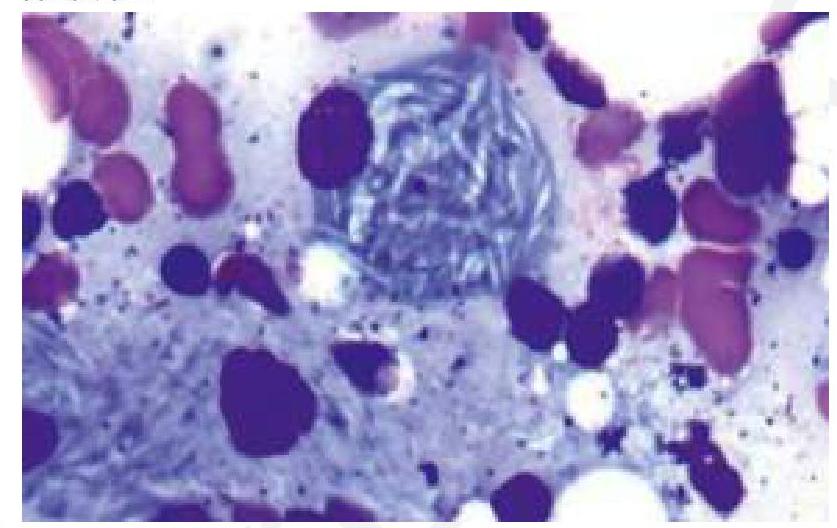
Phospholipid Metabolism Indian Medical PG Question 1: A child presents with bone pain and hepatosplenomegaly, indicative of Gaucher's disease. A trephine biopsy and aspirate show the following finding. Which of the following is the most likely enzyme deficient in this condition?
- A. Hexosaminidase
- B. Glucocerebrosidase (Correct Answer)
- C. Sphingomyelinase
- D. Alpha 1,4-glucosidase
Phospholipid Metabolism Explanation: ***Correct: Glucocerebrosidase***
- The clinical presentation of **bone pain**, **hepatosplenomegaly**, and the characteristic histological finding of **lipid-laden macrophages** (Gaucher cells) with a **crinkled paper** appearance in the bone marrow aspirate are highly suggestive of **Gaucher's disease**.
- **Gaucher's disease** is caused by a deficiency of the lysosomal enzyme **glucocerebrosidase**, leading to the accumulation of **glucocerebroside**.
*Incorrect: Hexosaminidase*
- Deficiency of **hexosaminidase A** is associated with **Tay-Sachs disease**, which presents with neurological degeneration but typically **lacks hepatosplenomegaly** and bone pain.
- The histological findings in Tay-Sachs disease would show neuronal storage of **GM2 gangliosides**, not Gaucher cells.
*Incorrect: Sphingomyelinase*
- Deficiency of **sphingomyelinase** causes **Niemann-Pick disease**, characterized by hepatosplenomegaly, neurological involvement, and interstitial lung disease, but the storage cells (foam cells) have a **foamy appearance** due to sphingomyelin accumulation, not the "crinkled paper" appearance of Gaucher cells.
- While there is organomegaly, the distinct **histological features** in the image rule out Niemann-Pick disease.
*Incorrect: Alpha 1,4-glucosidase*
- Deficiency of **alpha 1,4-glucosidase** (acid maltase) causes **Pompe disease** (Glycogen Storage Disease Type II), which primarily affects muscle and liver with **glycogen accumulation**.
- Pompe disease does not typically present with the same type of **bone pain** or the characteristic **Gaucher cells** seen in the image.
Phospholipid Metabolism Indian Medical PG Question 2: Enzyme deficiency in Farber disease is:
- A. Arylsulfatase A
- B. Sphingomyelinase
- C. Ceramidase (Correct Answer)
- D. Hexosaminidase A
Phospholipid Metabolism Explanation: ***Ceramidase***
- Farber disease, also known as **Farber lipogranulomatosis** or **Farber's disease**, is an autosomal recessive lysosomal storage disorder caused by a deficiency of the enzyme **acid ceramidase**.
- This deficiency leads to the accumulation of **ceramide** in various tissues, causing granulomatous lesions, joint deformities, and neurological symptoms.
*Arylsulfatase A*
- Deficiency of **arylsulfatase A** is associated with **metachromatic leukodystrophy**, a lysosomal storage disorder affecting the nervous system.
- This enzyme is crucial for the breakdown of **sulfatides**, not ceramide.
*Sphingomyelinase*
- A deficiency in **sphingomyelinase** is the hallmark of **Niemann-Pick disease**, specifically types A and B.
- This enzyme is responsible for breaking down **sphingomyelin**, leading to its accumulation in organs like the liver, spleen, and brain.
*Hexosaminidase A*
- A deficiency in **hexosaminidase A** is the cause of **Tay-Sachs disease**, a severe neurodegenerative disorder.
- This enzyme is essential for the metabolism of **GM2 ganglioside**, which accumulates in neurons in affected individuals.
Phospholipid Metabolism Indian Medical PG Question 3: What is the main component of a bilayer cell membrane?
- A. Cholesterol ester
- B. Triacyl glycerol
- C. Cholesterol
- D. Phospholipids (Correct Answer)
Phospholipid Metabolism Explanation: ***Correct: Phospholipids***
- **Phospholipids** are the primary structural components of cell membranes, forming a **bilayer** due to their amphipathic nature.
- The **hydrophilic heads** face the aqueous environment, while the **hydrophobic tails** form the core of the membrane.
*Incorrect: Cholesterol*
- **Cholesterol** is an important component of animal cell membranes, contributing to fluidity and stability, but it is not the **main structural component**.
- It inserts between phospholipids, modulating membrane fluidity by preventing the tight packing of fatty acid tails at lower temperatures and hindering excessive movement at higher temperatures.
*Incorrect: Cholesterol ester*
- **Cholesterol esters** are storage forms of cholesterol and are primarily found in intracellular lipid droplets or associated with lipoproteins in the bloodstream.
- They are generally too **hydrophobic** to be significant structural components within the phospholipid bilayer itself.
*Incorrect: Triacyl glycerol*
- **Triacylglycerols** (triglycerides) are the primary form of **energy storage** in cells, found in lipid droplets within the cytoplasm.
- They are highly **hydrophobic** and do not form a structural part of the cell membrane bilayer.
Phospholipid Metabolism Indian Medical PG Question 4: Which of the following is required for fatty acid synthesis ?
- A. NADPH (Correct Answer)
- B. NADH
- C. FADH₂
- D. None of the options
Phospholipid Metabolism Explanation: ***NADPH***
- **NADPH** is crucial for fatty acid synthesis, providing the **reducing power** needed for the successive reduction steps.
- The enzymes involved, such as **fatty acid synthase**, utilize **NADPH** for the conversion of keto groups to hydroxyl groups and then to saturated methylene groups.
*NADH*
- **NADH** plays a primary role in **oxidative phosphorylation** and the electron transport chain to generate ATP.
- It is generally produced during **catabolic reactions** and is not primarily used as a reducing agent in anabolic processes like fatty acid synthesis.
*FADH*
- **FADH2** (reduced form of FAD, not FADH) is a coenzyme involved in redox reactions, particularly in the **Krebs cycle** and beta-oxidation of fatty acids.
- Like NADH, it is mostly involved in **catabolic processes** that generate energy, rather than anabolic processes requiring reducing equivalents for synthesis.
*None of the options*
- This option is incorrect because **NADPH** is indeed required for fatty acid synthesis, serving as the essential reducing agent.
- The other coenzymes mentioned (NADH, FADH) have different metabolic roles, primarily in energy production rather than biosynthesis.
Phospholipid Metabolism Indian Medical PG Question 5: A primigravida at 38 weeks of gestation has gone into labor. Oxytocin was started to augment labor. The second messenger system through which oxytocin acts is:
- A. Tyrosine kinase
- B. Phospholipase C (IP3/DAG pathway) (Correct Answer)
- C. cGMP
- D. cAMP
Phospholipid Metabolism Explanation: ***Phospholipase C (IP3/DAG pathway)***
- Oxytocin binds to its receptor, which is a **Gq protein-coupled receptor**. This activates **phospholipase C**.
- **Phospholipase C** then hydrolyzes **phosphatidylinositol 4,5-bisphosphate (PIP2)** into **inositol triphosphate (IP3)** and **diacylglycerol (DAG)**, which act as second messengers to increase intracellular calcium and mediate myometrial contraction.
*Tyrosine kinase*
- **Tyrosine kinase receptors** are typically activated by growth factors (e.g., insulin, epidermal growth factor) and lead to phosphorylation cascades.
- This mechanism is not primarily associated with the downstream signaling of **oxytocin receptors**.
*cGMP*
- **Cyclic guanosine monophosphate (cGMP)** is a second messenger primarily involved in signaling pathways initiated by **nitric oxide** and some peptide hormones.
- It often acts to cause smooth muscle relaxation, which is contrary to oxytocin's role in uterine contraction.
*cAMP*
- **Cyclic adenosine monophosphate (cAMP)** is a common second messenger for many hormones that bind to **Gs protein-coupled receptors**.
- Hormones such as **epinephrine (beta-adrenergic receptors)** and **glucagon** utilize cAMP, typically leading to different cellular responses than those of oxytocin.
Phospholipid Metabolism Indian Medical PG Question 6: Which of the following is not a phospholipid ?
- A. Lecithin
- B. Plasmalogen
- C. Cardiolipin
- D. Ganglioside (Correct Answer)
Phospholipid Metabolism Explanation: ***Ganglioside***
- Gangliosides are a type of **glycosphingolipid** because their structure includes a ceramide (a sphingoid base linked to a fatty acid) and a carbohydrate portion with one or more **sialic acid** residues, but no phosphate group.
- They are primarily found in **nerve cell membranes** and are crucial for cell-cell recognition and signaling, differentiating them from phospholipids which contain a phosphate group.
*Lecithin*
- Lecithin, specifically **phosphatidylcholine**, is a common phospholipid characterized by a **phosphate group** and a **choline head group** attached to a diacylglycerol backbone.
- It plays vital roles in cell membrane structure and function and is an important emulsifier.
*Plasmalogen*
- Plasmalogens are a class of phospholipids characterized by a **vinyl ether linkage** at the *sn*-1 position of the glycerol backbone, instead of the typical ester linkage found in other phospholipids.
- They retain the defining **phosphate group** that classifies them as phospholipids.
*Cardiolipin*
- Cardiolipin is a unique phospholipid composed of **two phosphatidic acid moieties** connected by a glycerol molecule, resulting in four fatty acid chains and two phosphate groups.
- It is predominantly found in the **inner mitochondrial membrane**, essential for mitochondrial function.
Phospholipid Metabolism Indian Medical PG Question 7: Phospholipid associated with the mechanism of hormone action is
- A. Phosphatidylcholine
- B. Phosphatidylethanolamine
- C. Plasmalogen
- D. Phosphatidylinositol (Correct Answer)
Phospholipid Metabolism Explanation: ***Phosphatidylinositol*** (Correct)
- **Phosphatidylinositol (PI)** and its phosphorylated derivatives, particularly **PIP2 (phosphatidylinositol 4,5-bisphosphate)**, are critical in signal transduction pathways activated by many hormones.
- Hormones binding to **G protein-coupled receptors** can activate phospholipase C, which cleaves PIP2 into **inositol triphosphate (IP3)** and **diacylglycerol (DAG)**, leading to increased intracellular calcium and protein kinase C activation, respectively.
*Phosphatidylcholine* (Incorrect)
- **Phosphatidylcholine** is a major component of cell membranes and is involved in membrane structure and fluidity.
- While it can be a source of signaling molecules like **lysophosphatidic acid**, it is not primarily associated with the initial intracellular signaling events of hormone action in the same way as phosphatidylinositol.
*Phosphatidylethanolamine* (Incorrect)
- **Phosphatidylethanolamine** is another abundant membrane phospholipid primarily involved in membrane structure and stability.
- It can be a precursor for other lipids, but it does not directly participate in the **second messenger systems** triggered by most hormones as a primary signaling molecule.
*Plasmalogen* (Incorrect)
- **Plasmalogens** are a unique class of phospholipids containing an ether bond at the sn-1 position.
- They are abundant in certain tissues, particularly nervous and cardiovascular tissues, and are thought to have antioxidant properties, but they are not directly involved in the initiating events of **hormone signaling pathways**.
Phospholipid Metabolism Indian Medical PG Question 8: Match the following: A) Caplan syndrome- 1) Found first in coal worker B) Asbestosis- 2) Upper lobe predominance C) Mesothelioma- 3) Involves lower lobe D) Sarcoidosis- 4) Pleural effusion is seen
- A. A-3, B-4, C-2, D-1
- B. A-1, B-4, C-3, D-2 (Correct Answer)
- C. A-4, B-2, C-3, D-1
- D. A-2, B-4, C-3, D-1
Phospholipid Metabolism Explanation: **A-1, B-4, C-3, D-2**
- **Caplan syndrome** was first described in **coal workers** with **rheumatoid arthritis** and progressive massive fibrosis.
- **Asbestosis** is often associated with **pleural effusion**, which can be benign or malignant.
- **Mesothelioma** typically involves the **lower lobes** of the lungs, specifically the pleura, and is strongly linked to asbestos exposure.
- **Sarcoidosis** is characterized by **non-caseating granulomas**, which have a predilection for the **upper lobes** of the lungs.
*A-3, B-4, C-2, D-1*
- This option incorrectly states that Caplan syndrome involves the lower lobe; **Caplan syndrome** is defined by the presence of large nodules in the lungs of coal workers with rheumatoid arthritis, and their specific lobar distribution is not a defining characteristic.
- This option incorrectly states that Mesothelioma has an upper lobe predominance; **Mesothelioma** is a pleural malignancy and typically involves the **lower lobes**, extending along the pleura.
*A-4, B-2, C-3, D-1*
- This option incorrectly associates Caplan syndrome with pleural effusion; **Caplan syndrome** manifests as rheumatoid nodules in the lungs, not primarily pleural effusion.
- This option incorrectly states that Asbestosis has an upper lobe predominance; **Asbestosis** predominantly affects the **lower lobes** of the lungs, causing interstitial fibrosis.
*A-2, B-4, C-3, D-1*
- This option incorrectly states that Caplan syndrome has an upper lobe predominance; the defining feature of **Caplan syndrome** is the combination of rheumatoid arthritis and pneumoconiosis, not specific lobar involvement.
- This option correctly identifies pleural effusion with asbestosis and lower lobe involvement with mesothelioma, but **Caplan syndrome** is not characterized by upper lobe predominance.
Phospholipid Metabolism Indian Medical PG Question 9: Essential fatty acid:
- A. Citric acid
- B. Palmitic acid
- C. Linoleic acid (Correct Answer)
- D. Stearic acid
Phospholipid Metabolism Explanation: ***Linoleic acid***
- **Linoleic acid** is an **omega-6 fatty acid** that is considered essential because the human body cannot synthesize it and must obtain it through diet.
- It is a precursor for other important fatty acids like **arachidonic acid**, which are involved in inflammation and blood clotting.
*Citric acid*
- **Citric acid** is an organic acid found in citrus fruits and is a key intermediate in the **Krebs cycle** (citric acid cycle), a central metabolic pathway, but it is not a fatty acid.
- It is readily synthesized by the body and is therefore not considered an essential nutrient.
*Palmitic acid*
- **Palmitic acid** is a **saturated fatty acid** with 16 carbon atoms, which is the most common fatty acid in animals and plants.
- It can be synthesized by the human body from excess carbohydrates and proteins, hence it is not an essential fatty acid.
*Stearic acid*
- **Stearic acid** is another common **saturated fatty acid** with 18 carbon atoms, found in various animal and plant fats.
- Like palmitic acid, it can be endogenously synthesized by the body and is not considered essential.
Phospholipid Metabolism Indian Medical PG Question 10: A person switches from a high-fat diet to a low-fat diet with a compensatory increase in carbohydrates to maintain the same caloric intake. Which lipoprotein is likely to increase?
- A. Chylomicron
- B. IDL
- C. HDL
- D. VLDL (Correct Answer)
Phospholipid Metabolism Explanation: ***VLDL***
- A low-fat diet with increased **carbohydrates** can lead to increased hepatic synthesis of triglycerides, which are then packaged into **VLDL** particles for transport from the liver. This is because excess carbohydrates can be converted to fatty acids and then to triglycerides in the liver.
- The liver's increased triglyceride production, driven by abundant **glucose** from carbohydrates, directly corresponds to a rise in **VLDL** secretion to export these lipids.
*Chylomicron*
- **Chylomicrons** primarily transport **dietary fats** (exogenous triglycerides) absorbed from the intestine.
- Switching to a low-fat diet would typically lead to a *decrease* in chylomicron production, as less dietary fat is available for absorption.
*IDL*
- **IDL** (Intermediate-Density Lipoprotein) is a remnant of **VLDL** metabolism, formed after VLDL loses some triglycerides.
- While VLDL may increase, leading to *more* IDL formation, IDL itself is not the primary component that *increases* directly due to high carbohydrate intake; rather, the precursor **VLDL** is directly affected.
*HDL*
- **HDL** (High-Density Lipoprotein) is involved in **reverse cholesterol transport**, picking up excess cholesterol from peripheral tissues and returning it to the liver.
- High carbohydrate intake, especially refined carbohydrates, can sometimes lead to a *decrease* in HDL levels, not an increase.
More Phospholipid Metabolism Indian Medical PG questions available in the OnCourse app. Practice MCQs, flashcards, and get detailed explanations.