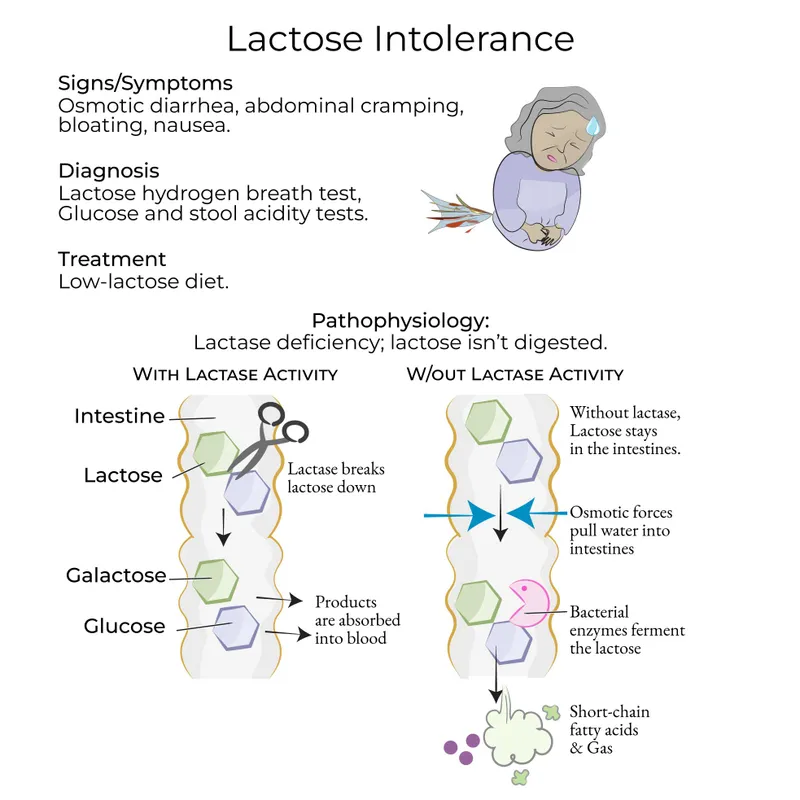
Lactose Intolerance and Galactosemia Indian Medical PG Practice Questions and MCQs
Practice Indian Medical PG questions for Lactose Intolerance and Galactosemia. These multiple choice questions (MCQs) cover important concepts and help you prepare for your exams.
Lactose Intolerance and Galactosemia Indian Medical PG Question 1: Fructose intolerance is due to deficiency of which enzyme?
- A. Aldolase B (Correct Answer)
- B. Aldolase A
- C. Fructokinase
- D. Triokinase
Lactose Intolerance and Galactosemia Explanation: ***Aldolase B***
- **Hereditary fructose intolerance** is a genetic disorder caused by a deficiency in the enzyme **aldolase B**.
- This deficiency leads to an accumulation of **fructose-1-phosphate** in the liver, kidneys, and small intestine, causing **hypoglycemia**, **vomiting**, and **liver damage** upon exposure to fructose.
*Fructokinase*
- A deficiency in **fructokinase** causes **essential fructosuria**, a benign metabolic disorder.
- This condition is asymptomatic because **fructose** simply accumulates in the blood and urine without causing significant clinical problems.
*Triokinase*
- **Triokinase**, also known as **glycerol kinase**, is involved in glycerol metabolism, converting glycerol to **glycerol-3-phosphate**.
- Its deficiency is not directly linked to fructose intolerance and typically presents with **hyperglycerolemia**.
*Aldolase A*
- **Aldolase A** is one of the three aldolase isoenzymes (A, B, and C) and is primarily involved in **glycolysis**, specifically in the breakdown of **fructose-1,6-bisphosphate**.
- A deficiency in aldolase A can lead to **hemolytic anemia** and **myopathy**, not directly fructose intolerance.
Lactose Intolerance and Galactosemia Indian Medical PG Question 2: A baby from a second degree consanguineous marriage presents with diarrhoea and redness in the perianal diaper area. What is the most likely diagnosis?
- A. Fungal infection (Correct Answer)
- B. Shigella infection
- C. Salmonella infection
- D. Lactose intolerance
Lactose Intolerance and Galactosemia Explanation: ***Fungal infection (Candida diaper dermatitis)***
- **Diarrhea with perianal diaper rash** is the classic presentation of **Candida (fungal) diaper dermatitis**, the most common cause of diaper rash in infants with diarrhea.
- **Diarrhea increases skin moisture and alters pH**, creating optimal conditions for **Candida albicans overgrowth**.
- **Perianal involvement with bright erythema** is characteristic of Candida, often with **satellite lesions** and involvement of skin folds.
- This is a **clinical diagnosis** based on distribution pattern and association with diarrhea; consanguinity is not directly relevant to this common condition.
*Lactose intolerance*
- **Congenital lactase deficiency** is extremely rare (< 50 cases worldwide) and unlikely to be the primary diagnosis.
- While **secondary lactose intolerance** can occur with gastroenteritis causing diarrhea, it doesn't explain the **specific perianal rash pattern** described.
- The perianal redness in lactose malabsorption would be **irritant contact dermatitis** from acidic stools, which would secondarily get infected with **Candida** - making fungal infection the more complete diagnosis.
*Shigella infection*
- Typically presents with **bloody diarrhea (dysentery)**, high fever, abdominal cramps, and tenesmus.
- Would not specifically cause the **perianal diaper rash pattern** characteristic of Candida.
- Consanguinity doesn't predispose to this bacterial infection.
*Salmonella infection*
- Usually presents with **fever, vomiting, and systemic symptoms** along with diarrhea.
- May cause bloody or non-bloody diarrhea but doesn't explain the **characteristic perianal redness pattern**.
- Not associated with consanguinity as it's an acquired infectious disease.
Lactose Intolerance and Galactosemia Indian Medical PG Question 3: Galactosemia is due to deficiency of which enzyme?
- A. Galactose-1-phosphate uridyltransferase (Correct Answer)
- B. HGPRT
- C. Galactokinase
- D. Epimerase
Lactose Intolerance and Galactosemia Explanation: ***Galactose-1-phosphate uridyltransferase***
- Deficiency of **galactose-1-phosphate uridyltransferase (GALT)** leads to the most severe form, **classic galactosemia**.
- This enzyme is crucial for converting **galactose-1-phosphate** to **glucose-1-phosphate** in the Leloir pathway.
*HGPRT*
- **HGPRT** (hypoxanthine-guanine phosphoribosyltransferase) deficiency causes **Lesch-Nyhan syndrome**, a distinct metabolic disorder.
- Lesch-Nyhan syndrome is characterized by **hyperuricemia**, neurological dysfunction, and self-mutilation, unrelated to galactose metabolism.
*Galactokinase*
- Deficiency of **galactokinase** causes Type II galactosemia, a milder form than classic galactosemia.
- This defect primarily leads to **cataracts** due to galactitol accumulation but does not result in the severe systemic issues seen in classic galactosemia.
*Epimerase*
- Deficiency of **UDP-galactose-4'-epimerase** (GALE) causes Type III galactosemia, which has a variable clinical presentation from mild to severe.
- While involved in galactose metabolism, it's not the primary enzyme deficient in the most common and severe form of **galactosemia**.
Lactose Intolerance and Galactosemia Indian Medical PG Question 4: A 6-month-old child presents with jaundice, hepatomegaly, and cataracts. What is the most likely diagnosis?
- A. Fructose intolerance
- B. Hemochromatosis
- C. Glycogen storage disease
- D. Galactosemia (Correct Answer)
- E. Wilson disease
Lactose Intolerance and Galactosemia Explanation: ***Galactosemia***
- **Galactosemia** is a genetic disorder affecting galactose metabolism, leading to a build-up of galactose-1-phosphate in tissues.
- Symptoms like **jaundice**, **hepatomegaly**, and **cataracts** in an infant are classic presentations, often exacerbated by milk (lactose/galactose) intake.
*Fructose intolerance*
- **Hereditary fructose intolerance** typically manifests after the introduction of fructose into the diet, causing symptoms like vomiting, hypoglycemia, and liver dysfunction.
- While it can cause hepatomegaly and jaundice, **cataracts** are not a typical feature of fructose intolerance.
*Hemochromatosis*
- **Hemochromatosis** is a disorder of iron overload, usually presenting in adulthood with symptoms such as fatigue, joint pain, liver disease (cirrhosis), and diabetes.
- It is rarely diagnosed in infancy and **cataracts** are not a characteristic symptom.
*Glycogen storage disease*
- **Glycogen storage diseases** involve defects in glycogen synthesis or breakdown, leading to various symptoms depending on the specific enzyme deficiency.
- Types affecting the liver often cause **hepatomegaly** and **hypoglycemia**, but **cataracts** are not a common, primary feature in most forms, and jaundice is also less typical than in galactosemia.
*Wilson disease*
- **Wilson disease** is a copper metabolism disorder that causes liver disease and neuropsychiatric symptoms.
- It typically presents later in childhood or adolescence (rarely before age 3), and while it causes hepatomegaly and jaundice, the ocular finding is **Kayser-Fleischer rings**, not cataracts.
Lactose Intolerance and Galactosemia Indian Medical PG Question 5: Most Common enzyme deficient in galactosemics:
- A. Galactosidase
- B. UDP galactose epimerase
- C. Galactokinase
- D. Galactose-1-phosphate uridyl transferase/GALT (Correct Answer)
Lactose Intolerance and Galactosemia Explanation: ***Galactose-1-phosphate uridyl transferase/GALT***
- **GALT deficiency** is the most common cause of **classic galactosemia** (Type I), a severe inherited metabolic disorder.
- This enzyme is crucial for converting **galactose-1-phosphate** to **glucose-1-phosphate** in the main pathway of galactose metabolism.
- Accounts for approximately **95%** of all galactosemia cases.
*Galactosidase*
- **Galactosidase** enzymes are involved in the hydrolysis of galactose-containing oligosaccharides or glycoconjugates but are not the primary enzymes deficient in classic galactosemia.
- This enzyme is not part of the Leloir pathway of galactose metabolism, which is the pathway affected in galactosemia.
*UDP galactose epimerase*
- Deficiency of **UDP galactose epimerase** (GALE) causes a milder form of galactosemia (Type III), but it is much less common than GALT deficiency.
- GALE is involved in the interconversion of UDP-galactose and UDP-glucose.
- This is the rarest form of galactosemia.
*Galactokinase*
- **Galactokinase deficiency** (GALK) causes a different, milder form of galactosemia (Type II), characterized by **cataracts** as the primary symptom.
- It prevents the initial phosphorylation of galactose to galactose-1-phosphate.
- This accounts for less than 5% of galactosemia cases.
Lactose Intolerance and Galactosemia Indian Medical PG Question 6: Which of the following is not a reducing sugar?
- A. Sucrose (Correct Answer)
- B. Lactose
- C. Glucose
- D. Fructose
Lactose Intolerance and Galactosemia Explanation: ***Sucrose***
- Sucrose is a **non-reducing disaccharide** composed of **glucose** and **fructose** linked by a glycosidic bond between their anomeric carbons.
- This bond prevents the ring-opening necessary to form an aldehyde group (or to be oxidized as a **ketone** in the case of fructose), making it unable to reduce other compounds.
*Lactose*
- Lactose is a **reducing disaccharide** made of **glucose** and **galactose**.
- Its ability to reduce other compounds comes from the **free anomeric carbon** of the glucose unit, which can open to form an aldehyde group.
*Glucose*
- Glucose is a **reducing monosaccharide** due to its **free aldehyde group** (aldose sugar).
- This aldehyde group can be oxidized, allowing glucose to reduce other substances.
*Fructose*
- Fructose is a **reducing monosaccharide**, even though it's a **ketose sugar** (contains a ketone group).
- In an alkaline solution, fructose can isomerize to **glucose** and **mannose** (which contain aldehyde groups), allowing it to act as a reducing sugar.
Lactose Intolerance and Galactosemia Indian Medical PG Question 7: Lactose intolerance in a suspected patient is diagnosed by giving an oral load and measuring concentrations of ?
- A. CO2
- B. H2 (Correct Answer)
- C. N2
- D. One/two carbon compounds
Lactose Intolerance and Galactosemia Explanation: ***H2***
- The **hydrogen breath test** is the most common diagnostic test for lactose intolerance. Unabsorbed lactose in the colon is fermented by bacteria, producing hydrogen gas.
- **Hydrogen gas** is then absorbed into the bloodstream and exhaled, allowing its measurement in the breath.
*CO2*
- While some CO2 is produced during fermentation, it is not specific enough to diagnose lactose intolerance.
- **CO2 levels** are significantly influenced by other metabolic processes and respiratory activity, making it a poor marker.
*N2*
- **Nitrogen** is an inert gas and not produced in significant amounts during lactose fermentation in the gut.
- It is not a metabolic byproduct relevant to the diagnosis of carbohydrate malabsorption.
*One/two carbon compounds*
- While fermentation produces various short-chain fatty acids (SCFAs), which are one or two-carbon compounds, they are absorbed by the colonic mucosa.
- Measuring these compounds directly in a non-invasive way to diagnose lactose intolerance is currently not standard clinical practice; breath hydrogen is preferred.
Lactose Intolerance and Galactosemia Indian Medical PG Question 8: A cataract formation in both eyes was discovered in a 1-year-old child during a routine well-child visit, with blood tests showing elevated galactose and galactitol levels. To determine which enzyme might be defective in the child, which intracellular metabolite should be measured?
- A. Galactose
- B. Fructose
- C. Glucose
- D. Galactose-1-phosphate (Correct Answer)
Lactose Intolerance and Galactosemia Explanation: ***Galactose-1-phosphate***
- An elevation of **galactose-1-phosphate** in a patient with cataracts and elevated galactose and galactitol levels points to a deficiency in **galactose-1-phosphate uridyltransferase (GALT)**, indicating **classic galactosemia**.
- The accumulation of **galactose-1-phosphate** is toxic and underlies the severe symptoms of classic galactosemia, including cataracts, liver damage, and intellectual disability.
- Measuring this metabolite specifically identifies GALT deficiency and distinguishes it from other enzyme defects in galactose metabolism.
*Galactose*
- Elevated **galactose** is observed in **galactosemia**, but measuring galactose itself doesn't differentiate between the different enzyme deficiencies (e.g., GALT vs. GALK deficiency).
- While elevated, it's the downstream metabolites like **galactose-1-phosphate** that are more specific for diagnosing the enzyme defect in classic galactosemia.
*Fructose*
- **Fructose** metabolism is distinct from galactose metabolism, and its levels would not be directly affected by defects in galactose-metabolizing enzymes.
- Elevated fructose would suggest a different metabolic disorder, such as **hereditary fructose intolerance**, which has different clinical presentations.
*Glucose*
- **Glucose** levels are not specific for diagnosing enzyme defects in galactose metabolism.
- While hypoglycemia can occur in severe galactosemia, measuring glucose doesn't identify which specific enzyme is deficient and is not the primary diagnostic metabolite.
Lactose Intolerance and Galactosemia Indian Medical PG Question 9: In glycolysis, which of the following enzymes is not involved?
- A. Pyruvate dehydrogenase (Correct Answer)
- B. Phosphofructokinase
- C. Glucokinase
- D. Pyruvate kinase
Lactose Intolerance and Galactosemia Explanation: ***Pyruvate dehydrogenase***
- **Pyruvate dehydrogenase** is a mitochondrial enzyme complex that converts **pyruvate** to **acetyl-CoA** in the link reaction, which occurs after glycolysis and prepares for the citric acid cycle.
- It is not directly involved in the ten-step glycolytic pathway itself, which converts glucose to pyruvate.
*Phosphofructokinase*
- **Phosphofructokinase-1 (PFK-1)** is a key regulatory enzyme in glycolysis, catalyzing the phosphorylation of **fructose-6-phosphate** to **fructose-1,6-bisphosphate**.
- This step is often considered the **rate-limiting step** of glycolysis.
*Glucokinase*
- **Glucokinase**, located primarily in the liver and pancreatic beta cells, phosphorylates glucose to **glucose-6-phosphate** in the first step of glycolysis.
- It has a high **Km** (low affinity) for glucose, allowing it to respond to high glucose concentrations.
*Pyruvate kinase*
- **Pyruvate kinase** catalyzes the final step of glycolysis, transferring a phosphate group from **phosphoenolpyruvate (PEP)** to ADP to form **ATP** and **pyruvate**.
- This is one of the **irreversible** steps in glycolysis and a point of regulation.
Lactose Intolerance and Galactosemia Indian Medical PG Question 10: In glycolysis, inorganic phosphate is used in a reaction catalyzed by?
- A. Enolase
- B. Pyruvate kinase
- C. Aldolase
- D. Glyceraldehyde-3-phosphate dehydrogenase (Correct Answer)
Lactose Intolerance and Galactosemia Explanation: ***Glyceraldehyde-3-phosphate dehydrogenase***
- This enzyme catalyzes the conversion of **glyceraldehyde-3-phosphate** into **1,3-bisphosphoglycerate**, incorporating inorganic phosphate (Pi) to form a high-energy phosphate bond.
- This is the **only step in glycolysis** where inorganic phosphate is directly used to generate a phosphorylated intermediate, not derived from ATP.
*Enolase*
- Enolase catalyzes the dehydration of **2-phosphoglycerate** to form **phosphoenolpyruvate (PEP)**, which is a key high-energy intermediate.
- This reaction does not involve the direct incorporation of inorganic phosphate; rather, it removes a molecule of water.
*Pyruvate kinase*
- Pyruvate kinase catalyzes the final step of glycolysis, transferring a phosphate group from **phosphoenolpyruvate (PEP)** to ADP, forming ATP and pyruvate.
- This is a substrate-level phosphorylation step and does not involve the use of inorganic phosphate as a reactant.
*Aldolase*
- Aldolase cleaves **fructose-1,6-bisphosphate** into two three-carbon molecules: **dihydroxyacetone phosphate** and **glyceraldehyde-3-phosphate**.
- This is a cleavage reaction and does not involve the direct incorporation of inorganic phosphate.
More Lactose Intolerance and Galactosemia Indian Medical PG questions available in the OnCourse app. Practice MCQs, flashcards, and get detailed explanations.