Nerves of Lower Limb Indian Medical PG Practice Questions and MCQs
Practice Indian Medical PG questions for Nerves of Lower Limb. These multiple choice questions (MCQs) cover important concepts and help you prepare for your exams.
Nerves of Lower Limb Indian Medical PG Question 1: All the following nerves are involved in entrapment neuropathy except -
- A. Median nerve
- B. Femoral nerve (Correct Answer)
- C. Ulnar nerve
- D. Lateral cutaneous nerve of thigh
Nerves of Lower Limb Explanation: ***Femoral nerve***
- While the femoral nerve can be injured, it is **uncommonly involved** in entrapment neuropathy compared to other nerves.
- Entrapment of the femoral nerve is rare and typically occurs in the **pelvis** or **inguinal region**, often due to trauma or mass effect.
*Median nerve*
- The median nerve is classically involved in **carpal tunnel syndrome**, where it is compressed at the wrist [1], [2].
- Symptoms include pain, numbness, and tingling in the thumb, index, middle, and radial half of the ring finger [1].
*Ulnar nerve*
- The ulnar nerve is commonly entrapped at the **cubital tunnel** (elbow) or the **Guyon's canal** (wrist) [1].
- This leads to symptoms such as numbness and weakness in the small finger and ulnar half of the ring finger [1].
*Lateral cutaneous nerve of thigh*
- This nerve is frequently entrapped as it passes under the **inguinal ligament**, causing **meralgia paresthetica**.
- Symptoms include burning pain and numbness on the lateral aspect of the thigh.
Nerves of Lower Limb Indian Medical PG Question 2: A policeman found a person lying unconscious in the lateral position on the road with superficial injury to the face, bruises on the right arm, and injury to the lateral aspect of the right knee. Given the mechanism of injury and positioning, which nerve is most probably injured?
- A. Femoral nerve
- B. Common peroneal nerve (Correct Answer)
- C. Radial nerve
- D. Trigeminal nerve
Nerves of Lower Limb Explanation: **Correct: Common peroneal nerve**
- The **lateral aspect of the right knee** is particularly vulnerable to direct trauma to the **common peroneal nerve** due to its superficial course around the neck of the fibula.
- The unconscious state and lateral position suggest a prolonged compression or direct impact mechanism, making this nerve highly susceptible to injury.
- The common peroneal nerve is the **most commonly injured nerve in the lower limb** due to its superficial location.
*Incorrect: Femoral nerve*
- The **femoral nerve** runs deep within the groin region and anterior thigh, making direct injury at the knee unlikely from an isolated lateral knee trauma.
- Injuries to the femoral nerve typically result from pelvic fractures, abdominal surgery, or deep penetrating wounds to the groin.
*Incorrect: Radial nerve*
- The **radial nerve** is located in the upper limb and primarily affects the extensor muscles of the arm, forearm, and hand.
- While bruises on the right arm are noted, an injury to the radial nerve would not explain the specific trauma to the lateral aspect of the knee.
*Incorrect: Trigeminal nerve*
- The **trigeminal nerve** is a cranial nerve responsible for sensation in the face and motor functions such as biting and chewing.
- Superficial injury to the face might affect sensory branches, but it is entirely unrelated to an injury to the lateral aspect of the knee.
Nerves of Lower Limb Indian Medical PG Question 3: Which of the following structures is supplied by the superior gluteal nerve?
- A. Gluteus minimus (Correct Answer)
- B. Gluteus maximus
- C. Piriformis
- D. All of the options
Nerves of Lower Limb Explanation: ***Gluteus minimus***
- The **superior gluteal nerve** provides motor innervation to the gluteus medius, gluteus minimus, and tensor fasciae latae muscles.
- This nerve originates from the sacral plexus **(L4, L5, S1)** and exits the pelvis through the greater sciatic foramen, superior to the piriformis muscle.
*Gluteus maximus*
- The gluteus maximus muscle is innervated by the **inferior gluteal nerve**, not the superior gluteal nerve.
- The inferior gluteal nerve also arises from the sacral plexus **(L5, S1, S2)** and is crucial for hip extension and external rotation.
*Piriformis*
- The piriformis muscle receives its own direct branches from the sacral plexus **(S1, S2)** via the nerve to piriformis, distinct from the superior or inferior gluteal nerves.
- It plays a key role in hip external rotation and abduction when the hip is flexed.
*All of the options*
- This option is incorrect because gluteus maximus is innervated by the inferior gluteal nerve, and piriformis has its own specific nerve supply.
- The superior gluteal nerve specifically innervates only the gluteus medius, gluteus minimus, and tensor fasciae latae.
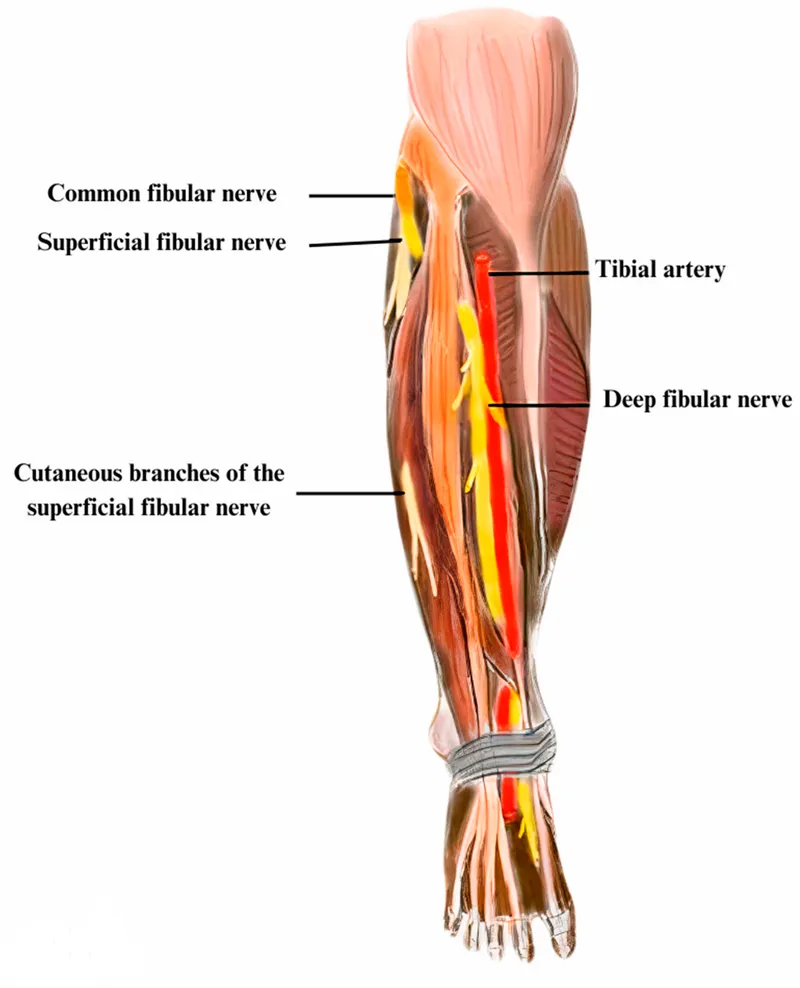
Nerves of Lower Limb Indian Medical PG Question 4: A man is struck with a lathi on the lateral aspect of the head of fibula. Which of the following sensory deficits can occur as a result of nerve injury?
- A. Loss of sensation of adjacent sides of 1st & 2nd toe (Correct Answer)
- B. Dorsiflexion not possible
- C. Loss of sensation of lateral foot
- D. Inversion inability
Nerves of Lower Limb Explanation: ***Loss of sensation of adjacent sides of 1st & 2nd toe***
- Injury to the lateral aspect of the head of the fibula commonly damages the **common fibular (peroneal) nerve**, which then divides into superficial and deep fibular nerves.
- The **deep fibular nerve** supplies sensation to the web space between the first and second toes, and its injury would cause loss of sensation in this specific area.
- This is the correct **sensory deficit** resulting from common fibular nerve injury at the fibular head.
*Loss of sensation of lateral foot*
- Sensation to the lateral aspect of the foot is primarily supplied by the **sural nerve**, a branch of the tibial nerve, not the common fibular nerve.
- Damage to the common fibular nerve would not typically result in isolated loss of sensation on the lateral foot.
*Dorsiflexion not possible*
- Inability to **dorsiflex** the foot ("foot drop") is a common consequence of common fibular nerve injury.
- However, this is a **motor deficit**, not a **sensory deficit** as specifically asked in the question.
- Dorsiflexion is performed by tibialis anterior and extensor digitorum longus, both innervated by the deep fibular nerve.
*Inversion inability*
- **Foot inversion** is primarily mediated by muscles innervated by the **tibial nerve** (tibialis posterior) and to a lesser extent by the deep fibular nerve (tibialis anterior).
- This represents a **motor deficit**, not a **sensory deficit** as asked in the question.
- Injury to the common fibular nerve would not significantly impair inversion since tibialis posterior (the primary invertor) remains intact.
Nerves of Lower Limb Indian Medical PG Question 5: A 22-year-old woman is found in a comatose condition, having lain for an unknown length of time on the tile floor of the courtyard. She is found in possession of cocaine. The patient is transported to the hospital while EMT personnel receive instructions for treatment of drug overdose. During the physical examination the patient's gluteal region shows signs of ischemia. After regaining consciousness, she exhibits paralysis of knee flexion and dorsal and plantar flexion and sensory loss in the limb. What is the most likely diagnosis?
- A. Tibial nerve loss
- B. Piriformis entrapment syndrome
- C. Gluteal crush injury (Correct Answer)
- D. S1-2 nerve compression
Nerves of Lower Limb Explanation: ***Gluteal crush injury***
- Prolonged pressure on the gluteal region, especially in a comatose state on a hard surface, can lead to **muscle necrosis** and **compartment syndrome**, causing secondary nerve damage.
- The symptoms, including **paralysis of knee flexion** (hamstrings, supplied by sciatic/tibial) and **dorsal/plantar flexion** (peroneal and tibial nerves), along with sensory loss in the limb, are consistent with sciatic nerve damage resulting from a crush injury in the gluteal region.
*Tibial nerve loss*
- While damage to the tibial nerve would cause **paralysis of plantar flexion** and sensory loss, it would not explain the **paralysis of dorsal flexion** (peroneal nerve) or knee flexion (hamstrings).
- This option represents a partial injury pattern and does not fully encompass all the described neurological deficits.
*Piriformis entrapment syndrome*
- This syndrome primarily involves compression of the **sciatic nerve** by the piriformis muscle, causing gluteal pain and paresthesias, often exacerbated by activities.
- It typically does not result in a global loss of motor function in the entire lower limb, especially in the context of a crush injury.
*S1-2 nerve compression*
- Compression at the S1-S2 level would primarily affect **plantar flexion** (S1-S2), **eversion** of the foot, and sensation along the posterior leg and sole of the foot.
- It would not explain the **paralysis of knee flexion** (L5-S2, predominantly L5-S1) or **dorsal flexion** (L4-S1, predominantly L4-L5).
Nerves of Lower Limb Indian Medical PG Question 6: Injury at which of the following marked sites on the leg causes failure of dorsiflexion?
- A. Anterior aspect of the thigh (site 1)
- B. Medial aspect of the leg (site 4)
- C. Lateral aspect of the leg (site 3) (Correct Answer)
- D. Posterior aspect of the thigh (site 2)
Nerves of Lower Limb Explanation: ***Lateral aspect of the leg (site 3)***
- Site 3 points to the **fibula head** and the adjacent region on the lateral aspect of the leg. This is the anatomical location where the **common fibular nerve (peroneal nerve)** wraps around.
- The common fibular nerve innervates the muscles responsible for **dorsiflexion** and eversion of the foot. Damage to this nerve, often due to trauma at the fibular neck, leads to **foot drop** and an inability to dorsiflex the foot.
*Anterior aspect of the thigh (site 1)*
- Site 1 points to the distal femur, which is part of the thigh. Nerves in the anterior thigh (e.g., **femoral nerve**) primarily control hip flexion and knee extension.
- Damage here would affect movements of the hip and knee, not directly causing failure of dorsiflexion of the foot.
*Medial aspect of the leg (site 4)*
- Site 4 points to the medial tibia. This area is associated with the **tibial nerve** and saphenous nerve, which primarily innervate muscles for plantarflexion and inversion of the foot, or provide sensory innervation.
- Injury to the tibial nerve would result in an inability to plantarflex and invert the foot, not dorsiflexion.
*Posterior aspect of the thigh (site 2)*
- Site 2 points to the posterior aspect of the thigh, which is the region for the hamstrings. The **sciatic nerve** and its branches (tibial and common fibular) pass through this region.
- While the common fibular nerve originates from the sciatic nerve in the posterior thigh, an injury at this level would likely cause more widespread motor and sensory deficits than isolated dorsiflexion failure, and site 3 is a more common and specific site for common fibular nerve injury isolated to foot drop.
Nerves of Lower Limb Indian Medical PG Question 7: Which is the largest nerve that exits the pelvis through the greater sciatic foramen?
- A. Sciatic nerve (Correct Answer)
- B. Superior gluteal artery
- C. Inferior gluteal artery
- D. Piriformis muscle
Nerves of Lower Limb Explanation: ***Sciatic nerve***
- The **sciatic nerve** is the largest nerve in the human body, formed from the sacral plexus, and it is indeed the largest structure that passes through the **greater sciatic foramen** as it descends into the posterior thigh.
- It supplies motor and sensory innervation to the posterior thigh, lower leg, and foot.
*Superior gluteal artery*
- The superior gluteal artery exits the pelvis through the **greater sciatic foramen** above the piriformis muscle.
- While significant, it is an artery and not a nerve, and it is not the largest structure passing through this foramen.
*Inferior gluteal artery*
- The inferior gluteal artery also exits the pelvis via the **greater sciatic foramen**, inferior to the piriformis muscle.
- Like the superior gluteal artery, it is an arterial structure and not a nerve, and it is not the largest structure in the foramen.
*Piriformis muscle*
- The **piriformis muscle** originates inside the pelvis and passes through the **greater sciatic foramen** to insert on the greater trochanter of the femur.
- Although it occupies a significant portion of the foramen, it is a muscle, not a nerve, and the sciatic nerve is the largest nerve exiting this aperture.
Nerves of Lower Limb Indian Medical PG Question 8: A patient complains to a physician of chronic pain and tingling of the buttocks. The pain is exacerbated when the buttocks are compressed by sitting on a toilet seat or chair for long periods. No lumbar pain is noted. Pain is elicited when the physician performs Freiberg's maneuver. Most likely diagnosis?
- A. Disk compression of the sciatic nerve
- B. Fibromyalgia
- C. Popliteus tendinitis
- D. Piriformis syndrome (Correct Answer)
Nerves of Lower Limb Explanation: ***Piriformis syndrome***
- The symptoms of **chronic pain and tingling in the buttocks**, exacerbated by sitting, and the positive finding on **Freiberg's maneuver** (passive internal rotation of the hip) are hallmark signs.
- This condition involves **entrapment or irritation of the sciatic nerve by the piriformis muscle**, which is located deep in the buttock.
*Disk compression of the sciatic nerve*
- While it can cause similar symptoms, the absence of **lumbar pain** makes a primary disc issue less likely.
- **Freiberg's maneuver** is specific to piriformis irritation, not typically for disk compression.
*Fibromyalgia*
- Fibromyalgia presents with **widespread musculoskeletal pain** and tenderness, not typically localized to the buttocks with specific positional exacerbation.
- It does not involve nerve entrapment or specific orthopedic maneuvers like Freiberg's maneuver.
*Popliteus tendinitis*
- Popliteus tendinitis causes pain in the **posterolateral aspect of the knee**, not the buttocks.
- It is typically associated with activities involving downhill running or pivoting of the knee.
Nerves of Lower Limb Indian Medical PG Question 9: Which is the thickest nerve of the body?
- A. Radial
- B. Median
- C. Sciatic (Correct Answer)
- D. Axillary
Nerves of Lower Limb Explanation: ***Sciatic***
- The **sciatic nerve** is the **longest and thickest nerve** in the human body, stemming from the sacral plexus.
- It supplies motor and sensory innervation to the posterior thigh, and the entire lower leg and foot.
*Radial*
- The **radial nerve** originates from the brachial plexus and innervates extensor muscles of the arm, forearm, and hand.
- While significant, it is not as large or thick as the sciatic nerve.
*Median*
- The **median nerve** also arises from the brachial plexus, primarily innervating muscles of the forearm and hand responsible for pronation and flexion.
- It is smaller in diameter compared to the sciatic nerve.
*Axillary*
- The **axillary nerve** is a relatively short nerve derived from the brachial plexus, supplying the deltoid and teres minor muscles.
- Its size is considerably smaller than the sciatic nerve and it provides innervation to a more limited area.
Nerves of Lower Limb Indian Medical PG Question 10: Which of the following group of lymph nodes does NOT receive direct lymphatic drainage from the perineum?
- A. Superficial inguinal
- B. Internal iliac
- C. External iliac (Correct Answer)
- D. Deep inguinal
Nerves of Lower Limb Explanation: ***External iliac***
- The external iliac lymph nodes do **NOT receive direct lymphatic drainage** from the perineum.
- They primarily receive lymph from the **deep inguinal nodes**, pelvic organs (bladder, upper vagina), and lower anterior abdominal wall [1].
- Perineal lymphatics drain to superficial inguinal, deep inguinal, or internal iliac nodes first, making external iliac a **secondary or tertiary drainage station** rather than a direct recipient.
*Superficial inguinal*
- These are the **primary drainage site** for lymph from the superficial perineum.
- They receive direct lymphatic vessels from the **vulva, distal vagina, labia majora**, scrotum, and skin of the perineum.
- This is the main first-line drainage pathway for superficial perineal structures.
*Internal iliac*
- Internal iliac lymph nodes receive **direct lymphatic drainage** from the deep perineum, including the **male urethra, prostate**, and deep structures [2], [3].
- They serve as primary drainage for pelvic visceral structures and deep perineal tissues [3].
*Deep inguinal*
- Deep inguinal lymph nodes receive lymph from the **superficial inguinal nodes** and from deep structures of the lower limb.
- They are part of the drainage pathway from the perineum via the superficial inguinal nodes.
More Nerves of Lower Limb Indian Medical PG questions available in the OnCourse app. Practice MCQs, flashcards, and get detailed explanations.


oka