Principles of Teratology Indian Medical PG Practice Questions and MCQs
Practice Indian Medical PG questions for Principles of Teratology. These multiple choice questions (MCQs) cover important concepts and help you prepare for your exams.
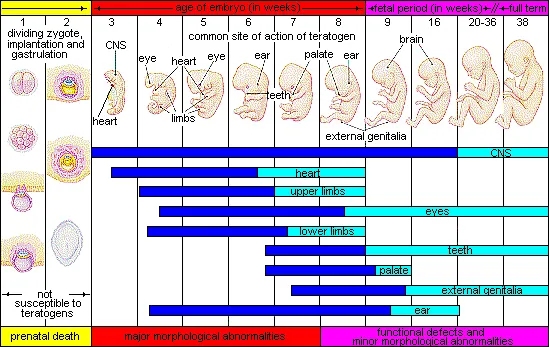
Principles of Teratology Indian Medical PG Question 1: At which gestational period is the fetus most radiosensitive?
- A. 8-15 weeks (Correct Answer)
- B. 10-15 weeks
- C. >20 weeks
- D. 15-20 weeks
Principles of Teratology Explanation: ***8-15 weeks***
- The period between **8-15 weeks of gestation** is considered the most radiosensitive for the fetus, as the **central nervous system** is undergoing rapid development and cell differentiation.
- Exposure to radiation during this time significantly increases the risk of severe **developmental abnormalities**, including **intellectual disability** and **microcephaly**.
*10-15 weeks*
- While falling within the highly sensitive period, this option is slightly less precise as the most critical window of vulnerability begins earlier, around **8 weeks**.
- The peak sensitivity for radiation-induced **severe mental retardation** is specifically stated to be between 8-15 weeks gestational age.
*15-20 weeks*
- Sensitivity to radiation-induced severe developmental effects, such as **intellectual disability**, decreases significantly after **15 weeks gestation**.
- While some risks still exist, the likelihood of major malformations or severe neurological damage is considerably lower compared to the earlier period.
*>20 week*
- Beyond **20 weeks of gestation**, the fetus is much less susceptible to **teratogenic effects** from radiation exposure, as most organogenesis is complete.
- Risks during this later period are more commonly related to **growth restriction**, **premature birth**, or an increased lifetime risk of **childhood cancer**, rather than major developmental anomalies.
Principles of Teratology Indian Medical PG Question 2: Use of folic acid to prevent congenital malformations should be best initiated:
- A. During 1st trimester of pregnancy
- B. During 2nd trimester of pregnancy
- C. During 3rd trimester of pregnancy
- D. Before conception (Correct Answer)
Principles of Teratology Explanation: ***Before conception***
- **Neural tube defects (NTDs)**, such as spina bifida and anencephaly, occur very early in pregnancy, often before a woman even knows she is pregnant.
- Adequate folate levels are crucial for **neural tube closure**, which happens between 21 and 28 days after conception. Therefore, supplementation needs to start before this period.
*During 1st trimester of pregnancy*
- While still helpful, initiating folic acid during the first trimester might be **too late** to prevent all NTDs.
- The critical period for neural tube formation has largely passed, meaning the **maximum preventive effect** may not be achieved.
*During 2nd trimester of pregnancy*
- This is **too late** for primary prevention of NTDs, as neural tube closure is completed in the first few weeks of gestation.
- At this stage, folic acid supplementation would primarily benefit the ongoing **fetal growth and development**, but not the prevention of NTDs.
*During 3rd trimester of pregnancy*
- This timing is **ineffective** for the prevention of congenital malformations like NTDs, which have already occurred or been avoided by this point.
- Folic acid at this stage primarily supports continued fetal growth and maternal health, but offers no additional benefit regarding **early developmental defects**.
Principles of Teratology Indian Medical PG Question 3: All the following drugs are teratogenic except?
- A. Alcohol
- B. Phenytoin
- C. Warfarin
- D. Metoclopramide (Correct Answer)
Principles of Teratology Explanation: ***Metoclopramide***
- **Metoclopramide** is an antiemetic and prokinetic agent generally considered **safe during pregnancy**.
- It does **not** have established teratogenic effects and is often used to treat **nausea and vomiting** in pregnant women.
*Alcohol*
- **Alcohol** is a well-known teratogen, leading to **fetal alcohol syndrome** characterized by facial dysmorphia, growth restriction, and CNS abnormalities.
- Even moderate consumption can have detrimental effects on fetal development, particularly brain development.
*Phenytoin*
- **Phenytoin** is an antiepileptic drug associated with **fetal hydantoin syndrome**, which includes craniofacial anomalies, mental deficits, and distal phalangeal hypoplasia.
- It interferes with **folate metabolism** and can increase the risk of neural tube defects.
*Warfarin*
- **Warfarin** is an anticoagulant that can cause **fetal warfarin syndrome** when used during the first trimester, leading to chondrodysplasia punctata, nasal hypoplasia, and skeletal abnormalities.
- Its mechanism involves interfering with **vitamin K-dependent coagulation factors**, affecting fetal bone and cartilage development.
Principles of Teratology Indian Medical PG Question 4: A 29 year old lady came to psychiatry OPD with symptoms of hypomania. She has a past history of manic episode. Now, she is planning to conceive. Which drug should be avoided for being highly teratogenic to the fetus?
- A. Oxcarbazepine
- B. Lithium
- C. Olanzapine
- D. Valproate (Correct Answer)
Principles of Teratology Explanation: ***Valproate***
- **Valproate** is highly **teratogenic** and is associated with multiple birth defects, including **neural tube defects** (e.g., spina bifida), cardiac anomalies, and craniofacial defects.
- Due to its significant risks, it is generally **contraindicated** in women of childbearing potential, especially during pregnancy, unless no other suitable alternatives exist.
*Oxcarbazepine*
- While it has some teratogenic risk (e.g., cleft palate), the risk is generally considered **lower than valproate**.
- It is often favored over valproate in pregnant women requiring mood stabilizers, but still requires careful risk-benefit assessment.
*Lithium*
- **Lithium** is associated with an increased risk of **Ebstein's anomaly**, a specific cardiac defect, if used during the first trimester.
- However, the overall risk of major malformations is still **lower than valproate**, and it can be used with careful monitoring if other options are not viable.
*Olanzapine*
- **Olanzapine** is an **atypical antipsychotic** that can be used as a mood stabilizer and is considered to have a **relatively lower teratogenic risk** compared to anticonvulsants like valproate.
- While it's not entirely risk-free (associated with gestational diabetes and fetal growth issues), it's often a safer option in pregnancy for bipolar disorder than valproate.
Principles of Teratology Indian Medical PG Question 5: The fundamental equilibrium principle of population genetics was given by?
- A. Hardy Weinberg (Correct Answer)
- B. Sewall Wright
- C. J. B. S. Haldane
- D. R. A. Fisher
Principles of Teratology Explanation: ***Hardy Weinberg***
- The **Hardy-Weinberg principle** describes the conditions under which allele and genotype frequencies in a population remain constant from generation to generation.
- It established the baseline for understanding when evolutionary forces like **mutation**, **selection**, **gene flow**, and **genetic drift** are acting on a population.
*Sewall Wright*
- Sewall Wright is known for his work on **genetic drift**, particularly the concept of the **effective population size** and the **shifting balance theory** of evolution.
- While fundamental to population genetics, his contributions did not lay the initial equilibrium principle.
*J. B. S. Haldane*
- J.B.S. Haldane made significant contributions to the **mathematical theory of natural selection** and was a pioneer in developing population genetics as a field.
- He focused more on the dynamics of evolution under selection rather than the foundational equilibrium state.
*R. A. Fisher*
- R. A. Fisher was a key figure in modern statistics and population genetics, known for developing concepts like **Fisher's fundamental theorem of natural selection** and the **evolution of dominance**.
- His work built upon the Hardy-Weinberg equilibrium, explaining how selection drives evolutionary change.
Principles of Teratology Indian Medical PG Question 6: At 30 days of intrauterine life, what is the expected developmental milestone?
- A. Optic vesicle appears (Correct Answer)
- B. Heart starts beating
- C. Cerebellum develops
- D. Pinna appears
Principles of Teratology Explanation: Optic vesicle appears
- The **optic vesicle** is an outpocketing from the diencephalon that appears around **day 22-28** of development.
- At approximately **30 days** (end of 4th week/early 5th week), the optic vesicle is actively present and beginning to invaginate to form the optic cup.
- Among the given options, this represents the developmental structure most characteristically associated with the **late 4th week/30-day timeframe** in embryology milestones.
*Heart starts beating*
- The primitive heart tube begins to beat around **day 22-23** of gestation.
- By 30 days, the heart has already been beating for over a week, making this an earlier milestone rather than one expected "at" 30 days.
*Cerebellum develops*
- The cerebellum develops later, primarily during the **second and third months** (weeks 8-12) of gestation as the metencephalon differentiates.
- Major cerebellar development occurs well after 30 days.
*Pinna appears*
- The external ear (pinna) begins forming around the **sixth week** (~42 days) from six auricular hillocks.
Principles of Teratology Indian Medical PG Question 7: Which of the following drugs is given during pregnancy, resulting in fetal abnormalities such as cleft lip and central nervous system defects?
- A. Warfarin
- B. Phenytoin
- C. Valproic acid
- D. Retinoic acid (Vitamin A derivative) (Correct Answer)
Principles of Teratology Explanation: ***Retinoic acid (Vitamin A derivative)***
- **Retinoic acid** (including isotretinoin) is a **potent teratogen** with a characteristic pattern of malformations including **craniofacial defects (cleft lip/palate)**, **cardiac abnormalities** (transposition of great arteries, VSD), and **severe CNS defects** (hydrocephalus, microcephaly, neural tube defects)
- The mechanism involves **disruption of gene expression** during embryogenesis, particularly affecting **neural crest cell migration** critical for facial and cardiac development
- The combination of **cleft lip + CNS defects** is characteristic of retinoic acid embryopathy, making it the most fitting answer
*Phenytoin*
- **Phenytoin** causes **fetal hydantoin syndrome** with craniofacial anomalies (cleft lip/palate in ~5-10% of cases), **hypoplastic nails and distal phalanges**, wide-set eyes, and mild developmental delays
- While cleft lip can occur, the overall pattern emphasizes **digital/nail hypoplasia** and milder CNS effects compared to retinoic acid
*Valproic acid*
- **Valproic acid** is primarily associated with **neural tube defects** (spina bifida in 1-2% of exposures), the hallmark of valproate embryopathy
- Can cause minor facial anomalies and cardiac defects, but the **characteristic feature is spina bifida**, not cleft lip
*Warfarin*
- **Warfarin** causes **fetal warfarin syndrome** with distinctive features: **nasal hypoplasia**, **stippled epiphyses** (chondrodysplasia punctata), and potential CNS defects from hemorrhage
- Does **not** typically cause cleft lip; the skeletal abnormalities are the defining feature
Principles of Teratology Indian Medical PG Question 8: At what week of gestation do limb buds appear?
- A. Week 3
- B. Week 4 (Correct Answer)
- C. Week 6
- D. Week 9
Principles of Teratology Explanation: ***Week 4***
- The **upper limb buds** appear at the beginning of the fourth week, followed shortly by the **lower limb buds**.
- This marks the crucial initial stage of **limb development** as mesenchymal outgrowths from the ventrolateral body wall.
*Week 3*
- This is the period of **gastrulation** and early **neurulation**, where the three germ layers are established and the neural tube begins to form.
- While significant developmental events occur, the formation of visible **limb buds** has not yet begun.
*Week 6*
- By week 6, the limb buds have not only appeared but have undergone considerable development, with **hand and foot plates** becoming distinct.
- The upper and lower limbs are beginning to show more defined structures, including the appearance of **digital rays**.
*Week 9*
- By week 9, the limbs are well-developed, with all major segments and **digits clearly visible**.
- This stage is characterized by ongoing **ossification** and refined anatomical structures.
Principles of Teratology Indian Medical PG Question 9: What is the duration of embryogenesis in human development?
- A. From fertilization to the twelfth week
- B. From the second week to the eighth week
- C. From fertilization to the tenth week
- D. From fertilization to the eighth week (Correct Answer)
Principles of Teratology Explanation: ***From fertilization to the eighth week***
- **Embryogenesis** is the period during which the major **organ systems develop** [1].
- This critical phase begins at **fertilization** and extends through approximately the **eighth week of gestation** [1].
- The eighth week marks the end of the embryonic period, after which the **fetal period** begins [2].
*From the second week to the eighth week*
- This period correctly identifies the **end of embryogenesis** but incorrectly states the **beginning**.
- The first week post-fertilization involves **cleavage, morula, and blastocyst formation**, which are essential initial steps of embryonic development.
- Excluding the first week misses critical early embryonic events.
*From fertilization to the tenth week*
- This duration is **too long** for embryogenesis, as the **ninth week marks the beginning of the fetal period** [1], [2].
- The fetal period is characterized by **growth and maturation** of already formed organ systems rather than organogenesis [2].
*From fertilization to the twelfth week*
- This period is also **too long** for embryogenesis, encompassing a significant portion of the **fetal period**.
- By the twelfth week, most major structures are already established and are undergoing further **development and growth**, not organogenesis.
Principles of Teratology Indian Medical PG Question 10: Functional matrix theory suggests that the primary determinants of growth of skeletal tissues reside in:
- A. Cartilages
- B. Sutures
- C. Skeletal
- D. Non-skeletal tissues (Correct Answer)
Principles of Teratology Explanation: ***Non-skeletal tissues***
- The **functional matrix theory** posits that the growth and development of skeletal tissues, particularly in the craniofacial region, are primarily determined by the surrounding soft tissues and their functions. [1]
- These **non-skeletal tissues**, such as muscles, nerves, blood vessels, and fat, exert forces and provide stimuli that dictate the growth and remodeling of adjacent bones.
*Cartilages*
- While **cartilage** (e.g., condylar cartilage of the mandible) is a significant growth center, the functional matrix theory suggests its growth is still influenced by surrounding functional demands, not solely intrinsic factors.
- Cartilage growth alone does not entirely explain the comprehensive craniofacial growth patterns according to this theory.
*Sutures*
- **Sutures** are important growth sites in the cranium and maxilla, contributing to bone apposition and separation. [1]
- However, the functional matrix theory views sutural growth as a secondary event, responding to the expansive forces generated by the growth of underlying soft tissues and functional spaces.
*Skeletal*
- The functional matrix theory explicitly argues against the idea that **skeletal tissues** themselves (bones and cartilage) are the primary determinants of their own growth.
- Instead, it emphasizes that skeletal growth is adaptive and reactive to the influences of the associated non-skeletal tissues and their functions.
More Principles of Teratology Indian Medical PG questions available in the OnCourse app. Practice MCQs, flashcards, and get detailed explanations.