The _____ area of the hypothalamus is responsible for satiety
#2
Lesion of the _____ area of the hypothalamus results in hyperphagia
#3
Major reward centers are located along the course of the _____ bundle, especially in the lateral and ventromedial nuclei of the hypothalamus.
#4
_____ of the globus pallidus internus results in excitation of the ipsilateral ventral lateral (VL) nucleus of the thalamus (basal ganglia pathway)
#5
The _____ nucleus of the hypothalamus is responsible for our circadian rhythm, which regulates the sleep cycle
#6
Associative learning is linked to _____ and cerebellum
#7
The _____ area of the hypothalamus is responsible for hunger
#8
The image shows decerebrate rigidity, in which there is _____ excitation
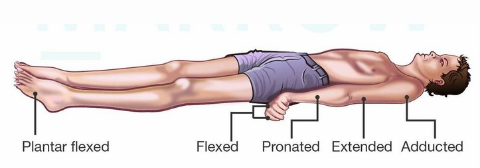
#9
Clonus is due to sustained hyperactivity of _____ motor neurons.
#10
_____ are sudden, jerky eye movements that occur as the gaze shifts from one object to another, performed to bring image of an object quickly on the fovea.
Hypothalamus and Limbic System Indian Medical PG Flashcards - Medical Study Cards
Master Hypothalamus and Limbic System with OnCourse flashcards. These spaced repetition flashcards are designed for medical students preparing for NEET PG, USMLE Step 1, USMLE Step 2, MBBS exams, and other medical licensing examinations.
Hypothalamus and Limbic System Flashcard Deck - 10 Cards
Flashcard 1: The _____ area of the hypothalamus is responsible for satiety
Answer: ventromedial
Flashcard 2: Lesion of the _____ area of the hypothalamus results in hyperphagia
Answer: ventromedial
Flashcard 3: Major reward centers are located along the course of the _____ bundle, especially in the lateral and ventromedial nuclei of the hypothalamus.
Answer: medial forebrain
Flashcard 4: _____ of the globus pallidus internus results in excitation of the ipsilateral ventral lateral (VL) nucleus of the thalamus (basal ganglia pathway)
Answer: Inhibition
Flashcard 5: The _____ nucleus of the hypothalamus is responsible for our circadian rhythm, which regulates the sleep cycle
Answer: suprachiasmatic
Flashcard 6: Associative learning is linked to _____ and cerebellum
Answer: amygdala
Flashcard 7: The _____ area of the hypothalamus is responsible for hunger
Answer: lateral
Flashcard 8: The image shows decerebrate rigidity, in which there is _____ excitation
Answer: reticulospinal
Flashcard 9: Clonus is due to sustained hyperactivity of _____ motor neurons.
Answer: alpha and gamma
Flashcard 10: _____ are sudden, jerky eye movements that occur as the gaze shifts from one object to another, performed to bring image of an object quickly on the fovea.
Answer: Saccades
Keywords: Hypothalamus and Limbic System flashcards, medical flashcards, NEET PG preparation, USMLE Step 1 flashcards, Anki alternative, spaced repetition medical, OnCourse flashcards
Hypothalamus and Limbic System Flashcards for NEET-PG
Study 10 flashcards on Hypothalamus and Limbic System for NEET-PG Physiology. These active recall cards cover the key concepts, clinical associations, and high-yield facts from this chapter of Neurophysiology. Each card is designed to test your understanding rather than just recognition, building stronger and more durable memories for exam day.
For personalised spaced repetition scheduling and unlimited flashcards, download the Oncourse app.
Frequently Asked Questions
Are Hypothalamus and Limbic System flashcards free?
Yes, all flashcards on this page are completely free. You can study all 10 cards at no cost. For spaced repetition scheduling, download the Oncourse app.
How many flashcards does this chapter have?
There are 10 flashcards for Hypothalamus and Limbic System, covering the key concepts, clinical correlations, and high-yield facts from this chapter of Neurophysiology.
How should I use these flashcards for NEET-PG?
Read through each prompt and try to answer before revealing the back of the card. This active recall approach builds stronger memories than passive reading. Combine flashcards with the study notes and MCQ practice for the best results.
Are there more flashcards for Neurophysiology?
Yes. This page covers one chapter of Neurophysiology. Visit the topic page to see all chapters and their flashcards under Physiology.
Want unlimited flashcards?
Get full access to all flashcards, spaced repetition, and progress tracking.
