_____ technique for chest compression is used for resuscitation in children aged >8 years
#2
The ideal rescue breath rate for children is _____ breaths/min
#3
_____ technique for chest compression is used for resuscitation in children aged 1-8 years
#4
The depth of compression for CPR should be about _____ cm in children and 4 cm in infants
#5
In a choking responsive infant, the first thing to be done is to perform 5 _____ and 5 downward thrusts
#6
Compression ventilation in a child experiencing sudden cardiac death (with 2 rescuers), is _____
#7
In a child experiencing sudden cardiac death (with witness), defibrillation should be initiated _____ starting CPR, if AED is available immediately
#8
Guidelines for pediatric basic life support: No answer _____
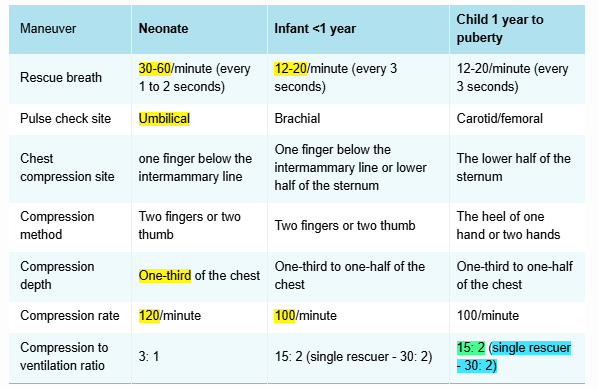
#9
Initial stabilization phase of SAM treatment includes SHIELDED:S_____,Hypothermia, Infection, ELectrolyte imbalance, DEhydration, Deficiency of nutrients
#10
Treatment of dehydration based on severity: Plan CIn infants _____ first 30ml/kg is given in the first 1 hr and the remaining 70ml/kg in the next 5 hours.
Hint: age
Pediatric Trauma Indian Medical PG Flashcards - Medical Study Cards
Master Pediatric Trauma with OnCourse flashcards. These spaced repetition flashcards are designed for medical students preparing for NEET PG, USMLE Step 1, USMLE Step 2, MBBS exams, and other medical licensing examinations.
Pediatric Trauma Flashcard Deck - 10 Cards
Flashcard 1: _____ technique for chest compression is used for resuscitation in children aged >8 years
Answer: Heel of both hands on lower 1/3rd of sternum
Flashcard 2: The ideal rescue breath rate for children is _____ breaths/min
Answer: 12-20
Flashcard 3: _____ technique for chest compression is used for resuscitation in children aged 1-8 years
Answer: Heel of hand on lower 1/3rd of sternum
Flashcard 4: The depth of compression for CPR should be about _____ cm in children and 4 cm in infants
Answer: 5
Flashcard 5: In a choking responsive infant, the first thing to be done is to perform 5 _____ and 5 downward thrusts
Answer: back slaps
Flashcard 6: Compression ventilation in a child experiencing sudden cardiac death (with 2 rescuers), is _____
Answer: 15:2
Flashcard 7: In a child experiencing sudden cardiac death (with witness), defibrillation should be initiated _____ starting CPR, if AED is available immediately
Answer: before
Flashcard 8: Guidelines for pediatric basic life support: No answer _____
Answer: :)
Flashcard 9: Initial stabilization phase of SAM treatment includes SHIELDED:S_____,Hypothermia, Infection, ELectrolyte imbalance, DEhydration, Deficiency of nutrients
Answer: ugar deficiency(hypoglycemia)
Flashcard 10: Treatment of dehydration based on severity: Plan CIn infants _____ first 30ml/kg is given in the first 1 hr and the remaining 70ml/kg in the next 5 hours.
Answer: <12 months
Keywords: Pediatric Trauma flashcards, medical flashcards, NEET PG preparation, USMLE Step 1 flashcards, Anki alternative, spaced repetition medical, OnCourse flashcards
Pediatric Trauma Flashcards for NEET-PG
Study 10 flashcards on Pediatric Trauma for NEET-PG Pediatrics. These active recall cards cover the key concepts, clinical associations, and high-yield facts from this chapter of Pediatric Critical Care. Each card is designed to test your understanding rather than just recognition, building stronger and more durable memories for exam day.
For personalised spaced repetition scheduling and unlimited flashcards, download the Oncourse app.
Frequently Asked Questions
Are Pediatric Trauma flashcards free?
Yes, all flashcards on this page are completely free. You can study all 10 cards at no cost. For spaced repetition scheduling, download the Oncourse app.
How many flashcards does this chapter have?
There are 10 flashcards for Pediatric Trauma, covering the key concepts, clinical correlations, and high-yield facts from this chapter of Pediatric Critical Care.
How should I use these flashcards for NEET-PG?
Read through each prompt and try to answer before revealing the back of the card. This active recall approach builds stronger memories than passive reading. Combine flashcards with the study notes and MCQ practice for the best results.
Are there more flashcards for Pediatric Critical Care?
Yes. This page covers one chapter of Pediatric Critical Care. Visit the topic page to see all chapters and their flashcards under Pediatrics.
Want unlimited flashcards?
Get full access to all flashcards, spaced repetition, and progress tracking.
