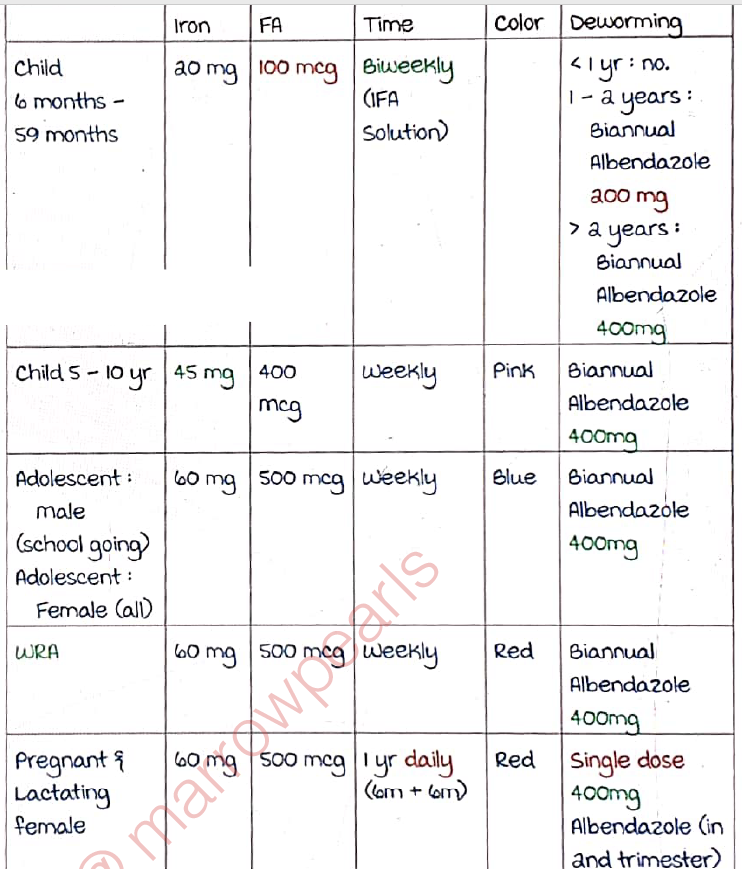
Under Anemia Mukt Bharat scheme, adolescent boys/girls (10-19 years), should take the _____ tablet weekly, containing 60 mg elemental iron + 500 mcg folic acid
Hint: colour
#2
_____ promotes greater retention of ingested fluoride, leading to fluorosis
#3
_____% in population at risk(6 months to 6 years) signifies population risk for Vitamin A deficiency
#4
Stage _____ of WHO grading of Vitamin A deficiency corresponds to Conjunctival xerosis
#5
_____ color tablets containing _____ mg of elemental iron and _____ mcg of folic acid can be given to adolescent boys/girls of age 10-19 years
#6
Under Anemia Mukt Bharat scheme, non-pregnant women and non-lactating mothers, should take the _____ tablet weekly, containing 60 mg elemental iron + 500 mcg folic acid
Hint: colour
#7
Stage _____ of WHO grading of Vitamin A deficiency corresponds to Night blindness
#8
The image shown below is the logo of _____

#9
1. Identify → _____
#10
ca918770834c4fba9844d66550f033ca-ao-2
Micronutrient Deficiencies Indian Medical PG Flashcards - Medical Study Cards
Master Micronutrient Deficiencies with OnCourse flashcards. These spaced repetition flashcards are designed for medical students preparing for NEET PG, USMLE Step 1, USMLE Step 2, MBBS exams, and other medical licensing examinations.
Flashcard 1: Under Anemia Mukt Bharat scheme, adolescent boys/girls (10-19 years), should take the _____ tablet weekly, containing 60 mg elemental iron + 500 mcg folic acid
Answer: blue
Flashcard 2: _____ promotes greater retention of ingested fluoride, leading to fluorosis
Answer: Jowar (sorghum) (Millet)
Flashcard 3: _____% in population at risk(6 months to 6 years) signifies population risk for Vitamin A deficiency
Answer: Serum retinol (5
Flashcard 4: Stage _____ of WHO grading of Vitamin A deficiency corresponds to Conjunctival xerosis
Answer: XIA
Flashcard 5: _____ color tablets containing _____ mg of elemental iron and _____ mcg of folic acid can be given to adolescent boys/girls of age 10-19 years
Answer: Blue; 60; 500
Flashcard 6: Under Anemia Mukt Bharat scheme, non-pregnant women and non-lactating mothers, should take the _____ tablet weekly, containing 60 mg elemental iron + 500 mcg folic acid
Answer: red
Flashcard 7: Stage _____ of WHO grading of Vitamin A deficiency corresponds to Night blindness
Answer: XN
Flashcard 8: The image shown below is the logo of _____
Answer: IFA tablets under anemia mukt bharat scheme
Extra:
Keywords: Micronutrient Deficiencies flashcards, medical flashcards, NEET PG preparation, USMLE Step 1 flashcards, Anki alternative, spaced repetition medical, OnCourse flashcards
Micronutrient Deficiencies Flashcards for NEET-PG
Study 10 flashcards on Micronutrient Deficiencies for NEET-PG Community Medicine. These active recall cards cover the key concepts, clinical associations, and high-yield facts from this chapter of Nutrition and Health. Each card is designed to test your understanding rather than just recognition, building stronger and more durable memories for exam day.
For personalised spaced repetition scheduling and unlimited flashcards, download the Oncourse app.
Frequently Asked Questions
Are Micronutrient Deficiencies flashcards free?
Yes, all flashcards on this page are completely free. You can study all 10 cards at no cost. For spaced repetition scheduling, download the Oncourse app.
How many flashcards does this chapter have?
There are 10 flashcards for Micronutrient Deficiencies, covering the key concepts, clinical correlations, and high-yield facts from this chapter of Nutrition and Health.
How should I use these flashcards for NEET-PG?
Read through each prompt and try to answer before revealing the back of the card. This active recall approach builds stronger memories than passive reading. Combine flashcards with the study notes and MCQ practice for the best results.
Are there more flashcards for Nutrition and Health?
Yes. This page covers one chapter of Nutrition and Health. Visit the topic page to see all chapters and their flashcards under Community Medicine.
Want unlimited flashcards?
Get full access to all flashcards, spaced repetition, and progress tracking.