Glucagon acts on the _____ (primarily) and adipose tissue
#2
After three days of starvation, the main source of energy for the brain becomes _____ from adipose stores
#3
Urea cycle and Krebs cycle are linked at _____
#4
Increased glucagon (fasting) leads to increased cAMP and protein kinase A, thus _____ activity of FBPase-2 and decreasing activity of PFK-2
#5
In starvation, the enzyme 5'-deiodinase is _____ in tissues such as skeletal muscle, but not inhibited in the other tissues, such as the brain
#6
In a person starving for more than 18 hours, the source of energy is _____.
#7
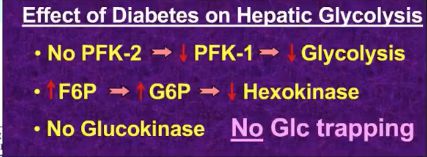
Effect of diabetes on hepatic glycolysis: no answer _____
- No PFK-2 due to lack of insulin
- No glucose trapping in liver leads to elevated blood glucose (hyperglycemia)
#8
Glucagon causes _____ fatty acid synthesis and increased lipolysis, which shunts substrates towards gluconeogenesis
#9
Increased NADH/NAD+ (e.g. due to ethanol) causes increased conversion of _____ -> malate, thus preventing gluconeogenesis
Interorgan Metabolite Exchange Indian Medical PG Flashcards - Medical Study Cards
Master Interorgan Metabolite Exchange with OnCourse flashcards. These spaced repetition flashcards are designed for medical students preparing for NEET PG, USMLE Step 1, USMLE Step 2, MBBS exams, and other medical licensing examinations.
Flashcard 1: Glucagon acts on the _____ (primarily) and adipose tissue
Answer: liver
Flashcard 2: After three days of starvation, the main source of energy for the brain becomes _____ from adipose stores
Answer: ketone bodies
Flashcard 3: Urea cycle and Krebs cycle are linked at _____
Answer: fumarate
Flashcard 4: Increased glucagon (fasting) leads to increased cAMP and protein kinase A, thus _____ activity of FBPase-2 and decreasing activity of PFK-2
Answer: increasing
Flashcard 5: In starvation, the enzyme 5'-deiodinase is _____ in tissues such as skeletal muscle, but not inhibited in the other tissues, such as the brain
Answer: inhibited
Flashcard 6: In a person starving for more than 18 hours, the source of energy is _____.
Answer: gluconeogenesis
Flashcard 7: Effect of diabetes on hepatic glycolysis: no answer _____
- No PFK-2 due to lack of insulin
- No glucose trapping in liver leads to elevated blood glucose (hyperglycemia)
Answer: :)
Flashcard 8: Glucagon causes _____ fatty acid synthesis and increased lipolysis, which shunts substrates towards gluconeogenesis
Answer: decreased
Flashcard 9: Increased NADH/NAD+ (e.g. due to ethanol) causes increased conversion of _____ -> malate, thus preventing gluconeogenesis
Interorgan Metabolite Exchange Flashcards for NEET-PG
Study 9 flashcards on Interorgan Metabolite Exchange for NEET-PG Biochemistry. These active recall cards cover the key concepts, clinical associations, and high-yield facts from this chapter of Metabolic Integration. Each card is designed to test your understanding rather than just recognition, building stronger and more durable memories for exam day.
For personalised spaced repetition scheduling and unlimited flashcards, download the Oncourse app.
Frequently Asked Questions
Are Interorgan Metabolite Exchange flashcards free?
Yes, all flashcards on this page are completely free. You can study all 9 cards at no cost. For spaced repetition scheduling, download the Oncourse app.
How many flashcards does this chapter have?
There are 9 flashcards for Interorgan Metabolite Exchange, covering the key concepts, clinical correlations, and high-yield facts from this chapter of Metabolic Integration.
How should I use these flashcards for NEET-PG?
Read through each prompt and try to answer before revealing the back of the card. This active recall approach builds stronger memories than passive reading. Combine flashcards with the study notes and MCQ practice for the best results.
Are there more flashcards for Metabolic Integration?
Yes. This page covers one chapter of Metabolic Integration. Visit the topic page to see all chapters and their flashcards under Biochemistry.
Want unlimited flashcards?
Get full access to all flashcards, spaced repetition, and progress tracking.
