Which teeth are most commonly injured during laryngoscopy?_____
#2
Percentage of glottic opening (POGO score) and Cormack Lehane (CL) classification is broadly used to describe _____ view during direct laryngoscopy
#3
_____ position is for direct laryngoscopy or bronchoscopy
#4
The following capnography waveform represents:_____
#5
_____ with direct visualization is the first choice for definitive airway management in caustic ingestion
#6
_____ is a technique of external laryngeal manipulation of the airway during intubation for better visualization of the larynx.
#7
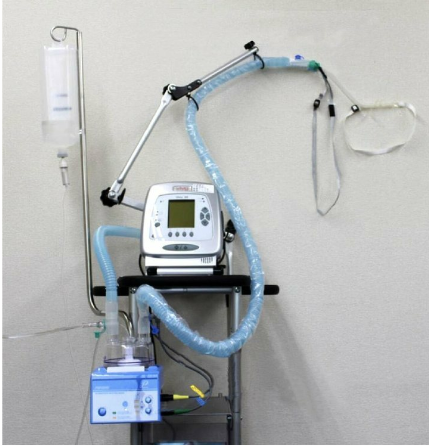
_____ delivers oxygen at 40-60 L/min and increases PEEP
#8
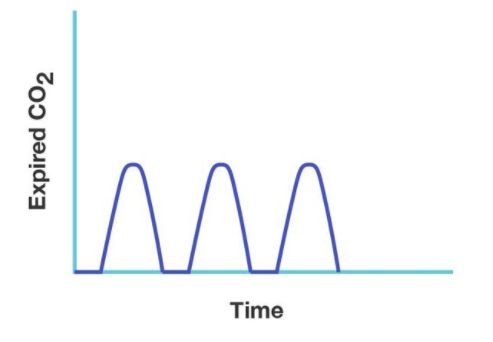
The following capnography waveform represents:
_____
#9
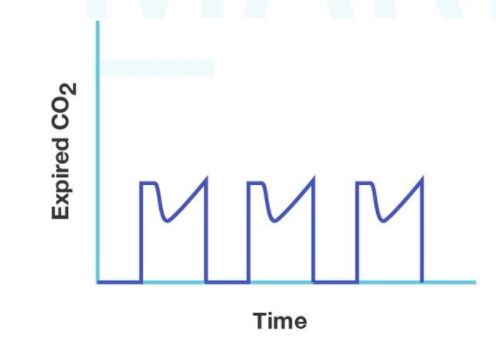
The following capnography waveform represents:
_____
#10
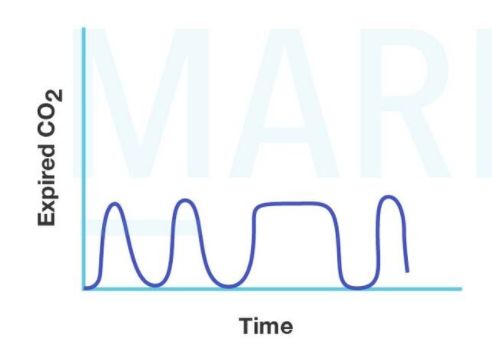
The following capnography waveform represents:
_____
Video Laryngoscopy Indian Medical PG Flashcards - Medical Study Cards
Master Video Laryngoscopy with OnCourse flashcards. These spaced repetition flashcards are designed for medical students preparing for NEET PG, USMLE Step 1, USMLE Step 2, MBBS exams, and other medical licensing examinations.
Video Laryngoscopy Flashcard Deck - 10 Cards
Flashcard 1: Which teeth are most commonly injured during laryngoscopy?_____
Answer: Upper central incisors
Flashcard 2: Percentage of glottic opening (POGO score) and Cormack Lehane (CL) classification is broadly used to describe _____ view during direct laryngoscopy
Answer: laryngeal
Flashcard 3: _____ position is for direct laryngoscopy or bronchoscopy
Answer: Barking-dog
Flashcard 4: The following capnography waveform represents:_____
Answer: bronchospasm
Flashcard 5: _____ with direct visualization is the first choice for definitive airway management in caustic ingestion
Answer: Oral intubation
Flashcard 6: _____ is a technique of external laryngeal manipulation of the airway during intubation for better visualization of the larynx.
Answer: BURP
Flashcard 7: _____ delivers oxygen at 40-60 L/min and increases PEEP
Answer: High-flow nasal cannula
Flashcard 8: The following capnography waveform represents:
_____
Answer: spontaneous breathing
Flashcard 9: The following capnography waveform represents:
_____
Answer: single lung transplant
Flashcard 10: The following capnography waveform represents:
_____
Answer: IMV in midst of spontaneous breathing
Keywords: Video Laryngoscopy flashcards, medical flashcards, NEET PG preparation, USMLE Step 1 flashcards, Anki alternative, spaced repetition medical, OnCourse flashcards
Video Laryngoscopy Flashcards for NEET-PG
Study 10 flashcards on Video Laryngoscopy for NEET-PG Anesthesiology. These active recall cards cover the key concepts, clinical associations, and high-yield facts from this chapter of Respiratory and Airway Management. Each card is designed to test your understanding rather than just recognition, building stronger and more durable memories for exam day.
For personalised spaced repetition scheduling and unlimited flashcards, download the Oncourse app.
Frequently Asked Questions
Are Video Laryngoscopy flashcards free?
Yes, all flashcards on this page are completely free. You can study all 10 cards at no cost. For spaced repetition scheduling, download the Oncourse app.
How many flashcards does this chapter have?
There are 10 flashcards for Video Laryngoscopy, covering the key concepts, clinical correlations, and high-yield facts from this chapter of Respiratory and Airway Management.
How should I use these flashcards for NEET-PG?
Read through each prompt and try to answer before revealing the back of the card. This active recall approach builds stronger memories than passive reading. Combine flashcards with the study notes and MCQ practice for the best results.
Are there more flashcards for Respiratory and Airway Management?
Yes. This page covers one chapter of Respiratory and Airway Management. Visit the topic page to see all chapters and their flashcards under Anesthesiology.
Want unlimited flashcards?
Get full access to all flashcards, spaced repetition, and progress tracking.
